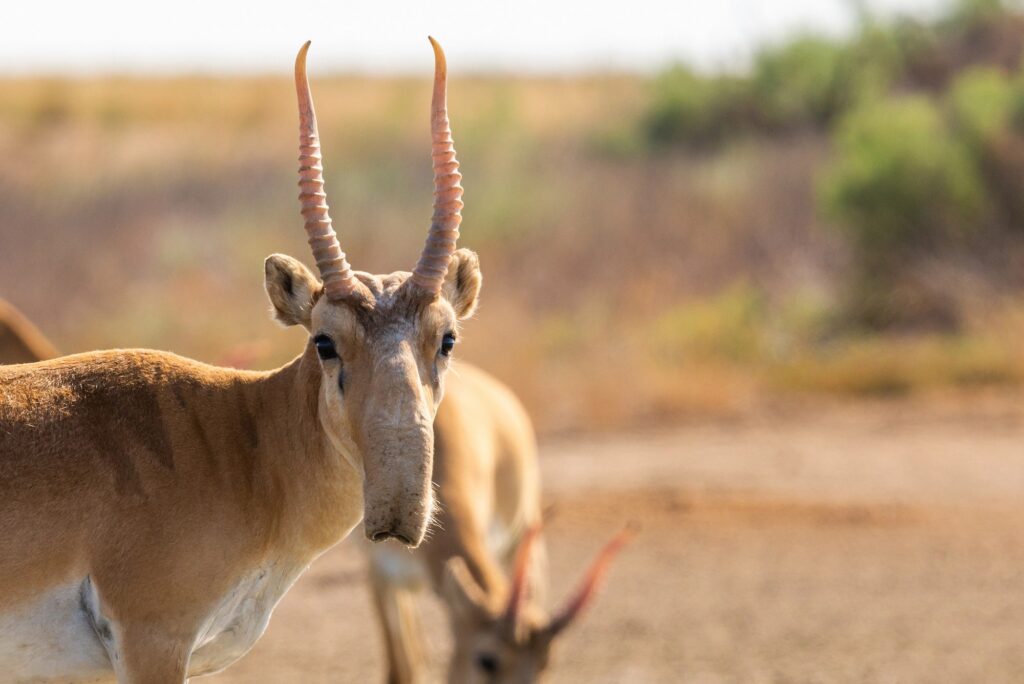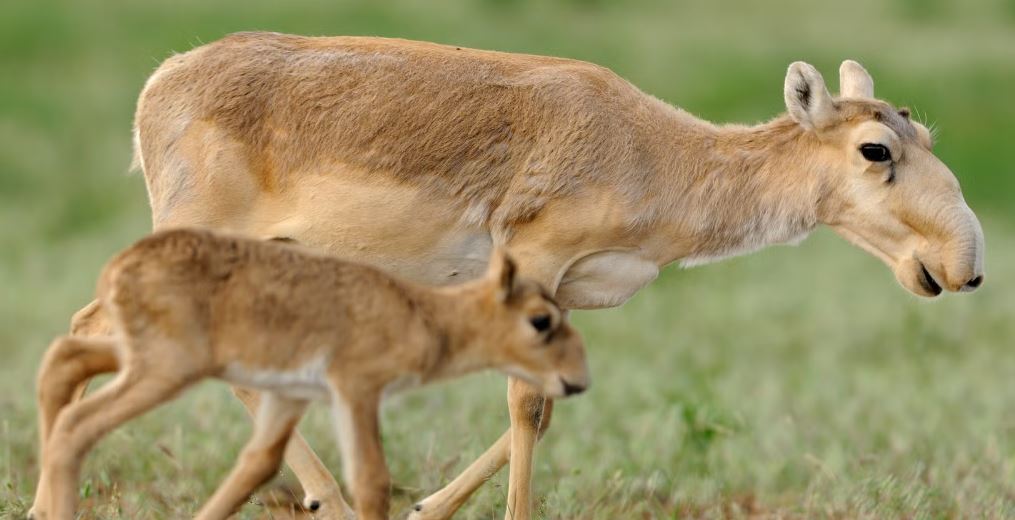
Kazakhstan has gifted 1,500 saiga antelopes to China, stepping in to support China’s own efforts to restore the species beyond Central Asia.
Loved for its handsome, bulbous nose, the saiga is found in large numbers across the Kazakh steppe. Once endangered in Kazakhstan, numbering as few as 40,000 in 2005, the antelope is in fact now overpopulated, as numbers have reached a record 4.1 million in 2025.
As such, Kazakhstan has been looking for ways to reduce its population while nurturing environmental and diplomatic ties with China.
In turn, China has long been interested in reviving the saiga, but previous attempts have not been successful.
Dastan Kusmanov, an ecologist and PhD candidate at the Nazarbayev University Graduate School of Public Policy, told The Times of Central Asia: “I believe that the saiga being gifted to China is an environmental measure. If a new saiga population is established in China, this is an overall benefit for the species’ survival, because if anything happens to the existing saiga population in Kazakhstan, the species still has a chance to survive elsewhere.”
Kusmanov added, “It’s also beneficial for the environment in China. Saigas are an officially extinct species in China, but you need ungulate animals for the benefit of the environment. Ungulates are animals that eat grass and trample soil to make it softer. Through their diet, they then take seeds from one place to another through their excrement. Saigas also serve as a food source for wolves and eagles, so they are a vital part of the ecosystem and food chain.”
The ecologist emphasized that losing 1500 animals from Kazakhstan’s steppe will not harm the species in the country: “As the gift of 1,500 saigas is less than 0.04% of over 4 million saigas in Kazakhstan, it will not have a negative impact on the existing Kazakhstan population.”
Dr. Kanat Baigarin, Chief Officer for Sustainable Development at Nazarbayev University, agreed with Kusmatov that this new herd would help to protect the saiga species as a whole. “The more widely the saiga population is distributed,” Baigarin told The Times of Central Asia, “the more resilient it becomes to epidemics and other threats. This is a unique example of how countries can work together to restore endangered species.”
“It’s important to plan ahead for food resources, animal adaptation, and transboundary protection: this way, the project can serve as a foundation for broader environmental cooperation.”
Meanwhile, neighboring Kyrgyzstan is focusing on species recovery. The Times of Central Asia previously reported that in May this year, Kyrgyzstan launched a conservation initiative to reintroduce another ungulate species, the jayran or goitered gazelle, along the southern shore of Lake Issyk-Kul.