• KZT/USD = 0.00217
  • TJS/USD = 0.10800
  • UZS/USD = 0.00008
  • TMT/USD = 0.29850
  • KZT/USD = 0.00217
  • TJS/USD = 0.10800
  • UZS/USD = 0.00008
  • TMT/USD = 0.29850
  • KZT/USD = 0.00217
  • TJS/USD = 0.10800
  • UZS/USD = 0.00008
  • TMT/USD = 0.29850
  • KZT/USD = 0.00217
  • TJS/USD = 0.10800
  • UZS/USD = 0.00008
  • TMT/USD = 0.29850
  • KZT/USD = 0.00217
  • TJS/USD = 0.10800
  • UZS/USD = 0.00008
  • TMT/USD = 0.29850
  • KZT/USD = 0.00217
  • TJS/USD = 0.10800
  • UZS/USD = 0.00008
  • TMT/USD = 0.29850
  • KZT/USD = 0.00217
  • TJS/USD = 0.10800
  • UZS/USD = 0.00008
  • TMT/USD = 0.29850
  • KZT/USD = 0.00217
  • TJS/USD = 0.10800
  • UZS/USD = 0.00008
  • TMT/USD = 0.29850
29 November 2026

Viewing results 1 - 6 of 62

Tokayev: Russia is “Militarily Invincible”

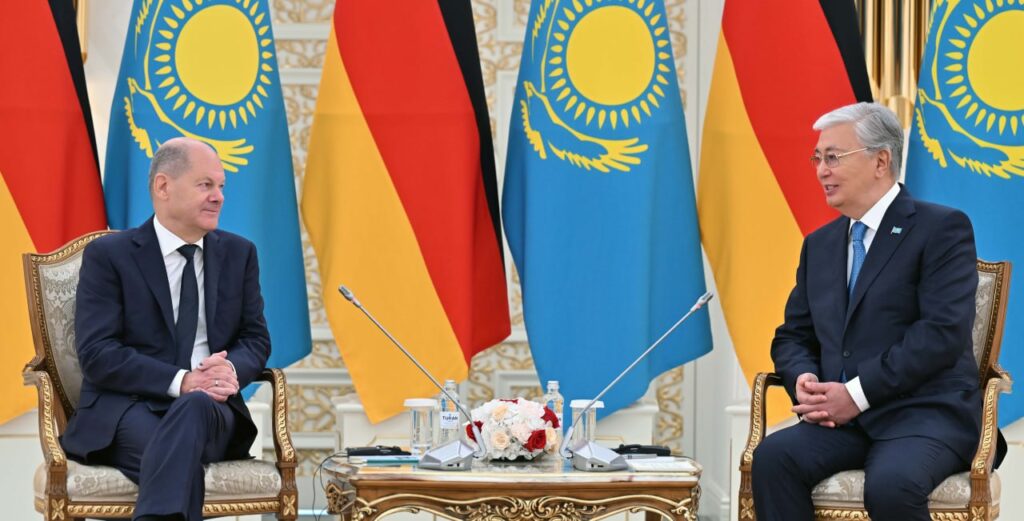
During a meeting in Astana with German Chancellor Olaf Scholz, Kazakhstan's President Kassym-Jomart Tokayev spoke about resolving the Russian-Ukrainian war. According to Tokayev, further escalation of the war will only lead to irreparable consequences for all mankind and, above all, for all countries directly involved in the war. Tokayev said: “The fact is that Russia is militarily invincible. Unfortunately, a good chance to achieve at least a truce was lost with the refusal to conclude the Istanbul Agreement. But the opportunity for peace still exists. We need to carefully consider all peace initiatives put forward by various states, come to a decision to stop hostilities, and then move on to discussing territorial issues. In our opinion, the peace plan of China and Brazil deserves support.” Tokayev reminded the public that Kazakhstan has the world's longest delimited land border with Russia. He further stated that “cooperation between our countries is developing within the framework of strategic partnership and alliance. In Kazakhstan, we have genuine sympathy for the Ukrainian people and their distinctive culture. There have never been any disagreements between our states. The embassy of our country continues to function in Kyiv.” While his comments about seeking peace before discussing territorial issues may seem like Tokayev is backing Russia, in 2022, he said that Kazakhstan would not recognize the independence of the so-called Donetsk and Luhansk people's republics (“DNR” and “LNR”). Speaking about the 'republics', he noted that the two basic principles of the UN Charter -- the right to self-determination for nations, and the territorial integrity of states -- have come into mutual contradiction. On this topic, Tokayev noted: "It is estimated that if the right of self-determination for a nation is realized on the globe, then instead of the current 193 states, more than 500-600 states will emerge on Earth. It will be chaos. For this reason, we do not recognize Taiwan, Kosovo, South Ossetia, or Abkhazia. We will apply this principle to all quasi-state territories, which, in our opinion, includes Luhansk and Donetsk.”

German Company to Assemble Airplanes in Almaty

The German company "Linding Group" is set to invest about $10 million in assembling airplanes in Almaty, pending necessary permits from the government. Based in the economic zone “PIT ‘Alatau", production will begin in 2026. During the first year, 20 airplanes will be assembled, rising to 50 units annually thereafter. Kazakhstan is already engaged in several joint projects with foreign enterprises in aircraft production. One such project  involves the "Russian Helicopters" company. Within the framework of the agreement with Kazakhstan's aircraft repair plant No. 405, a large-unit assembly of Mi-8AMT and Mi-171E helicopters was launched in Almaty, predominantly serving the Ministry of Emergency Situations and the National Guard of Kazakhstan. A further example of international cooperation is the contract between the Ural Civil Aviation Plant and Kazakhstan Aviation Industry (KAI) to produce the Baikal multi-purpose airplane. When fully assembled by the end of this year, the airplanes will be delivered to markets in Europe and Africa. The realization of all of these projects will both strengthen Kazakhstan's aviation industry and increase its presence in international aviation markets.

Kazakh-German Business Council Meets to Expand Economic Cooperation

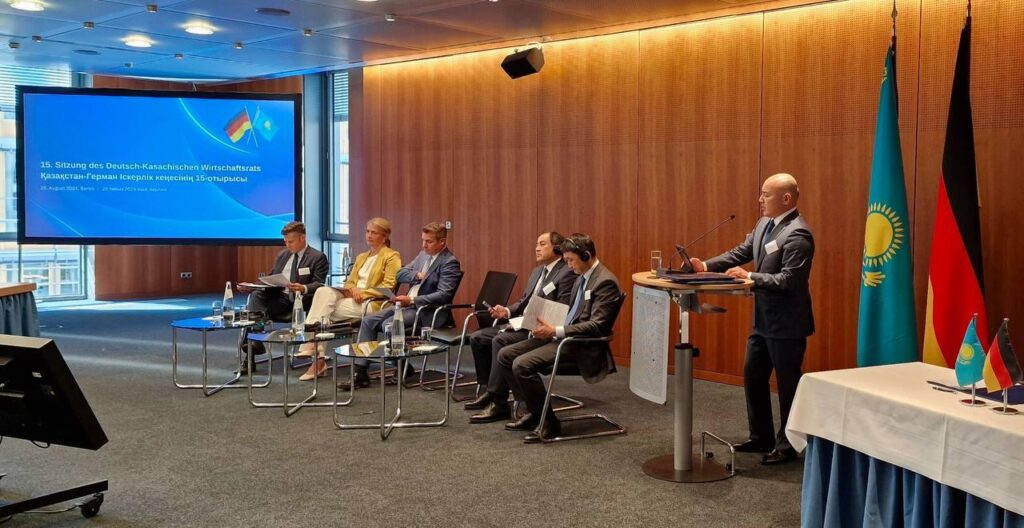
The 15th meeting of the Kazakh-German Business Council for Strategic Cooperation, co-chaired by First Deputy Prime Minister of Kazakhstan Roman Sklyar and Director of the Eastern Committee of the German Economy Michael Harms, was held in Berlin on August 28. The meeting gathered Kazakh government and business representatives and heads of leading German companies such as Siemens, Svevind Energy, CT Agro, CLAAS KGaA, Flight Design General Aviation, Deutsche Bahn, KfW Banken Gruppe, and Deutsche Bank. The co-chairs emphasized that the event was taking place ahead of Federal Chancellor of Germany Olaf Scholz's visit to Kazakhstan in September. The meeting focused on expanding Kazakh-German trade and economic cooperation, attracting investments, and implementing joint projects in the agro-industrial sector and processing industry. It was noted that Germany is Kazakhstan's largest trading partner in the European Union, and that Kazakhstan is among Germany's top 50 foreign trade partners. The lion's share of German investments in Kazakhstan go to the country’s non-raw materials sector — the processing industry, chemical industry, production of building materials, transport, and agro-industrial sector. Speaking on the sidelines of the event, Kazakhstan Deputy Minister of Foreign Affairs Alibek Kuantyrov urged further to intensify cooperation between the Kazakh and German business communities. Noting the critical role of German companies in Kazakhstan’s industrialization, Kuantyrov stated that German companies are implementing 66 projects in Kazakhstan for a total of $54 billion, creating about 15,000 jobs. Kuantyrov added that since 2005, German companies have invested about $7.8 billion in Kazakhstan’s economy, with a significant increase in the past year, reaching $770 million. He expressed confidence that the upcoming visit of Scholz to Kazakhstan will bring bilateral relations to a new level and give an additional impetus to strengthening existing and creating new economic ties. Kuantyrov emphasized the significance of cooperation in the context of the Trans-Caspian International Transport Route (TITR), also known as the Middle Corridor. He noted that cargo traffic through the Middle Corridor to Germany and the EU has increased almost threefold since the beginning of 2022 — to 1.5 million tons and 2.6 million tons, respectively, during the first seven months of this year, adding that the potential of TITR is estimated at 10 million tons of cargo a year. In this regard, Kuantyrov invited German partners to participate in developing Kazakhstan’s Caspian Sea ports of Aktau and Kuryk.

Kazakhstan and Germany to Cooperate in Water and Agriculture

During a visit to Germany last week, Kazakhstan Deputy Prime Minister Kanat Bozumbayev met with the German Federal Ministry of Food and Agriculture to discuss the possibility of Kazakh agricultural and organic products entering the German market. The parties agreed to draft a concept for the Regional Center for Sustainable Agriculture in Central Asia, an initiative announced by the President of Kazakhstan during his official visit to Germany back in September 2023. Following Kazakh Deputy Prime Minister's meeting with Boris Greifeneder, Managing Director of the German Water Partnership (GWP), a decision was made to draft an Agreement on a Water Partnership between Kazakhstan and Germany. Cooperation  with GWP, a network of more than 300 companies in the water sector with a strong international focus, marks an essential step towards sustainable and efficient water management in Kazakhstan and will allow the use of proven new technologies. Speaking at the roundtable "Water for Sustainable Development," Bozumbayev noted that the consequences of the unprecedented floods experienced by Kazakhstan in spring, illustrate the need for innovative approaches to combat and prevent similar disasters in the future. To this end, he added that Kazakhstan is currently testing Talsim, a German digital flood forecasting solution, and is ready to study German cases in solving flood problems. The Kazakh Deputy Prime Minister discussed training specialists for Kazakhstan’s water management industry and in turn, the German side expressed its readiness to identify a university to collaborate with the newly- established Kazakh National University of Water Management and Irrigation in Taraz.

Germany Negotiating Afghan Deportation Deal with Uzbekistan

The government of the Republic of Uzbekistan may agree with the leadership of Germany on sending its labor migrants to Europe in return for the deportation of Afghan refugees. This was reported by the Bloomberg agency. According to sources, Germany is negotiating with Uzbekistan on the conclusion of a migration pact, which may include the deportation of Afghan asylum seekers, so that Berlin does not have to make direct deals with the Taliban. Chancellor Olaf Scholz has promised a tougher stance on migration, including the deportation of asylum seekers from Afghanistan and Syria. The decision follows a recent series of violent attacks and growing sympathy for the populist far-right in Germany. Interior Minister Nancy Feather, a senior member of Scholz's center-left Social Democrats party, sent officials to the Uzbek capital, Tashkent in late May to negotiate a pact on migration and deportation. Any prospective deal is yet to be finalized. Under the proposed plan, the Uzbek government would accept a limited number of rejected Afghan asylum seekers deported from Germany, and then send them to neighboring Afghanistan using private flights to Kabul. The Uzbek government is considering the idea, but wants any migration pact to also include bilateral rules allowing for the legal migration of skilled workers from Uzbekistan to Germany. According to sources, the German government's special representative for migration agreements, Joachim Stamp, will soon travel to Uzbekistan for further negotiations on such an agreement. An interior ministry spokeswoman declined to comment on the plan, which was also reported by Der Spiegel magazine and the DPA news agency. Following a fatal knife attack by an Afghan refugee on a German policeman, Chancellor Scholz, delivering a speech on law and order in parliament on June 6, said his government would allow criminals to be deported to Taliban-ruled Afghanistan and war-torn Syria. "Serious criminals and terrorist threats have no place here," Scholz said, adding that the interior ministry was working on practical implementation and was already in talks with countries bordering Afghanistan. Germany previously completely halted deportations to Afghanistan shortly before the Taliban returned to power in the summer of 2021.

Turkmenistan Hosts European Exhibition on Energy-Saving

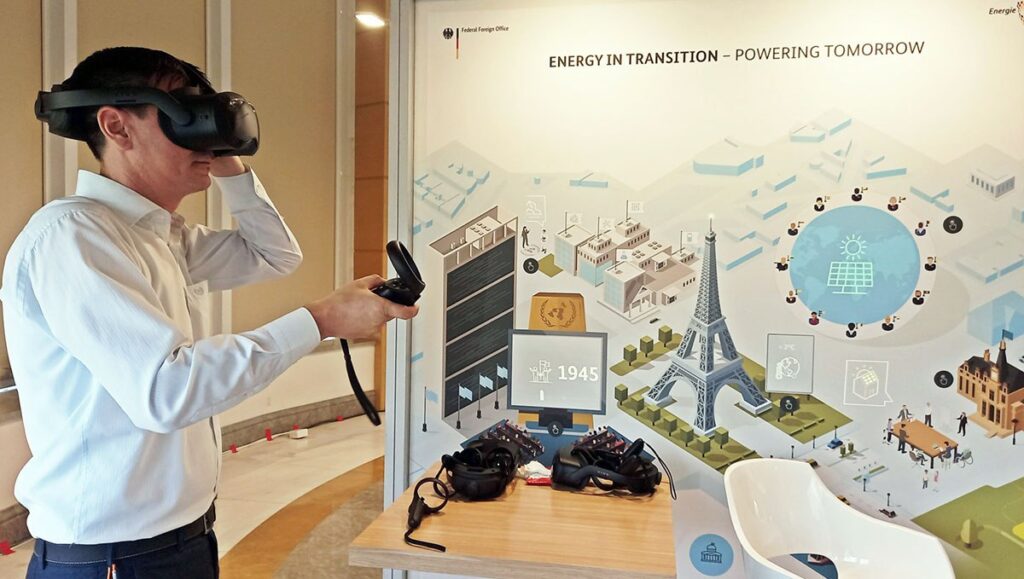
An ambitious and multi-faceted  traveling exhibition “Transition to Renewable Energy Sources—Energy of the Future” has just opened at the Technology Center of the Academy of Sciences of Turkmenistan. As reported by “Turkmenistan: Golden Age”, the exhibition, curated by  the Embassy of the Federal Republic of Germany and the German Society for International Cooperation (GIZ), presents the various means and  measures developed by European countries to save energy. Divided into five sections, the exhibition provides a hands-on exploration of energy efficiency practices through interactive touch panels and  by immersing themselves in virtual reality, visitors can envisage the world in the future. The exhibition highlights the multilevel aspects, challenges, and potential of the global energy transition from society, politics, economics, and science perspectives, and during its tour, aims to encourage widespread dialogue and an exchange of knowledge and views on decarbonization and global energy transition. Regarding the tour,  project manager Yasmine Deren, stated, “This exhibition started three years ago and has already visited Europe, Asia, the Gulf States and in Central Asia, Tajikistan and Uzbekistan. We are happy that the exhibition is now being shown in Ashgabat,  Turkmenistan and afterwards, Kyrgyzstan and Kazakhstan." The exhibition will be displayed Monday - Saturday in Ashgabat until 25 June and thereafter, in Turkmenistan's city of Mary.