• KGS/USD = 0.01144 0%
  • KZT/USD = 0.00206 0%
  • TJS/USD = 0.10844 0%
  • UZS/USD = 0.00008 0%
  • TMT/USD = 0.28571 0%
  • KGS/USD = 0.01144 0%
  • KZT/USD = 0.00206 0%
  • TJS/USD = 0.10844 0%
  • UZS/USD = 0.00008 0%
  • TMT/USD = 0.28571 0%
  • KGS/USD = 0.01144 0%
  • KZT/USD = 0.00206 0%
  • TJS/USD = 0.10844 0%
  • UZS/USD = 0.00008 0%
  • TMT/USD = 0.28571 0%
  • KGS/USD = 0.01144 0%
  • KZT/USD = 0.00206 0%
  • TJS/USD = 0.10844 0%
  • UZS/USD = 0.00008 0%
  • TMT/USD = 0.28571 0%
  • KGS/USD = 0.01144 0%
  • KZT/USD = 0.00206 0%
  • TJS/USD = 0.10844 0%
  • UZS/USD = 0.00008 0%
  • TMT/USD = 0.28571 0%
  • KGS/USD = 0.01144 0%
  • KZT/USD = 0.00206 0%
  • TJS/USD = 0.10844 0%
  • UZS/USD = 0.00008 0%
  • TMT/USD = 0.28571 0%
  • KGS/USD = 0.01144 0%
  • KZT/USD = 0.00206 0%
  • TJS/USD = 0.10844 0%
  • UZS/USD = 0.00008 0%
  • TMT/USD = 0.28571 0%
  • KGS/USD = 0.01144 0%
  • KZT/USD = 0.00206 0%
  • TJS/USD = 0.10844 0%
  • UZS/USD = 0.00008 0%
  • TMT/USD = 0.28571 0%

Viewing results 1 - 6 of 33

Chinese Company Opens Genetic Laboratory in Astana

Kazakh Invest has reported that the opening ceremony of the Astana Genetic Center laboratory of the Chinese company BGI Group took place in Kazakhstan’s capital, Astana, on July 19. BGI Group, a world leader in genome research of living organisms, has over a hundred joint laboratories, medical centers, and production facilities in more than 30 countries. The opening ceremony was attended by Yin Ye, CEO of BGI Group; Kunsulu Zakariya, Advisor to the President of Kazakhstan on Science and Innovation; Akmaral Alnazarova, Kazakhstan’s Minister of Health; and Saule Sabyr, First Secretary of the Investment Committee of the Kazakh Ministry of Foreign Affairs. BGI Group opened the laboratory jointly with a local partner, scientific and production company BIOGEN Technopark LLP. The laboratory will conduct various molecular genetic tests related to reproductive health and diagnosis of hereditary and oncological diseases. The Astana Genetic Center is the only full-cycle laboratory in Kazakhstan capable of conducting all stages of genetic research without taking biomaterial abroad.

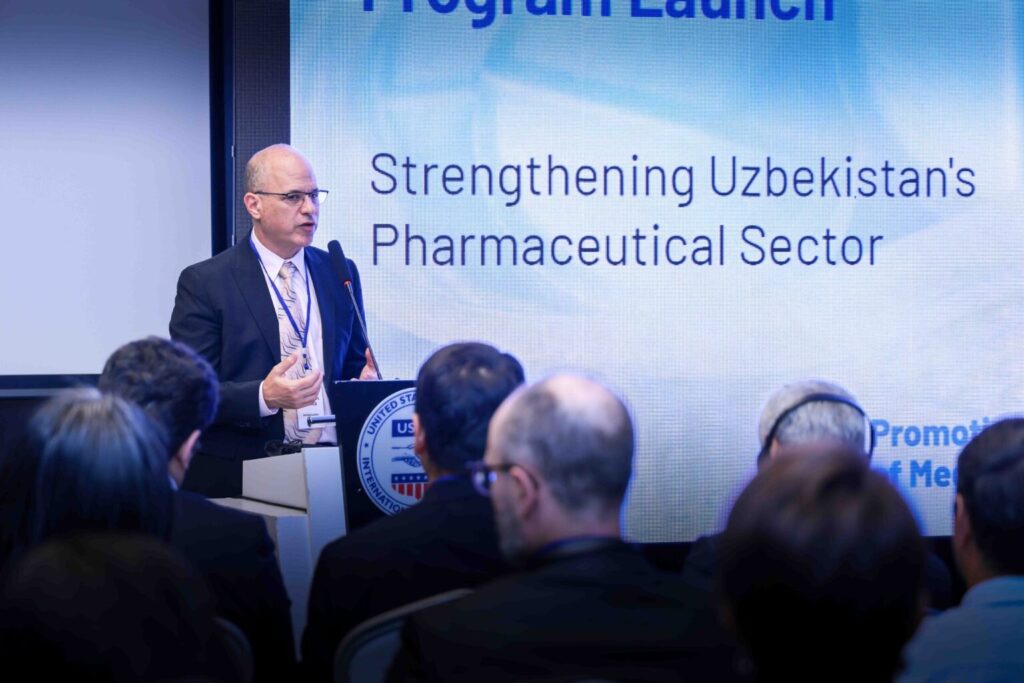
U.S. Support for Uzbekistan’s Pharmaceutical Industry

The launch of USAID’s Diversifying Asia’s Pharmaceutical Supply Chain project was attended by U.S. Ambassador to Uzbekistan Jonathan Henick and representatives of the country’s Ministry of Health and Agency for Development of the Pharmaceutical Industry. Running for two years and costing US $2.5 million, the project aims to strengthen local pharmaceutical regulation, enhance local technology and workforce skills, and attract investment in the industry. It will also ensure that medicines produced in Uzbekistan meet both national and international quality standards. Speaking at the launch, Henick stated, “Through our partnership, we will improve the health of the people of Uzbekistan while also improving the strength and responsiveness of the public and private pharmaceutical sectors. By aligning with global standards, we not only protect patients but also boost trust in local medicines, pharmaceutical companies, pharmacists, and the healthcare system as a whole.” A key objective of the project is promoting domestic production of medicines to boost the sector's contribution to the nation’s economic growth. Despite being Central Asia’s largest pharmaceutical supplier, with over 220 private manufacturers, Uzbekistan still relies heavily on imported medicines and raw materials. To address this issue, the Government of Uzbekistan offers various means of support and incentives for local manufacturers including import substitution and robust quality control regulations. Uzbekistan currently produces around 45% of the country’s medicines, a figure which the government aims to increase to 80% by 2026.

Uzbekistan to Increase Production and Export of Medicines

Uzbekistan President Shavkat Mirziyoyev called a government meeting  on 23 May to review plans for the country’s pharmaceutical industry. On 10 January, a road map for 2024–2025 was approved for the development of the pharmaceutical industry and the acceleration of related investment projects. This was followed by a presidential decree of 23 January which identified additional measures required to regulate the pharmaceutical sector. To date, a budget of $100 million has been allocated for the realization of new projects in the industry, boosted by an injection of $200 million from Asakabank. As a result, two projects worth $30.5 million have been launched over the past four months, with exports totalling $51 million. However, a lot of potential remains untapped. To redress the balance, plans are now underway to produce pharmaceutical products worth $400 million and increase the exports to $200 million.  A total of 147 projects worth $2 billion will be launched this year alongside the commission of a further 28. The head of state emphasized the need to increase the level of domestically produced medicines available in Uzbekistan and to ensure a balance between price and quality. The meeting also reviewed measures to intensify the work of the innovative pharmaceutical cluster, Tashkent Pharma Park, by launching 12 projects worth $470 million.  

Kazakhstan Launches Battle against Counterfeit Medicines

From 1 July 1, 2024, in an effort to rid the country of counterfeit drugs flooding the local market,  labeling of all medicines in Kazakhstan will become mandatory. According to the World Health Organization (WHO), every tenth package of medicines distributed in developing countries is counterfeit, and in Kazakhstan, exceeds 10% of the volume of imported medicines. This is not only an economic issue, but one that poses a direct  threat to people's lives and the health of the nation.  Under the new initiative, all drugs will be assigned an electronic passport detailing both its source and  path to the consumer. The Ministry of Health of the Republic of Kazakhstan stated that the key aim of the project is to eradicate illegal trade in medicines, including those used within the state's medical programs and mandatory social health insurance. Confident that mandatory labeling will prove effective in dealing with gray imports in the pharmaceutical market,  economist Andrei Chebotarev remarked, "When the manufacturer's goods are labeled, you can trace their  route all the way to your home medicine cabinet. Everyone will know, for example,  where the pills were produced and how they were imported into the country. At present, there is no  guarantee that  goods are genuine. Where was this medicine produced? In India, in Germany? It is almost impossible to check the source." In short, he continued, labeling is the surest way of "letting the cat out of the bag." Another positive impact of the introduction of labeling concerns  an increase in tax revenues and customs duties. Pharmacies in Kazakhstan already sell drugs labeled with the DataMatrix code. Specialists believe that the pharmaceutical industry is ready to exit the shadow turnover. During the first two months of 2024, almost 5,000 tons of various drugs worth $275.7 million, were imported by Kazakhstan.  

British Companies Enter Commercial Agreements with Kazakhstan

Two new Kazakh-British business agreements were signed off during UK Foreign Secretary David Cameron’s visit to Kazakhstan on 24 April. The first, between AstraZeneca, a British-Swedish multinational pharmaceutical and biotechnology company, Kazakhstan’s Ministry of Healthcare, Almaty City Administration and Kazakh Invest, aims to implement an investment project for contract manufacturing of biotechnological products in Kazakhstan. According to Kazakh Invest, the agreement represents a significant step towards Kazakhstan’s goal to increase its share of domestically- produced medicines in the local market to 50%. The second deal, signed by the Ministry of Transport of Kazakhstan and British company Car Park Transformer, makes provision for the construction of roadside service facilities on Kazakhstan’s national and international highways. Comprising 250 service stations equipped with restrooms, retail spaces, as well as electric vehicle charging points, the project aims to provide essential services and enhance the comfort of motorists.    

Kyrgyzstan Continues to Combat Drug Shortages

Health Minister of the Kyrgyz Republic, Alymkadyr Beishenaliyev has told local media that hospitals are 70-80% stocked with medicines, with hospitals in the Issyk-Kul region suffering the worst from short supplies. "There is a list of vital medicines, which we provide 100%. But doctors prescribe drugs which I, a medic, have never heard of; these are scarce drugs. Doctors used to get bonuses from private pharmacies [for prescribing them] - we are fighting this and it is impossible to change it in a short time," Beishenaliyev said. Kyrgyzstan's medical trade union reported that the country's hospitals lacked basic medicines and basic drugs. As of today, 290 medical organizations have applied for the necessary drugs, but are yet to receive them. Earlier this week, the Times of Central Asia reported about the difficult situation concerning the availability of drugs. Minister Beishenaliyev emphasized that the government is working to ensure hospitals have all the necessary drugs for the second quarter of 2024, promising that the problem would be resolved by 15 April. However, the head of Kyrgyzstan's medical trade union, Bermet Baryktabasova, criticized the statement made by the minister, saying that antibiotics, hormones, diuretics, anti-epileptic, psychotropic, cardiac and anti-asthma drugs are needed every day. It's medically advisable to have a three-month supply on hand, she said, adding that intensive care units need these drugs every minute, not next quarter. This year, to ensure timely and quality medical care, the Compulsory Medical Insurance Fund (CMIF) allocated 443.7 million sum ($5 million) for the purchase of medicines and medical devices.