• KGS/USD = 0.01144 0%
  • KZT/USD = 0.00215 0%
  • TJS/USD = 0.10680 0.19%
  • UZS/USD = 0.00008 0%
  • TMT/USD = 0.28530 0%
  • KGS/USD = 0.01144 0%
  • KZT/USD = 0.00215 0%
  • TJS/USD = 0.10680 0.19%
  • UZS/USD = 0.00008 0%
  • TMT/USD = 0.28530 0%
  • KGS/USD = 0.01144 0%
  • KZT/USD = 0.00215 0%
  • TJS/USD = 0.10680 0.19%
  • UZS/USD = 0.00008 0%
  • TMT/USD = 0.28530 0%
  • KGS/USD = 0.01144 0%
  • KZT/USD = 0.00215 0%
  • TJS/USD = 0.10680 0.19%
  • UZS/USD = 0.00008 0%
  • TMT/USD = 0.28530 0%
  • KGS/USD = 0.01144 0%
  • KZT/USD = 0.00215 0%
  • TJS/USD = 0.10680 0.19%
  • UZS/USD = 0.00008 0%
  • TMT/USD = 0.28530 0%
  • KGS/USD = 0.01144 0%
  • KZT/USD = 0.00215 0%
  • TJS/USD = 0.10680 0.19%
  • UZS/USD = 0.00008 0%
  • TMT/USD = 0.28530 0%
  • KGS/USD = 0.01144 0%
  • KZT/USD = 0.00215 0%
  • TJS/USD = 0.10680 0.19%
  • UZS/USD = 0.00008 0%
  • TMT/USD = 0.28530 0%
  • KGS/USD = 0.01144 0%
  • KZT/USD = 0.00215 0%
  • TJS/USD = 0.10680 0.19%
  • UZS/USD = 0.00008 0%
  • TMT/USD = 0.28530 0%

Viewing results 1 - 6 of 162

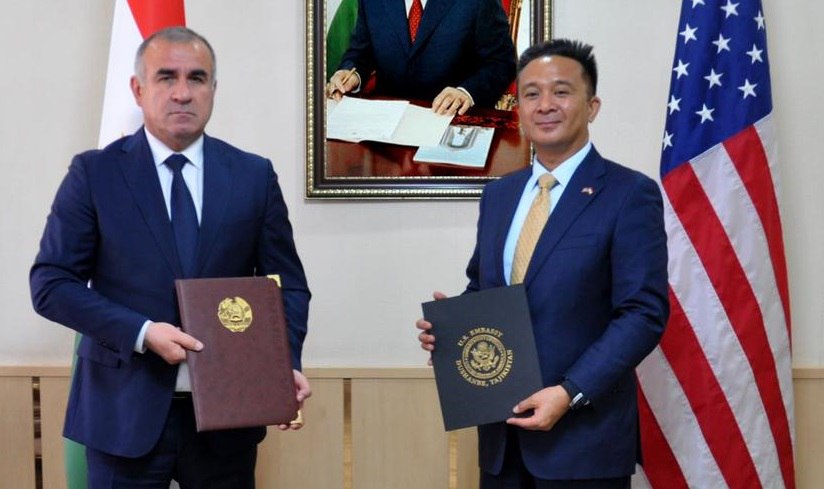
Prosecutor General’s Office of Tajikistan and U.S. State Department Sign Memorandum of Cooperation

Tajikistan and the U.S. have agreed to continue bilateral legal cooperation in various areas, as reported by the General Prosecutor's Office of the Republic of Tajikistan. During the meeting, Prosecutor General of Tajikistan, Rahmon Yusuf Ahmadzoda and the U.S. Ambassador to the Tajikistan, Manuel Mikaller discussed issues related to the exchange of information on challenges and threats to the security of both states, the protection of the rights and interests of citizens, preventing and combating manifestations of violent extremism and terrorism, cyber-crime, transnational organized crime, and other issues. A Memorandum of Intent on cooperation on the implementation of the Personal Identity Comparison and Evaluation System to Regulate the Movement of Terrorists (PISCES) was signed. "This system allows the movement of terrorists to be tracked through extensive technological surveillance, as well as assisting in their capture and apprehension," the report stated.

Case Documents for 11 Temirov Live Journalists Submitted to Court in Kyrgyzstan

Legal documents regarding the cases of eleven current and former journalists of the Temirov Live project, who are accused of calling for mass riots, have been handed over to the court. According to the Pervomaisky District Court of Bishkek, the criminal case was received by the court office and will be handed over to the judge through the automatic distribution of cases of the AIS system, 24.kg news agency has stated. As previously reported by the Times of Central Asia, on January 16, Interior Ministry officers searched the office of Temirov Live and confiscated its editorial equipment. The police also searched the journalists' homes and detained eleven current and former employees of the publication. The motivation behind the case was one of Temirov's projects called "Ait, Ait Dese," which was published on YouTube in the fall of 2023, which the authorities claim called for mass disorder. At the time, Kyrgyz Interior Minister Ulanbek Niyazbekov said the detainees weren't journalists. "We cannot [help] but respond when they disseminate inaccurate information and engage in vilification. There are those who do not know the laws of journalism and do not have the relevant knowledge. They do not know and spread misleading information, sowing confusion among the people. I believe that we should not consider them as journalists," news agencies quoted the Interior Minister as saying. The detainees were Makhabat Tazhibek kyzy, Sapar Akunbekov, Azamat Ishenbekov, Saipidin Sultanaliyev, Aktilek Kaparov, Tynystan Asypbekov, Maksat Tazhibek uulu, Joodar Buzumov, Zhumabek Turdaliyev, Aike Beishekeeva and Akyl Orozbekov. They were all taken into custody in January for two months, until March 13. Later, the court released some of the detained journalists under house arrest and on their own recognizance. Already facing a backlash over its so-called "foreign agents law," Bishkek has pushed back against international criticism of the high-profile prosecution, saying the case is not politically motivated and that those facing charges are poorly educated people masquerading as journalists. In late 2022, Kyrgyzstan deported Bolot Temirov, an investigative reporter with dual Kyrgyz and Russian nationality. "Temirov was sent to Russia by force with no belongings, no phone, no money or international passport, and in violation of deportation procedures,” the head of Reporters Without Bordfers Eastern Europe and Central Asia desk, Jeanne Cavelier stated at the time.

American Travels to Kazakhstan to Seek Information on Father’s Fate in 1940s

Since 2022, U.S. citizen Jeff Scheingold has been looking for any information about his close relatives who fled to Kazakhstan to escape the Nazis. Kazakhstani police officers helped him find out about the fate of his father, mother and brother. Scheingold asked the Kyzylorda Region Police Department to find information about his family. His parents and brother were Polish Jews who lived in the Terenozek district of the Kazakh Soviet Socialist Republic (KazSSR) after feeling into the Soviet Union from Poland to escape the Nazis. In 1943, during Stalinist repressions that were particularly acute for war refugees who had come from abroad, his father was arrested. "In 2022, I found out that my parents lived in Kazakhstan during the Great Patriotic War. They escaped from the Nazis from Poland. We didn't have any more information, except for the protocol of the court. As a result of our searches, we found documents that had been kept in the archive for almost 80 years. They concerned my parents and my brother  who are buried in aul (village) Number 6," said Scheingold. According to the Scheingold, he has now reconstructed the details of his blood relatives' lives from 1942 to 1946, with members of the Scheingold family traveling to Kyzylorda to visit the burial site of his brother. According to the Kazakh Ministry of Internal Affairs, more than 30,000 documents have been kept in the archive of the regional police. These documents are very important for thousands of people looking for information about the fate of relatives - as well as for scientists, journalists, and historians - to fully reconstruct and understand historical events using first-hand information.

Kazakh Embassy Counselor in UAE Recalled After Domestic Violence Allegations

The Ministry of Foreign Affairs of Kazakhstan has recalled an Embassy Counselor from the United Arab Emirates (UAE), Saken Mamash, after the publication of a video message by his wife, Karina Mamash, who alleged ongoing domestic violence, according to a report in Kursiv.kz. "We urgently recalled this employee to Kazakhstan. Further, his case will be dealt with by law enforcement agencies," said an official representative of the ministry. Karina Mamash's appeal was published on an Instagram page run the public foundation, "NeMolchi" (Don't Remain Silent"). In the video, Mamash accuses her husband of years of violence, and expresses fear for her own safety and the safety of their children. "My name is Karina Mamash Gosmanovna. My husband, counselor to the Ambassador of the Republic of Kazakhstan to the UAE, yesterday beat me and my sister, who came to visit me on the 3rd [of May]. I demand help from our state. I am tired of being silent. I am tired of tolerating. For ten years he has been raping me, beating me. I am in danger, and my children are in danger around him. I demand help from our state. Help me," she said, attaching photos of herself and her sister with bruises on their faces to the post. Karina Mamash also insisted that her husband be "stripped of his status as a diplomat and put in jail for all the abuse." Domestic violence has become a key topic of discussion in Kazakhstan amid the high-profile case of Kuandyk Bishimbayev for allegedly killing his common-law wife, Saltanat Nukenova. On April 15, President Tokayev signed into law amendments and additions passed by Kazakhstan’s parliament ensuring the rights of women and the safety of children. The initiative represents a first in the CIS in terms of how far it goes to provide protection for women and children in the country.

Bishimbayev Trial: Will the “Show” Shift Reality?

The trial of Kuandyk Bishimbayev, accused of murdering his common-law wife, Saltanat Nukenova, is coming to an end with the verdict now in the hands of the jury. The trial has resonated widely in Kazakhstani society, but according to Gulmira Ileuova, a sociologist and head of the public foundation, Strategy: Center for Social and Political Research, Kazakhstan still has a long way to go to successfully fight abusive relationships. Ileuva commented on the case in an interview with the Times of Central Asia.   TCA: In Kazakhstan, Bishimbayev's trial has received a huge amount of attention, and Nukenova's death is being discussed at home and abroad, with rallies being held in her memory. Moreover, a law toughening penalties for domestic violence has recently been passed. Will that help to radically change the situation with violence to which thousands of Kazakhstani women are subjected every year? Ileuova: It seems to me that Bishimbayev's trial has influenced some categories of people - those who are ready to listen and draw conclusions. But society in a broader sense will not be overtly affected by this situation. Specialists are watching the trial, examining the behavior of lawyers, prosecutors, and other participants. Conclusions are also being drawn that the arguments used by the defense remain childish, infantile. Public opinion attributes to Bishimbayev's lawyers, let's say, the moral image of Bishimbayev himself. Psychologists will also draw conclusions: about problems with upbringing, family relations, etc. But in general, the feeling is that of a show having been created, captivating the audience, and making [the audience] terrified or delighted. Emotional swings are created, adrenaline is produced, and accordingly, people watch and get involved. But I doubt that there has been a profound shift in society against the backdrop of the trial. There needs to be a lot of additional activities, outreach, to tie the new law on domestic violence, in particular, to direct practice. Just the other day, the wife of a Kazakhstani diplomat appealed to the authorities for protection, saying that her husband had been torturing her for years and had beaten her again. This particular man did not draw any conclusions from Bishimbayev's story, including concerning his own actions. This official should have realized that the president was one of the most active initiators of the law on domestic violence. Of course, further public reaction will also be influenced by the expected decision of the court in the Bishimbayev case. If the principle of the inevitability of punishment and changes in the judicial system are demonstrated, there will be a certain shift. However, for now it is perceived mainly as a show. There is still an educational effect [only] in a small segment of society.   TCA: Why doesn't society perceive such clear signals? Why isn't there a shift to zero tolerance for domestic violence? Ileuova: We want change too fast, which is hardly possible because the inertia within society is huge. If women are sold for kalym (bride price or dowry), then they are still...

Kazakhstan Proposes Life Imprisonment for Drug Traffickers

Kazakhstan plans to toughen punishment for drug traffickers by introducing the possibility of life imprisonment for convicted dealers. Legislative amendments have already been presented in the Mazhilis (lower house of parliament). Kazakhstan has become the center of synthetic drug production in Central Asia, member of parliament Dmitry Koloda said. Drug traffickers, he says, have become more creative in recent years and have established several new transportation networks. However, existing laws don't provide for criminal liability for the trafficking of components inside the country. "Law enforcement's hands are tied. In fact, they are forced to wait for drug traffickers to proceed directly to the 'cooking' of drugs. Otherwise, the case will have no judicial perspective," said Koloda. The bill also proposes strengthening criminal liability for trafficking in potent substances, such as tropicamide and pregabalin. Those narcotics are popular with drug addicts, including teenage users. Kazakh parliamentarians have introduced amendments that seek to equate illegal drug production with the most dangerous types of drug offenses. The punishment for that level of serious crime is up to life imprisonment. Currently, drug couriers and drug producers are prosecuted under the same article, with sentences ranging from 10 to 15 years, plus confiscation of property. The bill will differentiate and define criminal liability more specifically. Over the past year alone Kazakhstani police have disrupted and dismantled three transnational criminal groups specializing in the production of synthetic drugs. More than a ton of narcotic drugs were seized during those operations.