• KZT/USD = 0.00210
  • TJS/USD = 0.10810
  • UZS/USD = 0.00008
  • TMT/USD = 0.29760
  • KZT/USD = 0.00210
  • TJS/USD = 0.10810
  • UZS/USD = 0.00008
  • TMT/USD = 0.29760
  • KZT/USD = 0.00210
  • TJS/USD = 0.10810
  • UZS/USD = 0.00008
  • TMT/USD = 0.29760
  • KZT/USD = 0.00210
  • TJS/USD = 0.10810
  • UZS/USD = 0.00008
  • TMT/USD = 0.29760
  • KZT/USD = 0.00210
  • TJS/USD = 0.10810
  • UZS/USD = 0.00008
  • TMT/USD = 0.29760
  • KZT/USD = 0.00210
  • TJS/USD = 0.10810
  • UZS/USD = 0.00008
  • TMT/USD = 0.29760
  • KZT/USD = 0.00210
  • TJS/USD = 0.10810
  • UZS/USD = 0.00008
  • TMT/USD = 0.29760
  • KZT/USD = 0.00210
  • TJS/USD = 0.10810
  • UZS/USD = 0.00008
  • TMT/USD = 0.29760

Viewing results 37 - 42 of 395

Opinion: The U.S. Still Doesn’t Know Where Central Asia Belongs

Washington cannot decide where Central Asia belongs. Is it part of Europe? Asia? The Middle East? The confusion is on full display in how the House of Representatives has reassigned the region across subcommittees in rapid succession. In the 116th Congress, which convened in 2019, Central Asia fell under the Subcommittee on Europe, Eurasia, Energy and the Environment. Two years later, in the 117th Congress, it was moved to the Subcommittee on Asia, the Pacific, Central Asia and Nonproliferation. That arrangement barely settled before the 118th Congress shifted it again—this time to the Subcommittee on the Middle East, North Africa, and Central Asia. Now, in the 119th Congress, it has been relocated to the Subcommittee on South and Central Asia. On the banks of the Potomac, Central Asia has taken on a nomadic life of its own—constantly on the move, never quite settling in one place. At the State Department, Central Asia is grouped under the Bureau of South and Central Asian Affairs alongside Afghanistan, India, Pakistan, and Sri Lanka. At the Pentagon, by contrast, the Middle East team oversees relations with Central Asia, alongside countries like Israel, Saudi Arabia, Iran, and Pakistan. These mismatches are not just clumsy; they are strategically dangerous. By misplacing Central Asia, Washington is misreading the geography of China’s rise. It is time for Washington to stop the bureaucratic musical chairs and place Central Asia within a coherent grand strategy. Far from being an afterthought, the region is one of the most consequential pieces of the geopolitical puzzle facing the United States: how to respond to China’s strategy. This is because Central Asia sits at the heart of China’s decades-long effort to move its critical lifelines away from the Indo-Pacific and onto the Eurasian landmass. Over the past 15 years, China has quietly reoriented its energy routes, reducing reliance on maritime pathways vulnerable to U.S. naval dominance—particularly chokepoints such as the Strait of Hormuz and the Strait of Malacca—and expanded overland imports across Eurasia. Today, China imports significant volumes of natural gas via pipelines from Turkmenistan and Russia, as well as crude oil from Kazakhstan. These continental routes are largely insulated from maritime interdiction, giving Beijing strategic resilience. Central Asia should be understood through this lens. For China, the region is not peripheral—it is essential. The pipelines, railways and trade corridors that underpin China’s resilience all pass through Xinjiang and Central Asia. In this sense, Central Asia is not merely adjacent to China; it is embedded in China’s vision of the future. This is why Washington’s practice of grouping Central Asia with South Asia misses the mark. The two regions operate under fundamentally different strategic logics. South Asia is centered on the Indian subcontinent, shaped by maritime dynamics and the India‑Pakistan rivalry. Central Asia, by contrast, is a continental crossroads—defined by overland connectivity, energy flows and great‑power competition across Eurasia. India, meanwhile, is geographically constrained—lacking direct land access to Central Asia due to territory administered by Pakistan and separated from China by the Himalayas—leaving it...

Washington Meets Ashgabat as Turkmen-American Business Cooperation Association Debuts

On May 7, the Turkmen-American Business Cooperation Association (TABCA) and the Embassy of Turkmenistan in Washington marked the organization’s official launch through a series of daylong events attended by members of the business community, diplomats, and dignitaries, including senior representatives from the U.S. Department of Commerce. Serving as a definitive bridge between the business communities of the United States and Turkmenistan, TABCA aims to promote bilateral trade, support market access initiatives, and encourage strategic partnerships and innovation across key sectors. More than 50 Turkmen and American companies joined the meetings, underscoring Ashgabat’s continued push toward a more open and globally engaged economy—one that inevitably brings both opportunity and risk. According to Esen Aydogdyyev, Turkmenistan’s Ambassador to the United States, “We are committed to cultivating broad international partnerships where agreements contribute to national development, economic resilience, and long-term independence for its citizens. Ashgabat is seeking broader investor and commercial engagement, which is compatible with our strategic autonomy and non-aligned status.” [caption id="attachment_48630" align="aligncenter" width="901"] (L/R) Viktoriya Frolova, Commerical Specialist, U.S. Embassy Turkmenistan, former Ambassador of Turkmenistan to the U.S., Meret Orozov, Chairman of the Board, Turkmen American Business Cooperation Association Nurgeldi Meredov, and Mr.Maksat Annamyradov, Board Member, Turkmen American Business Cooperation Association. Image: Kakajan Ovezov, Begench Arazalyyev[/caption] The initiative reflects Turkmenistan’s effort to strengthen ties with Western investors while maintaining its neutrality and independent foreign policy. Economic growth is strongest, the participants echoed, when enterprise creates broad opportunity and shared prosperity. Ambassador Aydogdyyev said that “priority areas for cooperation include trade and commerce, energy, transportation and communications, agriculture, renewable energy, the chemical and food sectors, as well as environmental protection. We especially value entrepreneurship and small business partnerships between Turkmenistan and the United States. In addition, we want Turkmen entrepreneurs to play a role in supporting economic growth and employment opportunities in the United States, which they are already contributing to today.” Win-Win is the Guiding Principle TABCA’s official launch in Washington is more than symbolic—it reflects a meaningful new chapter in U.S.-Turkmenistan relations, grounded in practical business cooperation and a shared commitment to cross-border investment. While some observers in Turkmenistan remain cautious about the risk of outside geopolitical agendas or economic models that favor a narrow set of interests under the banner of long-term prosperity and commercial diplomacy, the focus today is on building fair opportunity, productive partnership, and tangible commercial results. “U.S. and Turkmen businesses are already helping drive jobs and economic growth in both countries—a reminder of why stronger commercial ties matter,” said Nurgeldi Meredov, TABCA’s Chairman. “Our goal is to expand trade, boost investment, and create long-term partnerships that open new opportunities for companies on both sides.” [caption id="attachment_48631" align="aligncenter" width="712"] Jamila Kerimova, founder of “Ish nokady” (standing); image: Kakajan Ovezov, Begench Arazalyyev[/caption] At TABCA’s morning session, Turkmen businesses highlighted B2B engagement and SME growth opportunities, showcasing companies in logistics, e-commerce, manufacturing, consulting, and real estate. The presentations were followed by networking aimed at fostering direct commercial partnerships. Nurgeldi Meredov, alongside Meret Orazov, former Ambassador of Turkmenistan...

No Tanks on Red Square as Moscow’s Victory Day Pull Fades in Central Asia

Russia’s Victory Day parade on May 9 is set to be more restrained this year, with tanks, armored vehicles, and missile systems absent from Red Square for the first time in nearly two decades. The Russian Defense Ministry cited the “current operational situation,” while the Kremlin blamed what it called Ukrainian “terrorist activity.” Russia also reported drone attacks aimed at Moscow in the days before the ceremony, and security around President Vladimir Putin has been tightened. The reduced scale of the parade carries a resonance beyond Russia. Victory Day remains one of the most emotionally charged dates in the post-Soviet calendar, including in Central Asia, where families still remember relatives who fought, died, or labored during World War II. But across the region, the holiday has increasingly been placed inside national calendars rather than left as part of Russia’s political script. The contrast with last year is sharp. In 2025, Moscow marked the 80th anniversary of Nazi Germany’s defeat with its largest Victory Day parade since the start of Russia’s full-scale invasion of Ukraine. Chinese troops marched on Red Square, Xi Jinping sat beside Putin, and foreign leaders attended from across Asia, Africa, Latin America, and the former Soviet space. Tanks, rocket launchers, missile systems, drones, and other military hardware rolled through the square. This year’s guest list is more limited. The Kremlin’s initial list of foreign delegations included leaders and senior figures from Belarus, Laos, Malaysia, Slovakia, the breakaway republics of Abkhazia and South Ossetia, and representatives from Bosnia and Herzegovina’s Republika Srpska. Attendance has also been hard to read. Earlier reports said Kazakhstan’s Kassym-Jomart Tokayev and Kyrgyzstan’s Sadyr Japarov were expected in Moscow, while the Kremlin’s initial published list of foreign guests did not include any Central Asian presidents. On May 8, however, Kazakh and Uzbek media reported that Tokayev and Uzbekistan’s Shavkat Mirziyoyev were traveling to Moscow for Victory Day events. The late confirmations complicate the picture, but they do not restore the full regional show of unity seen in the last two years, when all five Central Asian presidents were present at the Moscow parade. It does suggest, however, that Moscow’s political ownership of the date is less automatic than it once was. Victory Day, which commemorates the Soviet defeat of Nazi Germany in what Russia calls the Great Patriotic War, has long been one of the main rituals of modern Russian power. It draws large television audiences, fills public space with military symbolism, and presents the Kremlin as the guardian of a sacred national memory. The holiday speaks of sacrifice and family loss, but also of nationalism and state control over history. Putin has used that language repeatedly. On May 9, 2024, after appearing on Red Square in snowfall, he said Russia was going through a “difficult, milestone period,” and warned: “We will not allow anyone to threaten us. Our strategic forces are always in combat readiness.” In 2025, he used the 80th anniversary parade to link Soviet wartime memory to Russia’s current war, saying...

Business Leaders from Turkmenistan Talk Trade on U.S. Tour

Dozens of business executives from Turkmenistan and the United States have met in Washington amid efforts by the two countries to strengthen trade. The conference of the Turkmen American Business Cooperation Association, also known by its acronym TABCA, was held on Thursday, according to Turkmenistan’s embassy in the U.S. It said the association is a “new practical platform” for expanding economic ties, with a focus on small and medium-sized enterprises. Earlier this month, business leaders from Turkmenistan attended the SelectUSA Investment Summit, an event hosted by the U.S. Department of Commerce that was designed to connect investors, companies and experts from around the world. The investment forum was held in National Harbor, Maryland. Ambassador Esen Aydogdyyev of Turkmenistan, meanwhile, has been making contacts since he was appointed to his new post in Washington in March. On May 1, Aydogdyyev met S. Paul Kapur, U.S. Assistant Secretary of State for South and Central Asian affairs. On April 22, the Turkmen ambassador held talks with Patryk Łoszewski, an executive director of the International Monetary Fund. U.S. goods trade with Turkmenistan was $152.7 million in 2025, according to U.S. government data. U.S. goods exports to Turkmenistan last year were $113.3 million, up 43.6% from the previous year, and U.S. goods imports from Turkmenistan were $39.4 million, up 169% from 2024. While those numbers are relatively low compared to the volume of trade between the United States and its bigger trading partners, the annual percentage increase is notable. One of Turkmenistan’s biggest exports to the U.S. is fertilizer. Turkmenistan has major reserves of natural gas and oil, and the Central Asian country is working to diversify its trading partners. U.S. and other foreign companies are hoping for reforms in the highly controlled country that would make it a more attractive place to invest.

Turkmenistan’s White City Casts Itself as Cutting Edge

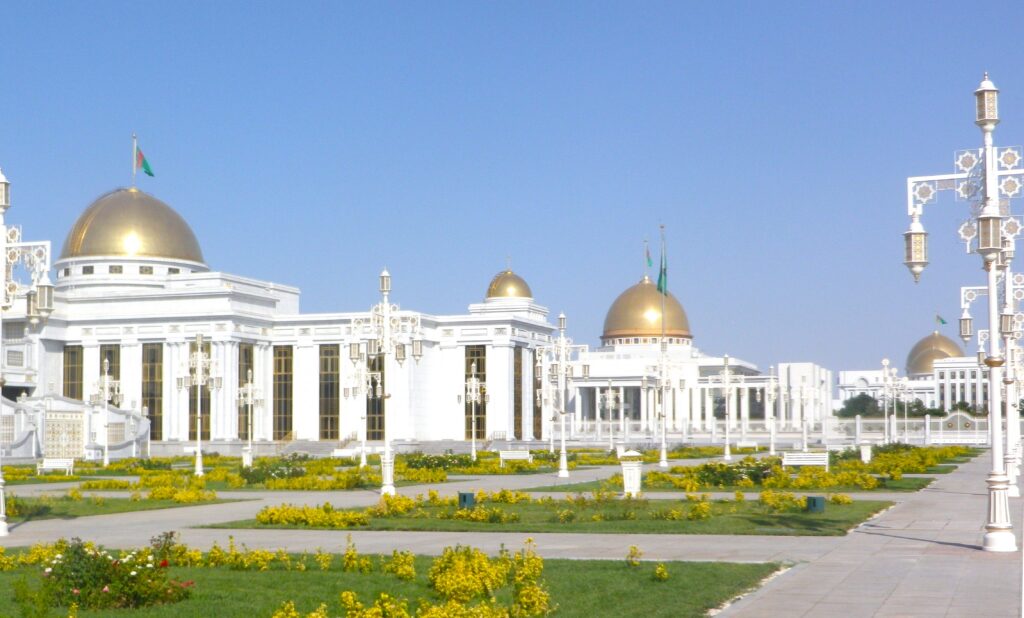
Turkmenistan’s so-called “white city” of Ashgabat, where hundreds of buildings are clad in white marble, will host a conference this month aimed at attracting international investment and innovation to the showcase capital. Organizers of the government-backed White City Ashgabat 2026 forum, scheduled for May 24-25, say the delegates will include investors, architects, and engineers, and that the agenda will cover urban planning, digital technologies, and the modernization of water, transport, and other infrastructure. Organizers of the government-backed White City Ashgabat 2026 forum, scheduled for May 24-25, say delegates will include investors, architects, and engineers, and that urban planning, digital technologies, and the modernization of water, transport, and other infrastructure will be discussed. Turkish Airlines and S&P Global Energy are listed as partners for the event. Media partners include several Middle Eastern outlets. Listed speakers include Rahym Gandymov, mayor of Ashgabat; Japanese Ambassador Sasaki Hiroshi; and Francesco La Camera, director-general of the Abu Dhabi-based International Renewable Energy Agency. First-time visitors to Turkmenistan’s capital, with its broad avenues, squares and elaborate monuments, sometimes describe it as eerie and unusual. In 2013, the city made it into the Guinness World Records for the highest density of white marble-clad buildings. Perceptions of Ashgabat can range from a futuristic “smart” city to a grandiose display only made possible by the wealth from Turkmenistan’s immense energy resources and the whims of its leaders. Turkmen officials are trying to shape a positive narrative about the city by hosting more international events and focusing on the idea of sustainability. Erfan Ali is director of the regional office for eastern Europe and Central Asia of UN-Habitat, which promotes social and environmental priorities in towns and cities. He said he was looking forward to the Ashgabat conference this month. “Discussions will focus on advancing resilient, inclusive, and smart cities, from climate action to digital transformation, while highlighting practical pathways for future-ready urban systems globally,” Ali said on X. In recent years, Turkmenistan has also focused on the development of Arkadag, a city that lies about 30 kilometers from Ashgabat and features plenty of white marble as well. Arkadag means “protector,” a reference to the formal title of Gurbanguly Berdimuhamedov, the former president who retains some power even though his son, Serdar, is now the president. This month, the elder Berdimuhamedov visited Arkadag to check on what state media described as the “second phase” of the construction of Arkadag, which formally opened in 2023. A delegation from the city will attend the World Urban Forum, a United Nations conference on sustainable urbanization in Baku, Azerbaijan, on May 17-22.

Opinion: Hormuz Crisis Pushes Afghanistan Aid Routes Toward Central Asia

The crisis surrounding the Strait of Hormuz is usually viewed through the lens of energy security or military escalation. But it also has another, less visible, humanitarian dimension. A recent article in The Guardian, “Calls for humanitarian corridor through Strait of Hormuz as Iran war hits vital aid,” points to a critical shift: because of the conflict involving the United States, Israel, and Iran, along with instability around Hormuz, traditional humanitarian supply routes are beginning to break down. For Afghanistan, this is no longer a theoretical concern but an operational reality. According to the World Food Programme (WFP), cited by The Guardian, the cost of delivering food to Afghanistan has tripled. Cargo that previously moved by sea through Hormuz and onward to Pakistani ports must now travel overland across multiple countries, adding weeks to delivery times. The consequences are felt most acutely by vulnerable populations, particularly children. Predictability is one of the core requirements of any humanitarian system, and that predictability is now disappearing. Some shipments are stranded in regional hubs. Routes are constantly changing. Fuel costs continue to rise. Even modest increases in oil prices significantly raise operational expenses for humanitarian agencies. For Afghanistan, the implications are severe. The country has been in a prolonged food crisis for several years, with millions dependent on external aid. Delays of even one or two weeks can directly affect malnutrition and mortality rates. According to United Nations estimates, around 3.7 million Afghan children are currently suffering from wasting, nearly one million of them from severe wasting, a condition associated with sharply elevated mortality risks. UNICEF estimates that in 2026 alone, 1.304 million children aged 6-59 months will require treatment for acute malnutrition, including severe cases and other high-risk groups. Another 1.2 million pregnant and breastfeeding women are also suffering from acute malnutrition. Under these conditions, even temporary disruptions in aid deliveries become a direct threat to human life. The situation is being compounded by several overlapping factors. First, instability around the Strait of Hormuz has made maritime routes both more expensive and riskier. Second, the Pakistani corridor, previously the main overland route, has become unreliable, as repeated border closures and restrictions have tied humanitarian deliveries to the fluctuating political and security relationship between Kabul and Islamabad. Third, Iran has imposed restrictions on food exports and has itself become part of the conflict zone, undermining its role as both a supplier and transit route for Afghanistan. Together, these developments are creating what can be described as a “triple crisis” for humanitarian logistics into Afghanistan. The previous aid delivery system is effectively ceasing to function. In response, the WFP is restructuring its logistics network. One solution has been increased use of the Lapis Lazuli Corridor: Turkey-Georgia-Azerbaijan via the Caspian Sea-Turkmenistan and Afghanistan. Although this route is longer and more expensive, it offers predictability and an alternative to disrupted maritime pathways. The key issue is no longer which route is cheapest, but which is reliable. This shift places Central Asia increasingly at the center of...