• KZT/USD = 0.00212
  • TJS/USD = 0.10810
  • UZS/USD = 0.00008
  • TMT/USD = 0.29760
  • KZT/USD = 0.00212
  • TJS/USD = 0.10810
  • UZS/USD = 0.00008
  • TMT/USD = 0.29760
  • KZT/USD = 0.00212
  • TJS/USD = 0.10810
  • UZS/USD = 0.00008
  • TMT/USD = 0.29760
  • KZT/USD = 0.00212
  • TJS/USD = 0.10810
  • UZS/USD = 0.00008
  • TMT/USD = 0.29760
  • KZT/USD = 0.00212
  • TJS/USD = 0.10810
  • UZS/USD = 0.00008
  • TMT/USD = 0.29760
  • KZT/USD = 0.00212
  • TJS/USD = 0.10810
  • UZS/USD = 0.00008
  • TMT/USD = 0.29760
  • KZT/USD = 0.00212
  • TJS/USD = 0.10810
  • UZS/USD = 0.00008
  • TMT/USD = 0.29760
  • KZT/USD = 0.00212
  • TJS/USD = 0.10810
  • UZS/USD = 0.00008
  • TMT/USD = 0.29760

Viewing results 19 - 24 of 97

Opinion: The Reform Paradox for Uzbekistan: Global Capital, Political Control

In mid-May, Uzbekistan is preparing to take a major step onto the global financial stage – one that reflects its broader, decade-long push to open its economy to international investors. The country's National Investment Fund (UzNIF), a $2.4 billion vehicle holding minority stakes in 13 strategic state-owned enterprises, is preparing to list 30% of its capital on the London and Tashkent stock exchanges — the first time such a state-backed investment vehicle is being listed on international equity markets. For President Shavkat Mirziyoyev, the move signals that Uzbekistan wants to be seen as an investable, reforming, and globally connected state. But the planned listing also captures the central paradox of Uzbekistan's current trajectory: the country is opening economically while remaining politically closed. Foreign investors are being invited in. State assets are being partially exposed to market discipline. Capital markets are being developed. Yet the political system remains tightly managed, with limited opposition, weak institutional pluralism, and few independent channels for releasing social pressure. That is why Uzbekistan's stability should not be read only as a strength. It should also be read as a system test: can controlled modernization keep producing legitimacy without creating political mechanisms for absorbing the expectations it generates? Mirziyoyev as a Controlled Modernizer Shavkat Mirziyoyev’s political style is not that of a frontline strongman constantly mobilizing society against enemies. His approach is administrative, developmental, and transactional: reform from above, personnel control, investment attraction, infrastructure, market opening, and the redistribution of economic flows. In this sense, Mirziyoyev is best understood not as a liberal reformer in the Western sense, but as a controlled modernizer. The reform agenda is real. Uzbekistan has moved to attract foreign capital, open selected state assets, improve its business image, and position itself as a more predictable investment destination. The UzNIF listing fits this broader effort: it is designed to deepen capital markets, signal openness to international investors, and show that the state is willing to place parts of its economic architecture under market scrutiny. But the political architecture remains tightly managed. Freedom House continues to rate Uzbekistan as "Not Free" — 12 points out of 100 in its 2026 report — citing the concentration of power in the executive branch, the absence of a genuine parliamentary opposition, and severe restrictions on independent journalists and human rights defenders. This is the central tension: Uzbekistan is reforming economically, but not politically. [caption id="attachment_48249" align="aligncenter" width="2560"] Tashkent has opened up to investment over the past decade. Image: Joe Luc Barnes[/caption] Growth as Legitimacy For now, the model works because growth provides legitimacy. The World Bank expects Uzbekistan's economy to grow by around 6.4% in 2026, following 7.7% growth in 2025 – supported by domestic demand, private consumption, and continued investment. Public debt remains comparatively moderate at around 28% of GDP, and the country benefits from the perception that it is one of the more dynamic economies in the region. This gives the ruling system room to maneuver. The reform narrative allows the leadership to present itself as forward-looking without opening the...

Opinion: Uzbekistan’s Growth Story Has a Skills Problem

Uzbekistan has become one of Central Asia's strongest growth stories. GDP expanded by 6.5% in 2024, and the Asian Development Bank projects growth of 6.7% in 2026 and 6.8% in 2027. Industry, services, and foreign investment are all expanding. The World Bank says real GDP growth averaged around 6% a year between 2017 and 2025. Beneath that momentum, however, a quieter problem is taking shape. Uzbekistan may not yet be training enough workers for the economy it is trying to build. The issue is not a shortage of capital; it is a shortage of market-ready skills. The country has moved from an isolated, heavily state-controlled economy toward a more open and reform-driven model in less than a decade. But if education, vocational training, and private-sector demand do not align faster, Uzbekistan risks turning one of the region's strongest demographic advantages into a labor-market strain. A Dividend That Could Become a Deficit Uzbekistan is a young country in every sense. About 700,000 young people enter the job market each year, while the working-age population is expected to keep expanding for decades. In development economics, this kind of demographic concentration is often described as a dividend: a period when a large share of the population is of working age, productive, and capable of driving growth. The risk is that the dividend does not materialize automatically. It depends on whether young people can move into productive, formal, and better-paid work. If the workforce entering the economy is not equipped with the skills employers need, the same demographic pressure can feed into informality, underemployment, migration, and social strain. The official unemployment rate fell to 4.9% in the third quarter of 2025. That is a meaningful improvement. But around 760,000 people remained registered as job seekers, and the International Labour Organization has estimated informal employment at about 40% of the workforce. Remittances also remain a structural pillar of household income: according to Central Bank data cited by local media, inflows reached $18.9 billion in 2025, up from $14.8 billion in 2024. This is not the picture of a country that has already solved its human-capital challenge. It is the picture of a country racing against time. The Mismatch at the Heart of the Problem The core challenge is not a shortage of graduates. Higher education has expanded dramatically. According to Uzbekistan's National Statistics Committee, coverage among 18- to 23-year-olds reached 47.7% at the start of the 2024/2025 academic year, up from 8.3% in 2017. The number of higher education institutions has also grown rapidly. By conventional access metrics, this is an extraordinary achievement. But enrollment alone is not the measure that matters. Employers need workers who can solve practical problems, operate modern equipment, manage digital systems, and adapt quickly to changing production and service needs. Too many students are still moving through programs shaped by an older economic model: credential-heavy, theoretically oriented, and weakly connected to the needs of a modern labor market in IT, manufacturing, logistics, energy, tourism, and services. The student-financing system has...

Opinion: As Water Runs Short, Uzbekistan Faces New Migration Pressure

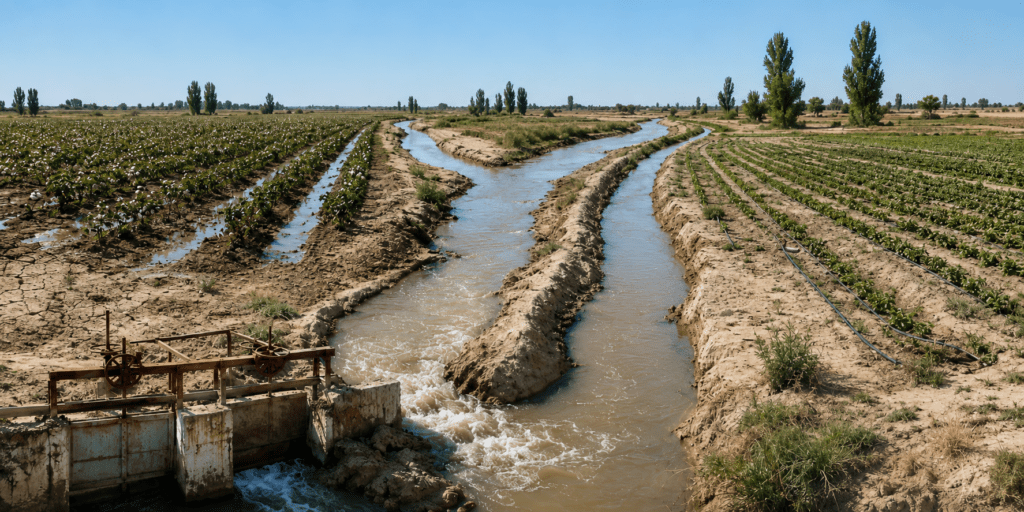
In the 21st century, Uzbekistan is no longer just confronting an ecological crisis - it is on the verge of socio-political transformations driven by water. As agricultural lands are being degraded and river flows are decreasing, the country is now facing what experts describe as a “slow-onset disaster”: internal climate migration. The roots of this crisis go back to the tragedy of the Aral Sea, once the world’s fourth-largest lake, which has shrunk to roughly 10% of its original area since the 1960s largely due to Soviet-era irrigation projects. The human toll has been enormous: not only is agriculture in decline, but the lives of the people living in the Aral Sea region have been profoundly altered. Each year, storms lift an estimated 15 million to 75 million tons of sand, dust, and salt from the dried Aral seabed, spreading it across Uzbekistan and the wider region. Now, another challenge is looming - the water supply. In 2018, 79,942 internally displaced people were reported in Uzbekistan. The dwindling water supply and the threat to agro-ecosystems are creating a new generation of climate migrants. The number of climate-related displacements is expected to reach 200,000 in the coming years. The Amu Darya and Syr Darya rivers, Uzbekistan’s hydrological lifelines, are under growing strain from climate change, inefficient irrigation, and transboundary water-distribution pressures. Experts warn that the country's water deficit could reach 7 billion cubic meters by 2030, and 15 billion cubic meters by 2050. The World Bank predicts that Uzbekistan's economy could shrink by 10% by 2050 if no meaningful action is taken to adapt to climate change. Now, another new factor threatens to accelerate this trend. The Taliban government in Afghanistan is building the Qosh Tepa Canal, a 285-kilometer irrigation project that will divert water from the Amu Darya River. According to Rieks Bosch, an international expert on natural resources and economics, the canal will divert 20% of the Amu Darya's water, which will exacerbate water shortages in some parts of Uzbekistan and negatively affect agriculture. "In any case, Uzbekistan will definitely suffer," he said.  Analyses show that up to 250,000 people could lose their jobs in agriculture as a result of water shortages. The most vulnerable regions - Bukhara, Khorezm, Karakalpakstan, Surkhandarya, and Kashkadarya - are located mainly in rural areas and depend on agriculture and livestock. With almost half of Uzbekistan’s population living outside urban centers, the loss of agricultural viability is not just an economic problem; it is the disruption of a way of life. “Water scarcity, air pollution, biodiversity loss, and a sharp decline in agricultural productivity are constantly increasing,” President Shavkat Mirziyoyev said at COP 28, acknowledging that these problems are “reaching their “critical peak.” Yet policy responses are still lagging behind the pace of environmental change. Uzbekistan’s climate migration problem cannot be solved by managing water resources alone. This requires a new strategic framework – a “Water-Migration-Security” strategy that combines regional cooperation, innovative water-saving technologies in agriculture, and proactive adaptation measures for the communities most at...

Insider’s View: Tashkent’s Water Diplomacy – From National Reforms to Regional Synergy in Central Asia

On April 22, a summit of the International Fund for Saving the Aral Sea (IFAS), one of the region's prominent organizations, takes place in Astana. The meeting of the Heads of the Founding States is especially significant because it marks the transition of the Fund's chairmanship to Uzbekistan for the 2027-2029 period. This will be our country's third mandate, following leadership terms in 1997-1999 and 2013-2016. Tashkent was at the forefront of the creation of IFAS. Yet returning to this leadership role after a decade comes in a fundamentally transformed regional landscape. Today, Uzbekistan brings not only substantial experience but also a broad portfolio of initiatives that have received international recognition. The Transformation of Uzbekistan's Water Sector for Sustainable Development Facing intensifying climate pressures alongside strong economic and demographic growth, Uzbekistan has made the restructuring of water resource management a core priority of state policy. The scale of the challenge is clear in the data. Over the last 15 years, per capita water availability in the republic has fallen by more than half, from 3,000 to 1,400 cubic meters per year. According to the Ministry of Water Resources, the annual volume of water resources has dropped to 51-53 billion cubic meters, a 21% decline from 1991 levels of 64 billion cubic meters. A major challenge remains the country's high dependence on external sources, as approximately 80% of surface water, or 41 billion cubic meters, originates outside the country. While the water shortage did not exceed 3 billion cubic meters prior to 2015, expert forecasts indicate that the deficit could reach 7 billion cubic meters by 2030 and 15 billion cubic meters by 2050. Recognizing the scale of these risks, Uzbekistan, under the leadership of Shavkat Mirziyoyev, is pursuing broad technological modernization of the water sector. In less than a decade, the area using water-saving technologies has grown from 28,000 hectares to more than 2.6 million hectares, now covering more than 60% of all irrigated land. At the same time, large-scale work continues across the country on canal concreting and the reconstruction of flume networks. By 2030, these systemic measures are projected to yield annual savings of up to 15 billion cubic meters of water. At the same time, the sector is undergoing digitalization. Currently, 11 information platforms are being deployed to manage the water cadastre, monitor pumping stations, and track land reclamation status. Over the past four years, the management of 100 major water facilities has been fully automated, the Smart Water system has been introduced at 13,000 water intake points, and more than 1,700 pumping stations have been equipped with real-time online monitoring devices. At the same time, the national economic model is also adapting. According to the Center for Economic Research and Reforms, the share of agriculture in GDP has declined from 32% in 2017 to 19% by 2024. Notably, against this backdrop, total agricultural production has increased by 17%. This divergence points to a transition toward more efficient resource use and higher productivity. Regional Synergy and Water...

Opinion: Supply Chains of Power: How Critical Minerals Are Shaping China–U.S. Competition in Central Asia

Central Asia is no longer a distant frontier for global geopolitics. It is developing into a central arena of competition for critical minerals, supply chains, and industrial power, where minerals are no longer simple commodities but have instead become key components of contemporary statecraft. In essence, this transformation highlights a recognition in Washington and other capitals that critical mineral supply chains are fundamental to next-generation energy systems, the development of artificial intelligence (AI), and strategic defense capabilities. Even as the global economy is multipolar, critical mineral supply chains remain highly concentrated and dominated by China. Control of rare earths is increasingly geopolitical, with clear economic, political, and security consequences. The significance of that imbalance is now shaping U.S. foreign policy, Central Asia’s development strategies, and the future of global economics. China’s Strategy: Control the Chain, Not Just the Mine Though many years in the making, China’s critical minerals strategy is still often misunderstood as focused primarily on resource access. However, Beijing’s efforts are far broader and more effective. Not only securing raw materials, the Chinese leadership has also worked to control the entire supply chain—from extraction to processing, refining, and manufacturing. China’s long-term focus and investments began in the 1980s with efforts that culminated in the Made in China 2025 plan for national and overseas manufacturing. In 2023 alone, Chinese firms invested more than $120 billion in overseas mining and processing, targeting key elements used in energy supply chains. Beijing also fed its industrial base by providing over $220 billion for the production of electric vehicles, batteries, and renewable infrastructure. As a result, China now controls approximately 60% of lithium processing, more than 70% of cobalt refining, and over 90% of battery material manufacturing. Strategically, China controls roughly 90% of global rare earth refining and associated technologies. Early investments in supplies enabled Beijing to subsequently concentrate funds into refining capacity to feed its industrial sector. This integrated approach has shifted the power dynamic for global supply chains tied to the critical minerals economy. As evidenced by Beijing’s near monopoly on processing, market control is not just associated with geological supplies but with processing capacity. China’s willingness to weaponize access not only to rare earths but also to processing technology demonstrates Beijing’s market muscle. This distinction is critical. Rare earth elements are not inherently scarce, but they are rarely found in concentrated deposits, making them difficult to extract and refine. Over decades, Beijing developed unique refining capabilities and subsidized an industrial base that disincentivized competition and encouraged processing to shift to China. The Vicious Circle Prohibitive investment costs, long development timelines, and market volatility have discouraged Western investment in alternative supply chains. Each stage (mining, processing, refining, manufacturing) is interdependent: miners won’t invest without buyers and offtake agreements, processors and refiners need secure financing and stable mineral supply, and manufacturers need steady inputs. Such interdependence creates an investment standoff and heightens perceptions of risk. By integrating all stages, Beijing exerts influence across global markets, from pricing to production. This has conditioned global markets...

Opinion: Trump Has Golden Opportunity to Launch C6+1 on Sidelines of UN

Representatives of the five Central Asian states — Kazakhstan, Uzbekistan, Kyrgyzstan, Tajikistan, and Turkmenistan — along with Azerbaijan, are expected in New York for the United Nations General Assembly in September. Historically, meetings between the Central Asian states and the United States – the C5+1 – have taken place on the sidelines of the United Nations. It is the most natural and logistically efficient venue for President Donald Trump to re-engage with the C5 partners he hosted at the White House last November. As of now, only foreign ministers are expected to attend the UNGA. But this could change if Trump extends an invitation to the leaders, according to a Central Asian diplomatic source. This time, however, he has the opportunity to add Azerbaijan, transforming the format into a C6+1. Baku has already been invited to participate as a full member in Central Asian gatherings, and Washington should build on that momentum. Azerbaijan is uniquely positioned: close to both Israel and Turkey – two of America’s most important regional partners – it sits astride one of the most important connectivity corridors linking Europe and Asia. Its inclusion would turn the C5+1 into a genuinely trans‑Caspian framework that reflects the emerging realities of Eurasian integration. The move would also link two major diplomatic achievements of Trump’s second term: the launch of the Trump Route for International Peace and Prosperity (TRIPP), a 43-km strategic transit corridor connecting mainland Azerbaijan to its Nakhchivan exclave through Armenia, and Trump’s elevation of the C5+1 to a White House-level summit. While TRIPP was discussed at the C5+1 meeting in November, bringing Azerbaijan into the next gathering would allow the administration to present itself as the architect of a new Eurasian trade and energy map. Strategically, a C6+1 format carries significant implications for great-power competition with China. This is because Central Asia is so crucial to Beijing’s grand strategy. In its recently adopted 15th five-year plan, neighborhood diplomacy is listed as the top priority — ahead of relations with major powers or developing countries. Beijing seeks to build a “community with a shared future” with 17 neighboring states, including all five in Central Asia, to “create a favorable external environment” for national rejuvenation, as Foreign Minister Wang Yi has stated. For China, Central Asia is a vital “hinterland” for energy and resource security, and a buffer against maritime disruptions. The United States does not need to dominate the Eurasian Heartland or force Central Asian states to choose between Washington and Beijing. It simply needs to ensure that any Chinese westward access runs through a vast landmass of countries that maintain constructive relations with the United States. A C6+1 format helps shape that environment without confrontation. A stable Middle Corridor – the energy and trade route running through Central Asia, across the Caspian Sea and through Azerbaijan to Turkey and the Mediterranean – also benefits America's energy-hungry allies in Asia, such as Japan and South Korea. Both increasingly look to Kazakhstan as an alternative oil supplier as they...