• KGS/USD = 0.01144 0%
  • KZT/USD = 0.00205 0%
  • TJS/USD = 0.10784 0%
  • UZS/USD = 0.00008 0%
  • TMT/USD = 0.28490 0%
  • KGS/USD = 0.01144 0%
  • KZT/USD = 0.00205 0%
  • TJS/USD = 0.10784 0%
  • UZS/USD = 0.00008 0%
  • TMT/USD = 0.28490 0%
  • KGS/USD = 0.01144 0%
  • KZT/USD = 0.00205 0%
  • TJS/USD = 0.10784 0%
  • UZS/USD = 0.00008 0%
  • TMT/USD = 0.28490 0%
  • KGS/USD = 0.01144 0%
  • KZT/USD = 0.00205 0%
  • TJS/USD = 0.10784 0%
  • UZS/USD = 0.00008 0%
  • TMT/USD = 0.28490 0%
  • KGS/USD = 0.01144 0%
  • KZT/USD = 0.00205 0%
  • TJS/USD = 0.10784 0%
  • UZS/USD = 0.00008 0%
  • TMT/USD = 0.28490 0%
  • KGS/USD = 0.01144 0%
  • KZT/USD = 0.00205 0%
  • TJS/USD = 0.10784 0%
  • UZS/USD = 0.00008 0%
  • TMT/USD = 0.28490 0%
  • KGS/USD = 0.01144 0%
  • KZT/USD = 0.00205 0%
  • TJS/USD = 0.10784 0%
  • UZS/USD = 0.00008 0%
  • TMT/USD = 0.28490 0%
  • KGS/USD = 0.01144 0%
  • KZT/USD = 0.00205 0%
  • TJS/USD = 0.10784 0%
  • UZS/USD = 0.00008 0%
  • TMT/USD = 0.28490 0%

Our People > Vagit Ismailov

Vagit Ismailov's Avatar

Vagit Ismailov

Journalist

Vagit Ismailov is a Kazakhstani journalist. He has worked in leading regional and national publications.

Articles

Middle East Crisis: Kazakhstan Could Become an Alternative Supplier of Petroleum Products to Asia

The two-week ceasefire announced after Pakistani mediation between Iran and the U.S. has reduced the risk of immediate escalation in the Strait of Hormuz, but disruptions to one of the key routes of global oil trade have already triggered structural changes in energy markets. Against this backdrop, Kazakhstan and other countries in the region are increasingly being viewed as alternative suppliers of hydrocarbons, at least from the perspective of South Korea and Japan. Despite the agreement on a two-week pause, Iran has made it clear that it retains control over shipping in the strait, including the potential to impose restrictions and coordinate tanker movements with its military. This has heightened concerns among importers, many of whom depend heavily on this route. The most notable shift is taking place in Asia. South Korea, which receives about 61% of its crude imports and 54% of its naphtha imports through the Strait of Hormuz, is sending a high-level delegation to Kazakhstan, Oman, and Saudi Arabia to seek alternative sources of supply. Talks in Astana are expected to focus on oil and naphtha for industrial use. South Korea, Asia’s fourth-largest economy, has proven to be among the most vulnerable to disruptions in the Strait of Hormuz. In response, Seoul is taking urgent diplomatic and economic measures, with Presidential Chief of Staff Kang Hoon-sik traveling to Kazakhstan as a special envoy for strategic economic cooperation. The delegation includes representatives from relevant ministries and major energy companies, underscoring the urgency of the effort. The purpose of the visit is not only to address a potential short-term shortfall but also to establish sustainable alternative supply channels. South Korea has already secured a 24 million-barrel supply deal with the UAE, and shipments are already arriving at its ports, though officials say that volume is still insufficient given the ongoing instability. The government is coordinating efforts with private fuel importers and logistics operators to ensure uninterrupted supplies until tankers arrive at the country’s ports. Kazakhstan, which possesses large oil fields including Kashagan, is emerging as a key candidate to partially replace Middle Eastern volumes. However, geography imposes clear limitations: oil from the region requires more complex logistics, including transit across the Caspian Sea and onward through the Caucasus or the Black Sea. This is compounded by a projected decline in the country’s oil production. In March, Energy Minister Yerlan Akkenzhenov stated that output could fall by 2-4 million tons by the end of 2026 due to disruptions linked to attacks on infrastructure belonging to the Caspian Pipeline Consortium (CPC), as well as fires at the Tengiz field. Initial projections placed Kazakhstan’s 2026 oil production at 100.5 million tons, potentially a record level. However, the minister indicated that actual output will most likely fall short of this target. Japan is also reassessing its supply strategy. With more than 90% of its oil traditionally sourced from the Middle East, Tokyo is considering increasing imports from Kazakhstan and Azerbaijan through projects involving the national company INPEX. Japanese experts note that oil from...

2 months ago

Turkmenistan Ranked Last Among Central Asian Countries in Internet Freedom Index

According to a report by Cloudwards, a portal focused on technology and internet security, Turkmenistan scored just 16 out of 100 points for internet freedom in 2026, placing it among the countries with the lowest levels of online freedom. The authors note that significant internet censorship persists in the country. Compared with its regional neighbors, Turkmenistan’s score is among the lowest. Uzbekistan received 24 points, Kazakhstan 35, and Kyrgyzstan 52, while Tajikistan ranked highest in Central Asia with 56 points. The gap reflects varying levels of access to information and differing degrees of online restrictions across the region. In a global context, the disparity is even more pronounced. North Korea received the lowest possible score of 0. The report describes it as a country where most residents have no access to the global internet, with only a limited group permitted to use a heavily restricted internal network. Countries ranking only slightly higher include Russia, Pakistan, Iran, and China, each scoring 4 points. None is classified as fully free under the report’s criteria. According to the study, platforms such as X, Facebook, YouTube, and TikTok are blocked or have at times been restricted in these countries. The report also highlights that in some cases, restrictions are more flexible in nature. For example, in China, access to VPNs and social media is not entirely prohibited but is tightly controlled, with users largely limited to approved platforms. Expressing politically sensitive views can lead to serious consequences. Turkmenistan is grouped alongside India, Myanmar, and Bangladesh, all of which scored between 12 and 20 points. In these countries, the report notes significant censorship and restricted access to information. At the other end of the ranking are Belgium, East Timor, Denmark, Iceland, Costa Rica, Liechtenstein, New Zealand, Norway, Slovakia, Suriname, and Finland, each with a score of 92. No country achieved a perfect score of 100. The study assessed internet freedom across several criteria, including access to torrents, adult content, political and social media platforms, and the ability to use VPN services. “Although certain types of internet regulation, when implemented carefully, can help combat hate speech, protect vulnerable groups, and limit the spread of harmful misinformation, in many countries, censorship has been taken to extremes,” the report’s authors state. They add that residents of countries with strict internet controls are effectively deprived of full access to information. This has implications not only for freedom of expression but also for education, technological development, and innovation. In some cases, the consequences can be more severe, including imprisonment for online speech.

2 months ago

Central Asian Startups See Investment Surge

The fifth Central Eurasian Venture Forum (CEVF 2026) opened in Uzbekistan for the first time, drawing around 800 investors, startups, and technology companies from Central Asia, Europe, the U.S., Southeast Asia, and the Middle East and North Africa. Minister of Digital Technologies Sherzod Shermatov attended the opening ceremony. The event was organized by MOST Holding and IT Park Uzbekistan with government support. Partners included Astana Hub, the European Bank for Reconstruction and Development, the International Finance Corporation, Visa, and others. During the forum, the report Startups and Venture Capital in Central Asia 2026, prepared by RISE Research, was presented. According to the study, total venture capital investment in the region reached $320 million in 2025. The two largest deals, $130 million for Higgsfield and $65.5 million for Uzum, accounted for 61% of the total. Excluding these deals, the market reached $124.5 million, marking a 31% increase compared to 2024 and indicating steady organic growth. At the forum, the analytical agency RISE Research presented a study of the Central Asian venture capital market for 2025. According to the study, the volume of venture capital investments in Kazakhstan nearly tripled, reaching $209 million, with artificial intelligence being the main driver, accounting for approximately half of the total investment.  In Uzbekistan, funding reached $33.8 million, an increase of more than eleven times compared to 2022. Including major deals, the Uzbek market is estimated at $99.3 million, with 85% of investment coming from domestic investors. The forum also hosted the CEVF Awards ceremony, recognizing key players in the regional venture ecosystem. In addition, the European Bank for Reconstruction and Development announced 13 finalists for its Star Venture program for Central Asia, aimed at supporting high-tech startups. During the forum, cooperation agreements were signed with international partners, including companies from South Korea and the Middle East, to support the development of the startup ecosystem and attract investment. The second cohort of the Investment Readiness Accelerator (IRA) Tashkent program, focused on early-stage startups, was also launched.

2 months ago

Food Spending Remains High in Kazakhstan Households

A high share of household spending on food remains a key indicator of living standards in Kazakhstan, according to analysts at Finprom.kz. By the end of 2025, average annual spending on food and non-alcoholic beverages reached $1,292 per person, up 13.9% year-on-year and nearly six times higher than in 2010. At the same time, the structure of spending has remained largely unchanged. In 2025, food accounted for 47.8% of total expenditures, only slightly below the pre-pandemic level of 50.4%. As a share of income, food expenditures rose to 42.5%, compared to 40.7% a year earlier, suggesting that income growth is being largely offset by inflation. Consumption patterns also remain relatively rigid. Meat and meat products account for 34.4% of food spending, approximately $444 per person, with prices in this category rising by 18.1% over the year. Bread and cereal products (14.7%) and dairy products (10.6%) also make up a significant share. Combined, these categories account for about 60% of total food expenditures. Spending on fruit and vegetables is increasing in absolute terms by 15.3% and 22.8%, respectively, but their shares remain relatively low at 9.1% and 7.7%, pointing to limited diversification in consumption. Fish and seafood account for 4.4% of spending, and eggs for 2.1%, further reflecting a concentration on staple foods. According to analysts, inflation remains the main driver of rising expenditures. In February 2026, prices for food and non-alcoholic beverages increased by 12.6% year-on-year, compared to 6.3% a year earlier. This level is close to the highest rates recorded over the past decade, with the exception of February 2023, when growth reached 26.4%. Analysts warn that if current inflation trends persist, the share of spending on food in 2026 could again exceed 50%, limiting households’ ability to spend on non-food goods and services and placing additional pressure on living standards.

2 months ago

Afghanistan Aims to Increase Trade with Central Asia to $10 Billion

Afghanistan aims to increase trade with Central Asian countries to $10 billion over the next three to four years, Foreign Minister Amir Khan Muttaqi said at a meeting in Kabul. According to Muttaqi, Afghanistan’s trade turnover with countries in the region reached approximately $2.7 billion in 2025, marking a significant increase compared to previous years. The statement was made during a consultative dialogue involving representatives from Kazakhstan, Uzbekistan, Kyrgyzstan, Tajikistan, and Turkmenistan, focused on regional cooperation, trade, and the development of transit routes. Muttaqi said Afghanistan intends to leverage its geoeconomic position to connect Central Asia with markets in South and West Asia. Among key projects, he highlighted the TAPI gas pipeline, which is currently under construction. Afghan authorities are seeking to expand economic ties despite ongoing international sanctions affecting the banking sector, which continue to constrain investment inflows. At the same time, Russia remains the only country to have officially recognized the Taliban government that came to power in 2021. Several countries, including China, India, Turkey, and the United Arab Emirates, maintain a diplomatic presence in Kabul. Landlocked Central Asian countries view southern routes through Afghanistan as an alternative to northern corridors via Russia, which have been complicated by sanctions. Afghanistan shares a border of more than 2,300 km with Tajikistan, Uzbekistan, and Turkmenistan, and continues to face security challenges, including threats from extremist groups, drug trafficking, and irregular migration. However, Muttaqi said the situation along the borders remains generally stable. Earlier reports indicated that Kazakhstan is exploring the possibility of investing in rare earth metal mining in Afghanistan. The national company Tau-Ken Samruk is conducting laboratory analysis of samples collected in Afghanistan and Rwanda.

2 months ago

Meeting of the Organization of Turkic States Held in Baku

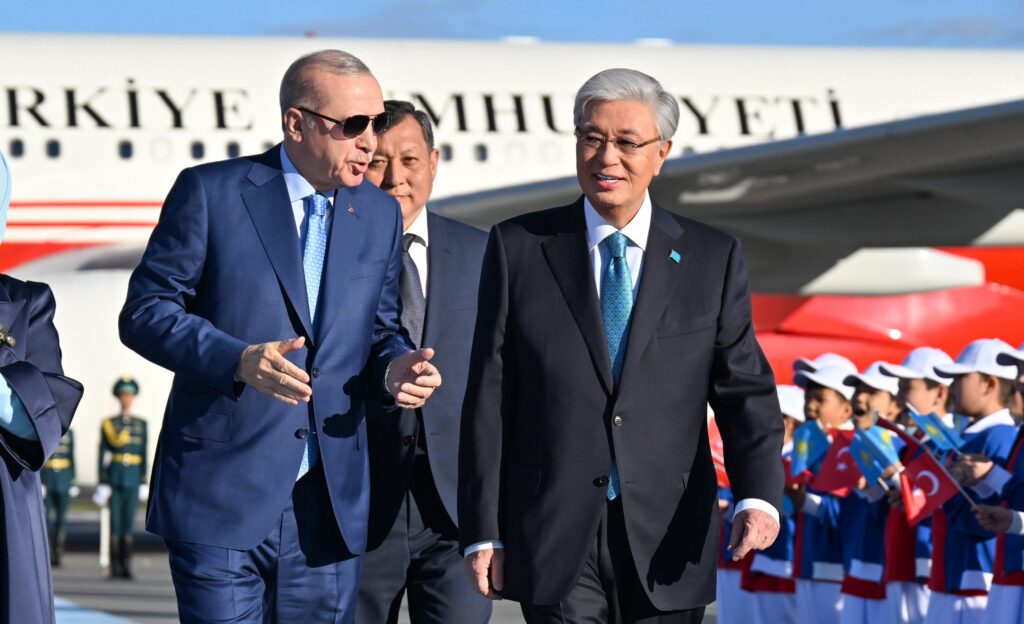
On April 2, Azerbaijani President Ilham Aliyev met with participants of a meeting of the heads of government of the Organization of Turkic States (OTS) in Baku, outlining key areas of cooperation. Among those attending were Turkish Vice President Cevdet Yılmaz, Uzbek Prime Minister Abdulla Aripov, Kazakh Prime Minister Olzhas Bektenov, Kyrgyz Prime Minister Adylbek Kasymaliev, Deputy Chairman of the Cabinet of Ministers of Turkmenistan Nokerguly Atagulyev, Prime Minister of the Turkish Republic of Northern Cyprus Unal Ustel, and OTS Secretary General Kubanychbek Omuraliev. Opening the meeting, Aliyev stressed the importance of dialogue. “This meeting of the heads of government of the Organization of Turkic States is being held in Baku. I warmly welcome you all,” he said. According to Aliyev, such meetings allow not only for the discussion of economic issues but also for reaffirming unity among member states. He noted that cooperation within the organization remains a priority of Azerbaijan’s foreign policy. He also reiterated a key message that ran throughout his speech: “We have repeatedly stated from various platforms that the Turkic world is our family; we have no other family,” Aliyev said. Special attention was devoted to economic cooperation. According to the president, trade between member states is growing, and investment volumes are increasing. He noted that Azerbaijan has invested more than $20 billion in the economies of OTS member states. Most of this has been directed to Turkey, though investment activity is expanding elsewhere. In particular, joint funds have been established with Uzbekistan, Kazakhstan, and Kyrgyzstan to support project implementation. Aliyev also thanked partners for their participation in the reconstruction of Karabakh. Facilities built with the support of OTS countries are already operational in the region, including the Mirza Ulugbek School, the Kurmangazy Children’s Creative Center, and the Manas School. In addition, a garment factory has been opened in Khankendi with the participation of Uzbekistan. He also highlighted mutual support among member states. Following the earthquake in Turkey, Azerbaijan financed the construction of the “Azerbaijani Quarter” in Kahramanmaraş, valued at $100 million. Transport and logistics projects were another key topic. According to the president, infrastructure development remains a top priority. These include the Middle Corridor, the Trans-Caspian route, and the Zangezur Corridor, all of which are gaining importance in the current geopolitical environment. Aliyev said that infrastructure within Azerbaijan is largely complete. Railways, the Baku port, highways, and airports are operational. Construction of the Zangezur Corridor is also progressing, with the highway nearly 90% complete and the railway approximately 70% complete. He also noted the construction of the Kars-Nakhchivan railway line in Turkey, which is expected to enable a new international route with an initial capacity of about 15 million tons of cargo. In conclusion, Aliyev said these projects are aimed not only at serving regional interests but also at expanding international transport connectivity. He expressed confidence that the meeting would contribute to the further development of the OTS and strengthen cooperation among member states.

3 months ago

Turkmenistan Introduces Fuel Limits for Vehicles Leaving the Country

Turkmenistan introduced new rules governing fuel exports at the beginning of April. Under the regulations, the amount of diesel in the tanks of vehicles leaving the country must not exceed 300 liters. If this limit is exceeded, a fee of approximately $1 per additional liter is charged. The new rules primarily affect heavy-duty trucks, which traditionally carry large volumes of fuel. Enforcement has been assigned to the State Border Service, the State Customs Service, and the state-owned company Turkmenneft. Specialists from the General Directorate of Türkmennebitönümleri, the entity responsible for the distribution of petroleum products, are tasked with measuring fuel volumes at border checkpoints. The fuel volume of each vehicle is checked and entered into an electronic system. If the limit is exceeded, the driver is issued two receipts: one remains with the driver, while the other is sent to a bank for payment. All measurements are also recorded in a dedicated logbook. According to the authorities, this system is intended to reduce the risk of fraud and informal payments. The reasons for tightening the regulations are clear. Diesel in Turkmenistan costs around $0.05 per liter. By comparison, in the summer of 2025, it cost about $1 in Uzbekistan, approximately $0.60 in Kazakhstan, and around $0.90 in Russia. This price disparity has long created conditions for black-market activity. Fuel is smuggled abroad and resold, while domestic shortages periodically occur. Drivers face restrictions at filling stations, and additional fuel is often sold at a surcharge that can reach 200% of the official price. As a result, the market has become distorted, with potential state revenue reportedly being diverted through corrupt practices. Another contributing factor is the recent rise in global fuel prices, driven in part by escalating tensions in the Strait of Hormuz, a critical route for global oil and gas shipments. Similar measures have been introduced elsewhere in the region. Kazakhstan tightened regulations on the export of petroleum products and, in autumn 2025, imposed a full ban that remains in effect until May this year. Russia also restricted fuel exports starting April 1, with the measures expected to remain in place until at least July 31.

3 months ago

Kazakhstan’s SCAT Airlines Adds Two Boeing 737 MAX 8 Aircraft

Kazakhstan-based SCAT Airlines has taken delivery of two new Boeing 737 MAX 8 aircraft. The planes were delivered directly from Boeing’s facility in Seattle, marking the first time the carrier has added two aircraft of this type to its fleet simultaneously. The fleet expansion is linked to the growth of the airline’s route network and the strengthening of existing flight programs. In 2026, SCAT launched new routes from Shymkent to Karaganda, Kostanay, Bishkek, Novosibirsk, St. Petersburg, and Tyumen, as well as a direct service from Astana to Ulaanbaatar. The new aircraft will support the development of a hub at Shymkent Airport, which is emerging as a key node in the airline’s network. “It is important for SCAT that the new aircraft will be used to develop the hub in Shymkent and expand the route network,” said company president Vladimir Denisov. The airline’s fleet currently consists of approximately 40 aircraft. In September 2025, the carrier received another Boeing 737 MAX 8, bringing the total number of aircraft of this type in its fleet to eleven. SCAT Airlines was founded in 1997. The company’s structure includes Aulie-Ata International Airport in Taraz, a 70% stake in Yuzhnoye Nebo Airlines, and a 40% stake in the Egyptian carrier Red Sea Airlines. The Times of Central Asia previously reported that SCAT Airlines, in partnership with Boeing, had begun construction of a new maintenance center in Shymkent. The facility will specialize in servicing Boeing aircraft, including the Boeing 737 (Classic, NG, and MAX), Boeing 757 and Boeing 767, as well as the wide-body Boeing 777. During a working visit to the United States, President Kassym-Jomart Tokayev met with Boeing executives. He noted that airlines including Air Astana, SCAT, and Vietjet Qazaqstan are interested in expanding joint projects that are important for the development of Kazakhstan’s aviation industry.

3 months ago

U.S. Extends Sanctions Exemption for Transit of Russian Oil Through Kazakhstan

The United States has extended a sanctions exemption allowing the transit of Russian oil to China through Kazakhstan until March 2027, according to Kazakhstan’s Ministry of Energy. The license was issued by the Office of Foreign Assets Control under the U.S. Department of the Treasury and is valid until March 19, 2027. “Following negotiations with OFAC, the term of the license for the transit of Russian oil to China has been extended. Cooperation on this issue will continue,” the ministry said in a statement. The ministry added that Kazakhstan and Russia are discussing the possibility of increasing supply volumes. At present, transit continues under existing sanctions exemptions. Kazakhstan transports approximately 10 million tons of Russian oil to China annually under an intergovernmental agreement valid until 2034. Earlier, Islamdaut Akubaev, a representative of KazTransOil, said Kazakhstan had received notification from OFAC regarding an extension of the transit permit until April 2026.

3 months ago

Georgia May Replace Russian Oil with Imports from Turkmenistan and Kazakhstan

Georgia’s only oil refinery, owned by Black Sea Petroleum (BSP), plans to completely stop importing Russian oil and instead switch to crude supplies from Turkmenistan and, potentially, Kazakhstan. This was announced by the company’s CEO, David Potskhveria. According to Potskhveria, the shift would not only diversify supply sources but also open access to European markets. “We will completely replace Russian oil with Turkmen oil, and then with Kazakhstani oil. This will give us the opportunity to export products to the EU,” he said. The rationale is straightforward: imports of Russian petroleum products into the European Union are currently prohibited. Maintaining previous supply arrangements would effectively block access to European markets. However, switching suppliers presents logistical challenges. As Potskhveria noted, processing of Turkmen crude can begin only after transit issues through Azerbaijan are resolved. For now, logistics remain the main bottleneck. While the refinery is technically ready, implementation depends on securing reliable transport routes. The proposed move away from Russian oil follows earlier developments. In late February, the EU considered including the Kulevi port on a preliminary sanctions list due to its import and processing of Russian crude. The trigger was a shipment delivered in October 2025 by Russneft, involving approximately 105,000 tons of oil to the port of Kulevi. The shipment prompted criticism from the Georgian opposition, which accused the authorities of undermining the sanctions regime and appealed to European institutions. The Kulevi refinery is a relatively new entrant to the regional oil market. It began operations in December last year and has already outlined expansion plans. Its current processing capacity is around 1.2 million tons per year, with plans to increase this to 4.5 million tons. At present, the facility produces fuel oil, diesel, and other petroleum products. Future plans include expanding output to Euro-5 standard gasoline, jet fuel, and Eurodiesel. BSP’s international partners reportedly include Trafigura and Saudi Aramco.

3 months ago