• KGS/USD = 0.01143 -0%
  • KZT/USD = 0.00192 -0%
  • TJS/USD = 0.10820 0.19%
  • UZS/USD = 0.00008 0%
  • TMT/USD = 0.28575 0%
  • KGS/USD = 0.01143 -0%
  • KZT/USD = 0.00192 -0%
  • TJS/USD = 0.10820 0.19%
  • UZS/USD = 0.00008 0%
  • TMT/USD = 0.28575 0%
  • KGS/USD = 0.01143 -0%
  • KZT/USD = 0.00192 -0%
  • TJS/USD = 0.10820 0.19%
  • UZS/USD = 0.00008 0%
  • TMT/USD = 0.28575 0%
  • KGS/USD = 0.01143 -0%
  • KZT/USD = 0.00192 -0%
  • TJS/USD = 0.10820 0.19%
  • UZS/USD = 0.00008 0%
  • TMT/USD = 0.28575 0%
  • KGS/USD = 0.01143 -0%
  • KZT/USD = 0.00192 -0%
  • TJS/USD = 0.10820 0.19%
  • UZS/USD = 0.00008 0%
  • TMT/USD = 0.28575 0%
  • KGS/USD = 0.01143 -0%
  • KZT/USD = 0.00192 -0%
  • TJS/USD = 0.10820 0.19%
  • UZS/USD = 0.00008 0%
  • TMT/USD = 0.28575 0%
  • KGS/USD = 0.01143 -0%
  • KZT/USD = 0.00192 -0%
  • TJS/USD = 0.10820 0.19%
  • UZS/USD = 0.00008 0%
  • TMT/USD = 0.28575 0%
  • KGS/USD = 0.01143 -0%
  • KZT/USD = 0.00192 -0%
  • TJS/USD = 0.10820 0.19%
  • UZS/USD = 0.00008 0%
  • TMT/USD = 0.28575 0%
13 December 2025
Uncategorized

Uzbekistan and Kyrgyzstan Leaders Discuss Regional Cooperation and Tourism Development

On January 25, Kyrgyz President Sadyr Japarov paid a visit to Uzbekistan, where he held an informal meeting with Uzbek President Shavkat Mirziyoyev at the Amirsoy resort complex in the Tashkent region.

During their meeting, the two leaders discussed a range of topics, including bilateral relations, regional cooperation, and international politics. The relaxed setting allowed for a candid exchange of ideas about enhancing collaboration between the neighboring countries.

President Japarov commended the modern infrastructure of the Amirsoy ski resort, describing it as meeting international standards. Both leaders expressed a shared vision for developing joint tourism projects that capitalize on the unique natural landscapes of Uzbekistan and Kyrgyzstan. This cooperation, they noted, could help create resort and recreation centers in both countries, boosting tourism and local economies.

President Japarov shared his impressions of Amirsoy in a Facebook post, accompanied by aerial photographs of the resort. Reflecting on Kyrgyzstan’s missed opportunities in tourism development, he wrote: “Mountains occupy 94% of the territory of our country. Each of our seven regions could have such resorts. But we hardly have them. Why? Because since we gained independence, from ordinary people to presidents, we have only been engaged in politics. Every day we held meetings, and every day there were weddings. We did not pay attention to the economy, tourism, and other important areas.”

Japarov praised Mirziyoyev’s efforts in building Amirsoy from scratch, highlighting its economic and social benefits. “Looking at the Amirsoy ski resort, I was amazed. My colleague Shavkat Mirziyoyev built this resort from scratch. No problem. Blessed. How many people are employed? Millions of tourists come here to relax. The level of service is not inferior to that of Europe. Everything is at a high level,” Japarov wrote.

The informal meeting highlights the strengthening relationship between Uzbekistan and Kyrgyzstan, as both countries seek to enhance cooperation in various fields, including tourism, economic development, and regional stability.

Uncategorized

Amre Kashaubaev and the Mystery of an Old Photograph

In Kazakhstan, the musical talent of Amre Kashaubaev is well known. Thanks to him, European audiences were introduced to the live melodies of Kazakh music when Kashaubaev performed Kazakh songs at the International Exhibition of Modern Decorative and Industrial Arts of 1925 in Paris.

As previously reported by The Times of Central Asia, the first recordings of Kazakh music were made between 1903 and 1909 during the travels of the German explorer Richard Karutz in Turkestan. His book, Among the Kirghiz and Turkmens in Mangyshlak, published in 1911 in Russia, was edited by Vasily Radlov, a renowned ethnographer, archaeologist, and educator of German origin, who was also a pioneer in Turkology. However, it was only in 1925, thanks to Kashaubaev’s talent, that Europeans could hear Kazakh folk songs performed live.

The fate of this man is very similar to the destinies of thousands of talented individuals in the early years of the Soviet Union, whose creative works could not fit into the “Procrustean bed” of communist ideology.

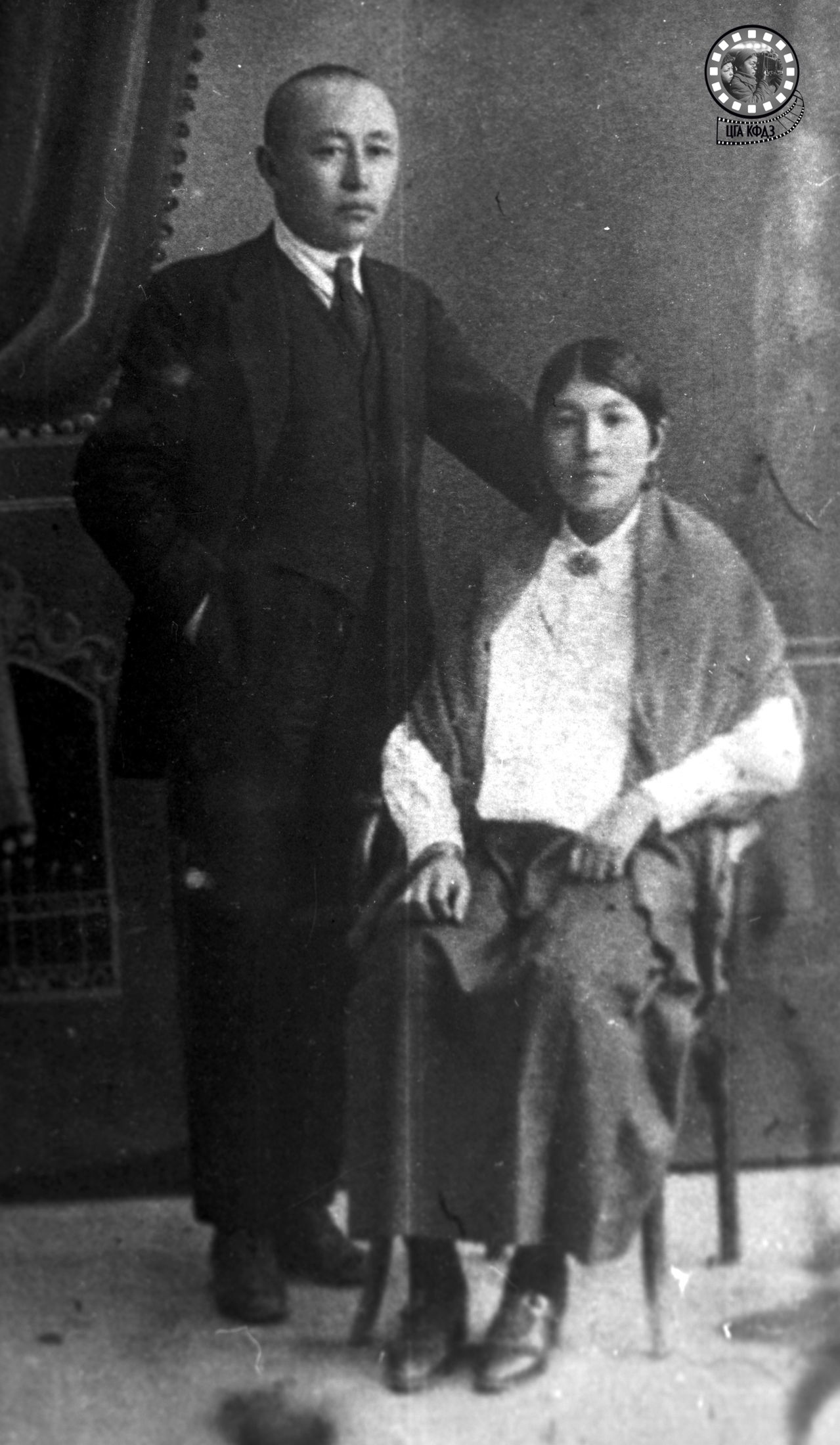
Amre Kashaubaev and his wife Orazke, Kzyl-Orda, 1926.

Amre Kashaubaev was born in 1888 in the Abraly district of the Semipalatinsk region. His first professional attempt to become a singer was a public performance at a fair near the village of Koyandy, not far from the modern city of Petropavlovsk, at a festival of Kazakh oral art. Through his songs, Kashaubaev’s art became famous throughout Kazakhstan. Anatoly Lunacharsky, then the People’s Commissar for Education, personally invited him to participate in concerts at the International Exhibition in Paris. Kashaubaev also actively participated in the creation of the first Kazakh professional theater.

In April 1927, he gave a concert in Moscow, followed by a performance in Frankfurt. He frequently performed on the radio, singing Kazakh folk songs and enchanting listeners with the beauty and depth of his voice. His theatrical performances also garnered great interest.

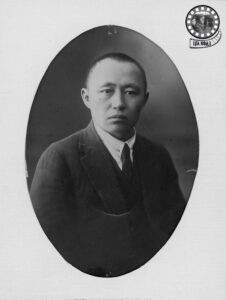
Today, archival institutions and museums in Kazakhstan hold only a few photographs and documents depicting Kashaubaev. This is because many documents were destroyed by his colleagues and relatives due to his political persecution by the Bolsheviks. His trip to Paris proved to be fatal for the singer since it drew the attention of the Soviet state security agencies.

During the Paris exhibition, the talented singer met Kazakh political dissident Mustafa Shokay, who in 1917 had been the Chairman of the Kokand Autonomy — a state entity that lasted for six months in the Turkestan region of the Russian Empire. Moreover, Shokay was an active member of the Alash Party, which the Soviets deemed bourgeois and whose members were subjected to repression. Although Kashaubaev was not imprisoned for his ties with political opponents of the Bolsheviks, he faced significant pressure from the authorities. On December 6, 1934, he was found dead on the streets of Alma-Ata. The cause of his death remains unknown.

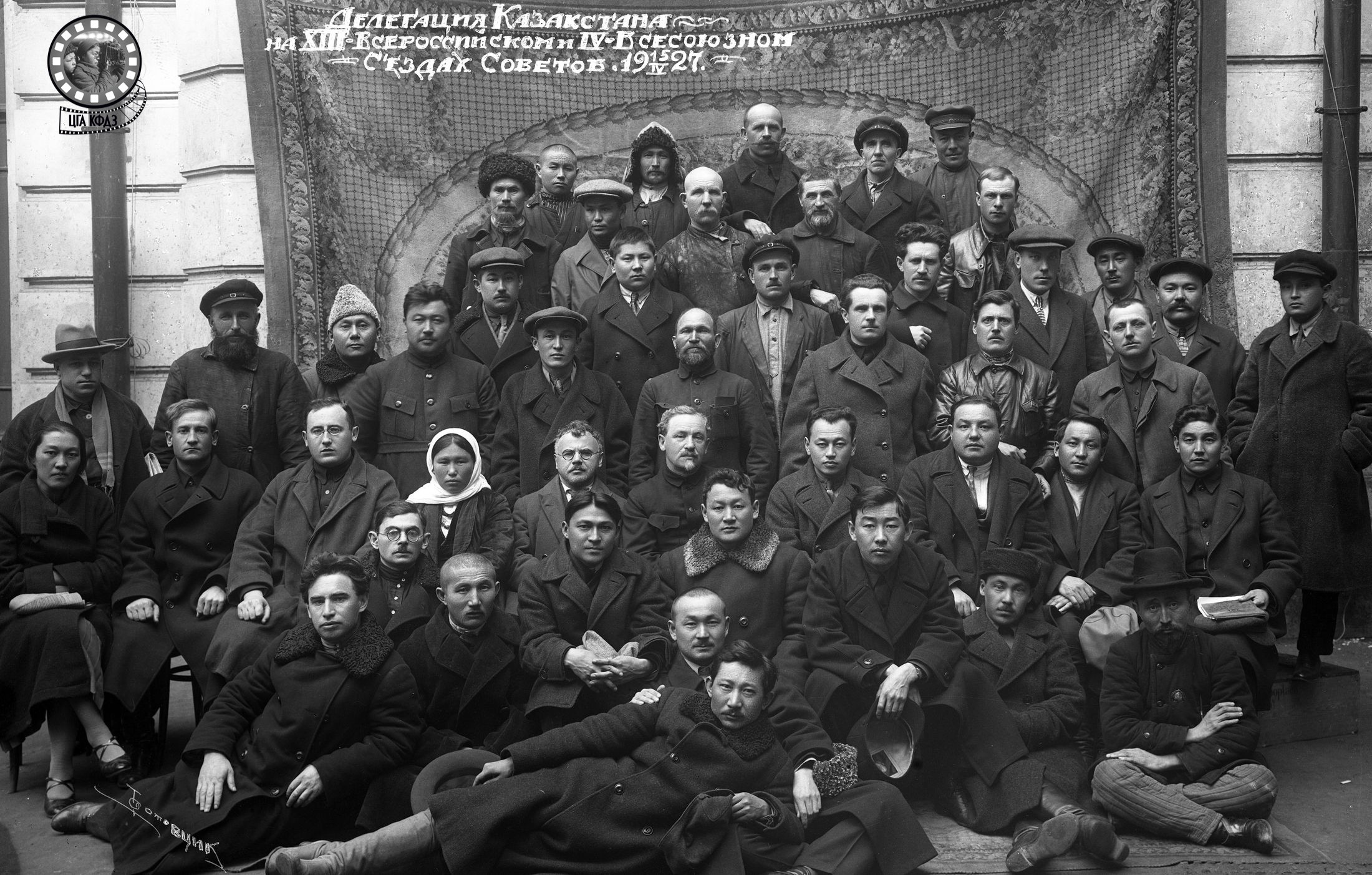
Within the archival fonds of The Central State Archive of Film, Photo Documents, and Sound Recordings of the Republic of Kazakhstan, we believe there is an original group photograph that features Amre Kashaubaev.

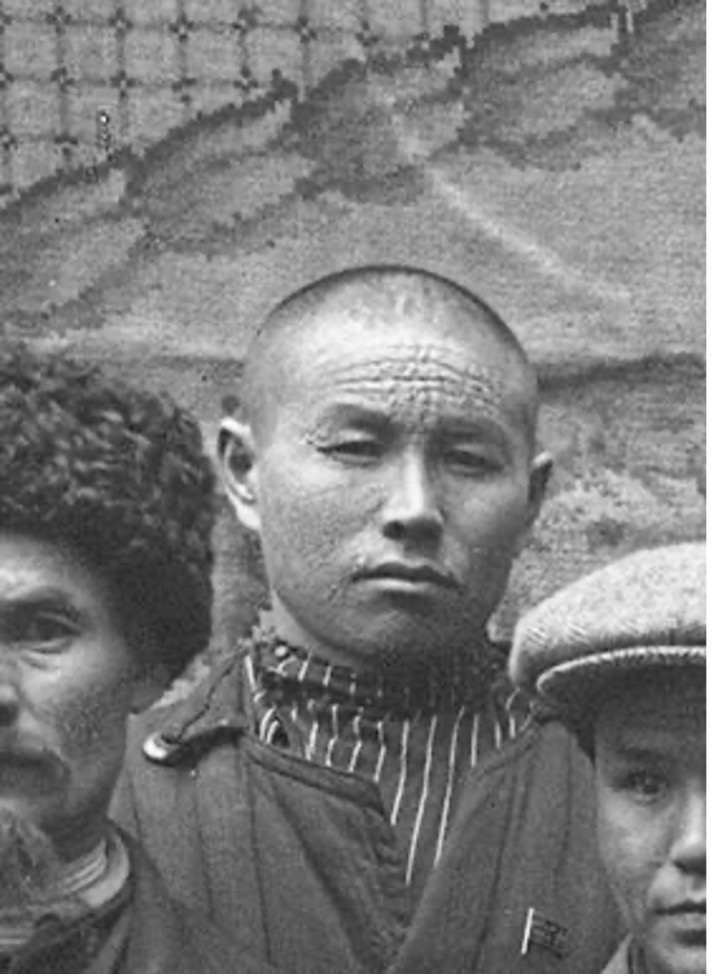
A group of Kazakh delegates at the XIII-th All-Russian and IV-th All-Union Congress of Soviets. Moscow, April 15, 1927 A.Kashaubaev first left in the last row.

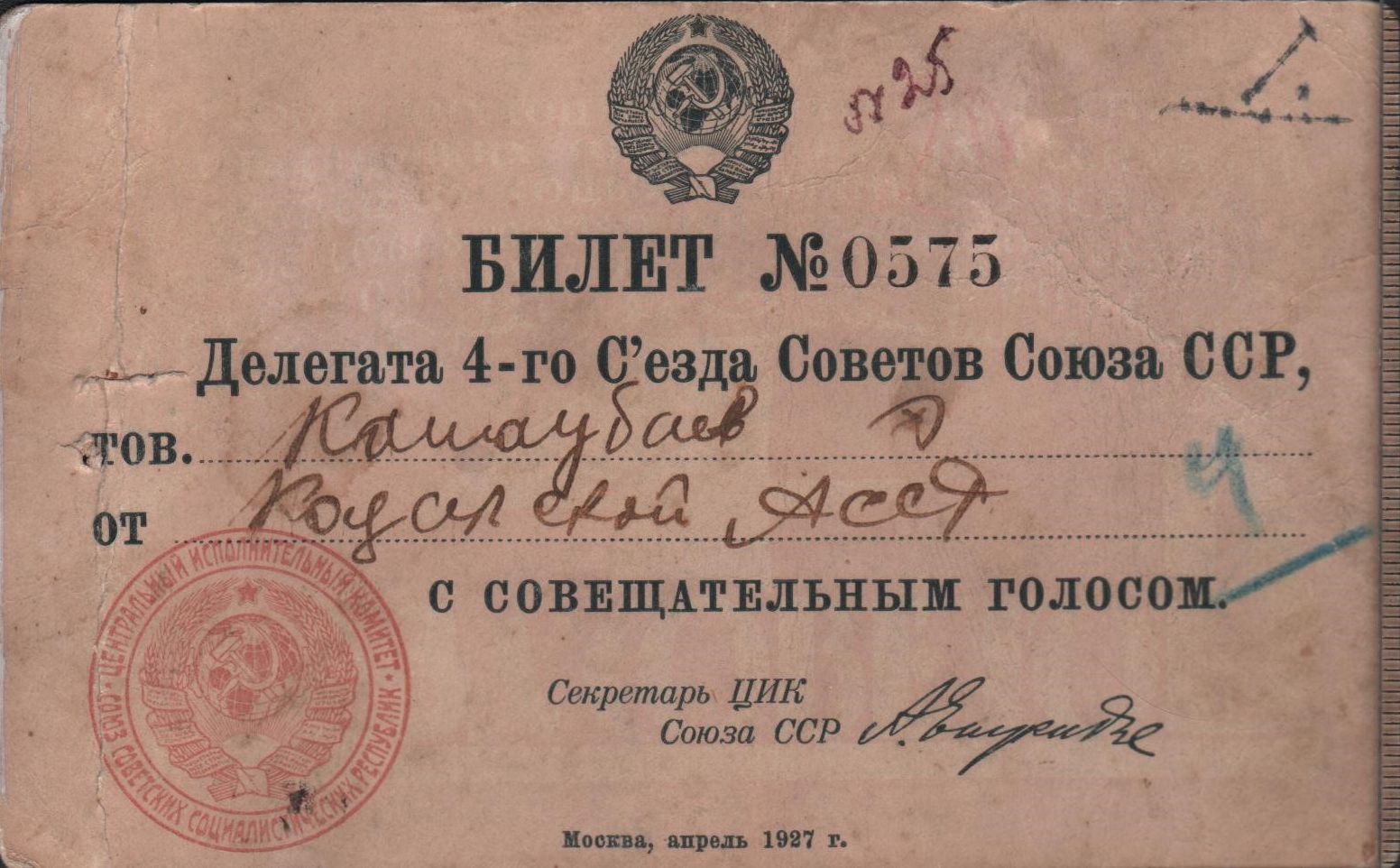
In the photograph, Kashaubaev is seen in the back row, appearing deeply pensive and sorrowful. This expression may well reflect his feelings about being forced to participate in Soviet party events and congresses. Following his return from Paris until his final days, Kashaubaev gave the impression of being a broken man. The photograph depicts participants of the 4th Congress of Soviets of the USSR in Moscow, where Kashaubaev was a delegate from the Kazakh Autonomous Soviet Socialist Republic. His participation in this event is confirmed by a delegate voting card issued in April 1927 by the Central Executive Committee of the USSR, the original of which is now preserved in the Central State Museum of the Republic of Kazakhstan.

Voting card

There is still no clear evidence that the person in the photo is indeed Amre Kashaubaev. However, comparing it with his remaining photographs, it seems almost certain that it is him.

Uncategorized

Uzbekistan Extends Agreement on Hairaton-Mazar-e-Sharif Railway with Afghanistan

Uzbekistan has reached an agreement with Afghanistan’s Taliban interim government to extend the contract for operating and maintaining the Hairaton-Mazar-e-Sharif railway. Uzbekistan’s Minister of Transport, Ilhom Mahkamov, met with Mohammad Ishaq Sahibzada, Afghanistan’s Deputy Minister of Public Works for Railways, during talks held in Tashkent from January 21 to 23. Uzbekistan’s Ministry of Transport agreement has confirmed the agreement.

The meetings, chaired by Mahkamov, focused on accelerating the construction of the Trans-Afghan Railway project and planning the next stages of work. Both sides emphasized the importance of enhancing regional connectivity and ensuring the smooth operation of the existing railway infrastructure.

Under the extended agreement, Sogdiana Trans LLC, a subsidiary of Uzbekistan Railways Joint Stock Company, will continue managing the Hairaton-Mazar-e-Sharif railway. This railway, constructed in 2010 for $129 million, has been operated by Sogdiana Trans since its completion.

In August 2024, the Naibabad railway station — part of the Hairaton-Naibabad-Mazar-e-Sharif railway line — was reopened after restoration. The work was carried out by Sogdiana Trans in collaboration with the Termez Regional Railway Hub under a contract with the Afghan Railways Administration.

Despite a 2022 proposal from Afghan authorities to transfer the railway’s management to local companies to reduce operational costs, the plan wasn’t implemented. In 2024, the Hairaton-Mazar-e-Sharif railway facilitated the transport of 4,200 containers of goods between Afghanistan and China, according to the Afghan Ministry of Public Works.

The Hairaton-Mazar-e-Sharif railway forms a critical part of the China-Kyrgyzstan-Uzbekistan-Afghanistan railway corridor. The corridor’s capacity is expected to expand significantly following the completion of the China-Kyrgyzstan-Uzbekistan railway. Currently, neither Kyrgyzstan nor Uzbekistan has a direct rail connection to China, with Central Asia’s rail access to China limited to a route through Kazakhstan.

Construction of the China-Kyrgyzstan-Uzbekistan railway officially began on December 27, 2024. The 523-kilometer route will run from Kashgar (China) through Torugart, Makmal, and Jalal-Abad (Kyrgyzstan), before reaching Andijan (Uzbekistan). Once operational, the railway is expected to handle up to 15 million tons of cargo annually, creating a vital new trade link across the region.

This agreement between Uzbekistan and Afghanistan secures the continued operation of the Hairaton-Mazar-e-Sharif railway and reinforces Uzbekistan’s commitment to regional cooperation and infrastructure development. These efforts aim to boost trade, connectivity, and economic opportunities across Central and South Asia.

Tver Court Convicts Salokhiddin Ashurov for Fraudulent Registrations Linked to Crocus City Hall Terror Case

A court in Tver, Russia, has found Salokhiddin Ashurov guilty of fraudulently registering individuals, including Aminchon and Dilovar Islomov, who are defendants in the Crocus City Hall terrorist attack case. The verdict was reported by RIA Novosti, citing court documents.

In April 2024, the Moscow District Court of Tver placed Ashurov in custody for his involvement in the fictitious registration of Russian citizens at his residential address. Among those registered were the Islomov brothers, Dilovar and Aminchon. By the summer, the case was transferred to the interdistrict court, which later forwarded it to a justice of the peace for review.

Ashurov was convicted on 14 charges of fraudulent registration of Russian citizens. According to RIA Novosti sources, the Islomov family — comprising father Isroil and sons Dilovar and Aminchon — were implicated in the Crocus City Hall case. The investigation revealed that Dilovar had owned a Renault Symbol vehicle, which the attackers reportedly used to flee the crime scene before being detained in Russia’s Bryansk region. Although Dilovar sold the car in February, the insurance policy remained under his name.

The Islomov brothers, Russian citizens who lived in Tver and worked as taxi drivers, deny any involvement in the terrorist act. Their father, Isroil, is a Tajik citizen with a Russian residence permit. Initially, the brothers faced charges of committing a terrorist act, but in September 2024, the charges were reduced to aiding and abetting a terrorist act under Part 3 of Article 205.1 of the Russian Criminal Code.

The Russian Investigative Committee has charged 27 individuals in connection with the terrorist attack at Crocus City Hall in the Moscow Region, according to committee chairman Alexander Bastrykin. The case remains one of the highest-profile investigations in recent years, as authorities continue to probe the circumstances surrounding the attack.

New Labor Code Comes Into Force in Kyrgyzstan

A new Labor Code has been implemented in Kyrgyzstan, introducing significant changes to labor relations in the country. The updated code includes provisions for remote work, digital labor records, and streamlined labor contracts. Additionally, relations between employees and employers will now be regulated by a separate law, “On Social Partnership.”

President Sadyr Japarov signed the new Labor Code into law following its approval by Kyrgyzstan’s parliament. The reforms aim to modernize the nation’s labor practices by accelerating the digitalization of processes. Under the new code, paper labor contracts are no longer mandatory. Instead, electronic contracts will suffice for official use and inspection purposes.

One of the notable provisions in the code allows for remote and hybrid work arrangements. “The labor contract, by agreement of the parties, may establish both remote work and combined remote work,” states the law, marking a shift toward more flexible employment practices.

The reforms also address labor books, which traditionally served as a lifelong record of an individual’s work history. Citizens now have the option to use digital labor books, though paper versions remain valid. However, the exact platform or system for storing the digital data has yet to be determined.

Another change eliminates the longstanding practice of shifting days off to accommodate public holidays. Previously, the Ministry of Labor, Social Security, and Migration could declare surrounding weekdays as non-working days. Under the new code, this practice has been discontinued, reducing the total number of non-working holidays.

The Labor Code introduces several worker protections. Employers are now required to provide lump-sum benefits in the event of labor-related injuries or the death of an employee. A single penalty rate of 0.25% has been established for late payments of wages, vacation pay, severance pay, and other compensation. Employees will also have a three-year limitation period to file wage-related disputes.

Additionally, the code prohibits the employment of pregnant women and nursing mothers in hazardous or physically demanding jobs, further strengthening workplace protections for vulnerable groups.

These reforms are expected to streamline labor relations, improve worker protections, and align Kyrgyzstan’s labor policies with modern international standards.

Uncategorized

Kazakhstan Sumo Wrestler Takes Third Place at Japan’s Emperor’s Cup

According to the Japanese publication Tachiai, Kazakhstan’s Yersin Baltagul, known in Japan as Kimbodzan Haruki, has achieved a historic milestone at the Emperor’s Cup, one of the most prestigious tournaments in the sumo world.

Baltagul entered the tournament’s final round with an impressive record of 12 wins and 3 losses. However, in the decisive matches, he was bested by Japan’s Ojo Konosuke and Mongolia’s Sugarragchaagiin Byambasuren, known by his ring name Hoshoryu Tomokatsu. This secured Baltagul a commendable third-place finish.

While Hoshoryu Tomokatsu ultimately claimed the championship title, Baltagul did not leave the tournament empty-handed. He was awarded the “Fighting Spirit” prize, a special recognition for his skill, determination, and resilience in the ring. This accolade cements Baltagul’s place as the first Kazakhstani athlete to reach such heights in the professional world of Japanese sumo.

Baltagul, 27, began his wrestling journey in his childhood, training in traditional kazaksha kures (national wrestling) and judo. Aged 18, he moved to Japan to pursue a career in sumo, and in 2019, he claimed the title of Japan’s youth sumo champion, marking an important early milestone. Since then, he has steadily risen through the ranks to become one of the strongest competitors in a sport deeply rooted in Japanese culture and tradition.

Baltagul’s 12th victory during the Emperor’s Cup has spotlighted his elite level of training and competitiveness, ranking him among the sport’s top athletes. His success demonstrates the growing prominence of Kazakhstan’s athletes on the international stage and paves the way for the development of sumo in Kazakhstan.

Baltagul’s story is one of perseverance and excellence, marking a proud moment for Kazakhstan in the global sports arena.