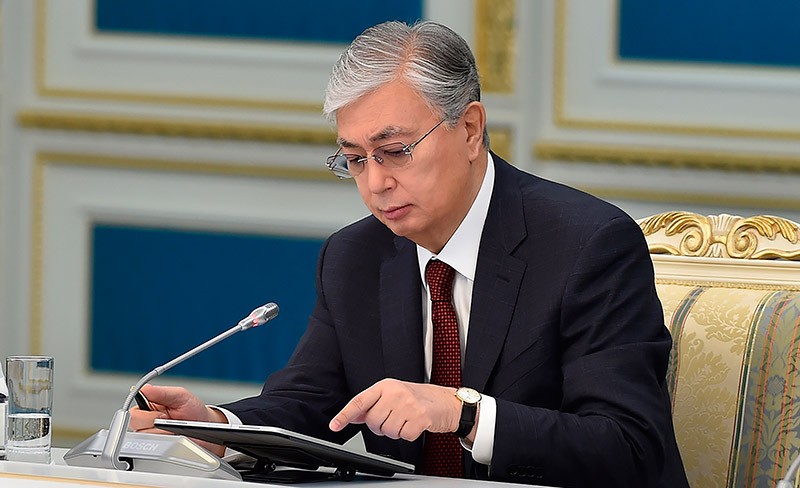
At the 32nd session of the Assembly of the People of Kazakhstan, President Kassym-Jomart Tokayev promoted peace and harmony as the state ideology and impressed on “national unity” by referring to all citizens of his country as Kazakhs regardless of their ethnic, linguistic or religious affiliation. “Society should not be divided on these grounds”, Tokayev said.
Kazakhstan, a predominantly Muslim nation where Christians make up nearly 25% of the population, constitutes a genuine melting pot housing 131 different ethnicities. Such diversity can positively fuel innovation by merging different perspectives and create complex problem-solving methods. But it can also turn into a vulnerability when differences are manipulated to divide communities to gain political advantage. The Assembly of the People of Kazakhstan was established in 1995 to mitigate such risks and foster social harmony in the country.
Forces of division
The President’s latest statements draw attention to what the country perceives as threats to its national unity, which also reverberate elsewhere in the world, including corruption, malign foreign influence, and disinformation. It is difficult to ascertain whether foreign-backed political activities are genuinely aimed at enhancing the human condition in a country or are instead trying to undermine the state’s stability to advance the agendas of other states or individuals. Worryingly for Kazakhstan, a survey of whom many of the well-known political activists are affiliated with shows that they have not grown organically from the country’s civil society ecosystem. Instead, they are often funded by foreign states, NGOs and/or oligarchs. This represents a complex scenario that should alarm true defenders of democracy and human rights.
Firstly, the entrenched oligarchy formed under former President Nazarbayev’s thirty-year reign presents a challenge to the current leadership’s efforts to tackle corruption, kleptocracy and disinformation. These powerful business elites, who largely control the economy and media, resist any efforts to curtail their reach and influence. The government’s anti-corruption initiatives and asset recovery efforts are seen as direct threats to their wealth and dominance.
Secondly, foreign actors see Kazakhstan’s strategic value in the renewed Cold War between Russia and the West. While Kazakhstan’s official and clear position has been one of neutrality, foreign-backed grassroots movements and misinformation campaigns have aimed to move society to take one side or another in this somewhat bipolar battle.
The convergence of these domestic and international pressures forms a formidable challenge that threatens to compromise Kazakhstan’s sovereignty and the welfare of its citizens. The oligarchs, mainly fearing repatriation of their assets hidden abroad through the recovery efforts of the country’s new leadership, could be inclined to support state-led polarization efforts to weaken the government, thus further intensifying the threat to Kazakhstan’s peace and stability.
The evolution of the Kazakh ideology
The development of Kazakhstan’s national identity has been in the works since its independence from the Soviet Union in 1991, and has intensified as the country became a focal point for foreign powers seeking influence in 2022.
This broader statehood identity celebrates Kazakhstan’s history and diversity. President Tokayev appears to be leading the country in defining its ideology in a way that pairs current affairs with preserving the country’s sovereignty and building a government that is more accountable to its citizenry. His rhetoric encourages the promotion of national interests and advocates for a “just and fair Kazakhstan” that should benefit all citizens.
This ideology is taking an eclectic form, rejecting some foreign influences while being receptive to others, depending on whether they fortify or upset the country’s social order. For example, Kazakhstan’s populace is increasingly resistant to the Russian language and is opting to use the Kazakh dialect. Most inhabitants disfavor supporting Russia’s war effort and do not celebrate historical military victories of the Soviet Union. At the same time, the country has lived peacefully with its ethnically Russian population of 3.8 million. Many Kazakhs, especially the older generation, still appreciate the Soviet Union’s contribution to the country’s industrialization as well as to the universal education and healthcare systems. Some 76% of higher education students choose to study in Russia.
While maintaining a balance between external forces, Kazakhstan is also trying to stay true to its own traditional morals. Some Western constructs, such as the LGTBQ movement, are at odds with the country’s family values. Despite being a Muslim-majority nation with a secular stance, Kazakhstan’s resistance to Islamic extremist ideologies is exemplified by its efforts to restrict groups like Tablighi Jamaat. Interestingly, these restrictions have elicited criticism from the U.S.
In any case, it would not be fair to judge Kazakhstan’s international alignment based on domestic social issues. Its trajectory points towards the West when it comes to its democratic orientation, compliance with international norms and regulations, and meeting environmental goals.
Conclusion
Whatever side of the global divide one observes from, Kazakhstan appears predictably and skillfully multi-vector in its trade and security policies. It seeks plurality in foreign relations and has been anchoring its legislation and policies in line with key international laws and conventions under the United Nations frameworks.
Building democratic institutions, practices, and culture is a gradual process that can span generations. Remember, for instance, that women in Portugal only gained universal suffrage in 1976, and African Americans in the U.S. were only allowed this right in 1965. Kazakhstan has been an independent country for just 33 years, and it has already seen significant democratic progress, particularly when compared to the rest of the region. It should be allowed to advance at its own pace, and to do so while preserving its own identity and upholding international norms.