• KGS/USD = 0.01144 0%
  • KZT/USD = 0.00200 0%
  • TJS/USD = 0.10475 -0.19%
  • UZS/USD = 0.00008 0%
  • TMT/USD = 0.28490 0%
  • KGS/USD = 0.01144 0%
  • KZT/USD = 0.00200 0%
  • TJS/USD = 0.10475 -0.19%
  • UZS/USD = 0.00008 0%
  • TMT/USD = 0.28490 0%
  • KGS/USD = 0.01144 0%
  • KZT/USD = 0.00200 0%
  • TJS/USD = 0.10475 -0.19%
  • UZS/USD = 0.00008 0%
  • TMT/USD = 0.28490 0%
  • KGS/USD = 0.01144 0%
  • KZT/USD = 0.00200 0%
  • TJS/USD = 0.10475 -0.19%
  • UZS/USD = 0.00008 0%
  • TMT/USD = 0.28490 0%
  • KGS/USD = 0.01144 0%
  • KZT/USD = 0.00200 0%
  • TJS/USD = 0.10475 -0.19%
  • UZS/USD = 0.00008 0%
  • TMT/USD = 0.28490 0%
  • KGS/USD = 0.01144 0%
  • KZT/USD = 0.00200 0%
  • TJS/USD = 0.10475 -0.19%
  • UZS/USD = 0.00008 0%
  • TMT/USD = 0.28490 0%
  • KGS/USD = 0.01144 0%
  • KZT/USD = 0.00200 0%
  • TJS/USD = 0.10475 -0.19%
  • UZS/USD = 0.00008 0%
  • TMT/USD = 0.28490 0%
  • KGS/USD = 0.01144 0%
  • KZT/USD = 0.00200 0%
  • TJS/USD = 0.10475 -0.19%
  • UZS/USD = 0.00008 0%
  • TMT/USD = 0.28490 0%

Viewing results 1 - 6 of 72

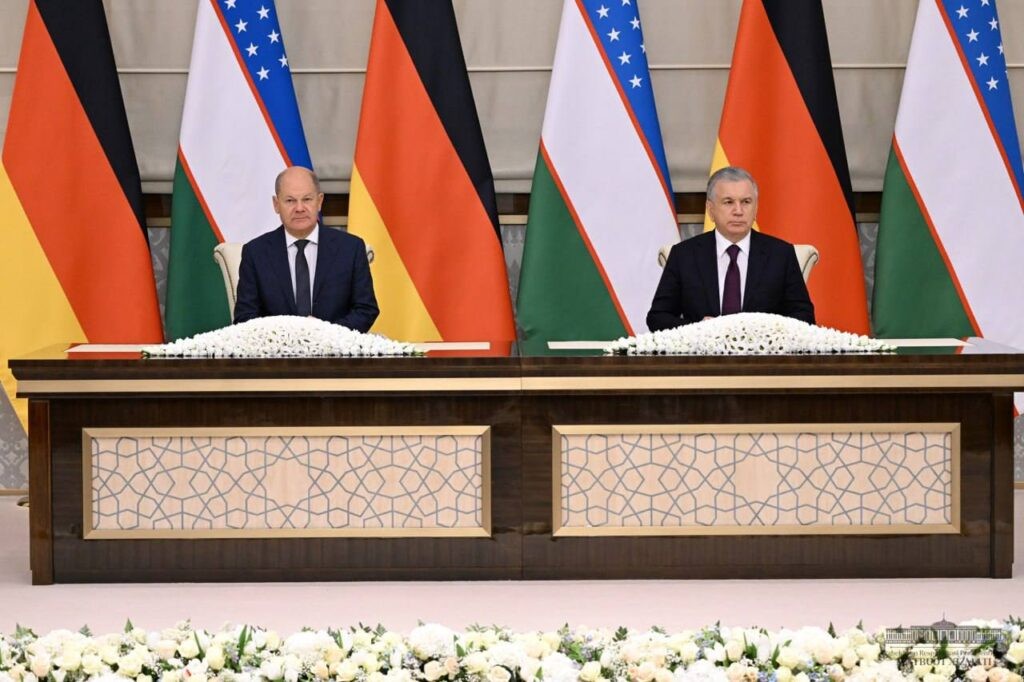
Mirziyoyev and Scholz Agree to Grow Uzbekistan-Germany Cooperation

On September 15, German Chancellor Olaf Scholz met with Uzbek president Shavkat Mirziyoyev in Samarkand. Last year the volume of trade between Uzbekistan and Germany exceeded 1 billion euros for the first time. Since the beginning of 2024, German companies have invested over 800 million euros into the Uzbek economy, while in June, the eighth meeting of the Uzbek-German Business Council was successfully held in Tashkent. At the end of the negotiations, Mirziyoyev and Scholz signed eight bilateral documents, including agreements in the fields of migration, use of water resources, essential minerals, transport and climate change. Additionally, Mirziyoyev and Scholz participated in the opening ceremony of the new Academy of Public Administration, which the Uzbek government has recently built in cooperation with the Hans Seidel Foundation and the Bavarian School of Public Administration. Scholz will also participate in a C5+1 meeting in Kazakhstan on September 17 with the leaders of Kazakhstan, Kyrgyzstan, Uzbekistan, Turkmenistan, and Tajikistan.

Kazakh-German Consortium to Build Cargo-Passenger Airport in Khorgos–Eastern Gate SEZ

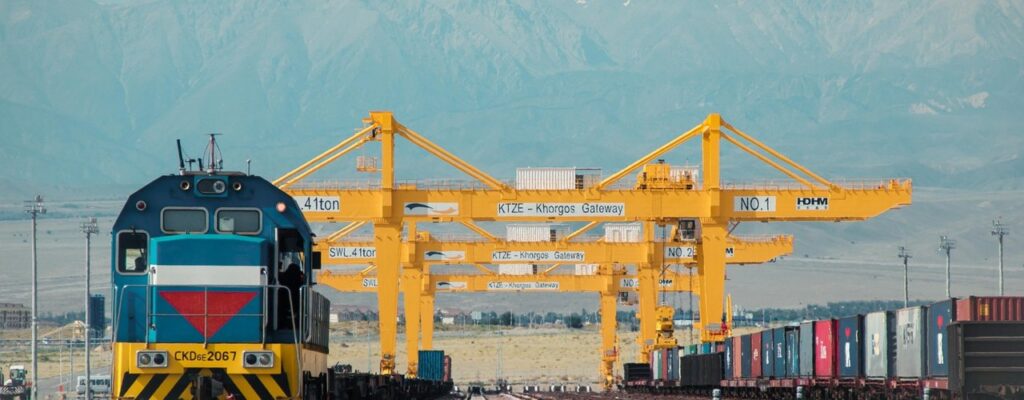
On September 16, Kazakhstan’s Ministry of Transport and Kazakh-German consortium SKYHANSA signed a framework agreement on a project to construct a cargo-passenger airport in the special economic zone (SEZ) Khorgos-Eastern Gate on the border between Kazakhstan and China. The document was signed as part of the official visit of Germany’s Federal Chancellor Olaf Scholz to Kazakhstan. The Khorgos–Eastern Gate SEZ is located in Kazakh territory, one kilometer from the state border and China’s border city, Khorgos. The SEZ is strategically located on the route of the Western Europe – Western China highway. It is also a central hub on the Trans-Caspian International Transport Route (TITR) that connects China and Europe. The SEZ includes a dry port and a multimodal logistics zone. The first stage of construction of a China-Kazakhstan industrial park on the territory of the SEZ began in November 2023. The Kazakh-German project involves the construction of an airport with a passenger terminal capable of handling up to 500 passengers per hour, a cargo terminal capable of handling up to 250,000 tons per year, a fuel storage facility capable of holding 550,000 tons, a technical center for servicing aircraft, and tourism, shopping, and entertainment facilities. Private investments in the project are expected to exceed $500 million, and more than 300 permanent jobs will be created. The administration of Kazakhstan’s Zhetysu region, where the SEZ is located, has now allocated a land plot for the airport's construction, and the investor plans to begin construction works after concluding the Investment Agreement.

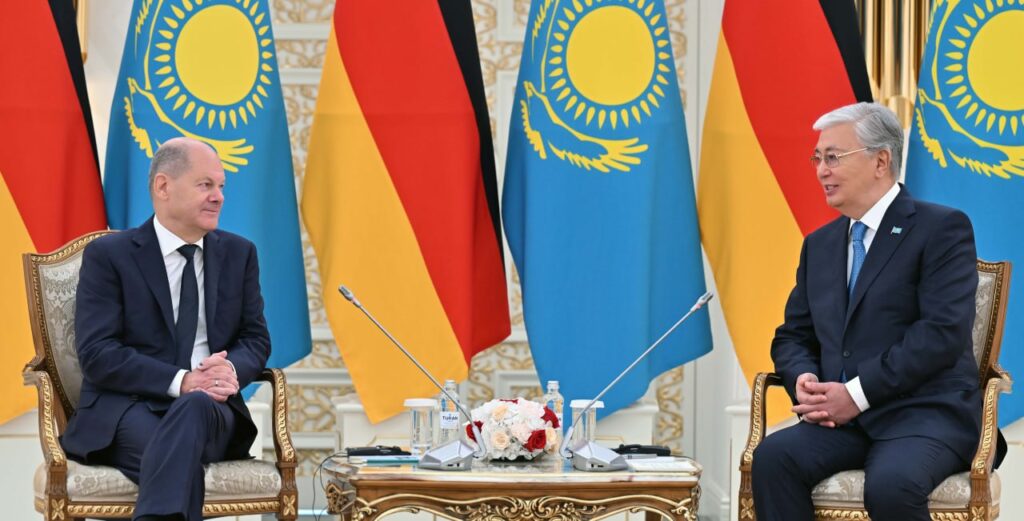
Tokayev: Russia is “Militarily Invincible”

During a meeting in Astana with German Chancellor Olaf Scholz, Kazakhstan's President Kassym-Jomart Tokayev spoke about resolving the Russian-Ukrainian war. According to Tokayev, further escalation of the war will only lead to irreparable consequences for all mankind and, above all, for all countries directly involved in the war. Tokayev said: “The fact is that Russia is militarily invincible. Unfortunately, a good chance to achieve at least a truce was lost with the refusal to conclude the Istanbul Agreement. But the opportunity for peace still exists. We need to carefully consider all peace initiatives put forward by various states, come to a decision to stop hostilities, and then move on to discussing territorial issues. In our opinion, the peace plan of China and Brazil deserves support.” Tokayev reminded the public that Kazakhstan has the world's longest delimited land border with Russia. He further stated that “cooperation between our countries is developing within the framework of strategic partnership and alliance. In Kazakhstan, we have genuine sympathy for the Ukrainian people and their distinctive culture. There have never been any disagreements between our states. The embassy of our country continues to function in Kyiv.” While his comments about seeking peace before discussing territorial issues may seem like Tokayev is backing Russia, in 2022, he said that Kazakhstan would not recognize the independence of the so-called Donetsk and Luhansk people's republics (“DNR” and “LNR”). Speaking about the 'republics', he noted that the two basic principles of the UN Charter -- the right to self-determination for nations, and the territorial integrity of states -- have come into mutual contradiction. On this topic, Tokayev noted: "It is estimated that if the right of self-determination for a nation is realized on the globe, then instead of the current 193 states, more than 500-600 states will emerge on Earth. It will be chaos. For this reason, we do not recognize Taiwan, Kosovo, South Ossetia, or Abkhazia. We will apply this principle to all quasi-state territories, which, in our opinion, includes Luhansk and Donetsk.”

German Company to Assemble Airplanes in Almaty

The German company "Linding Group" is set to invest about $10 million in assembling airplanes in Almaty, pending necessary permits from the government. Based in the economic zone “PIT ‘Alatau", production will begin in 2026. During the first year, 20 airplanes will be assembled, rising to 50 units annually thereafter. Kazakhstan is already engaged in several joint projects with foreign enterprises in aircraft production. One such project  involves the "Russian Helicopters" company. Within the framework of the agreement with Kazakhstan's aircraft repair plant No. 405, a large-unit assembly of Mi-8AMT and Mi-171E helicopters was launched in Almaty, predominantly serving the Ministry of Emergency Situations and the National Guard of Kazakhstan. A further example of international cooperation is the contract between the Ural Civil Aviation Plant and Kazakhstan Aviation Industry (KAI) to produce the Baikal multi-purpose airplane. When fully assembled by the end of this year, the airplanes will be delivered to markets in Europe and Africa. The realization of all of these projects will both strengthen Kazakhstan's aviation industry and increase its presence in international aviation markets.

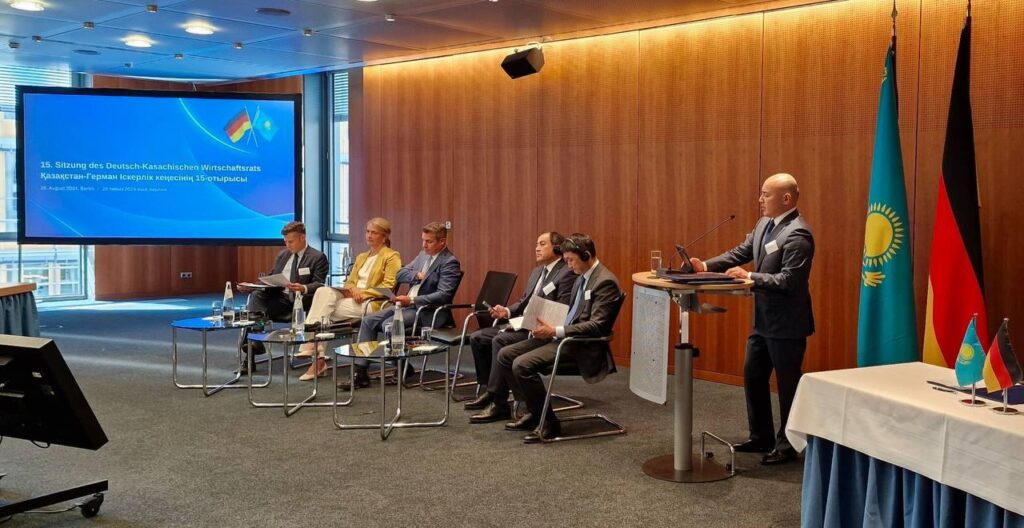
Kazakh-German Business Council Meets to Expand Economic Cooperation

The 15th meeting of the Kazakh-German Business Council for Strategic Cooperation, co-chaired by First Deputy Prime Minister of Kazakhstan Roman Sklyar and Director of the Eastern Committee of the German Economy Michael Harms, was held in Berlin on August 28. The meeting gathered Kazakh government and business representatives and heads of leading German companies such as Siemens, Svevind Energy, CT Agro, CLAAS KGaA, Flight Design General Aviation, Deutsche Bahn, KfW Banken Gruppe, and Deutsche Bank. The co-chairs emphasized that the event was taking place ahead of Federal Chancellor of Germany Olaf Scholz's visit to Kazakhstan in September. The meeting focused on expanding Kazakh-German trade and economic cooperation, attracting investments, and implementing joint projects in the agro-industrial sector and processing industry. It was noted that Germany is Kazakhstan's largest trading partner in the European Union, and that Kazakhstan is among Germany's top 50 foreign trade partners. The lion's share of German investments in Kazakhstan go to the country’s non-raw materials sector — the processing industry, chemical industry, production of building materials, transport, and agro-industrial sector. Speaking on the sidelines of the event, Kazakhstan Deputy Minister of Foreign Affairs Alibek Kuantyrov urged further to intensify cooperation between the Kazakh and German business communities. Noting the critical role of German companies in Kazakhstan’s industrialization, Kuantyrov stated that German companies are implementing 66 projects in Kazakhstan for a total of $54 billion, creating about 15,000 jobs. Kuantyrov added that since 2005, German companies have invested about $7.8 billion in Kazakhstan’s economy, with a significant increase in the past year, reaching $770 million. He expressed confidence that the upcoming visit of Scholz to Kazakhstan will bring bilateral relations to a new level and give an additional impetus to strengthening existing and creating new economic ties. Kuantyrov emphasized the significance of cooperation in the context of the Trans-Caspian International Transport Route (TITR), also known as the Middle Corridor. He noted that cargo traffic through the Middle Corridor to Germany and the EU has increased almost threefold since the beginning of 2022 — to 1.5 million tons and 2.6 million tons, respectively, during the first seven months of this year, adding that the potential of TITR is estimated at 10 million tons of cargo a year. In this regard, Kuantyrov invited German partners to participate in developing Kazakhstan’s Caspian Sea ports of Aktau and Kuryk.

Kazakhstan and Germany to Cooperate in Water and Agriculture

During a visit to Germany last week, Kazakhstan Deputy Prime Minister Kanat Bozumbayev met with the German Federal Ministry of Food and Agriculture to discuss the possibility of Kazakh agricultural and organic products entering the German market. The parties agreed to draft a concept for the Regional Center for Sustainable Agriculture in Central Asia, an initiative announced by the President of Kazakhstan during his official visit to Germany back in September 2023. Following Kazakh Deputy Prime Minister's meeting with Boris Greifeneder, Managing Director of the German Water Partnership (GWP), a decision was made to draft an Agreement on a Water Partnership between Kazakhstan and Germany. Cooperation  with GWP, a network of more than 300 companies in the water sector with a strong international focus, marks an essential step towards sustainable and efficient water management in Kazakhstan and will allow the use of proven new technologies. Speaking at the roundtable "Water for Sustainable Development," Bozumbayev noted that the consequences of the unprecedented floods experienced by Kazakhstan in spring, illustrate the need for innovative approaches to combat and prevent similar disasters in the future. To this end, he added that Kazakhstan is currently testing Talsim, a German digital flood forecasting solution, and is ready to study German cases in solving flood problems. The Kazakh Deputy Prime Minister discussed training specialists for Kazakhstan’s water management industry and in turn, the German side expressed its readiness to identify a university to collaborate with the newly- established Kazakh National University of Water Management and Irrigation in Taraz.