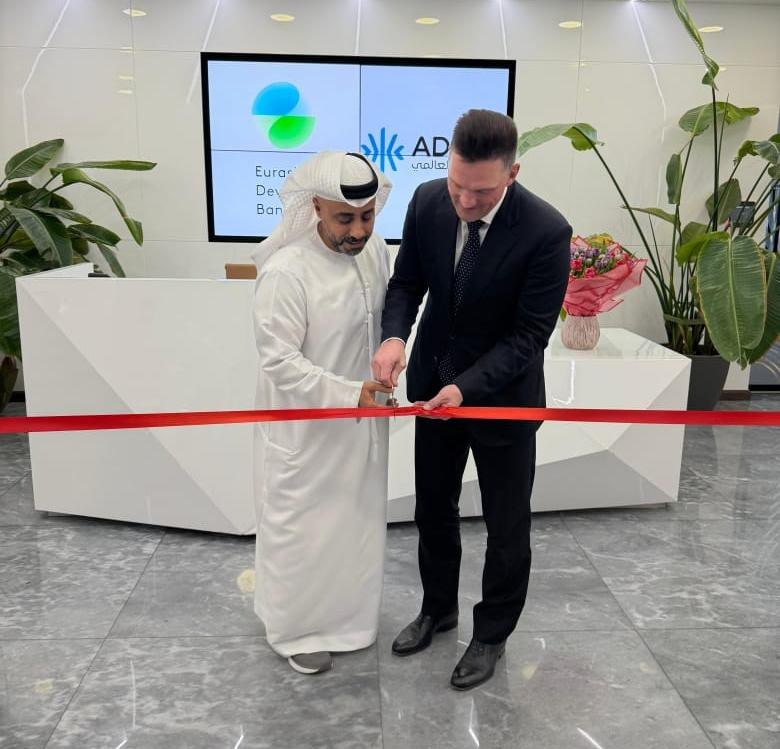
The Eurasian Development Bank (EDB), headquartered in Almaty, has opened a representative office in Abu Dhabi Global Market (ADGM), the United Arab Emirates’ international financial center, marking a strategic move to connect Gulf Cooperation Council (GCC) investors with high-potential projects across Central Asia.
According to the Bank, the new platform will offer GCC investors structured investment opportunities backed by EDB analytics, regional expertise, and strong ties with the governments of its member states, Armenia, Belarus, Kazakhstan, Kyrgyzstan, Russia, Tajikistan, and Uzbekistan. Through this initiative, investors will gain access to infrastructure and sustainable development projects with optimized risk-return profiles.
At the launch ceremony, EDB Management Board Chairman Nikolai Podguzov underscored the strategic significance of the move. “We are creating an ‘investment highway’ between Gulf capital and opportunities in Central Asia. Our new office in Abu Dhabi reinforces our role as a regional bridge, combining local knowledge with tailored financial instruments. Investors gain access to proven projects with favorable risk-return dynamics, while Central Asian economies unlock new development funding.”
A centerpiece of the new platform is a specialized credit fund dedicated to financing infrastructure development in Central Asia. Registered under ADGM jurisdiction, the fund will focus on debt financing for EDB’s infrastructure portfolio. The Bank highlighted ADGM’s regulatory advantages, noting that the fund will offer Middle Eastern and global investors a secure and efficient entry point into the region’s development landscape. EDB will serve as both a structuring partner and co-investor, providing access to a diversified project pipeline.
Priority Sectors for Investment
Transport and Logistics: The development of the North-South Corridor could boost transit volumes through Central Asia by up to 40%, significantly reducing shipping distances between the Gulf and key Eurasian markets.
Water Sector and Agribusiness: The irrigation equipment market in Central Asia is valued at approximately $426 million annually, while the broader water supply sector is worth up to $2 billion.
Renewable Energy: The sector continues to attract major players such as the UAE’s Masdar, which has established a growing footprint across Central Asia.
Strengthening Gulf-Central Asia Economic Ties
In recent years, the Gulf states have become major trading partners and investors in Central Asia. According to EDB data, trade between the Gulf and Central Asia reached $3.3 billion in 2024, a 4.2-fold increase since 2020. Imports from the Gulf made up 80% of the total trade turnover.
Top Central Asian trading partners with the Gulf in 2024 were:
- Turkmenistan – $2 billion (61%)
- Uzbekistan – $740 million (23%)
- Kazakhstan – $302 million (9%)
The highest trade growth rates were recorded in:
- Turkmenistan – up 9.9 times
- Kyrgyzstan – up 9.5 times
- Uzbekistan – up 8.1 times
The UAE accounted for 97% of all Gulf-Central Asia trade. For Turkmenistan, Gulf trade represented around 10% of total foreign commerce, while Kyrgyzstan’s share stood at approximately 1%, with even lower figures across other regional states.
The EDB projects continued growth in trade, citing an unrealized potential of $4.9 billion, including $4.4 billion in potential Gulf exports (motor vehicles, electronics, jewelry) and $500 million in potential Central Asian exports (precious and non-ferrous metals, agricultural products).
Gulf Investments on the Rise
A recent EDB study highlights a significant increase in Gulf investment across the Eurasian region, with Central Asia receiving the lion’s share.
The UAE is the leading Gulf investor in the region, with total investments growing 1.7-fold since 2016 to reach $12.2 billion by mid-2024. Of that, 90% was directed to Central Asia, including:
- Hydrocarbons in Turkmenistan – $8 billion
- Electric power in Uzbekistan – $1.7 billion
Saudi Arabia and Qatar have recently emerged as active investors. Saudi investment rose from $300 million in 2021 to $2.3 billion by mid-2024, driven largely by energy projects in Uzbekistan. Qatar made its first investment in the region in 2024, channeling $1.6 billion into a telecommunications project in Kazakhstan.