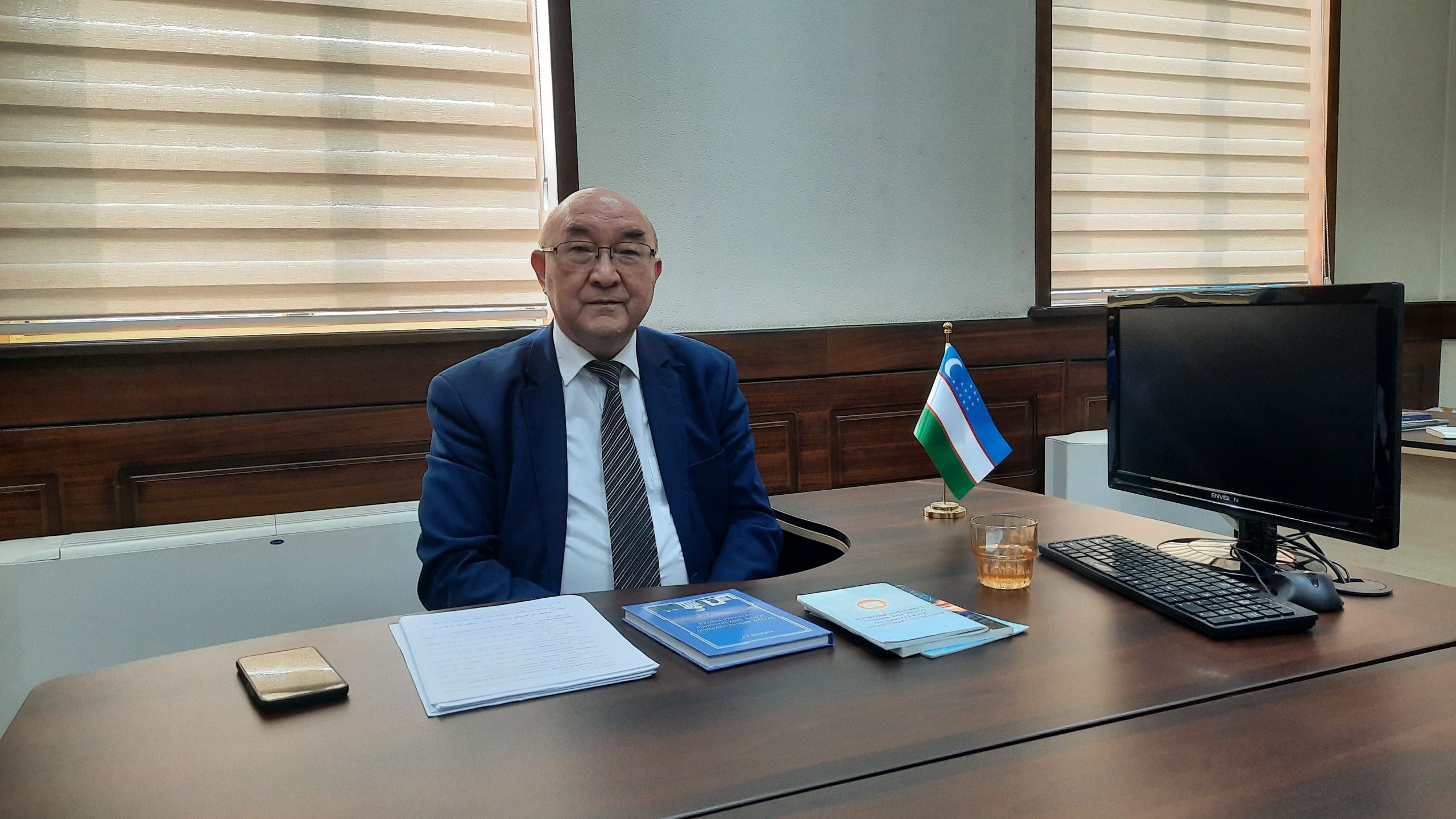
Across the Turkic-speaking world, debates over language policy and writing systems are gaining renewed importance. More than 300 million people across Eurasia speak Turkic languages, yet they use different scripts, Cyrillic, Latin, and Arabic. Uzbek scholar Bakhtiyor Karimov argues that this diversity of alphabets weakens cultural and intellectual connections among Turkic societies.
Karimov, a linguist and professor who helped develop the pan-Turkic auxiliary language Ortaturk, is an academician of the Turon Academy of Sciences and director of its Ortaturk Language Research Institute. Together with Shoahmad Mutalov, he developed the concept of the Ortaturk language. In this interview, he discusses the challenges posed by alphabet diversity, his proposal for a new writing model, and his view that language policy is closely linked to political and geopolitical developments.
A fragmented writing landscape
Karimov describes alphabet diversity as one of the most serious challenges facing Turkic-speaking communities.
“Roughly thirty Turkic languages exist,” he said. “About twenty use the Cyrillic alphabet, three use the Latin alphabet, two are transitioning toward Latin, and many communities still rely on the Arabic script. In numerical terms, around 100 million Turkic speakers use Arabic, another 100 million use Latin, and another 100 million use Cyrillic.”
The situation has deep historical roots. Over the past century, shifting political systems and state policies have shaped the writing traditions of Turkic languages. As a result, speakers of closely related languages often find it difficult to read each other’s texts.
For example, Uyghurs in China write using the Arabic script, while Uzbeks in Afghanistan also rely on Arabic-based writing. In Uzbekistan, both Cyrillic and Latin scripts are used. Azerbaijani communities in Iran use the Arabic script, whereas Azerbaijan employs a Latin-based alphabet. Most Turkic languages within Russia continue to use Cyrillic.
Karimov also notes legal constraints. He points to Russian legislation requiring languages used in official contexts to employ the Cyrillic alphabet, arguing that this limits the ability of Turkic-speaking communities in Russia to adopt Latin scripts even if they wish to do so.
“About twenty Turkic peoples living in Russia are effectively restricted to Cyrillic,” he said.
Meanwhile, Turkey, Azerbaijan, and Turkmenistan have fully adopted Latin alphabets. Uzbekistan and Kazakhstan are gradually transitioning, although the process has been uneven. Kyrgyzstan continues to rely primarily on Cyrillic.
“All of this means that the Turkic world is linguistically connected but graphically divided,” Karimov said.
Efforts toward a common alphabet
Recognizing this challenge, the Organization of Turkic States established a working group of linguists to explore the creation of a unified Turkic alphabet. Experts from Uzbekistan, Azerbaijan, Kazakhstan, Kyrgyzstan, Turkmenistan, and Turkey participated in the initiative.
“They worked together for about two years and produced a draft proposal,” Karimov said. “However, the project remains under discussion and has not yet been formally adopted. Ultimately, political leaders must reach a consensus.”
Karimov believes the draft proposal contains technical shortcomings, particularly in how certain sounds are represented.
“In some cases, a single phoneme is represented by more than one graphic symbol,” he said. “From a computational perspective, this creates complications. Ideally, each sound should correspond to one letter.”
The “Ortabitik” proposal
Karimov has developed an alternative model, which he calls the “Ortabitik writing system.” Rather than replacing existing alphabets, his concept seeks to link them through digital technology.
“In this system, each phoneme corresponds to one symbol that can be displayed simultaneously across several writing systems,” he explained. “The same text can appear in Latin, Cyrillic, Arabic, and the ancient Orkhon-Yenisey script.”
The approach relies on automated digital conversion. Once a text is entered in one script, software generates parallel versions in others.
“If a book is written in Cyrillic, a computer can instantly produce versions in Latin, Arabic, and Orkhon-Yenisey,” Karimov said. “Readers can simply choose the script they prefer.”
He argues that such a system could reduce communication barriers among Turkic-speaking communities.
“An older Uzbek accustomed to Cyrillic could continue reading in that script, while younger readers might prefer Latin. Uzbeks in Afghanistan could access the same text in Arabic script,” he said.
Karimov also highlights the symbolic importance of including the ancient Orkhon-Yenisey script, used in early Turkic inscriptions discovered in Central Asia and Siberia.
Technology, information, and identity
Karimov says modern digital tools make such integration feasible. Together with programmer Ilkhom Mannonov, he has developed a prototype capable of converting texts between alphabets and generating phonetic transcriptions based on international linguistic standards.
“This means that even readers unfamiliar with a language could pronounce Turkic texts correctly,” he said.
The system also assigns numerical codes to phonemes, enabling texts to be represented in encrypted numeric form.
“This allows texts to appear in multiple alphabets, phonetic transcription, and even coded numeric formats,” Karimov added.
Toward a shared intellectual space
Beyond linguistic considerations, Karimov views the project as part of a broader cultural and geopolitical vision.
“In the modern world, information is a key resource,” he said. “Access to knowledge creates advantages in science, technology, and economic development.”
He argues that a shared information space could give Turkic-speaking populations access to a much larger body of intellectual work.
“For instance, an Uzbek reader in Afghanistan could access the collective knowledge of the Turkic world in a familiar script,” he said.
Karimov believes that wider access to information could strengthen human capital and stimulate innovation across Turkic societies.
Historical references and future ambitions
Karimov often draws inspiration from historical figures such as Alisher Navoi and Zahiriddin Muhammad Babur, who played significant roles in shaping Turkic literary traditions.
“Five centuries ago, through the work of thinkers like Navoi and Babur, Turkic became one of the major literary languages of the region and the world,” he said. “It stood alongside Persian and Arabic.”
He suggests that renewed linguistic integration could contribute to what Uzbek leaders have described as a “Third Renaissance” in Central Asia.
Language and geopolitics
Karimov also links language policy to regional cooperation and security. He argues that stronger cultural and informational ties among Turkic states could foster closer political collaboration.
“In today’s competitive geopolitical environment, smaller states need cooperation to safeguard their independence,” he said.
He frequently refers to the well-known slogan of Crimean Tatar reformer Ismail Gaspirali: “Unity in language, work, and opinion.”
“If unity in language develops, unity in thought may follow and that can lead to unity in action,” Karimov said.
Looking ahead
Karimov emphasizes that his proposal remains at an early stage. He hopes that an international group of linguists and technology specialists will further refine the concept.
He suggests that the Organization of Turkic States could coordinate such work, potentially through the creation of a dedicated research center.
“For me, the ultimate goal is simple,” he said. “Every Turkic-speaking person should be able to access the intellectual heritage of the entire Turkic world.”