• KGS/USD = 0.01144 0%
  • KZT/USD = 0.00192 -0%
  • TJS/USD = 0.10849 0.37%
  • UZS/USD = 0.00008 0%
  • TMT/USD = 0.28571 0.28%
  • KGS/USD = 0.01144 0%
  • KZT/USD = 0.00192 -0%
  • TJS/USD = 0.10849 0.37%
  • UZS/USD = 0.00008 0%
  • TMT/USD = 0.28571 0.28%
  • KGS/USD = 0.01144 0%
  • KZT/USD = 0.00192 -0%
  • TJS/USD = 0.10849 0.37%
  • UZS/USD = 0.00008 0%
  • TMT/USD = 0.28571 0.28%
  • KGS/USD = 0.01144 0%
  • KZT/USD = 0.00192 -0%
  • TJS/USD = 0.10849 0.37%
  • UZS/USD = 0.00008 0%
  • TMT/USD = 0.28571 0.28%
  • KGS/USD = 0.01144 0%
  • KZT/USD = 0.00192 -0%
  • TJS/USD = 0.10849 0.37%
  • UZS/USD = 0.00008 0%
  • TMT/USD = 0.28571 0.28%
  • KGS/USD = 0.01144 0%
  • KZT/USD = 0.00192 -0%
  • TJS/USD = 0.10849 0.37%
  • UZS/USD = 0.00008 0%
  • TMT/USD = 0.28571 0.28%
  • KGS/USD = 0.01144 0%
  • KZT/USD = 0.00192 -0%
  • TJS/USD = 0.10849 0.37%
  • UZS/USD = 0.00008 0%
  • TMT/USD = 0.28571 0.28%
  • KGS/USD = 0.01144 0%
  • KZT/USD = 0.00192 -0%
  • TJS/USD = 0.10849 0.37%
  • UZS/USD = 0.00008 0%
  • TMT/USD = 0.28571 0.28%
11 December 2025

Uzbekistan Expands Basalt Production

On April 8, President Shavkat Mirziyoyev visited the Basalt Uzbekistan cluster in the Jizzakh region.

Seven years has passed since the region began extracting basalt and today, the cluster processes 177 thousand tons of stone per year and manufactures 42 different products. In addition to basalt wool and fibre, local enterprises employ technology from Germany, France, Italy, and the Czech Republic, to provide mesh and reinforcement and insulation materials for the construction industry.

In 2023, 80% of the 45 thousand tons of goods produced, were exported to the USA, Great Britain, Poland, Italy, the Czech Republic, Georgia, Russia, Turkey, Belarus, Kazakhstan, Kyrgyzstan, and Tajikistan.

Six major projects worth $498 million and employing 1.7 thousand currently operate across 300 hectares in the region. Due to be launched next year with imported equipment valued at $145 million, a new enterprise will produce 25 thousand tons of basalt fiber and fabric per annum, 90% of which is destined for export.

The president has now set the task for the instigation of further plants with investments of $500 million to manufacture 20 types of products and create two thousand new jobs.
Turkmenistan’s GDP Expands by 6.3% in First Quarter of 2024

In the first quarter of 2024, Turkmenistan demonstrated stable economic growth, President Serdar Berdimuhamedov said at a meeting of the Cabinet of Ministers, where the results of the first three months of this year were summarized.

Berdimuhamedov stated that positive dynamics are evident in the key economic indicators. Specifically, industrial production increased by 4.7 %, the transport and communication sector by 6.6%, the service sector by 7.6%, the trade sector by 8.2%, and the agricultural sector by 4.1%. The country’s average salary also rose by 10% in the first quarter.

In addition to the country’s economic growth, the president observed that the country is rapidly developing its large industrial and social infrastructure, which includes new villages, residential buildings, entertainment and medical facilities, and supporting families with new schools and kindergartens. These initiatives are being carried out in accordance with Turkmenistan’s 2022–2028 socioeconomic development strategic program.

Kazakhstan and Egypt Develop Economic Cooperation

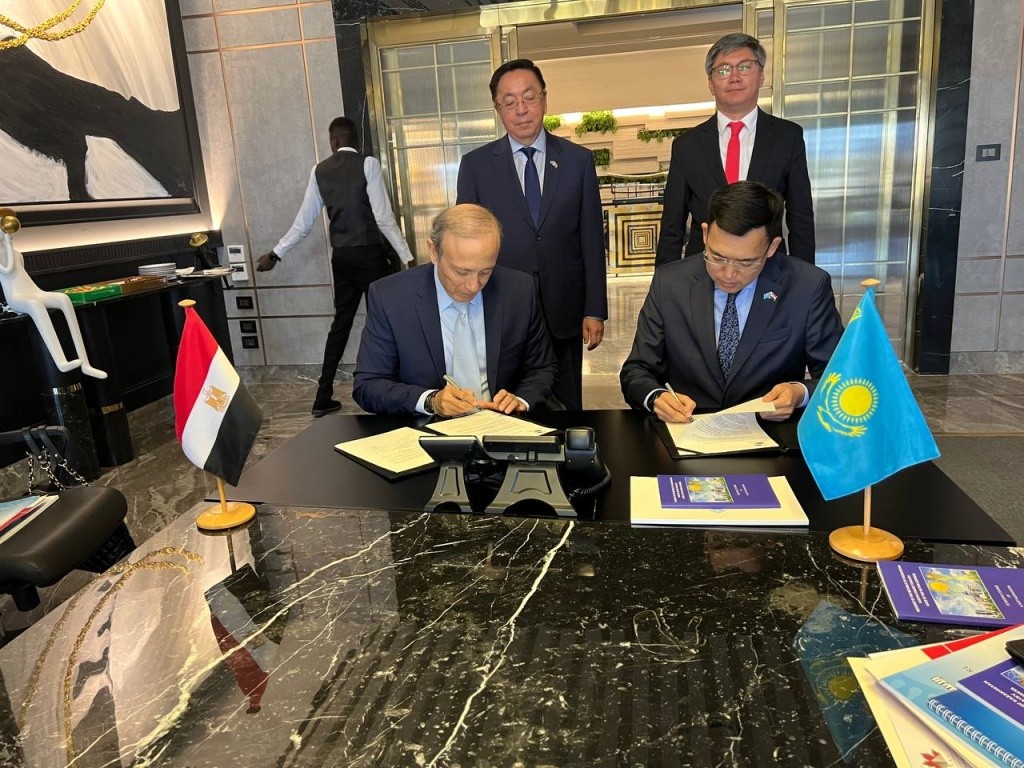
The Embassy of Kazakhstan in Egypt and Kazakh Invest last week organized a round table in Cairo for large company members of the Egyptian Business Council for International Cooperation.

Following discussion on trade and investment opportunities, a Memorandum of Cooperation was signed by Kazakh Invest and the Egyptian Business Council for International Cooperation.

Kairat Lama Sharif, Kazakhstan’s Ambassador to Egypt, stated that Egypt as one of the three largest economies among Arab countries, has high potential for increasing trade and economic cooperation with Kazakhstan. By way of illustration, he reported that many Kazakh producers of convenience food have expressed interest in the Egyptian market, which has a population of more than 105 million.

The ambassador invited Egyptian companies to expand cooperation with Kazakhstan enterprises and agreement was made for representatives of Egyptian business to visit Kazakhstan later this year.

Uzbekistan’s Budget Deficit Expands Over First Three Months of 2024

According to information provided by the Ministry of Economy and Finance of Uzbekistan for January of this year, federal budget revenues amounted to 16.160 trillion som ($ 1.275 billion), and expenses amounted to 21.927 trillion sum ($1.728 billion), leaving the negative difference between revenues and expenditure at 5.767 trillion sum ($454.5 million).

In February, state budget revenues were 16.909 trillion sum ($1.333 billion), and expenses were 24.137 trillion sum ($1.902 billion), a negative balance of 7.228 trillion sum ($569.7 million).

In March, state budget revenues were 17.457 trillion sum  ($1.376 billion), and expenses were 24.307 trillion sum ($1.916 billion), with a monthly deficit of 6.850 trillion sum ($539.9 million).

In total, the state budget deficit for the past three months amounted to 19.885 trillion sum ($1.567 billion).

Electricity Prices in Kazakhstan Rise by 26% Over Year

Electricity tariffs in Kazakhstan for March increased by almost 6% for the month and by 26% for the year. In the first two months of this year, Kazakhstan produced 21.4 billion kilowatt-hours (kWh) of electricity – which is 3.2% more than the first two months of 2023. Pavlodar region produced the most electricity at 9.3 billion kWh, followed by Karaganda region with 2.3 billion kWh, and Atyrau region at 1.4 billion kWh. Overall, those three regions provided the whole country with 60.7% of its total electricity production.

According to the results of last month, electricity tariffs in Kazakhstan for 31 days rose by 5.9% The largest price increases fell on residents in North Kazakhstan (+20%), East Kazakhstan (+19.8%), Abay (+19.7%), Pavlodar (+19%), and Almaty (+17.9%) regions, and in the city of Almaty (+10.3%). In the remaining 14 regions, the cost of electricity remained at the level of February 2024.

Currently, members of the Mazhilis (lower chamber of parliament) are introducing through a first reading legislative amendments to support the use of renewable energy sources (RES), as well as changes to the power industry and natural monopolies. The bill currently in Parliament aims to regulate the energy sector, including the development of small-scale facilities for the use of RES – as well as to create favorable conditions for attracting investment in the energy sector of the country.

Turkey Cancels Visa-Free Regime for Citizens of Tajikistan

From 20 April, citizens of Tajikistan will have to obtain a visa to travel to the Republic of Turkey. That’s according to a decree signed by Turkish President, Recep Tayyip Erdogan. The reasons for this decision remain unclear, but it’s noted that the visa regime is a temporary measure. Entry documents will be issued in Dushanbe and at other Turkish diplomatic missions. Those traveling through Turkey in transit will not require a visa.

Tajik Foreign Ministry spokesman, Shohin Samadi, said as of April 6, Dushanbe had not received an official notification from Turkey regarding the introduction of a visa regime. Nevertheless, he said, the issue of retaliatory measures for Turkish citizens is being worked out.  Up until this juncture, residents of the two countries could stay on the territory of the other for up to 30 days without a visa.

Some Russian media rushed to link these innovations with the March 2024 terrorist attack at the Crocus City Hall, which killed 144 people and injured 551. Among the 11 people arrested on suspicion of the terrorist attack, the majority are citizens of Tajikistan. According to various sources, the cell of Islamic State (ISIS) in Afghanistan – also known as “Wilayat Khorasan” – which claimed responsibility for the incident, was training terrorists inside of Turkey. To that point, Turkish newspaper Hurriyet wrote that two supporters of ISIS who were planning to carry out a attack were detained in Istanbul. Among them was a 37-year-old citizen of Tajikistan. On March 26, Turkish Interior Minister, Ali Yerlikaya, said that 147 people were detained on suspicion of links with the terrorist organization.

Following the attack on the Crocus City Hall near Moscow, Tajiks in Russia faced a wave of aggression and hatred. Tajikistan’s Government is urging its citizens to avoid traveling to Russia unless necessary, and in light of possible Russian rule changes targeting migrant workers from Central Asia, many Tajiks and others may be ready to leave Russia.