• KGS/USD = 0.01144 0%
  • KZT/USD = 0.00194 0%
  • TJS/USD = 0.10841 0%
  • UZS/USD = 0.00008 0%
  • TMT/USD = 0.28571 0%
  • KGS/USD = 0.01144 0%
  • KZT/USD = 0.00194 0%
  • TJS/USD = 0.10841 0%
  • UZS/USD = 0.00008 0%
  • TMT/USD = 0.28571 0%
  • KGS/USD = 0.01144 0%
  • KZT/USD = 0.00194 0%
  • TJS/USD = 0.10841 0%
  • UZS/USD = 0.00008 0%
  • TMT/USD = 0.28571 0%
  • KGS/USD = 0.01144 0%
  • KZT/USD = 0.00194 0%
  • TJS/USD = 0.10841 0%
  • UZS/USD = 0.00008 0%
  • TMT/USD = 0.28571 0%
  • KGS/USD = 0.01144 0%
  • KZT/USD = 0.00194 0%
  • TJS/USD = 0.10841 0%
  • UZS/USD = 0.00008 0%
  • TMT/USD = 0.28571 0%
  • KGS/USD = 0.01144 0%
  • KZT/USD = 0.00194 0%
  • TJS/USD = 0.10841 0%
  • UZS/USD = 0.00008 0%
  • TMT/USD = 0.28571 0%
  • KGS/USD = 0.01144 0%
  • KZT/USD = 0.00194 0%
  • TJS/USD = 0.10841 0%
  • UZS/USD = 0.00008 0%
  • TMT/USD = 0.28571 0%
  • KGS/USD = 0.01144 0%
  • KZT/USD = 0.00194 0%
  • TJS/USD = 0.10841 0%
  • UZS/USD = 0.00008 0%
  • TMT/USD = 0.28571 0%
18 December 2025

Militaries From Five Countries to Hold Exercises in Kazakhstan

The armed forces of Uzbekistan, Azerbaijan, Kazakhstan, Kyrgyzstan and Tajikistan will hold a joint exercise called Birlestik (Unification) 2024 in July of this year. They will be held at the Oymasha training ground and at Cape Tokmak, located on the Caspian Sea. During the events, the various militaries will train and undertake combat tasks aimed at defining the zone of armed conflicts.

Last July, the militaries of Uzbekistan and Azerbaijan held a joint computerized command and staff exercise named UZAZAZ-2023 in Tashkent. The theme of the event was, according to a joint statement, “organization and conduct of special operations of troops to limit, weaken and destroy illegal armed formations.” The exercise provided an opportunity for representatives of the two countries to exchange experiences in preventing illegal infiltration across the state border and conducting combat against illegal armed groups. They discussed the conduct of military operations during armed clashes, as well as the combat operations of special groups and battalions.

Uzbekistan, together with Kazakhstan, often conducts joint military exercises. For example, last August, service personnel from the two countries took part in joint tactical and special exercises at Kazakhstan’s Oymasha training range, during which the participants exchanged their experiences and improved the qualifications of service personnel.

In a 2024 military power ranking published in January, Kazakhstan came out on top among Central Asian countries. Uzbekistan dropped down in last year’s ranking, falling to 65th place among 145 countries

Kazakhstan and Uzbekistan Enhance Strategic Partnership

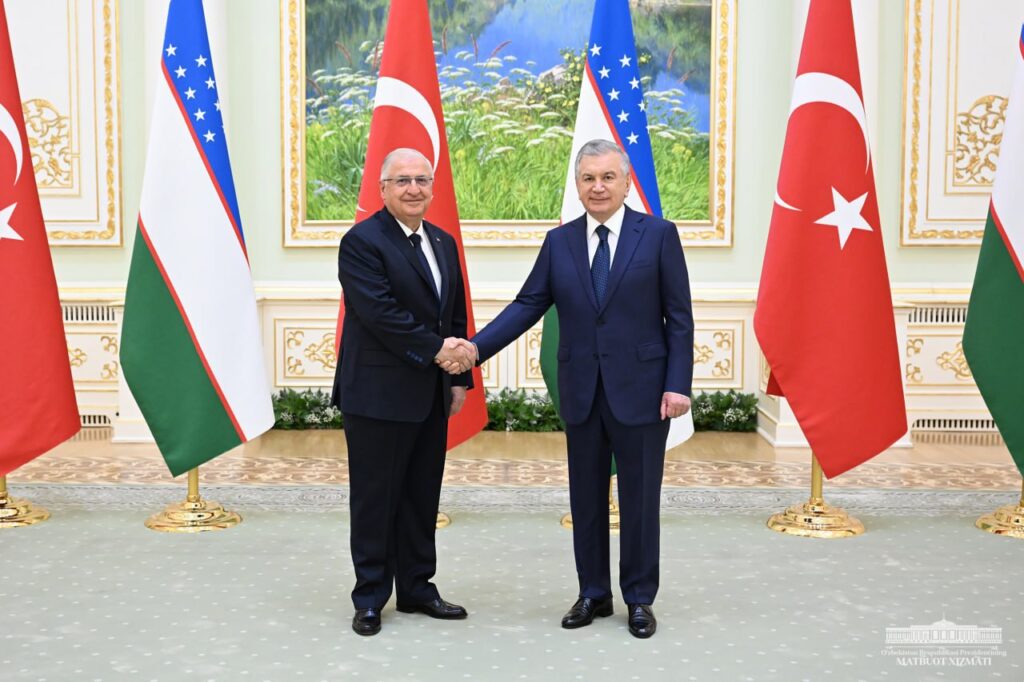
On April 5th, President of Uzbekistan Shavkat Mirziyoyev and President of Kazakhstan Kassym-Jomart Tokayev met in Khiva to discuss further strengthening of the Kazakh-Uzbek strategic partnership and allied relations.

The presidents exchanged views on a wide range of economic interactions, including increasing mutual trade, cooperation in the fields of energy, transport, water management, and the IT industry.
It was reported that last year, bilateral trade turnover amounted to $4.4 billion, and joint projects are now being implemented in the fields of industry, energy, transport and logistics, and agriculture.

The Kazakh-Uzbek portfolio currently includes 60 collaborative projects with investment exceeding $2.5 billion and the creation of more than 13 thousand jobs. Progress is also forging ahead on the construction of an International Centre for Industrial Cooperation between the two countries.

The Kazakh president stated that Kazakh-Uzbek collaboration is a vital necessity, and only by working together can sustainable development be ensured. In this regard, Tokayev supported plans to adopt and implement a Program of Strategic Partnership and Allied Relations between Kazakhstan and Uzbekistan until 2034.

The leaders also welcomed mutually beneficial initiatives between their countries’ railway administrations. Once in operation, the proposed joint venture will provide cargo terminals on the Kazakh-Chinese border and cargo transportation along the China-Kazakhstan-Uzbekistan route, as well as developments of the Trans-Afghan route.

Scientists in Kyrgyzstan Predicting More Earthquakes

Speaking to members of Parliament, the head of the Cabinet of Ministers of Kyrgyzstan, Akylbek Japarov, said that 13,000 seismic shocks have been recorded in Kyrgyzstan just this year. According to Japarov, specialists are currently studying dangerous zones.

“Only on April 2, 828 earthquakes were registered worldwide within 24 hours, and 6,892 in seven days… Over the past 150 years, more than a dozen earthquakes with a magnitude above seven have occurred on the territory of the republic,” Japarov said. The prime minister noted that scientists from the Kyrgyz National Academy of Sciences are now studying dangerous zones where destruction can be expected. In addition, he instructed members of parliament to strengthen regulatory control over the seismic resistance of buildings, as well as the quality of facilities under construction.

Following a strong earthquake on the border of Kyrgyzstan and China in late February this year (seven points in its epicenter), the authorities of Kyrgyzstan created an interdepartmental commission to check buildings that are at risk of being destroyed, but that commission didn’t record serious damage at that time. Additionally, special services raided construction sites. Despite corruption scandals in the industry – several directors of large construction companies are under investigation – the special services did not identify any major violations.

Meanwhile, according to the National Academy of Sciences of Kyrgyzstan, in 2024 the republic is indeed among the top five countries in terms of earthquakes registered. In 2023, the Institute of Seismology of Kyrgyzstan recorded twice as many tremors as a year earlier. At the same time, most of these tremors were not felt by people, they were recorded only by special devices. However, the public shouldn’t worry too much about it, Kanatbek Abdrakhmatov, the country’s chief seismologist said, adding that any seismic activity has its own periodicity.

“We are now living in the fourth period of seismic activity, which began in 2008 and will end according to our forecasts in 2026… The strength of earthquakes in this active period was not supposed to exceed 5-6 points. Until today, these predictions have been realized. The only event that exceeded our expectations was the Chinese earthquake on February 23, 2024. Well, it happens! Don’t be afraid, people!” Abdrakhmatov, head of the laboratory at the Institute of Seismology of Kyrgyzstan, wrote on his Facebook page.

As a mountainous country, Kyrgyzstan is in an earthquake-prone zone, and in recent months the country’s residents have felt more tremors than usual. The Institute of Seismology believes there is nothing to fear, because the tremors are not strong, but the panic that these tremors can provoke is much more dangerous. That’s why, almost every time there is another tremor in Kyrgyzstan, the head of the Institute of Seismology writes a note on his social media, attempting to reassure the population.

“Probably many people felt the small earthquake that occurred a few minutes ago. The epicenter was in the mountains, under the Kyrgyz ridge, about 25-30 kilometers south of Bishkek. In Bishkek it was 2-3 points. Nothing terrible!” Abdrakhmatov wrote on Facebook just a few days ago.

Tourism Doubles in Kazakhstan

In 2023, Kazakhstan hosted more than 9 million foreign tourists, double that of the previous year.

According to the Bureau of National Statistics, guests mainly hailed from from Germany, Great Britain, China and South Korea and the key factors cited for the growth were a post-pandemic rebound in global tourism coupled with Kazakhstan’s cancellation of tourist fees. However, experts have warned that for the industry to continue to develop and thrive, Kazakh authorities must strive to improve both the infrastructure and promotion of tourism.

As illustrated by statistical data, over the course of 2023, hotels and hostels in Kazakhstan accommodated some 8 million people. Of the million visitors from abroad, half came to Kazakhstan for business, and half for leisure. Among them, the majority were citizens of Russia, India, the U.S., Germany, South Korea and the UK. The country received over 16,000 visitors from the UAE, and from Italy, almost 15,000. Notably, the introduction in November 2023, of a visa-free regime with China resulted in a two-fold increase in Chinese tourists.
 
In a related report, Tatiana Vernitskaya, executive director of the Centre for Urban Tourism Development, stated, “The geopolitical situation around Kazakhstan is shaping up in favour of our tourism. There are now a lot of [migrants] from other countries in Kazakhstan, businesses have moved, – and European tourism has changed direction. Such changes are highly positive for Kazakhstan.”

She continued by saying, “There are states that (survive) on tourism. We have a huge potential (for expansion). Subsidies have only been available since 2022 (but access must be facilitated) to make them work. We (also) need advertisements at trade shows (complemented) by point-to-point workshops.”

Records show that the most popular destinations for foreign visitors were the country’s two major cities. Last year Almaty hosted more than 2 million people, and Astana, 1.3 million, providing owners of hotels, hostels and guest houses with revenue of almost $515.5 million.

By way of comparison, the number of tourists visiting Kazakhstan throughout 2023, is equal to that hosted by Thailand in the first 3 months of 2024, where local businesses earned almost $12.5 billion, equivalent to roughly one percent of Thailand’s annual gross domestic product.

Uzbeks, Tajiks Expelled from Chechnya; Turkey Releases Uzbek Suspect

Turkish local law enforcement agencies have reported the arrest of 70 people suspected of being members of the international terrorist group, Islamic State (ISIS). According to the Telegram channel of the press service of the Consulate General of Uzbekistan in Istanbul, a 39-year-old citizen of Uzbekistan, born in the the Andijan region, was among those arrested. As a result of the intervention of lawyers, the suspect was able to prove that he was not connected to any terrorist group, and he was subsequently released.

Also, according to EuraAsia Daily, since the beginning of 2024 Chechen bailiffs have expelled 38 foreigners without documents confirming their right to remain in Russia who had refused to leave the country after the deadline passed. According to the press service of the Russian federal bailiff service for the Republic of Chechnya, the majority of expelled illegal immigrants were citizens of Uzbekistan and Tajikistan.

All expelled foreigners will not be legally able to enter the territory of the Russian Federation for five years.

Transport Diversification Allows Resumption of Kazakh Oil Product Exports to Europe

In March 2024, Kazakh state pipeline operator JSC KazTransOil again started loading of dark oil products produced at Kazakhstani refineries onto Aframax size tankers through the Republic of Georgia’s Batumi Oil Terminal LLC. The shipments to European countries will total 60,000-80,000 tons. Aframax vessels are designed for the safe and efficient transportation of oil and oil products to various regions of the world, and can carry about 600,000 barrels of oil or petroleum products.

The move is designed to diversify modes of transit, transportation routes and to improve economic efficiency. KazTransOil reports that it plans to load dark oil products of Kazakhstani origin regularly every month. This decision will allow customers of the Batumi Oil Terminal to reduce transportation costs, making the export route through Batumi more attractive, and should contribute to an increase in the volume of transported products.

Over its more than twenty years of existence, KazTransOil has transported more than one billion tons of oil and has moved more than 825 billion ton-kilometers of cargo. To date, KazTransOil manages an extensive network of oil pipelines with a length of more than 5,400 kilometers, providing oil transportation both to domestic refineries and for export in different directions. The company remains in a leading position, providing transportation of about 40% of all oil produced in Kazakhstan and almost 90% of all crude supplies to domestic refineries.