• KGS/USD = 0.01144 0%
  • KZT/USD = 0.00196 -0%
  • TJS/USD = 0.10899 -0%
  • UZS/USD = 0.00008 -0%
  • TMT/USD = 0.28490 0%
  • KGS/USD = 0.01144 0%
  • KZT/USD = 0.00196 -0%
  • TJS/USD = 0.10899 -0%
  • UZS/USD = 0.00008 -0%
  • TMT/USD = 0.28490 0%
  • KGS/USD = 0.01144 0%
  • KZT/USD = 0.00196 -0%
  • TJS/USD = 0.10899 -0%
  • UZS/USD = 0.00008 -0%
  • TMT/USD = 0.28490 0%
  • KGS/USD = 0.01144 0%
  • KZT/USD = 0.00196 -0%
  • TJS/USD = 0.10899 -0%
  • UZS/USD = 0.00008 -0%
  • TMT/USD = 0.28490 0%
  • KGS/USD = 0.01144 0%
  • KZT/USD = 0.00196 -0%
  • TJS/USD = 0.10899 -0%
  • UZS/USD = 0.00008 -0%
  • TMT/USD = 0.28490 0%
  • KGS/USD = 0.01144 0%
  • KZT/USD = 0.00196 -0%
  • TJS/USD = 0.10899 -0%
  • UZS/USD = 0.00008 -0%
  • TMT/USD = 0.28490 0%
  • KGS/USD = 0.01144 0%
  • KZT/USD = 0.00196 -0%
  • TJS/USD = 0.10899 -0%
  • UZS/USD = 0.00008 -0%
  • TMT/USD = 0.28490 0%
  • KGS/USD = 0.01144 0%
  • KZT/USD = 0.00196 -0%
  • TJS/USD = 0.10899 -0%
  • UZS/USD = 0.00008 -0%
  • TMT/USD = 0.28490 0%
08 December 2025

Kazakhstan to Build Supercomputer

On February 12th, Kazakhstan’s Ministry of Digital Development, Innovation and Aerospace Industry, and the national welfare fund Samruk-Kazyna, signed an agreement with Presight aI Ltd., a United Arab Emirates-based software and artificial intelligence (AI) company. The parties will join together for a project to create a supercomputer and build a data processing center in Kazakhstan. 

Kazakhstan’s Minister for Digital Development, Innovation and Aerospace Industry, Bagdat Musin, earlier spoke about the importance of creating Kazakhstan’s own LLM (large language model) for introducing AI into all spheres of the economy, as well as into e-government. He also commented that AI will significantly boost the development of the financial services, healthcare, energy and manufacturing industries.

It is hoped that the launch of a supercomputer will consolidate Kazakhstan’s place as Central Asia’s AI leader, and will make it possible for the country to rent computing power to its neighboring states.

Why Are You Allowed and We Are Not? Japarov Responds to U.S. on Foreign Agents Law

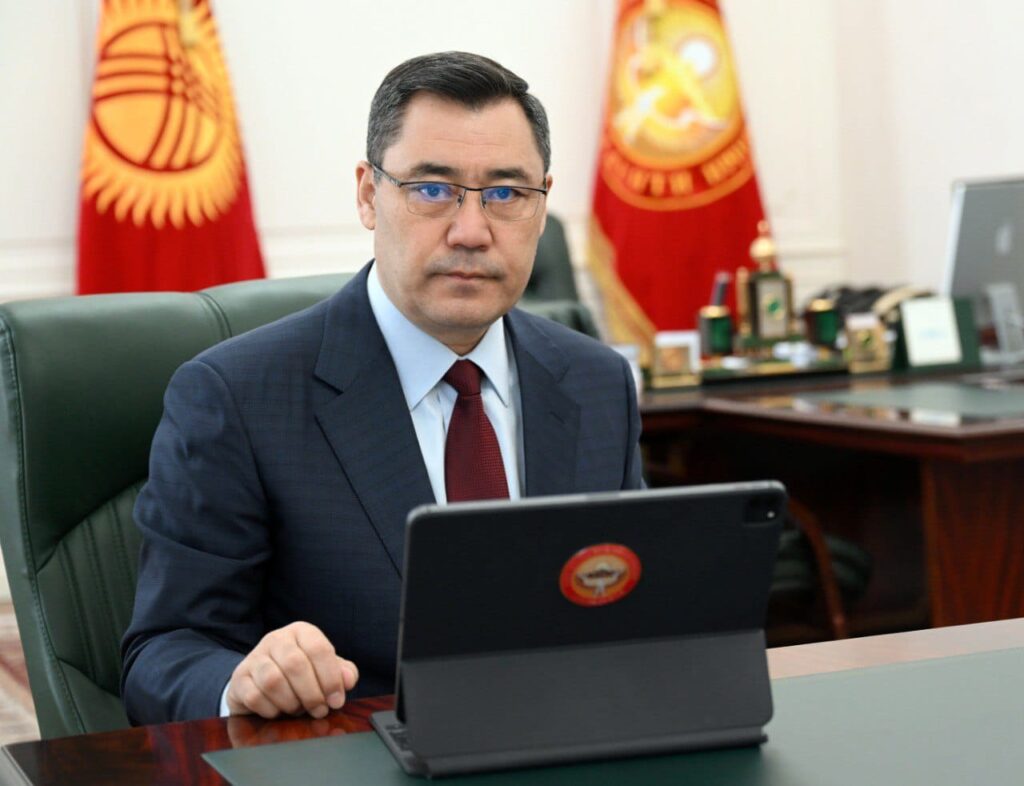
The Kyrgyz presidential administration published a letter of response from Sadyr Japarov to U.S. Secretary of State, Antony Blinken. It follows a letter to the Kyrgyz leader in which the top U.S. diplomat expressed concern about the draft law titled “On Non-Profit organizations,” which tightens control over their activities in Kyrgyzstan.

In his response letter to Blinken, Japarov thanked the American official for his appreciation of the work of the 78th UN General Assembly last September, where the Kyrgyz President urged the international community to support Kyrgyzstan’s environmental and green projects. But, he also noted with regret that U.S. authorities are interfering in Kyrgyzstan’s internal affairs, emphasizing that the desire for justice and freedom is a distinctive feature of his home nation.

“Regarding your concerns about the draft law on foreign agents… there are tens of thousands of non-governmental (NGOs)/non-profit organizations (NPOs) that are successfully working throughout Kyrgyzstan, addressing many problems on which the state previously had neither the will nor the desire to do something. At the same time, it should be recognized that some NGOs/[NPOs] receive funding from abroad, and not only from the U.S. and EU countries,” the president wrote.

According to Japarov, the Kyrgyz state, by legal definition, intends to control such organizations – namely, where their money comes from and for what purposes it is used.

The president emphasized that the draft law – which MPs initiated and adopted in its first reading – is very similar to the Foreign Agents Registration Act (FARA) adopted in 1938 in the United States. According to the president, the analogous American law assigns the status of a foreign agent and controls not only the mass media but also any individuals and legal entities financed from abroad. At the same time, violations of this law or delays in registering an organization in the United States are fraught with not only administrative but also criminal penalties.

“In this connection, the question cannot [help] but arise: why are you allowed and we are not allowed?” the Kyrgyz President asked rhetorically. In his letter, Japarov said that in accordance with the Constitution of Kyrgyzstan, human and civil rights and freedoms – including the right to freedom of speech and the right to association – may be restricted by law to protect national security, public order, health and public morals, as well as to protect the rights and freedoms of others. In this right, Kyrgyzstan is no different from other countries.

Japarov noted that it seems to him that when Blinken addressed him, he relied on unreliable information from NGOs who had earlier criticized the draft law. Japarov said that this information didn’t allow the U.S. foreign policy chief to draw an objective picture of the situation with human rights and freedoms in Kyrgyzstan.

“Only a small number, but a [quite] vociferous group, of these structures financed by foreign states… is a source of inaccurate information for their grantors. In addition, these nongovernmental structures often spread false, inaccurate information among the people, which leads to lawsuits by the victims or the defamed,” explained Japarov.

Japarov told Blinken that an entire layer of NGOs living on foreign money has recently appeared in the republic. They are also called “grant-givers.” The heads of some of these organizations have turned them into family businesses that do nothing but hoard money and send fictitious reports to sponsors, Kyrgyz media have repeatedly reported.

The president invited the U.S. Secretary of State to audit the use of financial resources of NPOs and NGOs that the U.S. government has funded over the past 10 years. “Taking this opportunity, I have the honor to invite you, distinguished Mr. Blinken, to visit our country and see for yourself that human rights and freedoms in Kyrgyzstan are reliably protected by the constitution and laws of the Kyrgyz Republic… My only request is that you do not interfere in the internal affairs of our country,” concluded Japarov.

Earlier, when the draft law on NGOs was just presented in the Kyrgyz Parliament, it was sharply criticized by the EU, the United Nations Development Program (UNDP), the Organization for Security and Co-Operation in Europe (OSCE), the U.S. Agency for International Development (USAID), as well as the embassies of EU, U.S., and other donors who finance NGOs in the country.

Central Asia’s First Green University Opens in Uzbekistan

The Central Asian University of Environmental and Climate Change Studies (Green University) was opened in Uzbekistan’s Tashkent Region on February 10th. The goal of the Green University is to introduce innovative ideas, practices and technologies for solving local, regional and global environmental problems, and strengthening regional cooperation in the field of ecology and environmental protection.

The university’s opening ceremony was attended by the director general of the International Union for Conservation of Nature (IUCN), Grethel Aguilar, Uzbekistan’s Minister of Ecology, Environmental Protection and Climate Change, Aziz Abdukhakimov, and the environment ministers from all the Central Asian countries. 

Speaking at the event, Aguilar said: “We congratulate the government of Uzbekistan on the opening of the Central Asian Green University, a major regional initiative that serves to develop environmental leadership and education. This university will help solve the triple planetary crisis of biodiversity loss, climate change, and pollution. Through environmental education, the university will contribute to the conservation of a region rich in nature.”

On the same day, the Green University hosted the opening of the first office of the International Union for Conservation of Nature (IUCN) in Central Asia.

Aguilar commented: “Today, our planet faces three major challenges – climate change, biodiversity loss, and air pollution. all countries must work together to solve these problems. Together with Uzbekistan and the countries of Central Asia, we are implementing new projects aimed at protecting the region’s ecosystem. The opening of the IUCN office is an important step in this direction”.

Central Asian Countries Work together to Protect Migratory Species

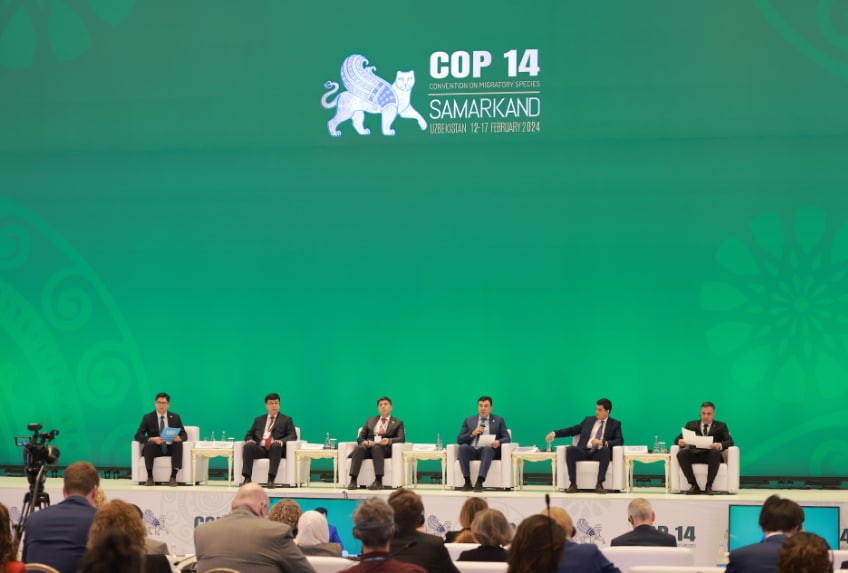
The 14th Conference of the Parties to the Convention on Migratory Species of Wild Animals (CMS COP14) is taking place from February 12th to 17th in Samarkand, Uzbekistan. 

Uzbekistan’s Minister for Ecology and Environmental Protection, Aziz Abdukhakimov commented on February 11th: “Over the next five days, we will be discussing a range of issues related to migratory species, including the socio-economic and environmental challenges of climate change. Our goal is to find solutions and develop effective plans for the conservation of migratory species, which play a vital role in maintaining ecosystems and a healthy planet.”

As part of the conference, Uzbekistan, Kazakhstan, and Kyrgyzstan have joined the Memorandum of Understanding on the Conservation of Migratory Birds of Prey in Africa and Eurasia. The document was signed by Abdukhakimov and his Kazakh and Kyrgyz counterparts. 

“The memorandum provides for the removal of obstacles to the migration of wild animals and the creation of favorable conditions for their migration from one territory to another. This will protect migrating animals and thereby preserve biodiversity. In addition, it will strengthen the unity of the Central Asian countries in this direction,” the Uzbek minister said.

Uzbekistan and Kazakhstan have also joined their efforts to preserve the wildlife of the Ustyurt Plateau. On February 11th a Memorandum of Cooperation in the conservation of wildlife of the Ustyurt Plateau was signed between Minister Abdukhakimov and the Deputy Minister for Ecology and Natural Resources of Kazakhstan, Nurken Sharbiev.

Farmers in Uzbekistan to Receive 60,000 Hectares of Land

A February 12th meeting chaired by President Shavkat Mirziyoyev focused on the topic of increasing fruit and vegetable production and exports in Uzbekistan, and an additional 60,000 hectares of land will be given to the local farmers with this goal in mind. Government data indicate that an extra $200m can be made in exports on an additional 1.5 million tons of agricultural products from such a move. The meeting also underlined the significance of teaching young people how to farm and keeping them employed across the farms of Uzbekistan.

It was also noted that an extra $1bn worth of goods could be produced by introducing industry and collaboration to the farmsteads and land plots that the local population is being awarded.

Credit resources worth one trillion som will be allotted for this. These loans are provided for cooperating to produce goods, purchase machinery, and fund working capital up to 100 million sum ($8,100) without collateral, or up to 150 million sum ($12,100) with 50% loan collateral.

Ten thousand machines will be leased to farmers and farm laborers for a total of 10 years, with an additional three-year grace period. The three-year customs privilege will be extended for mini tractors and imported/leased cultivators.

At the meeting, further steps were taken to encourage the production of fruits and vegetables in greenhouses. Officials mandated a revision to the crediting system for greenhouse farms. Mirziyoyev assigned the task of constructing up to 200 compact greenhouses measuring 10 square meters each, which must be handed over to farmers for use, after endorsing the experience of constructing fuel-free, small greenhouses. Unsecured loans up to 100 million sum ($8,100) will be made available for those greenhouses under the Family Business farm-credit program.

EDB Plans $3.5bn investment in Kazakhstan Projects in 2024

The Eurasian Development Bank’s annual investment in Kazakhstan’s economy has exceeded $1bn for the second consecutive year, the chairman of its management board Nikolai Podguzov said during a February 12th meeting with Kazakhstan’s president Kassym-Jomart Tokayev. 

The Eurasian Development Bank (EDB) is an international financial institution with member states including Armenia, Belarus, Kazakhstan, Kyrgyzstan, Russia, and Tajikistan. The bank’s investment in 2022 and 2023 amounted to $4.2bn, with the share of Kazakhstan-based projects in the bank’s portfolio steadily increasing and reaching 59% by the end of 2023.

The value of potential EDB projects under consideration for Kazakhstan for 2024 exceeds $3.5bn. These investments are planned for the country’s strategically important sectors such as transport infrastructure, thermal and renewable energy, industrial production, agriculture, and water management.

Podguzov emphasized that this year the EDB intends to foster the growth of Kazakhstan’s financial market, including the implementation of new instruments to fund infrastructure projects.

He also informed Tokayev about the EDB’s research on the Central Asian water and energy complex. Podguzov said that his bank plans to promote the advancement of Kazakhstan as a driver of efficient water use, and stands ready to offer grants totaling up to $10m to develop regional centers of expertise in water conservation and energy-efficient technologies – and to allocate up to $400m for projects involving digital water-metering technologies, laser land levelling for irrigated areas and the establishment of a regional production and service cluster for state-of-the-art irrigation equipment.