• KGS/USD = 0.01143 -0%
  • KZT/USD = 0.00192 -0%
  • TJS/USD = 0.10820 0.19%
  • UZS/USD = 0.00008 0%
  • TMT/USD = 0.28575 0%
  • KGS/USD = 0.01143 -0%
  • KZT/USD = 0.00192 -0%
  • TJS/USD = 0.10820 0.19%
  • UZS/USD = 0.00008 0%
  • TMT/USD = 0.28575 0%
  • KGS/USD = 0.01143 -0%
  • KZT/USD = 0.00192 -0%
  • TJS/USD = 0.10820 0.19%
  • UZS/USD = 0.00008 0%
  • TMT/USD = 0.28575 0%
  • KGS/USD = 0.01143 -0%
  • KZT/USD = 0.00192 -0%
  • TJS/USD = 0.10820 0.19%
  • UZS/USD = 0.00008 0%
  • TMT/USD = 0.28575 0%
  • KGS/USD = 0.01143 -0%
  • KZT/USD = 0.00192 -0%
  • TJS/USD = 0.10820 0.19%
  • UZS/USD = 0.00008 0%
  • TMT/USD = 0.28575 0%
  • KGS/USD = 0.01143 -0%
  • KZT/USD = 0.00192 -0%
  • TJS/USD = 0.10820 0.19%
  • UZS/USD = 0.00008 0%
  • TMT/USD = 0.28575 0%
  • KGS/USD = 0.01143 -0%
  • KZT/USD = 0.00192 -0%
  • TJS/USD = 0.10820 0.19%
  • UZS/USD = 0.00008 0%
  • TMT/USD = 0.28575 0%
  • KGS/USD = 0.01143 -0%
  • KZT/USD = 0.00192 -0%
  • TJS/USD = 0.10820 0.19%
  • UZS/USD = 0.00008 0%
  • TMT/USD = 0.28575 0%
13 December 2025

Uzbekistan to Boost Development in Karakalpakstan

On January 10th, the President of Uzbekistan, Shavkat Mirziyoyev held a government meeting on the socioeconomic development of the Republic of Karakalpakstan, an impoverished autonomous region in the northwest of the country. In recent years, Karakalpakstan has made headlines as a politically volatile area which saw deadly unrest break out in July 2022. The region has also suffered acutely from the consequences of the Aral Sea ecological disaster.

At the meeting, it was stated that over the past seven years, Karakalpakstan has undergone unprecedented changes. Twelve of the autonomous republic’s fifteen districts were formerly subsidized by the central government, but now they have begun to bring in revenues to the state budget. More than 5,300 projects have been implemented through investment. Forest plantations covering 1.8 million hectares have been sown on the desiccated bed of the former Aral Sea, and living conditions for 51,000 families have been improved.

In Karakalpakstan, there are incentives and opportunities for doing business which are not available in any other parts of Uzbekistan – taxes on profit, turnover, land and property have all been lowered twofold, and social tax has been set at 1%. Over the past two years, seven decrees and resolutions have been adopted on the development of industry, agriculture, entrepreneurship, and the improvement of the infrastructure in mahallas (local neighborhoods) in Karakalpakstan, with a total of $400 million and 250 billion Uzbek som have been allocated for these purposes.

Today, the population of Karakalpakstan exceeds two million, and every year 50,000 citizens enter the region’s labor market. At the meeting, the President emphasized the need to train them in modern professions, and provide them with gainful employment and decent conditions. In 2024, the government plans to attract $2.1 billion in foreign investment to the region. This injection of funds will help implement 206 projects in industry, 240 in the services sector, and 34 in agriculture, creating 13,000 jobs.

The head of state pointed out that tourism can become a driver of economic growth in Karakalpakstan, and set the task of developing a program to kick-start tourism in the region, with a focus on environmental, ethnographic, and pilgrimage destinations. The establishment of a tourism cluster and attracting foreign experts to the local tourist industry were also discussed.

USAID Provides $1.4 Million to Strengthen Central Asia’s Power Sector

On January 10th, the United States Agency for International Development (USAID) handed over $1.4 million of modern energy sector management equipment and software to the Coordinating Dispatch Center (CDC) Energia in Tashkent. This cutting-edge technology will allow CDC Energia’s dispatchers to display relevant information for maintaining the region’s energy regime, the U.S. Embassy in Uzbekistan reported.

This investment will enhance Central Asia’s ability to manage and monitor electricity flows to ensure the stability of the power grid and foster increased opportunities for the regional trade in electricity. It will also modernize the work of CDC Energia as a regional Systems Operator, which faces an increasing number of challenges in connection with the intensive integration of renewable energy sources and the introduction of the electricity and capacity market in Central Asia.

The Deputy Minister of Energy of Uzbekistan, Akmal Jumanazarov, U.S. Ambassador to Uzbekistan, Jonathan Henick, USAID/Uzbekistan Mission Director, David Hoffman, and the Head of CDC Energia, Khamidilla Shamsiev attended the ceremony.

Ambassador Henick emphasized Uzbekistan’s prominent role in the region’s energy sector, stating that “Uzbekistan plays a vital role in the region due to its central geographical location, abundant energy resources, and key infrastructure. As Central Asia’s power system expands and becomes more complex, innovative solutions are imperative for energy sector development planning. Together, we are creating the foundation for a sustainable future to address the complex challenges of energy transition.”

This delivery of modern equipment was possible through USAID’s flagship regional energy project, Power Central Asia. With a total budget of $39 million over a five-year period, the project aims to improve the performance of the energy sector, expedite clean energy development, and enhance energy security and resiliency through greater regional connectivity and expanded cross-border electricity trade. Through this project alone, USAID has leveraged $2.2 billion in clean energy investments and facilitated the installation of 2,241 megawatts of clean energy capacity across Central Asia to date.

The equipment’s installation is a significant step to achieving a more resilient and efficient energy landscape in Uzbekistan and the broader region, aligning with the high-level priorities outlined in the joint decree by the presidents of the U.S. and all five Central Asian nations. In a joint statement, the parties made it known that “Through C5+1 programs such as USAID Power Central Asia, the United States and Central Asian states will unlock the economic benefits of regional clean energy trade and a clean economy future.”

Uzbek-Japanese Forum Held in Tashkent

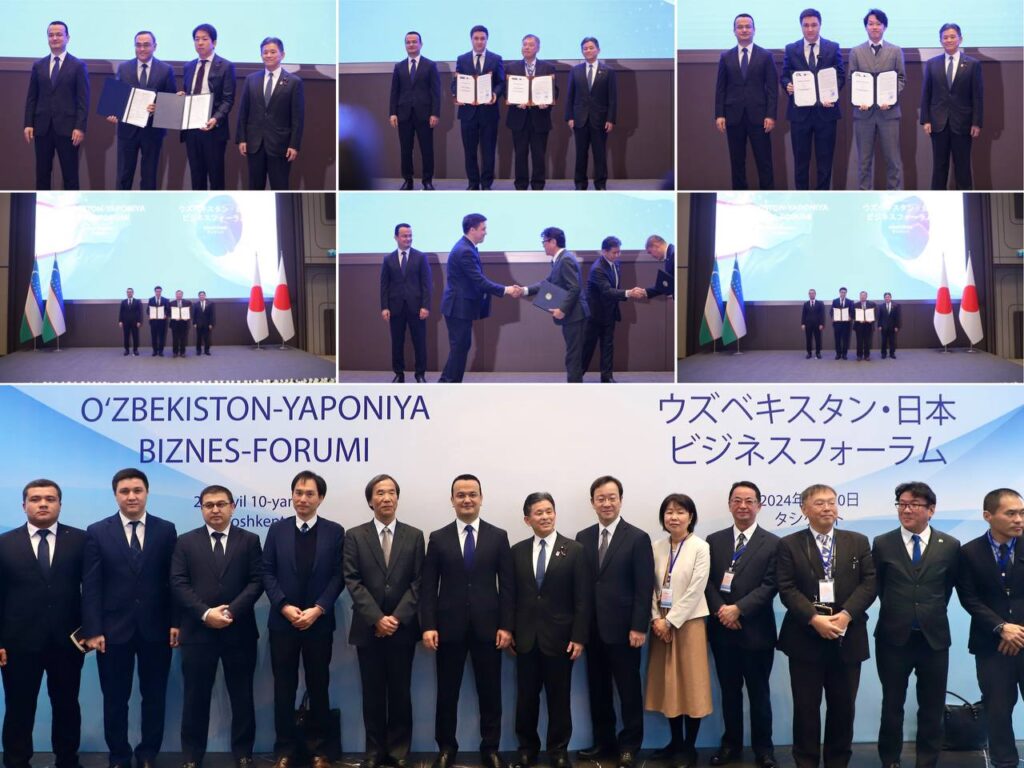
On January 10th, an Uzbek-Japanese business forum was held in Tashkent within the framework of the visit of Japan’s State Minister of the Economy, Trade and Industry, Ryosuke Kozuki. The forum gathered together the heads of key ministries, industry associations, as well as representatives from around 200 major companies from the two countries, the Ministry of Investment, Industry and Trade of Uzbekistan has reported.

Minister Kozuki and the Minister of Investment, Industry and Trade of Uzbekistan, Laziz Kudratov delivered the opening remarks at the forum. Kudratov outlined Uzbekistan’s key achievements in economic development and the improvement of the investment climate, highlighting the introduction of effective legislative norms aimed at protecting the rights of investors, the availability of energy resources, and the possibility of duty-free exports to EU markets within the framework of the EU’s GSP+ program for Uzbekistan.

Both sides emphasized the importance of intensifying direct contact between representatives of the business circles of the two countries. Alternative energy, IT, education, medicine, tourism, and digitization were named the most promising areas for joint investment projects.

The forum also included panel discussions on the topics of “Prospects for Energy Transformation,” and “Digital Transformation in Industrial Development: Japanese startups as a tool for the development of Uzbekistan’s economy.” Fourteen cooperation documents in the fields of education, IT-technologies, alternative energy, medicine, and the use of space technologies in geodesy and cartography were signed.

Kazakhstan and Japan to Cooperate in Low-Carbon Development

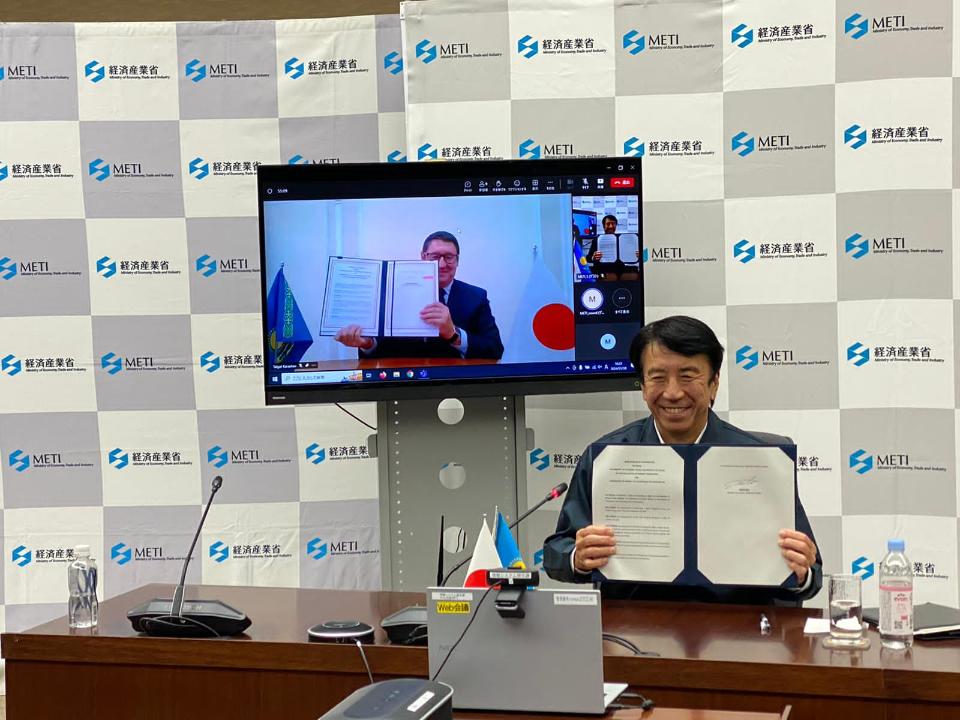
On January 9th the Minister of Energy of Kazakhstan, Almasadam Satkaliev, and the Minister of Economy, Trade and Industry of Japan, Ken Saito, signed a memorandum of cooperation in the field of low-carbon development and interaction in energy transition, the Ministry of Energy of Kazakhstan has stated. The document is aimed at strengthening cooperation in the use of energy resources and technologies, including energy conservation and renewable energy sources consistent with the goals of the Paris Agreement.

The Minister of Energy of Kazakhstan said that Kazakhstan and Japan are already successfully cooperating in the fields of uranium, oil and gas production, and are also introducing Japanese technologies at energy facilities.

The parties reached an agreement to prepare a list of potential projects for joint implementation in the energy sector, including in the field of electric power and renewable energy sources. One such project is for wind power using a 500 MW battery energy storage system in Kazakhstan.

The parties also agreed to strengthen their interaction in priority areas in the energy sector, including the implementation of sustainable development goals.

Uzbekistan and China: Cooperation in Ecology

A meeting was held at the Ministry of Ecology, Environmental Protection and Climate Change to discuss the prospects of cooperation and strategic partnership between China and Uzbekistan in the field of ecology and environmental protection. Important issues, including a number of promising projects based on the idea of constructing buildings that meet the principles of energy efficiency and environmental cleanliness were deliberated upon. In addition, the active introduction of green technologies and the development of strategies to recycle household and solid waste, including the recycling of batteries and the prevention of air pollution were proposed. Such projects are oriented towards the creation of a sustainable and environmentally friendly infrastructure, and reducing the negative impact on the climate.

The meeting also focused on the establishment of global environmental standards, the widespread use of digital technologies, and studying China’s experience in the field of ecology and creating mechanisms for environmental protection.

At the meeting, China’s best practices in the greening of barren desert areas was discussed. China is successfully implementing innovative methods, including the creation of specialized farms for planting seedlings. Measures to attract investors to implement the latest technologies in the systematic treatment of urban wastewater was also on the agenda. The Ministry of Environment and Natural Resources provided valuable information on the activities the government is actively pursuing to ensure the sustainable development of various sectors, including important work on environmental protection.

In addition, the parties discussed the establishment of a national taxonomy of green projects and the establishment of a Green Fund.

As a result of the meeting, the parties agreed to hold additional negotiations on these issues, emphasizing their intent and commitment to find the best solutions available.

Kazakhstan Participates in Summit in India

The Deputy Minister of Trade and Integration of Kazakhstan, Kairat Torebayev spoke at the country session of the 10th Global Summit, “Vibrant Gujarat”, which is taking place from January 10th to the 12th. The Gujarat Summit has been held in Gandhinagar since 2003 on the initiative of Prime Minister of India, Narendra Modi. Within the platform, participating countries discuss issues of socioeconomic development and promising projects for foreign investment.

In February, Kazakhstan and India will celebrate their 32nd anniversary of cooperation since the establishment of diplomatic relations. Trade relations between Kazakhstan and India continue to develop: in 2022 mutual trade turnover reached $2.5 billion, though from January-October 2023, this figure decreased to $811.2 million.

“Kazakhstan is the main trading partner of India among the Central Asian nations and is ready to further increase trade turnover in the amount of $148.1 million,” Torebayev stated. “Having significant natural resources in the energy sector, our country is a reliable partner for India in ensuring the supply of oil, gas, and other energy resources. In turn, the capacious Indian market is interesting to Kazakhstan’s exporters of goods and services.”

Torebayev went on to say that enterprises can increase the supply of products from the metallurgical, chemical, food, construction, and machine-building industries. The Deputy Minister also spoke about deepening cooperation between the two countries, as well as increasing mutual investments and implementing joint projects in areas with great potential, such as digitization, innovation, healthcare, education, and tourism.

Today, approximately 400 legal entities backed by Indian capital are registered in Kazakhstan. The inflow of foreign direct investment from India to Kazakhstan over the past 25 years totals $414 million.