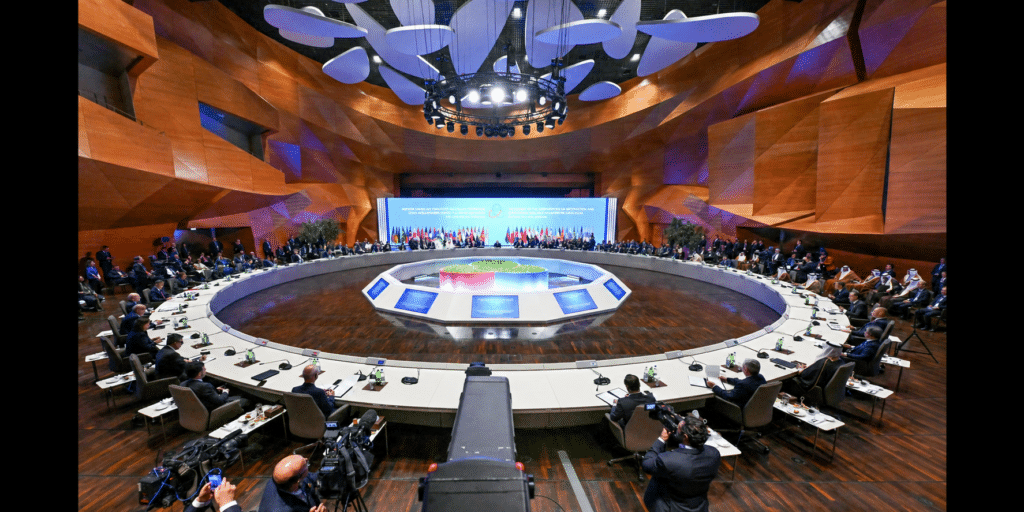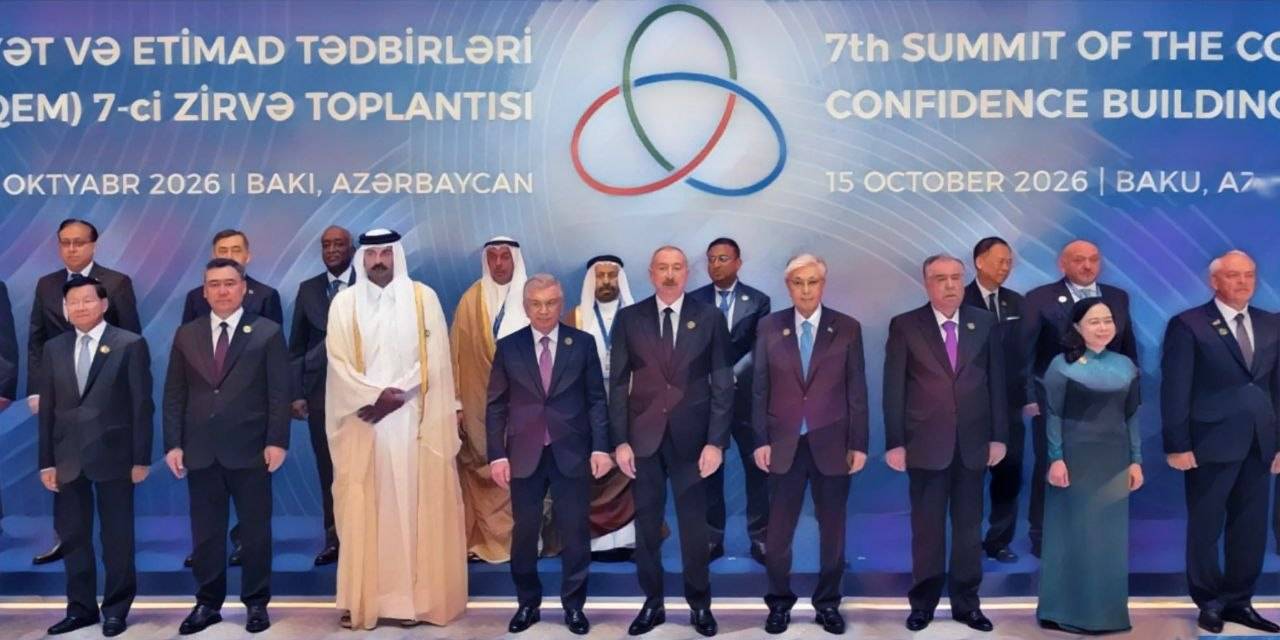
At the October 15 summit of the Conference on Interaction and Confidence Building Measures in Asia (CICA) in Baku, Kazakhstan proposed a mechanism for preventive diplomacy to address disputes before they escalate. President Kassym-Jomart Tokayev said the mechanism would give each member state a role in decision-making and help translate political commitments into coordinated action. If adopted, the proposal could increase Astana’s influence among Asia’s larger powers by making its founding initiative more enduring.
Influence Through an Asian Agenda
Kazakhstan already coordinates CICA’s military-political dimension, working with Türkiye on military exchanges, training-center visits, and seminars that include mediation. Kazakhstan could draw on these exchanges when seeking members’ agreement on a mandate for preventive diplomacy. They provide experience of organizing cooperation in a politically sensitive field, although a standing role in addressing emerging disputes would require a separate political agreement defining what members authorize the mechanism to do.
The Think Tank Forum offers another example of Kazakhstan’s influence over CICA’s institutional development. China initiated the Forum in 2014; its transformation into a permanent CICA advisory body followed in October 2021, when member states acted on Tokayev’s initiative. Azerbaijan hosted the first meeting outside China in September 2025, at which the handover to the Indian Council of World Affairs was announced; the latter now chairs the Forum for 2026–2027. Kazakhstan thus helped turn a Chinese initiative into a permanent CICA advisory body that Azerbaijani and Indian institutions subsequently helped sustain. China also contributes funding and seconded personnel to the Secretariat; Kazakhstan can build influence by securing agreement on standing arrangements through which other members pursue their priorities.
At the Baku summit, Tokayev also proposed establishing a CICA Water Partnership to promote joint research, technology exchange, and water-saving measures. He suggested that Central Asian countries and Azerbaijan could jointly advance a proposal for an International Water Organization under the United Nations. These proposals could give Kazakhstan a role in shaping cooperation on water security within CICA and, through a joint regional initiative, at the UN.
Kazakhstan’s Foundational Role in CICA’s Development
Kazakhstan conceived CICA in 1992 and has led its institutional development, including the effort to transform it into a full-fledged international organization. The initiative has a constituency extending well beyond Central Asia. Fifteen states adopted CICA’s first founding declaration in 1999. With Laos’s accession at Baku, CICA now has 29 members, ranging from China, India, Pakistan, and Russia to Iran, Israel, and South Korea.
The 2022 Astana summit launched CICA’s transformation into a full-fledged international organization. The Road Map endorsed by member states in 2023 specified reforms through which to pursue that transformation. The reforms cover the Charter, implementation of confidence-building measures, procedural rules, and the Secretariat’s organization. These changes affect CICA’s capacity to carry agreements forward between high-level meetings. Within CICA, the consensus rule makes collective agreement a condition both of institutional change and of policy coordination. Kazakhstan thus has an interest in the procedures through which future cooperation will be organized.
Cambodia’s pre-summit ratification of the convention on the Secretariat’s privileges and immunities enables its entry into force on November 8. The convention provides the Secretariat with the legal capacity needed for its functions in states bound by the treaty, while protecting its official operations and personnel. Kazakhstan separately strengthened the Secretariat’s position by ratifying amendments to the Host Country Agreement in May 2025.
Alongside these legal reforms, CICA is expanding its economic cooperation. The Finance Summit provides a forum for member states to cooperate on investment, development financing, and sustainable and digital finance. Tokayev proposed giving permanent status to the China-initiated Finance Summit at the 2022 Astana summit; members established it as a permanent CICA advisory body by adopting its regulations in September 2025 under Azerbaijan’s chairmanship. Its inaugural meeting, organized by the Astana International Financial Centre in September 2026, brought the arrangement into operation. The AIFC chairs the Finance Summit, with Azerbaijan’s Ministry of Finance as co-chair, giving Kazakhstan a continuing role in an institution developed through cooperation with other CICA members.
Kazakhstan and Azerbaijan’s Institutional Partnership
During its 2020–2024 chairmanship, with the Secretariat’s support, Kazakhstan prepared the initial Charter draft; Azerbaijan subsequently advanced negotiations over the text among member states. The draft declaration that senior officials approved for the Baku summit on October 14 welcomed progress on the Charter’s preparation. The Charter’s final provisions will determine the organization’s functions and the distribution of responsibilities among its organs. By preparing the text for discussion, Kazakhstan has already influenced those arrangements and given direction to the process, although the eventual agreement must accommodate other members’ positions.
During Azerbaijan’s 2024–2026 chairmanship, members established the Women’s Council, adopted regulations for a permanent Finance Summit, and began operating a network of leading universities. The university network had been proposed by Tokayev, while Kazakhstan’s chairmanship had sought permanent status for the China-originated Finance Summit. These developments thus reproduce a recognizable division of trans-Caspian labor: Kazakhstan formulates institutional proposals, while Azerbaijan helps give them collective effect and develops priorities of its own.
The university network is a case in point. Its 182 participating institutions come from thirteen member states; Azerbaijan’s ADA University chairs a coordination council that also includes universities from Kazakhstan, China, India, Kyrgyzstan, and Uzbekistan. The network’s diplomatic value will depend on the exchanges and joint work its members undertake, while its organization already provides a practical means of maintaining cooperation across successive chairmanships.
The Preventive-Diplomacy Proposal and Its Future
The preventive-diplomacy proposal would carry this institutional approach into a more politically demanding field. The next question is whether members can agree on the mechanism’s mandate and their participation. Negotiators would need to determine who could initiate consultations, how the states concerned would consent, what work the mechanism could undertake, and what responsibilities participants would assume. Resolving these questions would determine whether members were willing to authorize a continuing diplomatic function beyond the professional exchanges CICA already conducts.
Azerbaijan’s establishment of the Non-Aligned Movement’s Parliamentary Network in 2021 and Youth Organization in 2022, during its NAM chairmanship, exemplifies its wider experience in institutionalizing cooperation among governments with differing priorities. Azerbaijan’s CICA chairmanship, extended at Baku through 2028, provides scope to apply that experience to sustaining the transformation initiated under Kazakhstan’s 2020–2024 chairmanship while advancing Azerbaijan’s own role in shaping CICA’s development.
The Middle Corridor offers a parallel field of bilateral cooperation; CICA’s broader membership gives the Kazakhstan–Azerbaijan institutional partnership a different diplomatic constituency. Within CICA, the synergy between Kazakhstan’s institutional initiatives and Azerbaijan’s multilateral executive experience strengthens their joint capacity to organize cooperation across Asia. At the Baku summit, Kazakhstan sought to convert its investment in CICA into a greater role in determining what Asian states undertake together. Azerbaijan’s complementary contribution helps sustain that effort, while Kazakhstan’s lasting influence depends on what other members agree to undertake through CICA and whether the resulting institutions continue to guide their cooperation.