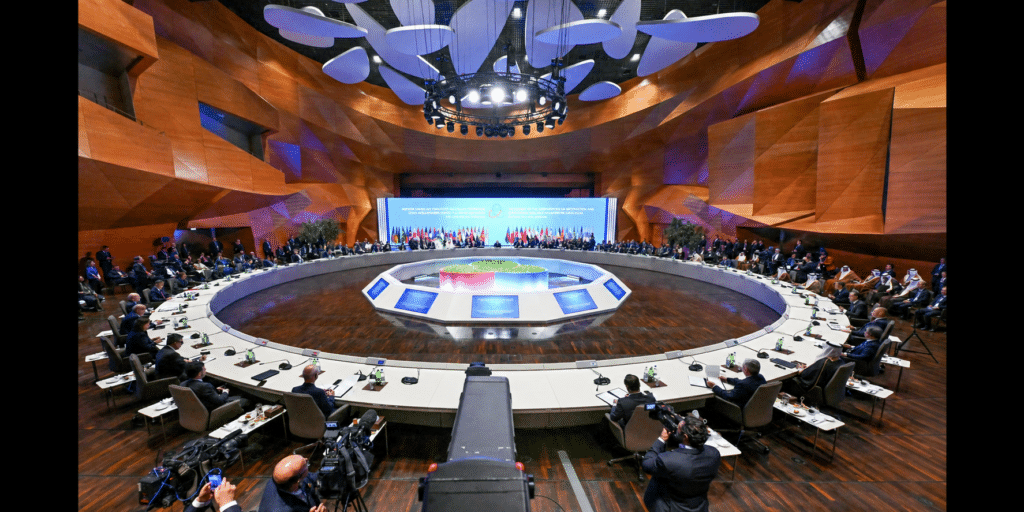
The tenth edition of Astana Media Week is taking place in Kazakhstan’s capital from October 14 to 16, with media professionals from Central Asia and other regions discussing how artificial intelligence (AI) is changing journalism. Dzhanibek Suleyev, a veteran Kazakh web publisher, and Alexander Smolin, former editor of Orda.kz, once one of the country’s most popular online news outlets, spoke to The Times of Central Asia about how to take advantage of this technological leap while minimizing its risks.
A New Revolution in Information Production
AI can generate large volumes of content in seconds, but Suleyev argues that the technology cannot replicate a journalist’s judgment: finding an original angle, choosing the right person to interview, or persuading them to speak candidly.
“I can’t say definitively whether the invention of AI is a blessing or a threat. That’s a question for philosophers,” he said.
Suleyev sees parallels with the advent of online journalism. The media, he noted, have repeatedly adapted to new technology. What once seemed radical – reading news on a computer or phone rather than in a newspaper – quickly became routine.
In the process, new professions emerged, including search engine optimization editors, audience analytics specialists, multimedia journalists, and social media editors, while demand for printing and newspaper distribution declined. Online publishing also dramatically lowered the cost of launching a news outlet.
“Just as the media’s move online in the 2000s did, AI is now reducing the cost of producing information. But there is a fundamental difference between these two revolutions,” Suleyev said. “The first changed how information was produced, distributed, and consumed. The second is also affecting the very process of creating journalistic content.”
The Right to Fair Compensation
That transformation raises an immediate financial problem: search engines can deliver AI-generated answers without users visiting the websites that originally reported the information. Suleyev says this is costing publishers traffic and advertising revenue.
Evidence of declining traffic is already mounting. Google search referrals to more than 2,500 news websites worldwide fell by 33% between November 2024 and November 2025, according to a report by the Reuters Institute for the Study of Journalism. Researchers cautioned, however, that it remains unclear how much of this decline can be attributed directly to AI-generated summaries.
On October 12, major publishers, including The New York Times and The Economist, joined a coalition seeking greater control over how AI companies use their content and fair compensation for that use. Suleyev believes such issues must be discussed by the media community and addressed through legislation.
Relying on AI Alone Is a Losing Strategy
Smolin is more optimistic about AI’s practical benefits. Tasks that once took a journalist two hours of searching can now, he said, be completed in minutes. Generating illustrations has also become easier, reducing the need for some in-house design work.
“There’s a saying I really like: to use artificial intelligence, you need to develop your own intelligence,” Smolin said. “I’m fully in favor of developing AI in the industry, but only in combination with our own skills and abilities. AI is simply an assistant that you cannot rely on completely.”
But speed creates risks. Smolin says newsrooms are already accumulating examples of journalists who blindly trusted AI-generated information and subsequently had to apologize for publishing errors.
He also acknowledged that AI is beginning to replace some newsroom jobs. In smaller outlets, he said, journalists may find themselves operating AI systems rather than producing original reporting, with only a handful of colleagues gathering comments and attending press conferences.
Yet he doubts such operations can compete with outlets offering original journalism.
“A machine always produces a template. What makes something interesting to read is a human perspective,” Smolin said.
He does not expect widespread layoffs in newsrooms in the near future. There is currently a surge in content produced by generative models, including text, photographs, and video, but he believes enthusiasm for the technological novelty will eventually fade.
“Without a doubt, producing information has become much cheaper and easier, but trust in it has also declined,” he said.
AI systems can produce false information through hallucinations, while misleading content can also be generated deliberately. These risks, Smolin argued, make editorial oversight more important than ever.
“Fact-checking has always been the number one responsibility of journalists and editors. AI doesn’t change that,” he concluded.
Legislation Will Continue to Evolve
During Astana Media Week, Kazakhstan’s First Vice Minister of Culture and Information, Kanat Iskakov, called on the media community to develop common principles for using AI.
He argued that public trust in the media should rest on three pillars: strong newsrooms, journalistic accountability, and technologies that help ensure information is reliable. An algorithm can produce an article, he said, but it cannot be held accountable for its words. That responsibility remains with journalists and their newsrooms.
Kazakhstan’s Law on Artificial Intelligence, which came into force on January 18, 2026, already requires synthetic AI-generated content to carry machine-readable labels, allowing software to identify it automatically, as well as warnings that are understandable to users.
However, questions remain over how AI-generated material should be used in newsrooms and how publishers should be compensated when their work is used by AI companies. As the technology continues to develop, the rules governing its use are likely to evolve with it.