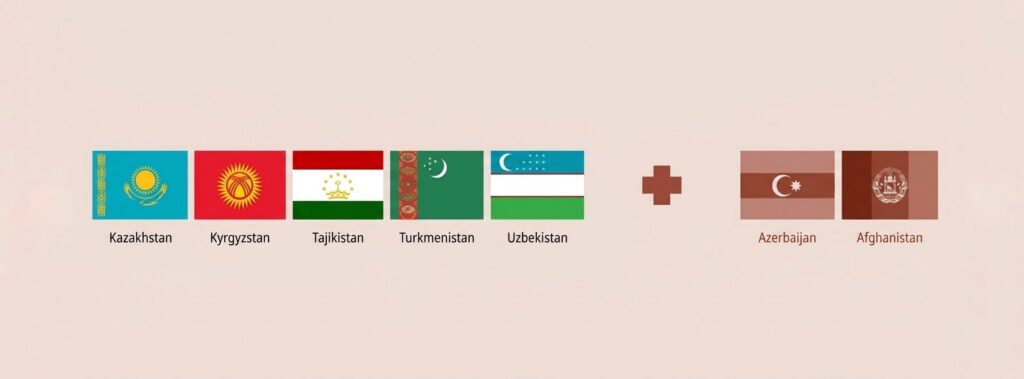
At the eighth Consultative Meeting of the Heads of State of Central Asia and Azerbaijan on October 8, 2026, Azerbaijan joined the forum as a full member after three years of participation as a guest of honor. President Ilham Aliyev stated that “Transport is one of the primary areas of cooperation between Central Asia and Azerbaijan”.
Uzbekistan’s President Shavkat Mirziyoyev called for comprehensive infrastructure along the routes, with logistics hubs and service centers supporting production facilities and industrial zones to generate economic activity around the transport corridors. Construction of the China-Kyrgyzstan-Uzbekistan railway is among Uzbekistan’s transport priorities and is important for Kyrgyzstan, making this “integrated transport corridor development” approach particularly relevant.
Construction of the China-Kyrgyzstan-Uzbekistan railway (also known as the Kashgar-Torugart-Makmal-Jalal-Abad-Andijan railway) has been underway since December 2024. Public discussion of the project focuses mainly on shorter routes linking China and Central Asia with the Middle East and Europe, and on the line’s design carrying capacity. However, growth in transit traffic does not in itself guarantee economic benefits for the Naryn and Jalal-Abad regions of Kyrgyzstan or the Andijan region of Uzbekistan.
Local economic impact depends on whether freight services and tariff policy allow small shippers to use the railway’s stations. Border delays can limit those benefits, as can a lack of storage and processing infrastructure nearby.
What the Project Involves
The intergovernmental agreement on the implementation of the project was signed by China, Kyrgyzstan, and Uzbekistan on June 6, 2024. The joint project company was registered in July 2024, the investment agreement was signed on December 20, 2024, and construction officially began on December 27, 2024, in Jalal-Abad. According to the Ministry of Transport of Uzbekistan, the total length of the line is 532.53 km; 20 stations are planned, including two border stations, one transshipment station, four intermediate stations, and 13 passing loops.
The Makmal transshipment station will be the transfer point between China’s 1,435 mm track gauge and the 1,520 mm gauge used in Kyrgyzstan and Uzbekistan. From Torugart to Makmal, the 165.5 km section will use the Chinese gauge. The 146.26 km section from Makmal to Jalal-Abad will use the wider gauge, connecting to the existing network toward Andijan.
At Makmal, containers will be sorted and transferred between trains. Wagons can instead have their wheel assemblies changed to run on the other gauge. Freight trains will be assembled or split up at the station, which will also have facilities to weigh wagons and cargo.
The parties estimate the cost of the project at USD 4.7 billion. Under the loan agreement signed on December 16, 2025, about USD 2.3 billion is provided by a syndicate of Chinese banks as a 35-year loan to the project company. Another USD 2.3 billion or so forms the project company’s charter capital. China holds 51% of the shares, while Kyrgyzstan and Uzbekistan each hold 24.5%.
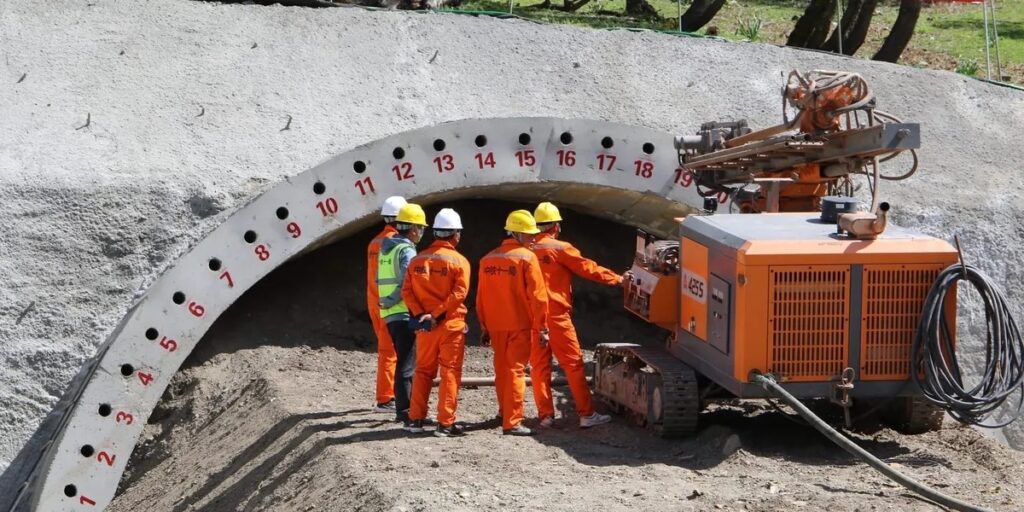
As of October 2026, construction is underway along the entire length of the route. In September 2026, the project company reported the completion of the first tunnel bore on the Kyrgyz section. Uzbekistan’s Ministry of Transport has indicated that construction is expected to be completed by the end of 2030, while suggestions of possible early completion remain statements by officials.
The design carrying capacity of the line is given as up to 15 million metric tons per year; this is a capacity figure, not a forecast of actual traffic. In September 2026, the government of Kyrgyzstan announced its intention to establish free economic and industrial zones based at the Torugart, Jerge-Tal, Makmal, and Jalal-Abad stations.
How Transit Could Affect the Local Economy
Freight from China to Uzbekistan via Kyrgyzstan is already carried under a multimodal arrangement: by rail to Kashgar, then by road through the Irkeshtam pass to Osh, and onward over the 1,520 mm network. The new line’s impact should therefore be measured against this route. The reductions in distance and transit time claimed by the parties refer to through traffic between China and third countries and do not describe the situation of local shippers.
The Andijan region is already connected to the 1,520 mm network, so the new line would give it a direct rail connection with China. Districts in the Naryn and Jalal-Abad regions between Torugart and Makmal would gain their first railway. Local shippers would need collection points where small loads could be combined into larger shipments. They would also need access to container yards and tariffs for small consignments. Andijan’s mechanical engineering and textile industries suggest a likely need for freight services. Demand could also come from the region’s food processors and fruit and vegetable growers, but it has not been measured.
Freight handling at Makmal will create jobs in storage and repair and generate demand for support services. It will also add costs that reduce the route’s competitiveness. Experience at the border between Kazakhstan and China shows that gauge change is the main source of delays at rail border crossings.
Part of the value of products would remain in the region if they were sorted and packaged near the stations, where cold storage and processing facilities were also available. The free economic zones announced at the stations could support this activity, but without published parameters their contribution cannot be assessed.
Construction currently has the most tangible economic effect, but this will end when the work is completed. The Kyrgyz side has declared an intention to engage local specialists and use local construction materials, but data on the share of local workers and local procurement are not publicly available.
Conditions That Will Determine the Distribution of Benefits
Empirical studies of the transport corridors of the Belt and Road Initiative indicate that infrastructure benefits are distributed unevenly across territories. Spreading them more widely requires domestic transport networks to be developed and trade procedures simplified; workers must also be able to move to where employment is available.
Access for small and medium-sized enterprises depends on whether stations will handle small consignments or work exclusively with block container trains of large operators. Without consolidation centers and non-discriminatory access to terminals, small producers will be unable to use the line.
Local shippers must factor in the cost of getting goods to the station and loading them onto trains, in addition to the rail tariff. Storage adds to the bill, while transferring freight at Makmal and clearing it through customs bring further charges. The project company and national carriers have not published their tariff policies. Uzbekistan has already applied preferential tariffs on existing multimodal routes, but it is unclear whether similar rates will apply to local exports and domestic freight.
Corridor monitoring data from the Central Asia Regional Economic Cooperation Program for 2024 show that the Irkeshtam road border crossing on the Kyrgyz side is among the crossings with the longest inbound clearance times in the region. For perishable products from the Fergana Valley, such delays are critical. Export-terminal status for Kashgar station and electronic advance cargo information could reduce them, but both remain under negotiation.
The value of a station to a district depends on how accessible it is by transport and on the availability of nearby warehouses, including cold storage. Small enterprises cannot afford the capital costs of such facilities without concessional financing, and no dedicated credit programs linked to the new line have been identified in open sources.
Operating the line and its transshipment facilities requires railway specialists, while customs and logistics personnel are needed to handle freight moving through the terminals and warehouse complexes. If training does not begin before the line is commissioned, the jobs will be filled by specialists from other regions or from abroad.
In August 2025, about 169 hectares of land in the Naryn and Jalal-Abad regions, most of it forest fund land, were reallocated for construction. No environmental impact assessment report or resettlement plan has been found in the public domain.
There is a risk that the railway’s main benefits will accrue to transit operators and large companies. Logistics centers outside the region may also gain, while adjacent districts bear the costs of land acquisition and environmental pressure. This “transit channel” risk increases, for example, if zones at stations are designed only for external investors. Its likelihood decreases if the conditions described above are built into planning before regular services begin.
How to Measure Local Impact
Transit volume reflects the utilization of the corridor but does not answer the question of outcomes for the territories. No baseline or target values have been officially set for local indicators, so baseline data should be collected before regular services begin.
Station and terminal data should show the local share of freight dispatched and received at stations along the line and the number of unique local shippers, including small and medium-sized enterprises. These measures would distinguish a transit channel from a hub of regional development.
At the corridor level, the full cost and delivery time for a typical local consignment should be compared with the existing route via Irkeshtam. The comparison should add terminal and border charges to the rail tariff and measure time from warehouse to border. This would show whether the line has become more accessible to local businesses.
Railway operations and transshipment facilities should report permanent job numbers, as should warehouses and the zones at stations. At district and enterprise level, these figures should be accompanied by wage data and the share of workers from adjacent districts to distinguish sustainable employment from the temporary construction effect.
The share of procurement by the project company and terminal operators that goes to local firms would show whether project spending stays in the local economy. Tracking the number of logistics and service businesses near the stations would provide a further measure of local supplier participation.
At the regional level and in the zones at stations, the share of processed products in local exports via the line should be recorded. Measuring capacity to sort and package goods, and to keep them in cold storage, would complete the assessment of value added.
Conclusions and Recommendations
The railway changes transport access for the Naryn, Jalal-Abad, and Andijan regions, but local economic impact does not follow automatically. Local shippers must be able to get their freight onto a train at a reasonable price, with open access and consolidation services included in the operating rules of stations and the zones attached to them. Publishing a tariff policy for local and domestic traffic would clarify the rail costs they face, while faster, less costly border procedures must apply to all users.
The reconstruction of access roads to stations and the construction of cold storage facilities should be synchronized with the launch of the line. Local businesses must be able to use the warehouses and processing facilities developed nearby, together with related services. To prepare local people for the jobs the railway creates, training programs in adjacent districts should begin before operations and cover railway work as well as customs and logistics.
The environmental impact assessment and resettlement plan should be disclosed, together with data on compensation. Establishing baseline values for local indicators before services start and publishing the data annually would make it possible to assess whether local economic benefits are materializing.
The views expressed in this article are those of the author and do not necessarily reflect the official policy or position of the publication, its affiliates, or any other organizations mentioned.