Kyrgyzstan has set a target of average annual real GDP growth of at least 8% and a 20% annual increase in foreign direct investment inflows through the end of 2030. Bishkek aims to achieve these goals by developing export-oriented industries, expanding transport routes, and attracting international capital. While recent international forecasts suggest growth could exceed 8% this year, sustaining that pace through 2030 remains a challenge.
The government outlined the priorities at a meeting in Bishkek on October 21. Its plans include expanding production of export goods, modernizing trade and customs procedures, strengthening private property protections, and improving businesses’ access to long-term financing.
Positive Momentum Set to Continue
The targets are set out in the National Development Program through 2030, adopted in June 2025. The program calls for nominal GDP to reach at least $30 billion and GDP per capita to rise to $4,500.
International forecasts suggest Kyrgyzstan’s economy will maintain strong growth in the near term, although a slowdown is expected. Following 11.1% growth in 2025, the IMF forecasts 9% growth in 2026 and 7% in 2027, while the World Bank projects 9.6% growth this year. However, both institutions have highlighted risks to the country’s economic momentum, including a potential slowdown in re-export trade, weaker growth in Russia and China, rising energy prices, and tighter sanctions restrictions.
To maintain rapid growth, Bishkek intends to support food processing, pharmaceuticals, chemicals, light manufacturing, machinery production, and mineral processing. The goal is to increase exports of domestically produced goods.
Infrastructure-led Growth
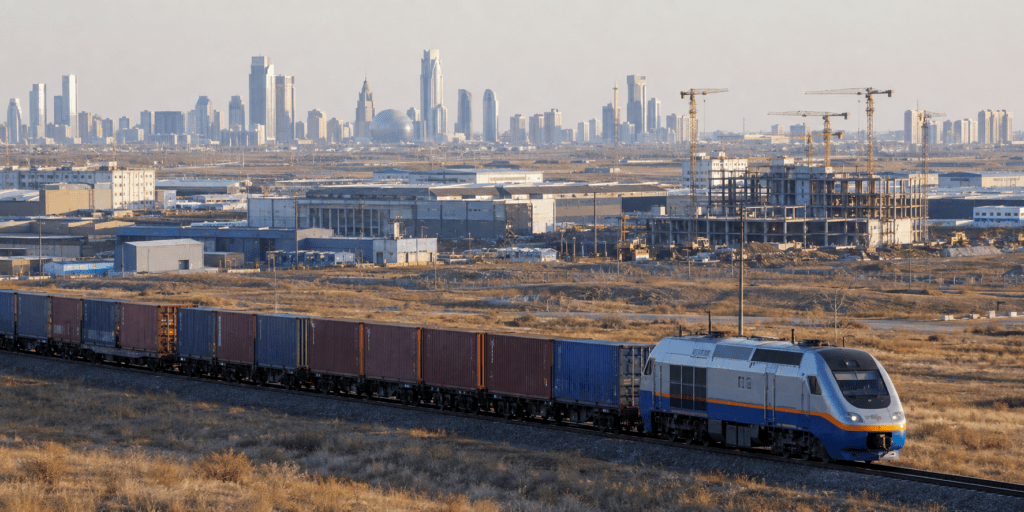
One of the country’s largest infrastructure projects remains the China–Kyrgyzstan–Uzbekistan railway. Construction began in December 2024, with completion scheduled for 2030. The project is estimated to cost $4.7 billion, including $2.3 billion in loans from Chinese banks. China holds a 51% stake in the joint project company, while Kyrgyzstan and Uzbekistan each own 24.5%.
The railway is expected to give Kyrgyzstan its first direct rail link to China and provide Uzbekistan with an alternative route to the Chinese market. For Bishkek, it offers an opportunity to generate transit revenue and develop logistics centers. However, the route’s commercial viability will depend on freight volumes, tariffs, and the efficiency of border crossings.
Another major project is the Kambarata-1 hydropower plant, which Kyrgyzstan is advancing jointly with Kazakhstan and Uzbekistan. Additional electricity generation capacity is needed, among other purposes, to support industrial expansion. On October 14, Kyrgyzstan’s ambassador to Switzerland presented both projects to potential investors in Geneva.
Bishkek also plans to encourage state-owned companies to issue Eurobonds, expand long-term financing through state banks, and develop the Tamchy special financial and investment zone to attract international capital. Logistics, information technology, tourism, and financial services have been identified as promising sectors.
Risks
At the same time, Kyrgyzstan’s close economic ties with Russia create additional risks for its banking sector and foreign trade. The IMF has warned that exposure to international sanctions and weaknesses in financial oversight could disrupt banking relationships and cross-border trade.
A further challenge is ensuring that major infrastructure projects benefit the wider economy. As The Times of Central Asia noted in its analysis of the China–Kyrgyzstan–Uzbekistan railway, without the development of industrial zones, warehousing infrastructure, and workforce training, a substantial share of the economic benefits could accrue to transit operators and large companies rather than the broader local economy.