On September 29, a new highway was opened connecting the village of Tyup, in the northeastern part of Lake Issyk-Kul, with Kegen in Kazakhstan’s Almaty region.
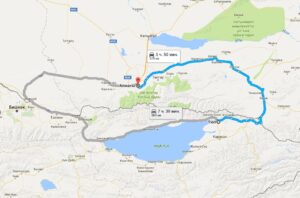
The 52-kilometer Tyup-Kegen road is of strategic significance, linking Kyrgyzstan’s most prominent tourist destination, Lake Issyk-Kul, with Kazakhstan’s largest city, Almaty, via the existing route through Kegen.
This new corridor creates a direct 280-kilometer connection between Almaty and the northeastern shore of Issyk-Kul, significantly shortening the previous route to the lake’s northern edge. While the straight-line distance between Almaty and Issyk-Kul is only about 80 kilometers, travelers were previously forced to detour through Bishkek due to mountainous terrain. The journey to Cholpon-Ata, the largest resort town on the lake’s northern shore, used to span 460 kilometers and could take up to eight hours.
Lake Issyk-Kul remains a top summer getaway for the region, particularly for Almaty residents seeking short weekend retreats.
@president.kg
The Times of Central Asia previously reported on the progress of long-standing plans to establish a more direct road between Almaty and Issyk-Kul. Kazakhstan and Kyrgyzstan signed a memorandum of understanding in 2007 for a route bypassing Bishkek, running through Uzynagash and Kemin and connecting directly to Cholpon-Ata. That project, however, stalled in its early stages. If completed, it would have reduced the travel distance to roughly 260 kilometers and substantially cut travel time.
In June, Asman Airlines launched regular passenger flights from Almaty to Tamchy Airport on the northern shore of Issyk-Kul, further strengthening cross-border travel links.
Experts believe the opening of the Tyup-Kegen highway will benefit not only tourism but also trade and cross-border cooperation between Kyrgyzstan and Kazakhstan. Enhanced transport accessibility is expected to stimulate small and medium-sized enterprises, boost agricultural trade and food supply chains, and create new employment opportunities for local communities.
In addition, the new route offers expanded opportunities for logistics companies and the tourism sector, paving the way for deeper regional engagement between the two neighboring countries.