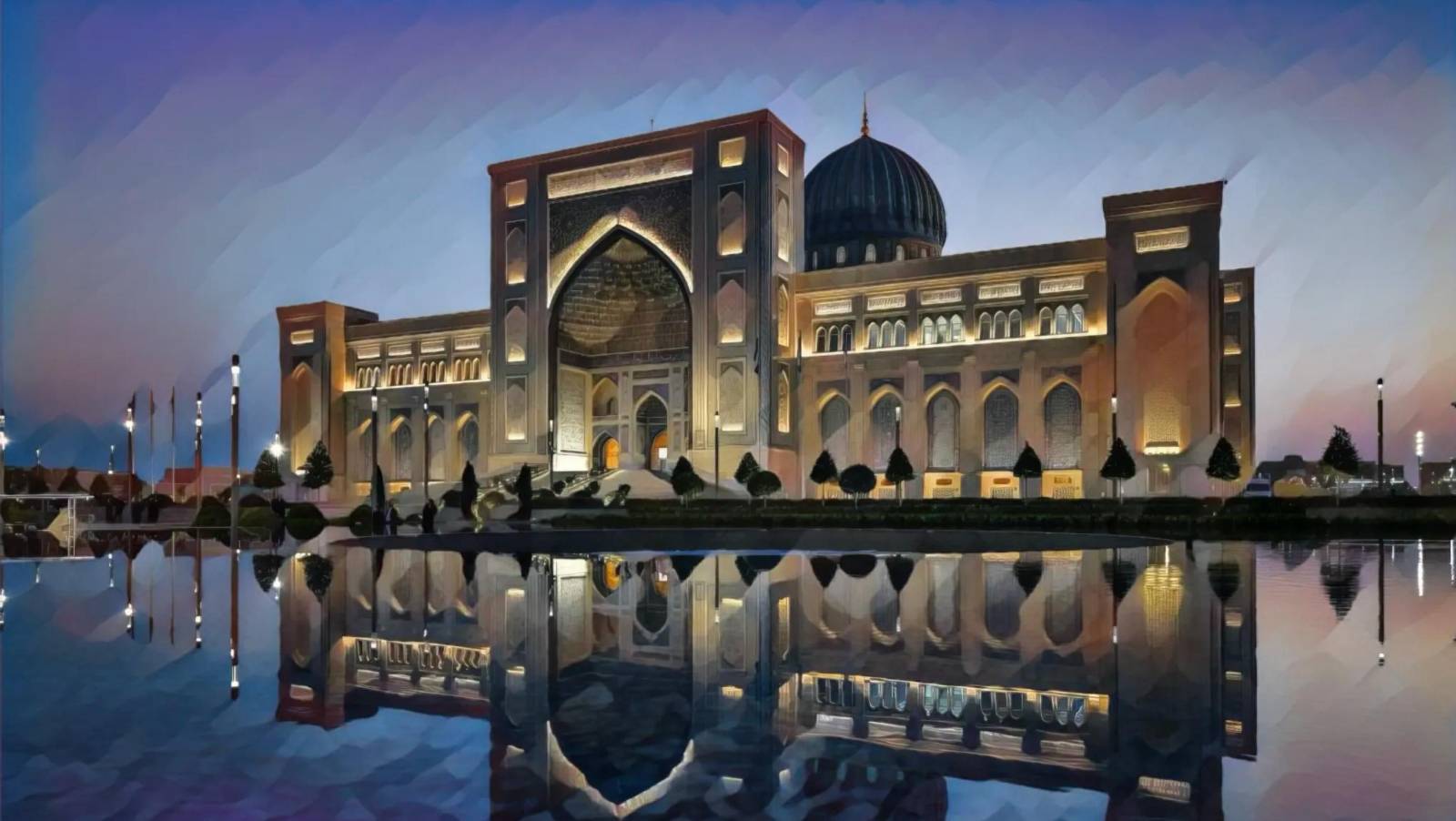
With its public opening scheduled for March 17, 2026, the Islamic Civilization Center in Tashkent is emerging as one of the most consequential cultural projects in contemporary Uzbekistan. Conceived under President Shavkat Mirziyoyev’s initiative first announced in 2017, the Center presents itself not simply as a museum but as a national statement about memory, scholarship, and identity. The Center’s own mission describes it as a bridge between the Golden Age and New Uzbekistan, linking a rich spiritual and scientific inheritance with the country’s modern aspirations. In that sense, the opening is not only an institutional debut; it is a carefully staged declaration of civilizational confidence.
The setting reinforces that message. The complex rises in Tashkent’s historic Hast-Imam area, at Karasaray 47 in the Almazar district, where architecture itself is part of the narrative. The official site says the building’s 65-meter dome and four portals symbolize the unity of Uzbekistan’s regions, turning the Center into a monument as much as a museum. From the outside, the structure is meant to signal national scale; from the inside, it is designed to draw visitors into a journey through faith, science, and statehood. The opening therefore introduces not just a new institution, but a new symbolic landmark for the capital.
What makes the Center distinctive is the scope of its ambition. Official descriptions emphasize that it is more than an exhibition venue: alongside museum halls, it includes a library, restoration and digitization laboratories, research departments, and archival storage. That institutional mix matters. Rather than treating Islamic civilization as a fixed inheritance locked behind glass, the Center is built to keep knowledge active through conservation, scholarship, and public interpretation. It is a museum-research hybrid with an international educational focus, drawing inspiration from historical centers of learning such as Baghdad’s House of Wisdom, the Khorezm Ma’mun Academy, and Ulugh Beg’s madrasah in Samarkand.
At the spiritual and architectural core of the complex is the Qur’an Hall. The official website describes it as the largest and most majestic section of the building, as well as the conceptual heart of the entire project. At its center stands the 7th-century Mushaf of Uthman, preserved beneath the great dome and recognized by UNESCO’s Memory of the World Register. The hall also features a gallery of 114 Qur’ans tracing the evolution of Islamic calligraphy, and the Center says the space is designed not only for display but also for contemplation, with continuous Qur’an recitation planned inside. The result is an opening centered on reverence as much as spectacle.
Beyond the Qur’an Hall, the Center organizes Uzbekistan’s civilizational story along a long historical arc. Its exhibition program moves from pre-Islamic heritage through the First and Second Renaissances and into New Uzbekistan, combining rare objects with replicas, models, 3D technologies, audiovisual tools, and other modern display formats. The Hall of Honor, one of the site’s highlighted spaces, contains 14 arches depicting key events in Central Asian history and interactive panels linked to a digital platform with avatars of more than one hundred thinkers and scholars. In this way, the opening signals a curatorial philosophy that prefers immersion and dialogue over static display.
The Center’s collections are meant to match that ambition. According to official materials, nearly two thousand rare manuscripts and artifacts have been repatriated through international cooperation, while more than 1,500 specialists—including architects, historians, artisans, conservators, and technologists from Uzbekistan and abroad—have contributed to the project. The preparation of the exhibitions has also been unusually systematic: the website reports that roughly 100 contracts were signed with scholars to enrich the content of the megaproject. These details matter because they show that the opening is not the product of a single ceremony or construction deadline. It is the culmination of years of research, acquisition, design, and scholarly collaboration.
That long preparation has also been visibly international. The Center’s site documents roundtables and design meetings involving Uzbek scholars and foreign partners such as Italy’s Magister Art and the French firm Wilmotte & Associés, all aimed at organizing the exhibitions to international standards. Another official report says the working groups combined scientific-methodological requirements with contemporary museum tools such as replicas, models, 3D technologies, and audiovisual equipment. Plans for an international forum linked to the official opening were discussed as part of the same process, underscoring that the event is intended not only for domestic audiences but for the wider academic and cultural world as well.
In that broader context, the opening of the Islamic Civilization Center in Tashkent carries meaning well beyond Uzbekistan. The Center’s public narrative repeatedly frames the project as a way to present the humanistic essence of Islam and the intellectual contributions of the region to world civilization. Official materials describe it as an internationally oriented platform for research, education, and intercultural dialogue, and note that in December 2025 the Center signed a memorandum of understanding with the United Nations Alliance of Civilizations. That combination of national memory and global outreach may prove to be the Center’s most important achievement. As its doors open, Tashkent is not simply unveiling a new museum; it is asserting its place, once again, as a crossroads of knowledge.