• KGS/USD = 0.01144 0%
  • KZT/USD = 0.00192 -0%
  • TJS/USD = 0.10849 0.37%
  • UZS/USD = 0.00008 0%
  • TMT/USD = 0.28571 0.28%
  • KGS/USD = 0.01144 0%
  • KZT/USD = 0.00192 -0%
  • TJS/USD = 0.10849 0.37%
  • UZS/USD = 0.00008 0%
  • TMT/USD = 0.28571 0.28%
  • KGS/USD = 0.01144 0%
  • KZT/USD = 0.00192 -0%
  • TJS/USD = 0.10849 0.37%
  • UZS/USD = 0.00008 0%
  • TMT/USD = 0.28571 0.28%
  • KGS/USD = 0.01144 0%
  • KZT/USD = 0.00192 -0%
  • TJS/USD = 0.10849 0.37%
  • UZS/USD = 0.00008 0%
  • TMT/USD = 0.28571 0.28%
  • KGS/USD = 0.01144 0%
  • KZT/USD = 0.00192 -0%
  • TJS/USD = 0.10849 0.37%
  • UZS/USD = 0.00008 0%
  • TMT/USD = 0.28571 0.28%
  • KGS/USD = 0.01144 0%
  • KZT/USD = 0.00192 -0%
  • TJS/USD = 0.10849 0.37%
  • UZS/USD = 0.00008 0%
  • TMT/USD = 0.28571 0.28%
  • KGS/USD = 0.01144 0%
  • KZT/USD = 0.00192 -0%
  • TJS/USD = 0.10849 0.37%
  • UZS/USD = 0.00008 0%
  • TMT/USD = 0.28571 0.28%
  • KGS/USD = 0.01144 0%
  • KZT/USD = 0.00192 -0%
  • TJS/USD = 0.10849 0.37%
  • UZS/USD = 0.00008 0%
  • TMT/USD = 0.28571 0.28%
11 December 2025

Kazakhstan To Increase Oil Shipping Along Trans-Caspian Route

Kazakhstan is carrying out major expansion projects at the Tengiz, Karachaganak, and Kashagan oil fields. The throughput capacity of the Kazakhstan section of the Caspian Pipeline Consortium (CPC) pipeline has been increased from 54 million to 72.5 million tons per year, and the country has begun oil shipments along the Trans-Caspian route, which will be increased to 3 million tons within two years, the Kazakh government’s website reported on February 5th.

In 2023 Kazakhstan increased crude oil shipments from the Caspian port of Aktau in the direction of the Baku-Tbilisi-Ceyhan oil pipeline from 250,000 tons to almost 1.4 million tons. 

In 2022 Kazakhstan’s president Kassym-Jomart Tokayev ordered that the volume of oil transported along the Trans-Caspian corridor be increased. Kazakhstan’s national oil and gas company KazMunayGas and the state oil company of Azerbaijan, SOCAR, entered into an agreement to transport up to 1.5 million tons of oil per year from the Tengiz field in the direction of the Baku-Tbilisi-Ceyhan oil pipeline.

The Kazakh government has also announced that work is underway to increase the production capacity of the Shymkent oil refinery in the south of Kazakhstan from 6 million to 12 million tons per year, which will fully meet the needs of the domestic market for motor fuel.

Kazakhstan To Co-Chair Conference On Nuclear Security

The 2024 International Conference on Nuclear Security (ICONS-2024) will be held in Vienna, Austria from May 20th to 24th. The conference is being organized by the International Atomic Energy Agency (IAEA), and will be jointly chaired by Kazakhstan and Australia. 

The forum will bring together more than 2,000 nuclear security experts from 178 IAEA member states, as well as the heads of foreign services and relevant ministries. Kazakhstan and Australia’s representatives to the International Organizations, Mukhtar Tleuberdi and Ian Biggs, held a briefing in the United Nations Office in Vienna on February 5th. 

The conference will showcase the achievements of IAEA member states in nuclear security, and strengthening control over nuclear and other radioactive materials.

Kazakhstan and Australia will play key roles in developing the conference’s final document, the ICONS-2024 Ministerial Declaration, which will become a roadmap for further promoting the peaceful use of nuclear energy, making nuclear facilities more safe, and encouraging the effective exchange of international experience and knowledge.

Harnessing Social Media for Social Change: An Interview with Tashkent-based Eco-Blogger Mutabar Khushvaktova

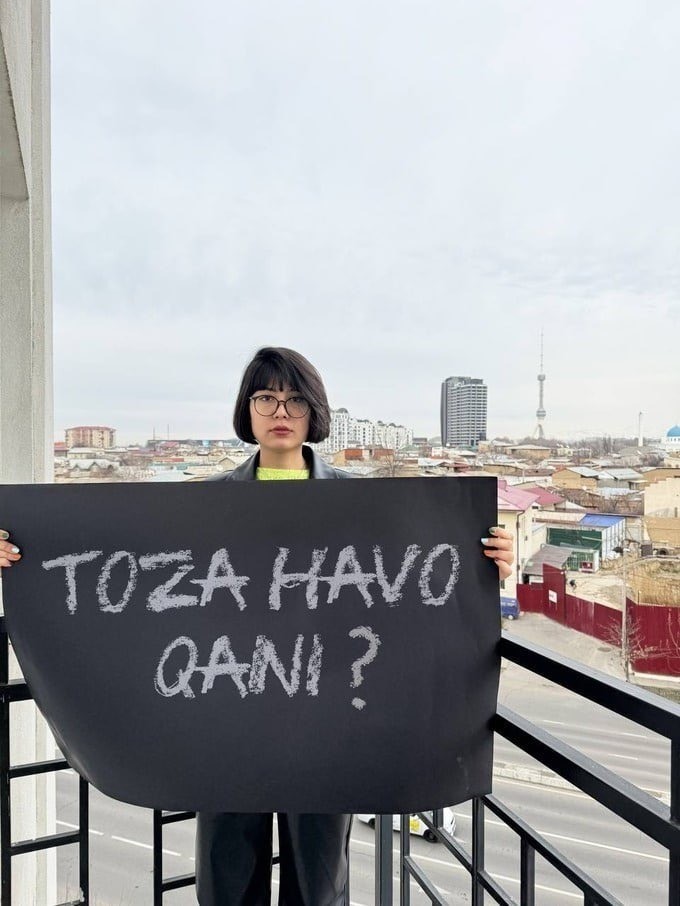
More and more people in Uzbekistan are paying attention to environmental issues and aspiring to make a real change in their country. One such campaigner is Mutabar Khushvaktova, an eco-blogger who has used her platform to draw attention to environmental issues and inspire others to take action. The Times of Central Asia spoke to Khushvaktova.

What is it like to be an environmental activist in Uzbekistan, and when did you first become so involved in environmental issues?

After my daughter was born, I began thinking about the future and what I could do to provide her with a favorable environment in which to live. I decided to start blogging and talking about the environment to raise awareness about these issues. I realized that the media plays an important role in shaping public opinion, so I resolved to use this tool.

One of my main accomplishments was to create a popular blog about environmentalism and opportunities to change our situation. I try to use my blog for educational outreach and to bring attention to these issues.

I base my content solely on source-verified information, including global statistics. This allows me to create content that’s truthful and credible. Next year, I plan to enroll in a European Master’s program to get a specialized education in the field of ecology. I would like to create books for kindergartners, school children and students.

From my childhood, I was very much in love with nature – animals, plants, everything related to nature. It was a passion my parents also shared. Being a parent is a huge responsibility, and a great motivator. I see every child as if they were my own; this generation is very exciting to me, and I want them to have a good future.

You’ve been involved in eco-activism in Uzbekistan for some time, now; have you noticed any improvement?

Yes, I have. After all, in the almost three years I’ve been involved in this field, I’ve witnessed the emergence and development of various eco-initiatives. Compared to when I first started addressing this issue, the situation today has changed considerably. Back then, people had no idea about environmental issues at all, especially on social media. But even at that time, I felt that people were ready to learn more. They were very interested, and asked me a lot of questions.

Nowadays, because there are more and more pressing environmental issues, people are paying more attention to this topic. It is worth saying that the whole idea of environmental awareness has become very popular in our society. For example, I notice that people no longer just send me direct messages with questions, but also actively discuss the issues in the comments section. They share their successes, tell me that they have started sorting garbage for recycling, started their own eco-friendly businesses, and even stopped using plastic bags.

Recently, there have been stories in the news about the deteriorating air quality in Uzbekistan – do you think the new measures being brought in by the government will bring a satisfactory resolution?

Once the situation became urgent, the state started talking about it more, and the Ministry of Ecology came up with a number of proposals which I like. On paper, everything looks perfect. However, I really hope that their policies will not just be perfect on paper, but when they are implemented in real life. It’s important that an action plan is developed and followed through step by step, so that there’s a true implementation of measures, and not only in the short term, but a stable solution on a long-term basis.

Why do changes in the sphere of the individuals’ environmental responsibility take place so slowly? Is it a peculiarity of mentality, or is it about the amount of support at  a governmental level?

Changes in the amount of responsibility each of us takes are slow; this is due to several factors. First, there is a lack of information and education, and availability of information plays a crucial role. For example, in Uzbekistan, there is very little information in Uzbek. That is, if an Uzbekistani simply types into Google, ‘what is microplastic?’ nothing will come up in the Uzbek language. The lack of sources and statistics in Uzbek creates barriers to education and awareness of the problem.

Secondly, this lack of information is compounded by a dearth of education and knowledge about environmental issues. Many people remain unaware of what is happening in the natural world and what problems exist. They simply go about their daily lives without thinking about ecology. In order to accelerate the process of change, it’s necessary to diversify and improve the information environment. It’s imperative that information about environmental issues is available not only on social networks, but in other media resources, such as radio and television. In addition, informational materials could be placed on public transportation and on the streets in the form of social videos, which would attract the attention of the widest possible audience. It’s also important that this information is presented in simple and understandable language, so that ordinary people can easily assimilate meaningful knowledge about environmental issues.

Bektenov Named as New Prime Minister of Kazakhstan

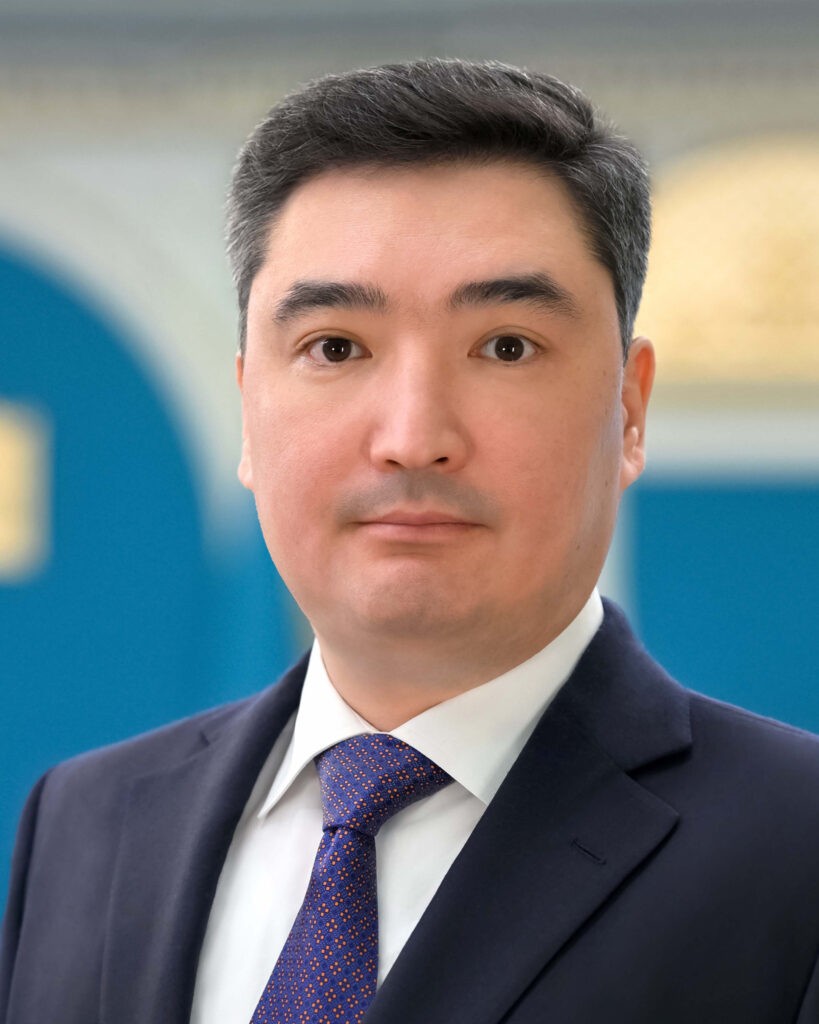
Olzhas Bektenov has been named as the new Prime Minister (PM) of Kazakhstan. His candidacy was presented to the President of Kazakhstan by the chairman of the ruling party, Amanat, Yerlan Koshanov. In accordance with the current legislation, President Kassym-Jomart Tokayev discussed Bektenov’s candidacy with the heads of parties in the Mazhilis (lower house of Parliament). These were Yelnur Beisenbaev (Amanat), Magerram Magerramov (People’s Party of Kazakhstan), Azat Peruashev (Ak Zhol), Askhat Rakhimzhanov (National Social Democratic Party), Serik Egizbaev (Auyl), and Aidarbek Hodzhanazarov (Respublica). Bektenov’s candidacy was approved by Ak Zhol, Auyl and Respublica, whilst the People’s Party of Kazakhstan and the Nationwide Social Democratic Party (OSDP) abstained from agreeing to Bektenov’s candidacy as the head of the Cabinet of Ministers.

Since April 2023, Bektenov has served as head of the Presidential Administration. Previously, he worked as chair of the Anti-corruption Agency, head of the Department of Public Procurement, and the National Anti-Corruption Bureau for the city of Astana.

Political analysts noted  that Bektenov has the qualities to become an effective leader, especially when Kazakhstan is de-monopolizing the economy. “Bektenov has experience in the regions – in the akimats of Astana and Akmola Region,” stated political scientist Gaziz Abishev on his widely-quoted Telegram channel. “His main thing is his work in the anti-corruption service, where he carried out serious work to identify and fight corruption schemes. Last year, President Tokayev appointed him head of his Administration. Bektenov has resolutely embarked on management reform, streamlining processes and significantly reducing bureaucracy. At the same time, he actively coordinated the process of returning illegally acquired assets.

“It seems that Tokayev looked at him for a long time and had the opportunity to make sure of his professional and personal qualities,” Abishev continued. “Now, the economy needs a decisive manager capable of actively reconfiguring processes, while not being constrained by excessive fears and being focused on concrete results. Bektenov will benefit from his experience in the Anti-Corruption Service, and [undertake] a merciless anti-corruption clean-up.”

For the first hundred days as head of the Cabinet of Ministers, Bektenov will be granted wide-ranging powers to achieve results.

Deputies also expressed their opinions today on who should be removed from their posts. Additionally, the head of state made by decree a number of other personnel changes. Murat Nurtleu was reappointed to the post of Minister of Foreign Affairs, and was also named as a Deputy Prime Minister. Defense Minister, Ruslan Zhaksylykov, and Interior Minister, Yerzhan Sadenov, meanwhile, were both reappointed to their respective offices.

Residents of Central Kazakhstan Village Arrested For Trying To Halt Saiga Killings

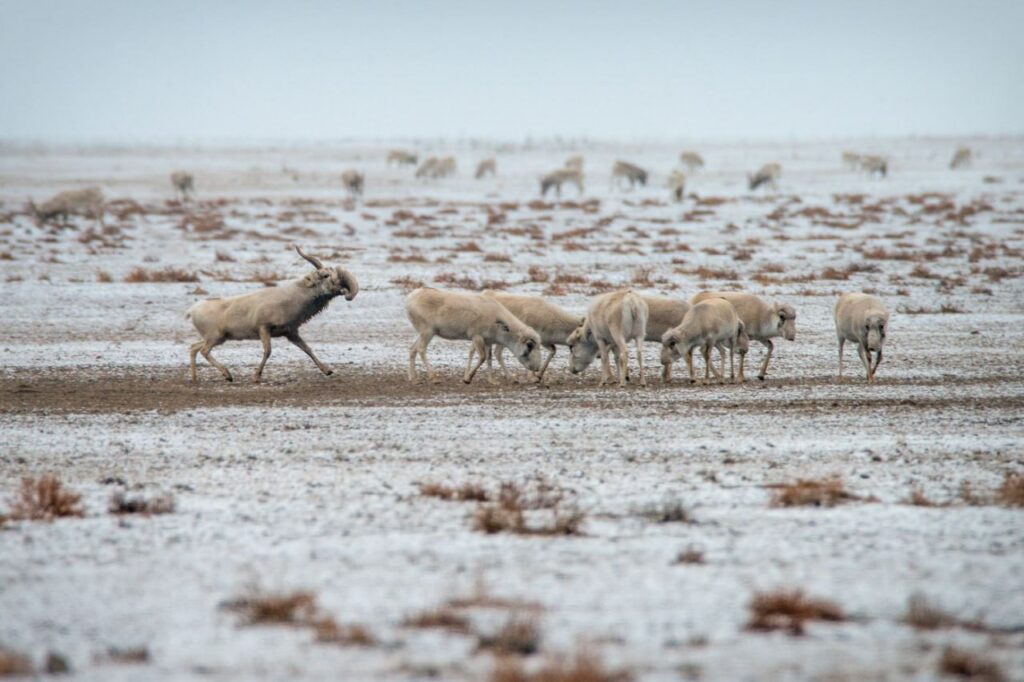
The shooting of saiga antelopes has resumed in Kazakhstan, which has angered many in the country, including residents of a village in the central Ulytau region, Kyzylzhar.

According to the Interior Ministry, on January 10 a group of Kyzylzhar residents deliberately prevented hunters from a company called Okhotzooprom from shooting the saigas. The persons were arrested and are currently in custody.

According to local ecologist Almasbek Sadyrbayev, the female saigas were carrying calves.  

The local authorities have pointed out that the saiga shootings were carried out lawfully, and that the villagers used physical force against Okhotzooprom staff.

Andrei Kim, deputy chairman of the Ministry of Ecology’s forestry and wildlife committee, confirmed at a press conference that the moratorium on saiga shooting in Kazakhstan, in force until 2024, will not be extended.

However, saigas have been introduced to western Kazakhstan as part of a program to regulate their population. Commercial hunting will continue until February 29.

Almaty Woman Protests Banning Of Women’s Rights March

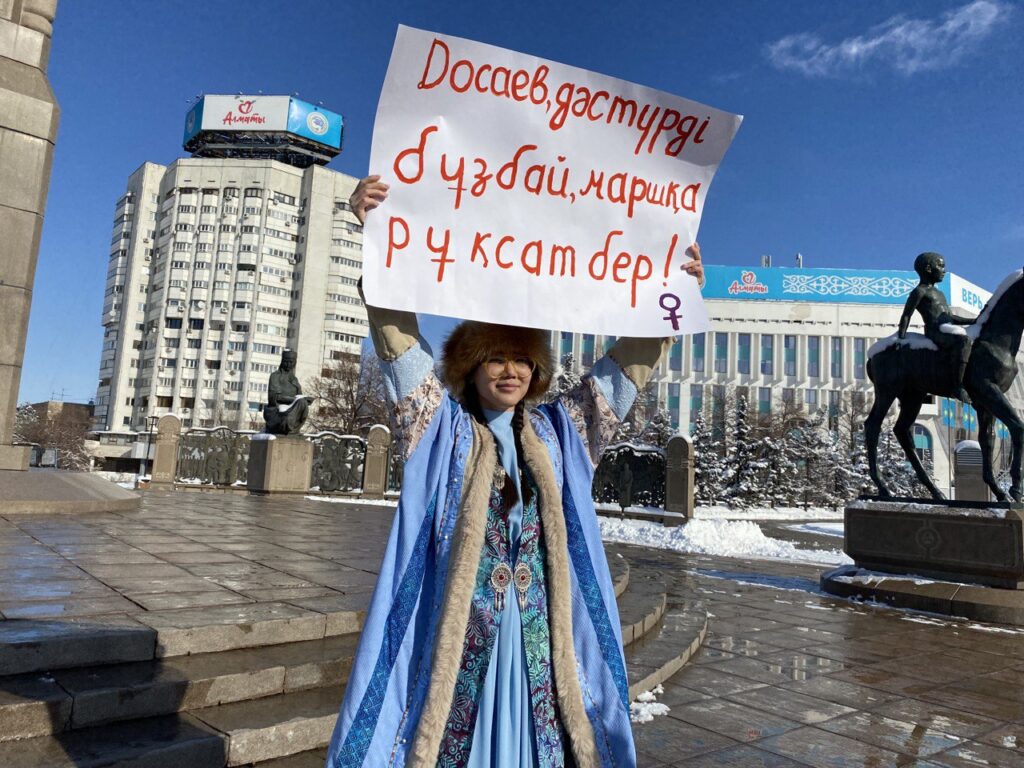
Almaty resident Liya Bergen recently made a lone protest on the city’s Republic Square to demand that the authorities approve an event for women’s rights. The event is planned for International Women’s Day on March 8, but the Almaty Akimat, headed by Yerbolat Dosayev, has refused to allow it to take place.

Ms Bergen held a placard written in Kazakh bearing the words: “Dosayev, don’t spoil the tradition, allow the march!”

She later explained that she was taking action for justice and equality, as well as reminding the city of the struggles that Kazakh women still face for their rights and dignity.