• KGS/USD = 0.01144 0%
  • KZT/USD = 0.00196 -0%
  • TJS/USD = 0.10899 -0%
  • UZS/USD = 0.00008 -0%
  • TMT/USD = 0.28490 0%
  • KGS/USD = 0.01144 0%
  • KZT/USD = 0.00196 -0%
  • TJS/USD = 0.10899 -0%
  • UZS/USD = 0.00008 -0%
  • TMT/USD = 0.28490 0%
  • KGS/USD = 0.01144 0%
  • KZT/USD = 0.00196 -0%
  • TJS/USD = 0.10899 -0%
  • UZS/USD = 0.00008 -0%
  • TMT/USD = 0.28490 0%
  • KGS/USD = 0.01144 0%
  • KZT/USD = 0.00196 -0%
  • TJS/USD = 0.10899 -0%
  • UZS/USD = 0.00008 -0%
  • TMT/USD = 0.28490 0%
  • KGS/USD = 0.01144 0%
  • KZT/USD = 0.00196 -0%
  • TJS/USD = 0.10899 -0%
  • UZS/USD = 0.00008 -0%
  • TMT/USD = 0.28490 0%
  • KGS/USD = 0.01144 0%
  • KZT/USD = 0.00196 -0%
  • TJS/USD = 0.10899 -0%
  • UZS/USD = 0.00008 -0%
  • TMT/USD = 0.28490 0%
  • KGS/USD = 0.01144 0%
  • KZT/USD = 0.00196 -0%
  • TJS/USD = 0.10899 -0%
  • UZS/USD = 0.00008 -0%
  • TMT/USD = 0.28490 0%
  • KGS/USD = 0.01144 0%
  • KZT/USD = 0.00196 -0%
  • TJS/USD = 0.10899 -0%
  • UZS/USD = 0.00008 -0%
  • TMT/USD = 0.28490 0%
08 December 2025

Kazakhstan’s Top Five Tourist Sites Revealed

According to Kazakhstan’s National Bureau of Statistics, from January to September 2023 more than three million people visited domestic tourist sites, an increase of 344,000 people compared to the same period in 2022.

The Ministry of Tourism and Sports has named the top five tourist sites in Kazakhstan by visitor numbers. The Almaty mountain cluster was the most popular destination — over 1.7 million people visited this area from January to September last year. The western Mangystau region was in second place, with just under 300,000 people visiting this part of the country. In third place was the Shchuchinsk-Borovoye area (Burabay National Park) in the north of the country, with 243,000 visitors. The list also included two popular summer holiday destinations: the Alakol area (Abay region, in the south) with 204,000 visitors, and Lake Balkhash with 94,000 visitors.

Deputy minister for tourism and sports Erzhan Erkinbayev commented: “Domestic resorts are increasingly popular not only among Kazakhstanis, but also among foreign guests. Unfortunately, the potential of some sites has not yet been fully realized. For example, in the Katon-Karagai national park [the largest national park in Kazakhstan, located in the East Kazakhstan region], the beauty of its nature is not inferior to any of the most popular tourist destinations in the country. However, only 7,800 people visited this place over the first nine months of last year,” 

President Rahmon Invites Qatari Business to Invest in Tajikistan

During his state visit to Qatar on January 22nd, the president of Tajikistan, Emomali Rahmon, held negotiations in Doha with the emir of the state of Qatar, Sheikh Tamim bin Hamad Al Thani. 

During the meeting, it was proposed to launch joint transport-transit projects in order to expand the logistics networks between the two countries. This will facilitate the transportation of cargo and passengers, as well as transit to other countries, Rahmon’s press service reported.

Also on January 22nd, Rahmon met with Qatar’s business community, expressing his views on a broad scope of cooperation opportunities with leading Qatari companies in the fields of agriculture, transport infrastructure, logistics, civil aviation, and tourism. The president emphasized that the government of Tajikistan is ready to support the proposals of investors to establish cooperation in these priority areas.

In his speech to the Qatari business community, Rahmon spoke about the current economic situation in Tajikistan and the macroeconomic stability ensured in the country. The president said that Tajikistan’s GDP growth rate in the last 20 years has been more than 7% on average, and in 2023 reached 8.3%, while inflation was 3.8%. “Today, more than 720 public investment projects worth more than USD 13.8 billion are under implementation in our country.”

Rahmon said that attracting investments is a priority for the Tajik government, and in this context, vast opportunities for investment have been created, and tax and customs incentives and guarantees are widely applied. 

According to Rahmon, Tajikistan’s aluminum production and lithium resources provide for favorable conditions for the production of electric vehicles. “That’s the two main types of materials for the production of electric cars available in our country,” he said.

The president pointed out that industrial production can be another future direction of cooperation, adding that projects in the light industry, food, metallurgy, machine building, chemistry, production of construction materials and pharmaceuticals are a priority for Tajikistan.

Rahmon also mentioned that Tajikistan is rich in mineral resources, with some 800 deposits of minerals, rare and precious metals, including copper, silver, gold, lead, lithium, antimony, nickel, tungsten, vanadium and other rare minerals having been discovered and partially prepared for mining in Tajikistan.

The president added that the reserves of food salt in Tajikistan amount to more than 72 billion tons, which is sufficient to meet the consumption needs of all inhabitants of the planet for this product for more than 300 years.

Forum Of Uzbek Regions And Chinese Provinces Held In Xinjiang

On January 22nd the first Uzbek-Chinese interregional forum was held in the city of Urumqi, in China’s Xinjiang Uyghur Autonomous Region. The forum was attended by heads of key ministries, industry associations, chambers of commerce and industry, companies and more than 1,200 representatives of the business communities of the two countries.

The Uzbek delegation at the forum was headed by deputy prime minister Jamshid Khojaev. The Chinese delegation was led by Ma Xingrui, secretary of the Party Committee of the Xinjiang Uygur Autonomous Region.

In their welcoming speeches, the heads of both delegations stated that Uzbek-Chinese relations have entered a qualitatively new stage, which became possible thanks to the far-sighted policies of the heads of the two states, the Uzbek Ministry of Investment, Industry and Trade reported.

The officials emphasized the positive dynamics of trade and investment partnership, with bilateral trade turnover having doubled and exceeding $14 billion over the past six years. It was noted that all the necessary capabilities are available to increase this indicator up to $20 billion in the coming years. The volume of utilized Chinese investments in Uzbekistan amounted to almost $15 billion. More than 2,000 enterprises with the participation of Chinese capital operate in Uzbekistan. In 2023 more than 60 projects worth almost $2 billion were successfully launched with the participation of Chinese companies, which are becoming leading partners in modernizing the country’s industrial sector.

Mr Khojaev and Mr Xingrui outlined the further steps to increase cooperation between the two countries, including through direct interaction between regions, emphasizing the importance of regularly holding exhibitions of the industrial and agricultural potential of the regions of Uzbekistan and the provinces of China.

The heads of delegations called on business leaders to step up efforts to create high-tech industries based on the competitive advantages of the economies of the two countries, develop industrial cooperation to produce in-demand products and jointly develop new markets, as well as increase the volume of mutual trade.

As a result of the forum, 27 documents were signed on the establishment of economic, trade and cultural ties between the regions of Uzbekistan and the provinces of China. In addition, a solid package of 30 agreements and contracts was signed between the business communities of the two countries.

The Last Emir of Bukhara – In the Shadow of Antiquity

The seventh largest city in Uzbekistan, the history of Bukhara is swathed in legends which stretch back for millennia and can be traced to the period of Aryan immigration into the region. After passing through the hands of Alexander the Great, the Bactrians, the Kushan Empire and many others, Bukhara became an epicenter of Persian culture in medieval Asia. With the rise of the Caliphate, by the end of the ninth century Bukhara was one of the most significant Islamic and cultural sites in the region. Throughout its history, Bukhara has been nourished by merchants and travelers, establishing itself as a major hub of trade and crafts on the Silk Road.

Today, in the orange early morning light, women holding parasols walk their children to school down gravel alleyways to the ever-present hum of air-con units. Broom-wielding figures in high-viz orange jackets cast bulbous shadows as they sweep the dust from side to side. As the sun arcs towards its zenith, a haze develops, the heat so overpowering that even the hawkers lose the will to sell.

Weaving past scant pedestrians, infrequent marshrutkas head out of town towards the glittering Summer Palace of Bukhara’s last Emir, the outsized Sayyid Mir Muhammad Alim Khan. Beyond the imposing majolica tiled gateway of the Russian-built Sitora-I Mohi Khosa – Palace of the Stars and the Magnificent Moon – the banqueting hall contains an elaborate bronze chandelier from Poland weighing half a ton. To gasps of awe, Bukhara’s first electric light shone from it during the 1910s thanks to a fifty-watt generator.

An avenue of quince trees leads to an ostentation of peacocks parading around a voluminous pool, where the Emir’s harem used to frolic. Raised on a platform high above them, the Emir would sit upon his gilded throne, bejeweled and decked in golden threads, choosing his lady for the night. Escaping the conflict between reformers and imams, and ever more dependent upon the overlords who would inevitably bring about his downfall, Amir Khan spent his last years as ruler cocooned in the Summer Palace, sating his gluttonous appetite from a glass-fronted Russian refrigerator.

Putting his lot in with the reformers, then switching sides in the face of the mullah’s power, in his final years the last Emir was a leaf in the wind. These were the dark days of mass executions, book burnings, and an intellectual exodus from the Emirate. When the ripples from the Bolshevik Revolution reached his kingdom, Alim Khan declared a Holy War upon the Russians and their reformist allies, the Young Bukharans. With Russian gunners initially forced back by frenzied, knife-wielding true believers, tit-for-tat retributions took place before, with their inevitable victory sealed, the Red Army set about pillaging and murdering their vanquished foes. On September 2nd 1920, soldiers raised the Red Banner from the bombed-out lantern of the Kalon Minaret.

From the ninth-century Pit of the Herbalists to the Ismail Samani Mausoleum, Bukhara isn’t about its separate sights, though, it is the sum of its parts, a timeless city permeated by an air of antiquity. On cobblestone back alleys, decked in dopys – four-sided black skullcaps – striped robes and knee-length rubber boots, revered white-bearded elders idle the afternoons away over pots of choy. From terraces where their mothers hang lines of laundry between buildings, the playful cries of children ring out by the Kalon Minaret.

Built as an inland lighthouse for desert caravans, the Kalon Minaret – ‘great’ in Tajik – was almost certainly the tallest building in Central Asia upon its completion in 1127. The third minaret to have been built on this site, previous incarnations had caught fire and collapsed onto the mosque below, officially because of the ‘evil eye’. Also known as the ‘Tower of Death’, over the centuries the minaret has seen countless bodies sewn into entrail catching sacks and tossed from its 47-metre-high lantern. Particularly popular during Mangit times, this practice survived until the 1920s.

Home to the first recorded use of the now ubiquitous blue tile in Central Asia, the fourteen distinct bands of the minaret are majestic in the pink light, its scale and intricacy remarkable. But despite the lingering sense of history, everyday life goes on unabated at its stout base. Traders hawk their wares, and when the heat of the day finally abates, head-scarfed babushkas sit chit-chatting on the cool stone steps of the Mir-i-Arab Madrassa. In the square around them, children bounce beach balls off the hallowed walls, as above them doves circle the Madrasa’s crescent moon.

Seven times rebuilt upon the ruins of its predecessor, at the northern edge of town, the Ark – the former Royal City – had grown ever higher with each new incarnation. Of mythic origins, the Ark of Bukhara dates back to at least the fifth-century AD. When it was leveled in an aerial bombardment ordered by the Bolshevik General Frunze in 1920, the planes that reduced it to rubble were the first most Bukharans had ever seen. What survived the blitz was ordered destroyed by the fleeing Alim Khan. Shortly to be safe in exile in Tajikistan with the city’s teeming coffers, the Emir bade that his harem should be blown-up lest the Bolsheviks desecrate it. It is unclear whether the women of the harem were still inside at the time.

The last vestiges left by Alim Khan’s beks (governors) after he fled, Southern Tajikistan is littered with ruined Bukharan garrisons. Escaping to Dushanbe – then just a village – Alim Khan sought international support, but found no backers. With the Bolsheviks advancing, his Basmachi (bandit) Army of Islam riven by infighting, and his requests for aid having gone unanswered, the last Emir floated across the Pyanj River to Afghanistan on a raft made of wood and sheep-gut, never to return to his homeland.

Kazakh PM Reports On Country’s Economic Results For 2023

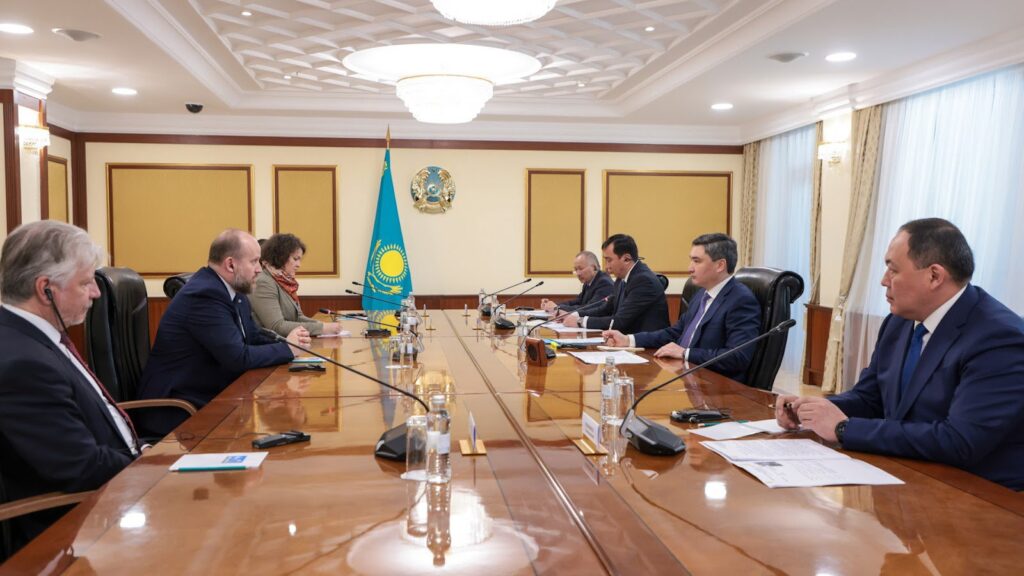
On January 22nd Kazakh president Kassym-Jomart Tokayev received the country’s prime minister Alikhan Smailov, who reported on Kazakhstan’s economic results for 2023, the presidential press office reported. 

In 2023 the country’s economic growth was 5.1%. Investments in fixed capital increased by 13.7%, to $39.5 billion, while over the first nine months of 2023 $19.7 billion of foreign direct investment was attracted. The number of people employed in small and medium-sized businesses increased by 14% (by 500,000) to 4.3 million people. Inflation was reduced twofold, down to 9.8%.

Kazakhstan’s foreign trade turnover last year increased by 2.2% and amounted to $126 billion, with exports exceeding imports by $16 billion.

Tokayev was informed that the government fulfilled all its social obligations. Pensions were indexed by 10.5%, and by another 9% since the beginning of this year. Payments to persons with disabilities increased by 23%.

The prime minister reported on the implementation of the Unified Pool of Investment Projects. Last year, 298 projects were launched. In 2024 it is planned to implement another 326 projects, including 180 projects in the manufacturing industry, creating 15,000 new jobs.

Turkmen Foreign Minister Visits Japan, Meets With Business Community

During a working visit to Japan on January 22nd, the Turkmen foreign minister, Rashid Meredov, held a meeting with the chief cabinet secretary of Japan, Yoshimasa Hayashi.

They exchanged views on the current state of their countries’ bilateral cooperation in priority areas, the Turkmen Ministry of Foreign Affairs reported, as well as prospects for developing ties. Mr Meredov stressed the positive dynamics in cooperation between Turkmenistan and Japan in the political, trade, economic, cultural and humanitarian spheres.

The parties focused on the development of trade and economic ties, mentioning a number of successfully completed joint projects in the energy and gas chemical industries. They also identified priorities for further cooperation in the energy, industrial, and investment sectors, as well as in the fields of culture, science, and education.

Also on January 22nd, the Turkmen delegation led by Mr Meredov met with representatives of the Japanese business community. It was suggested to invite Japanese companies to produce export goods with high added value in Turkmenistan, as well as to involve small and medium-sized enterprises from both countries in joint projects. Representatives of Japanese companies showed interest in cooperating in the fields of infrastructure and energy transition.