• KZT/USD = 0.00210
  • TJS/USD = 0.10810
  • UZS/USD = 0.00008
  • TMT/USD = 0.29760
  • KZT/USD = 0.00210
  • TJS/USD = 0.10810
  • UZS/USD = 0.00008
  • TMT/USD = 0.29760
  • KZT/USD = 0.00210
  • TJS/USD = 0.10810
  • UZS/USD = 0.00008
  • TMT/USD = 0.29760
  • KZT/USD = 0.00210
  • TJS/USD = 0.10810
  • UZS/USD = 0.00008
  • TMT/USD = 0.29760
  • KZT/USD = 0.00210
  • TJS/USD = 0.10810
  • UZS/USD = 0.00008
  • TMT/USD = 0.29760
  • KZT/USD = 0.00210
  • TJS/USD = 0.10810
  • UZS/USD = 0.00008
  • TMT/USD = 0.29760
  • KZT/USD = 0.00210
  • TJS/USD = 0.10810
  • UZS/USD = 0.00008
  • TMT/USD = 0.29760
  • KZT/USD = 0.00210
  • TJS/USD = 0.10810
  • UZS/USD = 0.00008
  • TMT/USD = 0.29760

Viewing results 1 - 6 of 108

Putin’s Astana Visit Shows What Russia Still Wants From Kazakhstan

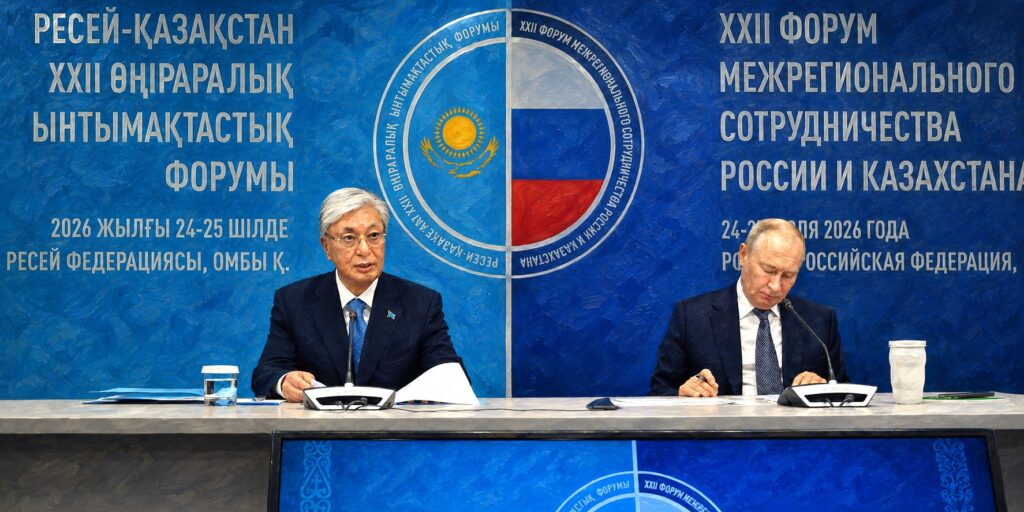
The Eurasian Economic Union summit in Astana gave Vladimir Putin's state visit a wider stage. The summit produced technical documents and familiar language about integration. The bilateral Russia-Kazakhstan package around it was more concrete. It showed what Moscow still wants from Kazakhstan, and what Astana expects in return. The detail lies in infrastructure, where contracts can last for decades. The setting echoed history. Belarus, Kazakhstan, and Russia signed the treaty creating the Eurasian Economic Union in Astana on May 29, 2014, with Armenia joining in January 2015, and Kyrgyzstan in August of the same year. In 2026, the bloc returned to Astana for the Supreme Eurasian Economic Council and the V Eurasian Economic Forum. The theme of the forum was artificial intelligence, digital regulation, and the EAEU's place in the global technology race. Its website said 14 integration documents were signed on the sidelines, including memoranda, agreements, protocols, and joint action plans. Those documents gave the visit a regional frame. The larger result came on May 28, when Kassym-Jomart Tokayev and Putin oversaw a broad set of bilateral agreements. Akorda listed nuclear power, Russian export credit, expanded oil-sector cooperation, a tenge-ruble currency swap, education projects, financial monitoring, transport digitalization, and nuclear safety regulation. That package points to the real agenda: energy, transit, payments, industrial production, and public-facing alliance language. For Moscow, Kazakhstan’s primary value is geographic: it sits between Russia and China, and across routes that connect Central Asia to Europe, the Caspian, and South Asia. Russian crude already crosses Kazakhstan on the Priirtyshsk-Atasu-Alashankou route to China. A KazTransOil contract keeps transit at 10 million tons a year until the end of 2033. The tariff is $15 per ton, excluding VAT. The Atasu-Alashankou pipeline has a design capacity of 20 million tons a year and belongs to Kazakhstan-China Pipeline LLP, a 50-50 venture between KazTransOil and China National Oil and Gas Exploration and Development Company. Reuters has reported that Russia and Kazakhstan agreed last year to raise that flow by 2.5 million tons, although the extra volume had not started flowing before Putin’s visit. The new agreement on oil-sector cooperation gives the issue a political push. For Moscow, the route strengthens access to China as Western sanctions keep pressure on Russian exports and payments. For Kazakhstan, it brings fees and gives Astana a useful position in Russia-China energy flows. The nuclear agreement, meanwhile, gives Russia a long-term role in Kazakhstan’s shift to nuclear power. Kazakhstan and Russia signed a $16.5 billion agreement for the Balkhash nuclear power plant at Ulken, near Lake Balkhash. The project covers two VVER-1200 III+ reactors. Kazakhstan held a groundbreaking ceremony for the plant in August 2025, with the active construction phase expected to begin in 2027, and the first reactor expected in early 2034. Russia will provide export credit for the first plant, with Rosatom leading the Balkhash project after competition with China National Nuclear Corporation (CNNC), France’s EDF, and Korea Hydro and Nuclear Power. But Kazakhstan has not handed the wider program to Moscow....

EAEU Summit in Astana: Is Moscow Pushing Armenia Toward the Exit?

Russian President Vladimir Putin is due to arrive in Astana on May 27 for a state visit, while the Eurasian Economic Forum and a meeting of the Supreme Eurasian Economic Council will take place in Kazakhstan’s capital on May 28-29. Against the backdrop of increasingly strained relations between Moscow and Yerevan, Armenian Prime Minister Nikol Pashinyan will not attend the summit. Armenia will instead be represented by Deputy Prime Minister Mher Grigoryan. Kazakhstan’s presidential administration has already outlined the agenda for the visit. Putin is expected to receive full state honors. After the official welcoming ceremony, Putin and Kazakh President Kassym-Jomart Tokayev will hold bilateral talks. On May 28-29, Tokayev, Putin, and other EAEU leaders are expected to take part in the Eurasian Economic Forum and the Supreme Eurasian Economic Council meetings. Strategic Partnership and Growing Pressure Political analyst Andrey Chebotarev said the agenda of the Tokayev-Putin talks is likely to focus on implementing the declaration signed during Tokayev’s state visit to Russia in November 2025, which raised Kazakhstan-Russia relations to the level of a “comprehensive strategic partnership and alliance.” The declaration envisioned expanded cooperation in politics, security, economics, integration, high technology, and humanitarian affairs. According to Chebotarev, the two presidents now need to define concrete mechanisms for implementing those agreements. Among the most sensitive issues is the planned construction of Kazakhstan’s first nuclear power plant with the participation of Russia’s Rosatom. Astana, Chebotarev argued, is particularly interested in ensuring the continuity of the project as Western sanctions against Moscow tighten. Another key issue is the uninterrupted transit of Kazakh oil exports to Europe through Russian territory. “This issue is especially relevant given, first, the suspension of oil deliveries through the Druzhba pipeline, which the Russian side explains as being due to technical reasons, and second, the continuing Ukrainian drone attacks on the Russian ports of Novorossiysk and Ust-Luga on the Black and Baltic seas,” Chebotarev said. Other likely topics include logistics linked to the North-South transport corridor and the worsening decline in the Caspian Sea’s water level, particularly ahead of the planned seventh summit of Caspian littoral states later this year. Information Wars and the Golden Horde Debate The Putin-Tokayev meeting is taking place against an increasingly difficult information backdrop shaped by several Russian media outlets and commentators. Russian public discourse has continued to react strongly to the recent international symposium in Astana dedicated to the legacy of the Golden Horde, as well as to Tokayev’s remarks during the event. Kazakh political analyst Daniyar Ashimbayev, commenting ahead of Putin’s visit, argued that Kazakhstan-Russia relations were being subjected to “attacks and information provocations.” He described this as part of a campaign to turn Kazakhstan into “a platform for confrontation with Russia” amid the broader Russia-West conflict. He added that similar efforts were visible in attempts to inflame tensions between Kazakhstan and China. At the same time, Ashimbayev avoided publicly criticizing Russian opinion leaders, many of whom have become increasingly vocal in questioning the alliance between Moscow and Astana. Armenia’s Growing...

China to Supply Tajikistan With Intelligence and Counterterrorism Equipment

China will provide Tajikistan with intelligence, police, and counterterrorism equipment worth more than $7.6 million under a grant assistance program approved by the two governments. The governments of the two countries signed the corresponding memorandum of understanding on May 8. The agreement provides for the transfer of equipment by China for the needs of Tajikistan’s Ministry of Internal Affairs. Under the terms of the deal, the Chinese side will deliver 34 intelligence devices along with additional police and counterterrorism equipment. The shipment is expected to enter Tajikistan through the Karasu border crossing. China will also dispatch eight specialists to Tajikistan to install and configure the equipment and train Tajik personnel. Their mission is expected to last 45 days. The total value of the equipment and services amounts to 52 million Chinese yuan, or approximately $7.64 million. All associated costs will be fully covered by the Chinese side. Tajikistan, for its part, has agreed to handle customs clearance, transportation and storage of the equipment once it arrives in the country. Authorities will also exempt the deliveries from taxes and customs duties and provide the necessary conditions for the Chinese specialists, including visas, accommodation, and security arrangements. A special working group will be established to coordinate with Chinese engineers during installation and personnel training. The document separately emphasizes that after delivery the two sides will jointly inspect the quality, quantity and technical specifications of the equipment before signing a formal acceptance certificate. Future operation and maintenance costs will then become the responsibility of the Tajik side. China remains one of Tajikistan’s largest strategic partners. Following President Emomali Rahmon’s recent state visit to China, Tajik officials said more than 80 cooperation documents were signed as a result of high-level talks and business meetings, while China’s Foreign Ministry referred separately to more than ten state-level cooperation documents. Earlier, Tajikistan’s parliament also approved an agreement under which China would finance the construction of nine border facilities along the Tajik-Afghan frontier. The new grant comes amid renewed scrutiny of China’s expanding role in Tajikistan’s security sector. Reports and speculation about a possible Chinese military facility in Gorno-Badakhshan have surfaced periodically, including in 2021 and again in 2024. However, Tajikistan’s Ministry of Internal Affairs and Ministry of Foreign Affairs have denied the existence of a Chinese military base on the country’s territory.

Opinion: How AI Is Reshaping the Global Image of Nations

Artificial intelligence is rapidly becoming one of the most powerful geopolitical and economic forces in the world. It is changing how countries compete, build influence, and attract investment. Until recently, discussions about Central Asia’s economic development were dominated by infrastructure, energy, logistics, and natural resources. Today, a new layer of competition is emerging: digital influence shaped by AI systems. According to McKinsey, AI could contribute up to $13 trillion to the global economy by 2030. For Central Asia and Kazakhstan, AI development is no longer just a digital transformation agenda; it is directly tied to technological sovereignty, economic resilience, and long-term competitiveness. Who Shapes a Country’s Image in the Age of AI? Digital influence is increasingly determined by how artificial intelligence systems interpret and represent countries. Consider a Singaporean investor asking Gemini about emerging technology markets in Central Asia. A European procurement manager using ChatGPT to identify logistics partners in the region. A journalist turning to Perplexity for insights on Kazakhstan’s fintech ecosystem before writing a report. In each case, AI generates answers based on the data it has been trained on and can access. This creates a new geopolitical reality: those who shape data and content structure ultimately shape how countries are represented globally. Generative AI is already used at a massive scale, with ChatGPT surpassing 900 million weekly active users as of early 2026. As these systems become default information interfaces, the visibility of countries within AI-generated responses is becoming increasingly important. When high-quality, structured, and authoritative content is missing, AI systems rely on outdated information, fragmented sources, and external narratives. In practice, this means that a lack of structured digital presence can directly influence international perception. How Other Countries Are Responding Several countries have already recognized this shift and are actively responding. According to Axios, Israel paid Brad Parscale’s firm $9 million as part of a campaign aimed at shaping how AI platforms portray the country. The United Arab Emirates and Saudi Arabia are investing heavily in AI infrastructure and Arabic-language models, including Gulf-backed data centers, sovereign AI initiatives, and Arabic-first large language models. These efforts go beyond technology development. They represent a broader competition for influence in an information environment where AI-generated responses increasingly shape global understanding. AI Momentum in Kazakhstan In 2025, Kazakhstan was listed among the region’s strongest performers in the Government AI Readiness Index published by Oxford Insights. Kazakh officials cited a ranking of 60th out of 195 countries, while Oxford Insights published a regional report that placed Kazakhstan 58th globally. In either case, it was the highest-ranked of the five Central Asian states and represented a sharp improvement from the previous year. Over the past two years, Kazakhstan has demonstrated rapid progress in artificial intelligence. Venture investment in AI has increased more than fivefold, from $14 million to $73 million. IT service exports surpassed $1 billion in 2025, with later ministry figures putting the total at about $1.14 billion. The Kazakh-linked AI startup Higgsfield AI has also been widely described as Kazakhstan’s...

Russian Official Says West Is Seeking to Reduce Moscow’s Influence in Central Asia

Russia’s Deputy Foreign Minister Mikhail Galuzin has accused Western countries of attempting to weaken Russia’s position in Central Asia by expanding their economic and strategic influence across the region, according to an interview published by the Russian newspaper Izvestia. Galuzin said the United States and the European Union are seeking greater control over key transport corridors and natural resources in Central Asia, presenting their engagement as efforts to diversify economies and strengthen regional resilience. However, he argued that such initiatives are driven by broader geopolitical objectives. “We note the desire of the United States and the European Union to take control of key transport corridors and natural resources in the region,” Galuzin told Izvestia. He added that Moscow is concerned by what it sees as Washington’s growing involvement in agreements related to critical minerals and rare earth metals. “This is not simply economic competition, but an attempt to push Russia out and create Western-controlled infrastructure near our borders,” Galuzin said. The remarks reflect Moscow’s concern over Central Asia’s multi-vector diplomacy, as Kazakhstan, Uzbekistan, and their neighbors expand ties with the European Union, China, the United States, and Gulf countries while maintaining longstanding relations with Russia. Galuzin also claimed that Western governments are promoting narratives portraying Russia as a security threat in an effort to influence regional policymakers. “We observe how the United Kingdom and some EU states systematically advance the narrative of an alleged danger coming from Moscow,” he said. According to the Russian diplomat, the aim is to encourage Central Asian governments to move away from cooperation with Russia in favor of political and economic incentives offered by Western countries. He argued that regional states are unlikely to support such a shift. “Neither Russia nor our historical friends and strategic partners in Central Asia are interested in such scenarios,” Galuzin said, adding that countries in the region “do not want to become pawns in someone else’s game.”

OTS Summit in Turkistan Reveals Strains Beneath Turkic Unity

Last Friday, the Kazakh city of Turkistan, officially promoted as the “spiritual capital” of the Turkic world, hosted an informal summit of the Organization of Turkic States (OTS). The official theme was artificial intelligence and digital development, but the meeting also highlighted older questions about the OTS’s political identity, its relationship with Russia, and Ankara’s influence within the Turkic world. Because the gathering was informal, much of what took place remained behind closed doors. Yet public statements, official readouts, and subsequent commentary offered clues about the tensions and competing agendas within the organization. The summit brought together the presidents of Turkey, Azerbaijan, Kyrgyzstan, and Uzbekistan, as well as Tufan Erhurman, president of the Turkish Republic of Northern Cyprus, which is recognized only by Turkey. The meeting followed Turkish President Recep Tayyip Erdoğan’s state visit to Kazakhstan, during which the two countries signed 15 agreements, including a Declaration on Eternal Friendship and an Enhanced Strategic Partnership between Kazakhstan and Turkey. In Turkistan, summit participants visited the mausoleum of Khoja Ahmed Yasawi, where Erdoğan donated a handwritten Quran manuscript to the historic site. Leaders also launched the construction of a Center for Turkic Civilization. The presidents of Kazakhstan and Uzbekistan separately visited a newly built mosque donated to Turkistan by Tashkent. Despite the atmosphere of symbolism and fraternity, however, the summit also exposed clear differences between Ankara’s wide-ranging vision for the OTS and Astana’s insistence that the organization should remain a practical cooperation platform. Those differences became especially visible in President Kassym-Jomart Tokayev’s speech at the summit. “Recently, opinions have been voiced portraying our organization as a military alliance. It is obvious that those spreading such speculation pursue malicious goals and seek to sow discord. Kazakhstan considers it necessary to reject such positions,” Tokayev said. “The Organization of Turkic States is neither a geopolitical project nor a military organization. It is a unique platform aimed at strengthening trade, economic, technological, digital, cultural, and humanitarian cooperation among brotherly nations.” Kazakh political analyst Daniyar Ashimbayev argued that Tokayev’s remarks reflected a growing internal debate within the OTS. “On the one hand, some media interpreted his words as a response to foreign experts warning about the emergence of a ‘Turanic NATO.’ On the other hand, it should be noted that some fellow presidents within the OTS persistently promote the development of military cooperation. Kazakhstan is equally persistent in defining which forms of interaction it considers acceptable within the organization,” Ashimbayev wrote. Another analyst, Andrei Chebotarev, also argued that the core message of Tokayev’s speech was to frame the OTS primarily as a platform for economic, technological, digital, cultural, and humanitarian cooperation. “In this context, he rejected the idea of transforming the organization into a military-political bloc. This sent a signal both to pan-Turkic political forces interested in such a transformation and to political elites in countries that view the organization’s activities with caution,” Chebotarev said. Chebotarev also noted that Tokayev referenced the “OTS+” format launched at the organization’s previous summit in Azerbaijan and voiced support...