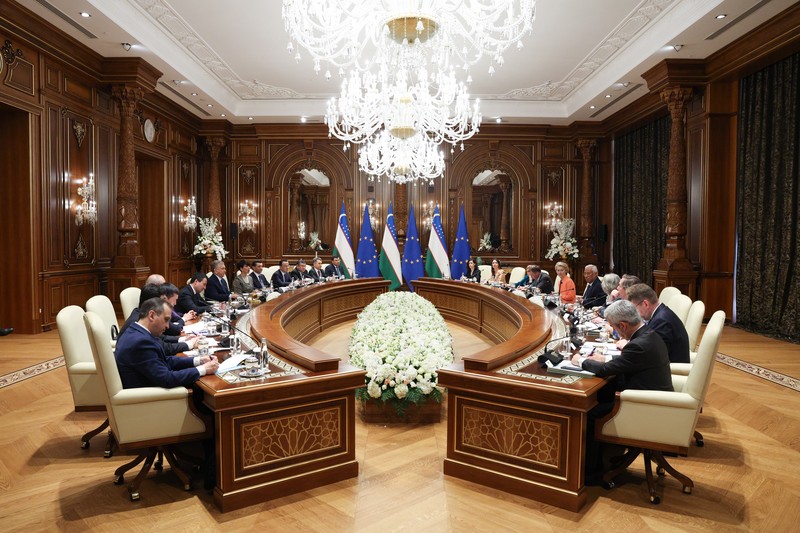
Central Asia is not foreign to the emerging geopolitics of silicon and artificial intelligence (AI). Kazakhstan especially has made itself noticed, joining the US-led Pax Silica initiative in June and the Chinese-led World Artificial Intelligence Cooperation Organization (WAICO) in July. Kazakhstan is the only country participating in both initiatives, which is characteristic of Astana’s multi-vector diplomacy.
Whilst other Central Asian states have joined WAICO, Turkmenistan, consistent with its permanent neutrality stance, has joined neither. Neutrality, however, does not prevent economic participation, and a case has to be made for Turkmenistan.
Two Frameworks for International Cooperation
Although both initiatives respond to the same underlying reality – the growing strategic importance of artificial intelligence – they differ in scope and emphasis. Pax Silica is built around the material and economic foundations of AI, focusing on securing and coordinating the physical supply chains that make computation possible and aiming implicitly to reduce reliance on China. WAICO, by contrast, is centered on the political and normative dimension of AI, prioritizing governance, safety standards, and international coordination, where Beijing could push its rhetoric in favour of open-source artificial intelligence as a model for AI development.
Taken together, they reflect two complementary but distinct ways of structuring the emerging AI order: one rooted in industrial capacity and supply-chain control, the other in multilateral rules. On that matter, Turkmenistan’s possible relevance does not lie in software, semiconductor fabrication or AI regulation, but much further upstream: silicon metallurgy.
From Gas to Silicon
Silicon is abundant in nature, but transforming it into industrial materials is an energy-intensive process. Quartz or quartzite is used to produce both silicon ferroalloys and silicon metal. Ferrosilicon is principally consumed by the iron and steel industries, where it serves as a deoxidizing and alloying agent. Silicon metal, meanwhile, is used in aluminum alloys and chemical production, while a small share is further purified into the extremely high-purity silicon required by the semiconductor industry.
Ferrosilicon should not be presented as a material that goes directly into AI chips. But establishing competitive ferrosilicon production can constitute a first industrial step into the broader family of silicon metallurgy. And Turkmenistan has already begun considering precisely that.
In 2020, the Turkmen authorities reported that the Ministry of Industry was studying the production of metallurgical-grade silicon using local resources. Practical tests had already been conducted using quartz sand, metal mixtures and petroleum coke, while the government presented the development of domestic mineral resources as part of a broader strategy of industrialization and export diversification.
The ambition became more concrete in January 2024. Turkmenistan’s Ministry of Industry and Construction Production launched an international tender for a feasibility study for a ferroalloy plant intended to manufacture ferrosilicon, silicon carbide, and technical silicon.
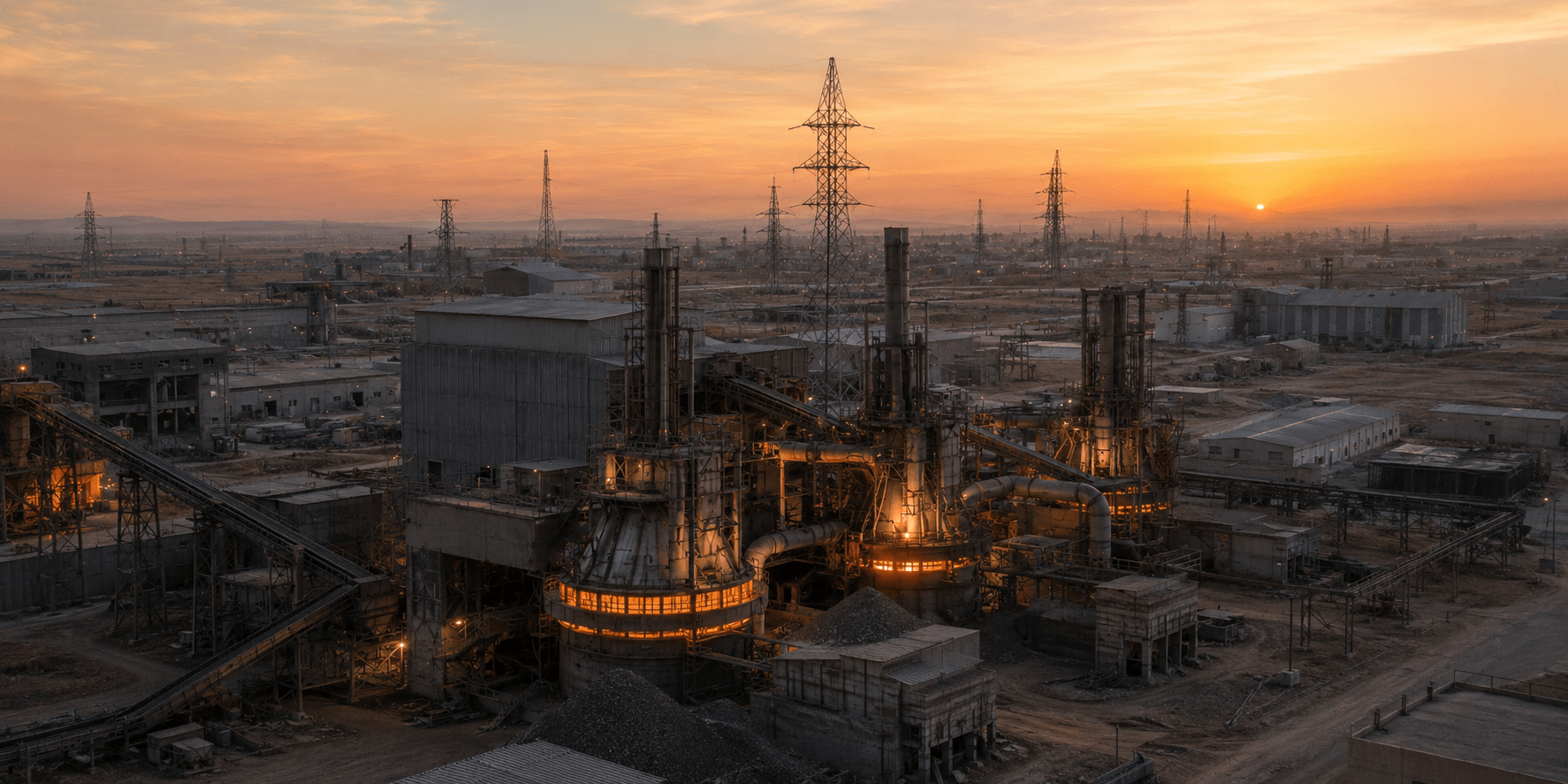
A 2024 feasibility study for such a project envisions a plant in Balkan Velayat capable of producing 15,000 tons of FeSi75 ferrosilicon annually. The proposed complex would operate two 12,500 kVA furnaces.
Rather than depending exclusively on domestic raw materials, the study envisages sourcing quartzite from nearby Iran and Uzbekistan, while petroleum coke could be supplied by the Turkmenbashi refinery complex. Electricity would be supplied domestically, while desalinated Caspian water is proposed for the plant’s industrial needs. Turkmenistan could therefore position itself not simply as a country possessing one particular resource, but as an industrial processing point.
For decades, the country has monetized its enormous natural-gas reserves mainly by exporting gas itself. Energy-intensive metallurgy offers another possibility: using domestic energy to transform comparatively ordinary raw materials into higher-value industrial exports. Electricity in Turkmenistan is among the cheapest worldwide, at around 20$/MWh, making such a project particularly relevant.
Access to regional silica resources, domestic petroleum coke, cheap energy and a location between the major markets of Europe and Asia are Ashgabat’s value proposition.
A First Step Towards a Silicon Industry
Obviously, a 15,000-ton ferrosilicon plant would hardly turn Turkmenistan into a semiconductor powerhouse. Nor is the technological jump from FeSi75 to electronic-grade silicon straightforward. Semiconductor silicon requires purification standards and industrial processes far beyond conventional ferroalloy production.
A ferrosilicon industry would create experience in sourcing and testing silica feedstocks, operating large electric furnaces, managing carbon reductants, controlling energy-intensive continuous production and selling silicon-based metallurgical products in international markets. Many of these capabilities are adjacent to the production of silicon metal, which is itself produced from quartz using electric furnaces before undergoing much more sophisticated downstream purification.
More importantly, Ashgabat’s own plans have never been limited to ferrosilicon. The 2024 tender explicitly combined ferrosilicon, silicon carbide and technical silicon within the same proposed industrial development.
That broader approach is encouraging.
Silicon carbide has applications stretching from traditional abrasives and refractories to advanced power electronics, while technical or metallurgical silicon provides a gateway toward much larger downstream value chains.
Ferrosilicon could therefore be viewed not as the end product of a Turkmen silicon strategy, but as its industrial entry point.
Central Asia’s Silicon Geography is Still Being Written
The first phase of Central Asia’s post-Soviet economic geography was largely shaped by what lay beneath its soil. Kazakhstan exported oil and uranium; Turkmenistan built its external economic relations around natural gas; Uzbekistan developed gold, copper and increasingly diversified manufacturing.
The emerging competition around AI could introduce a different logic. The question is increasingly not only who possesses resources, but who can transform them, provide the energy required to process them and connect them to secure international supply chains.
Kazakhstan is already making itself very much visible. For Ashgabat, the opportunity may lie precisely in converting its neutrality and abundant energy into an ability to supply several markets without defining the country’s future exclusively through one geopolitical camp.
If the country can build competitive ferroalloy production and gradually develop silicon metal and related industries around it, it could occupy a much earlier stage of the global AI technology supply chain. In many ways it will depend on Turkmenistan’s ability to attract foreign know-how.
The geopolitics of silicon and artificial intelligence may be discussed in Washington, Brussels or Beijing, but part of its industrial geography will be determined much further upstream, around quartz, electricity and furnaces.
The views expressed in this article are those of the author and do not necessarily reflect the official policy or position of the publication, its affiliates, or any other organizations mentioned.