• KGS/USD = 0.01143 0%
  • KZT/USD = 0.00205 0%
  • TJS/USD = 0.10433 0.1%
  • UZS/USD = 0.00008 0%
  • TMT/USD = 0.28577 0%
  • KGS/USD = 0.01143 0%
  • KZT/USD = 0.00205 0%
  • TJS/USD = 0.10433 0.1%
  • UZS/USD = 0.00008 0%
  • TMT/USD = 0.28577 0%
  • KGS/USD = 0.01143 0%
  • KZT/USD = 0.00205 0%
  • TJS/USD = 0.10433 0.1%
  • UZS/USD = 0.00008 0%
  • TMT/USD = 0.28577 0%
  • KGS/USD = 0.01143 0%
  • KZT/USD = 0.00205 0%
  • TJS/USD = 0.10433 0.1%
  • UZS/USD = 0.00008 0%
  • TMT/USD = 0.28577 0%
  • KGS/USD = 0.01143 0%
  • KZT/USD = 0.00205 0%
  • TJS/USD = 0.10433 0.1%
  • UZS/USD = 0.00008 0%
  • TMT/USD = 0.28577 0%
  • KGS/USD = 0.01143 0%
  • KZT/USD = 0.00205 0%
  • TJS/USD = 0.10433 0.1%
  • UZS/USD = 0.00008 0%
  • TMT/USD = 0.28577 0%
  • KGS/USD = 0.01143 0%
  • KZT/USD = 0.00205 0%
  • TJS/USD = 0.10433 0.1%
  • UZS/USD = 0.00008 0%
  • TMT/USD = 0.28577 0%
  • KGS/USD = 0.01143 0%
  • KZT/USD = 0.00205 0%
  • TJS/USD = 0.10433 0.1%
  • UZS/USD = 0.00008 0%
  • TMT/USD = 0.28577 0%

Viewing results 1 - 6 of 164

Chinese Mining Firm Lists on AIX in Landmark Belt and Road IPO

China’s Jiaxin International Resources Investment Limited, the world’s leading tungsten mining and production company, has successfully completed an offering of common shares on the Astana International Exchange (AIX) in Kazakhstan. The listing ceremony took place on September 5 during Astana Finance Days 2025, marking a milestone for Kazakhstan’s capital market. According to the Ministry of Industry and Construction, the transaction represents the first IPO in Central Asia denominated in Chinese yuan (CNY) and the first IPO on AIX’s dedicated Belt and Road Initiative segment. Strategic Importance of the Boguty Mine Jiaxin International is currently developing the Boguty tungsten deposit in Kazakhstan’s Almaty region. With reserves of approximately 107 million tons of ore, Boguty is ranked as the fourth-largest tungsten deposit in the world, positioning Kazakhstan as a critical player in the global supply chain for this strategic metal. At the listing ceremony, Minister of Industry and Construction Ersayin Nagaspayev emphasized the strategic value of the transaction: “This event once again demonstrates the high level of investor confidence in the Astana International Financial Center. I am confident that the example of such a large and reputable company will significantly increase the investment attractiveness of Kazakhstan and attract new foreign participants.” AIX, established in 2017 under the Astana International Financial Center (AIFC), counts among its shareholders the AIFC, Shanghai Stock Exchange, Silk Road Fund, and NASDAQ which also provides its trading platform. Record-Breaking Demand Ordinary shares of Jiaxin International were admitted to listing on August 28 on both AIX and the Hong Kong Stock Exchange (HKEX). The final offer price was set at CNY 9.93. Global demand exceeded $34 billion, with the IPO more than 220 times oversubscribed compared to the targeted amount. Confidence in Kazakhstan’s Market Assel Mukazhanova, CEO of AIX, highlighted the significance of the deal: “It has been about 10 years since Jiaxin first entered the Kazakh market with a tungsten investment project, and today we are proud to celebrate the inclusion of its shares into the AIX Official List. This achievement not only demonstrates the trust placed in our market but also sets a strong precedent for other issuers to follow.” For Jiaxin International, the dual listing underscores the growing economic ties between China and Kazakhstan. Liu Liqiang, Chairman of Jiaxin International Resources Investment Limited, stated: “This milestone not only marks a significant chapter in the company’s growth journey, but also reflects our solid step forward in deepening China-Kazakhstan economic cooperation in the context of High-Quality Belt and Road Cooperation.”

Tajikistan Uncovers Major Rare Earth Deposits in Rasht Valley

Newly discovered deposits of the rare earth metals tantalum and niobium in Tajikistan could reshape the country's mining sector and economic future, according to the Tajik Geological Survey. Strategic Discoveries in the Rasht Valley Ilkhom Oymukhammadzoda, head of the Geological Administration, announced the discovery of substantial niobium and tantalum concentrations in the Rasht Valley, based on the analysis of 125 samples collected from the Nazaraylok and Yosuman areas. Tantalum is critical to electronics manufacturing, while niobium is used in high-strength alloys for the aerospace and construction industries both metals are of growing strategic importance. Oymukhammadzoda also confirmed the identification of 15 additional sites rich in rare metals such as lithium, niobium, and tantalum across remote eastern regions including Karasu, Agbasoy, Pyron, and Rohshif. Gold prospects have also emerged. At the Novy Sarimardi site, a gold-bearing ore body with a concentration of 0.96 grams per tonne has been located, potentially attracting investor interest. Geophysical surveys have identified three anomalies in the Laylakul and Sangibek areas, suggesting further opportunities for mineral exploration and development. Key Geological Zones Tajikistan’s rare earth resources are primarily concentrated in two strategic zones: the Central Region and the Gorno-Badakhshan Autonomous Region (GBAO). In the Central Region, exploration is focused on the Zeravshan and Karategin ridges. Pegmatite fields in Karasu, Akbasai, and Payron are currently under assessment for reserves of niobium, tantalum, lithium, and tin. In GBAO, exploration is underway in the Shughnan, Rushan, Ishkoshim, and Vakhsh ridges. Sites such as Kolkhozabad, Taglikhas, and Vez-Dara have shown traces of rubidium and other rare elements essential to high-tech industries. Economic Potential and National Strategy Geological survey work is state-funded and focused on assessing reserves of strategic resources. One of the most promising sites is Nazaraylok, where preliminary projections suggest reserves of niobium and tantalum may reach several hundred thousand tons. Beyond these metals, Tajikistan’s subsoil contains beryllium, cesium, lithium, tin, and light lanthanides, all in increasing demand on global markets. Rare earth resources are emerging as a cornerstone of future economic development. With its expanding inventory of strategic metals, Tajikistan could become a key player in the global rare earth supply chain.

Kyrgyzstan Seeks Foreign Investment in Critical Minerals Sector

Kyrgyzstan is emerging as a potential player in the global critical minerals market and is actively seeking international partnerships to develop its untapped geological resources. Speaking at the International Forum on Critical Minerals 2025 in Seoul on May 12-13, Deputy Minister of Natural Resources, Ecology, and Technical Supervision Marat Jusupbekov emphasized the country’s growing relevance in the strategic resource sector. He noted that Kyrgyzstan is home to 11 deposits of rare earth elements (REEs), positioning it as a promising destination for investment and cooperation. “Kyrgyzstan has significant reserves of rare and critical minerals that are essential for the energy transition and high-tech manufacturing. We are open to cooperation with global partners,” Jusupbekov said during his address. One of the most notable assets is the Kutessay II deposit, which holds more than 63,300 tons of rare earth metals, along with molybdenum, silver, bismuth, lead, and zinc. The government is promoting joint development of this site with the nearby Kalesai beryllium deposit, which contains an estimated 11,700 tons of beryllium. Both deposits are licensed to Kyrgyzgeology, a state-owned enterprise tasked with attracting foreign investment. Jusupbekov also highlighted the potential of the Kyzyl-Ompol uranium-thorium group, including the Tash-Bulak area, where titanium-magnetite reserves are estimated at 5.5 million tons. This project is licensed to Kyrgyzaltyn, the country’s largest mining company. The deputy minister underlined the strategic role of critical minerals in the global transition to clean energy and advanced manufacturing. Materials such as lithium, cobalt, manganese, gallium, indium, graphite, and zinc are essential for the production of solar panels, electric vehicle batteries, and other next-generation technologies. “Kyrgyzstan is committed to modernizing its mining sector by adopting green technologies and responsible extraction practices,” he said. “We invite international partners to co-develop critical mineral projects and advance sustainable industrial growth.” In December 2024, Kyrgyzstan signed Memorandums of Understanding with South Korea’s Ministry of Trade, Industry and Energy and the Korea Institute of Geoscience and Mineral Resources (KIGAM). These agreements laid the foundation for deeper cooperation and potential South Korean investment in Kyrgyzstan’s mining sector. The International Forum on Critical Minerals 2025, co-hosted by KIGAM, South Korea’s Ministry of Trade, Industry and Energy, and its Ministry of Foreign Affairs, brought together representatives from 12 countries, including Kazakhstan, Uzbekistan, Tanzania, the Democratic Republic of the Congo, Nigeria, Mongolia, Vietnam, Indonesia, Australia, Canada, and new participants Kyrgyzstan and Tajikistan.

Kyzyl-Ompol Mining Resumes Under New Law, Public Concern Persists

Trial production of titanomagnetite has commenced at the Kyzyl-Ompol deposit near Balykchy in Kyrgyzstan’s Issyk-Kul region, First Deputy Prime Minister Bakyt Torobaev announced in a recent interview with local media. According to Torobaev, the deposit holds an estimated 20 million tons of titanomagnetite, and the total value of useful elements in the subsoil could approach $1 billion. “When this project was just starting, few believed in it. Today we see concrete results: experimental development has begun, infrastructure and technology are being developed. The potential of the deposit is enormous,” he said. Torobaev added that the site is also being used to test new technological solutions that could be implemented elsewhere in the country. A Controversial Resource and Legal Shifts Mining at Kyzyl-Ompol was previously prohibited due to the presence of uranium and thorium, radioactive elements often found alongside titanomagnetite. Their extraction has been banned in Kyrgyzstan since 2019, following widespread public protests over environmental and health concerns. However, a 2023 law lifted the ban under strict environmental compliance conditions. The bill’s explanatory note cited the need for alternative revenue sources in light of economic challenges stemming from the COVID-19 pandemic and regional sanctions. President Sadyr Japarov emphasized that titanomagnetite comprises roughly 95% of the deposit’s reserves. The Ministry of Natural Resources, Ecology, and Technical Supervision has assured the public that current extraction technologies meet all safety and environmental standards and pledged ongoing oversight. Economic Potential and Public Concerns Government estimates suggest that the project’s initial phase could contribute approximately $150 million to the state budget and generate around 1,000 jobs. Torobaev described Kyzyl-Ompol as having the potential to become a “second Kumtor”, a reference to the country’s largest and most profitable gold mine. Nonetheless, public debate continues. Critics caution that the area’s known uranium reserves could pose environmental risks if disturbed, particularly in the ecologically sensitive Issyk-Kul region. Titanomagnetite is used in metallurgy, particularly for producing specialized steels, and also has applications in the chemical and energy sectors. Discovered in 1951, the Kyzyl-Ompol deposit comprises five sites. To date, detailed geological surveys have been conducted on only one, with its reserves officially registered in the state balance.

Colorado School of Mines to Open First International Campus in Kazakhstan

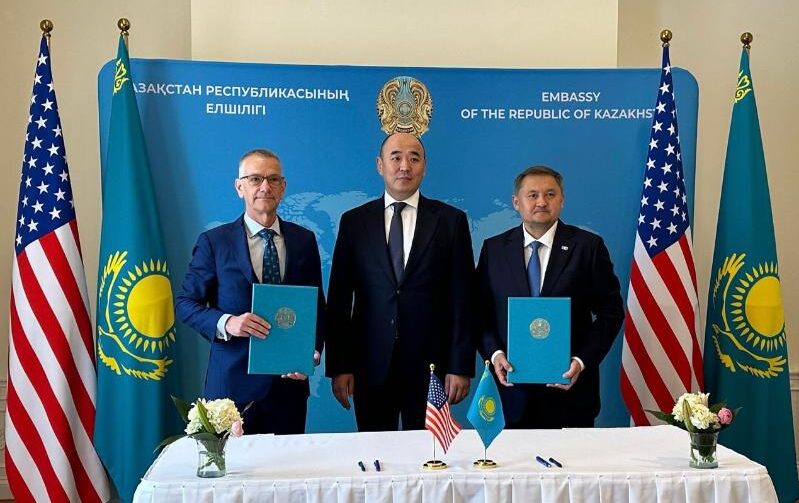
In 2026, the Colorado School of Mines will open its first international campus in Kazakhstan, marking a significant milestone in U.S.-Kazakhstan academic cooperation. An agreement to establish the branch was signed between Kazakhstan’s Ministry of Science and Higher Education and the Colorado School of Mines, which currently ranks No. 1 globally in Mineral & Mining Engineering according to the QS World University Rankings 2025. The new campus will be located in Zhezkazgan, the center of Kazakhstan’s geological industry, on the grounds of the newly established Ulytau Technical University. Instruction will be in English and will focus on four core bachelor's degree programs: Mining, Geology and Geological Exploration; Geophysical Engineering; and Petroleum Engineering. According to the Ministry, the project underscores Kazakhstan’s growing status as a destination for educational investment and knowledge transfer in technical fields. “We have identified Kazakhstan as a priority country for partnership and development,” said John Bradford, Vice President of Global Initiatives at the Colorado School of Mines. “This agreement will allow us to elevate our collaboration and academic exchange.” Earlier, the Colorado School of Mines signed a dual degree agreement with Kazakhstan’s Satbayev University in the fields of geology, petroleum engineering, and mining, which also includes joint research initiatives. Once operational, the Zhezkazgan campus is expected to attract young professionals to the region, create new job opportunities, and train highly qualified specialists for both Kazakhstan’s domestic needs and the global labor market.

Kazakhstan Considers Handing Rare Earth Deposits to State Mining Firm Tau-Ken Samruk

Kazakhstan may transfer a series of newly discovered rare earth metal deposits to the state-owned mining company Tau-Ken Samruk, according to Erlan Akbarov, Chairman of the Geology Committee under the Ministry of Industry and Construction. Geological exploration initiated by the government in 2021 has covered 12 targeted areas, with exploration completed in 10 of them. These surveys led to the discovery of multiple rare earth metal deposits, including 17 rare earth elements such as tantalum, lithium, and niobium. “The largest deposit we have discovered is the Kuyrektykol site, which has industrial reserves estimated at 1 million tons, with a projected reserve of 20 million tons. The remaining sites are located in eastern Kazakhstan (two), southern Kazakhstan (three), and northern Kazakhstan (three),” Akbarov said during a government briefing. “We have completed exploration and evaluation at these sites, and specific investors will continue the development. One of the options under consideration is transferring these sites to Tau-Ken Samruk,” he added. The National Mining Company Tau-Ken Samruk, a joint-stock company established in 2009, aims to unlock Kazakhstan's mineral wealth by attracting leading partners and technologies. It is preparing to lead the next development phase of the Kuyrektykol site, which includes pre-investment groundwork, further geological assessments, and the selection of appropriate mining technologies. Located in the Karaganda region in central Kazakhstan, initial exploration of Kuyrektykol began in 2022 and concluded in November 2024. Kazakhstan currently extracts 19 of the 34 globally recognized rare earth elements, including beryllium, tantalum, niobium, and rhenium. More than 100 deposits of rare and rare earth elements have been identified nationwide. Akbarov also noted that Tau-Ken Samruk might participate in a lithium mining project initiated by the Korea Institute of Geoscience and Mineral Resources (KIGAM) in eastern Kazakhstan. “KIGAM conducted geological studies with us and discovered lithium deposits. Negotiations are ongoing, and our Korean colleagues are keen to proceed with further exploration. Tau-Ken Samruk may acquire a stake in this project,” Akbarov stated. Earlier, The Times of Central Asia reported that in June this year, the Ministry of Industry and Construction will open electronic auctions granting private investors the right to explore and develop 50 gold and rare metal deposits.