• KGS/USD = 0.01144 0%
  • KZT/USD = 0.00203 0%
  • TJS/USD = 0.10486 0.48%
  • UZS/USD = 0.00008 0%
  • TMT/USD = 0.28571 0%
  • KGS/USD = 0.01144 0%
  • KZT/USD = 0.00203 0%
  • TJS/USD = 0.10486 0.48%
  • UZS/USD = 0.00008 0%
  • TMT/USD = 0.28571 0%
  • KGS/USD = 0.01144 0%
  • KZT/USD = 0.00203 0%
  • TJS/USD = 0.10486 0.48%
  • UZS/USD = 0.00008 0%
  • TMT/USD = 0.28571 0%
  • KGS/USD = 0.01144 0%
  • KZT/USD = 0.00203 0%
  • TJS/USD = 0.10486 0.48%
  • UZS/USD = 0.00008 0%
  • TMT/USD = 0.28571 0%
  • KGS/USD = 0.01144 0%
  • KZT/USD = 0.00203 0%
  • TJS/USD = 0.10486 0.48%
  • UZS/USD = 0.00008 0%
  • TMT/USD = 0.28571 0%
  • KGS/USD = 0.01144 0%
  • KZT/USD = 0.00203 0%
  • TJS/USD = 0.10486 0.48%
  • UZS/USD = 0.00008 0%
  • TMT/USD = 0.28571 0%
  • KGS/USD = 0.01144 0%
  • KZT/USD = 0.00203 0%
  • TJS/USD = 0.10486 0.48%
  • UZS/USD = 0.00008 0%
  • TMT/USD = 0.28571 0%
  • KGS/USD = 0.01144 0%
  • KZT/USD = 0.00203 0%
  • TJS/USD = 0.10486 0.48%
  • UZS/USD = 0.00008 0%
  • TMT/USD = 0.28571 0%

Viewing results 1 - 6 of

“I Hope Saltanat’s Family Can Find Peace” – Women of Kazakhstan Speak Out on Bishimbayev’s Sentence

On November 9, 2023, former Kazakh Minister of the National Economy, Kuandyk Bishimbayev was caught on surveillance cameras arguing with and then brutally beating his common-law wife, 31-year-old Saltanat Nukenova, for around eight hours outside a restaurant he owned in Astana. A forensic examination showed that she had been strangled, but the cause of death was recorded as traumatic injury to the brain. The high-profile case which was live-streamed garnered international attention. Despite pleading not guilty to premeditated murder, Bishimbayev was sentenced to 24 years’ imprisonment for torturing and murdering Nukenova, and his cousin Bakytzhan Baizhanov to four years for his part in covering up the crime. Prosecutor Aizhan Aimaganova, who became widely-known during the trial, said in an interview with Tengrinews.kz that she believes the verdict will change the country forever. "Family and domestic violence is a pressing problem... I hope that after this trial, women will realize that going to law enforcement is not useless. It is necessary to talk about problems. I think now any domestic tyrant will think twice before raising his hand," she said. [caption id="attachment_18029" align="aligncenter" width="872"] Prosecutor Aizhan Aimaganova; image: Press service of the Astana Court[/caption] While the length of the sentence is a victory for advocates against gender-based violence, both within Kazakhstan and in the many parts of Europe where the trial was also followed closely, many Kazakhs feel it is still too early to say that justice has been done. In an open discussion that is rare in Central Asia, many citizens are posting their concerns on social media that the Nazarbayev-era official will find a way to get out of prison early: there is already speculation that Bishimbayev, a former member of the country’s elite, will leverage his political connections to secure an early release – or be recognized as terminally ill. Following the verdict, TCA took to the streets of Kazakhstan to ask women their opinion. "I finally feel relieved,” Sara, an SMM manager from Astana told TCA. “Twenty-four years is a justified sentence in my opinion. Although tragic, this case drew public attention to a great many issues, such as the need for both a new law against domestic abuse and charities to support victims of domestic violence, which is very prominent in Kazakhstan. The whole country watched the case unfold, and that attention was put to good use since many other domestic violence cases got the attention they deserved. I hope that our justice system will make sure that Bishimbayev doesn't get a chance to get out early and serve his full sentence. The same applies to Baizhanov." "Considering various aspects, including the status of his family and the presence of his children, this sentence is probably objective, especially given the jury's involvement,” 21-year-old journalist, Kamila told TCA. “The main issue now is to prevent his release on parole once the unrest subsides, though I know this is only possible if the victim’s family give their consent.” "From an objective point of view, 24-years for a brutal...

A Steep Rise in Popularity of Women-Only Carriages on Kazakhstan’s Trains

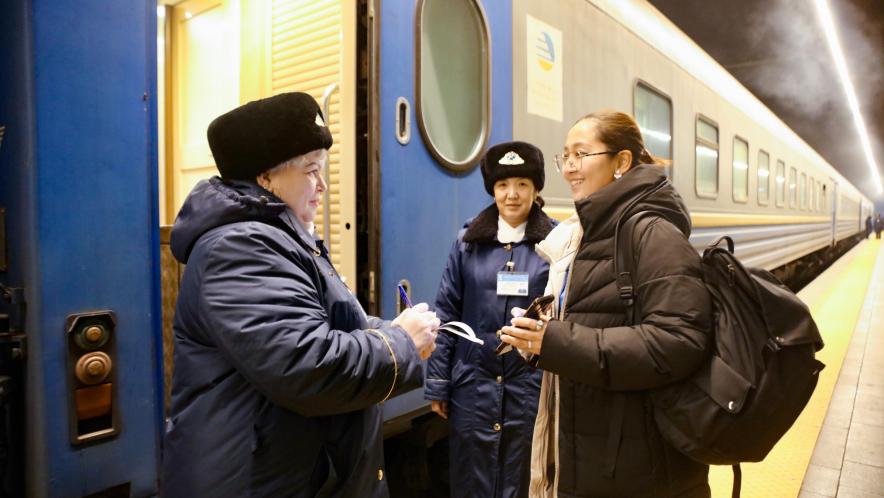
Since the beginning of this year, some 70,000 women in Kazakhstan have opted to travel by train in carriages designated as "women's cars". According to data provided  by the national carrier "Kazakhstan Temir Zholy" (KTZ), this is a steep rise from the 34,000 who used the same carriages in 2023. Introduced at the beginning of 2021, the service which female travelers deem safer and more comfortable than mainstream carriages, has now been used by over 359,000 women. Outlining the initiative, KTZ explained that tickets for women's cars, available on eight trains, are sold only to women and are staffed exclusively by female conductors. Any males traveling must be seven years' old or under. With reference to forward planning, the company stated, "A social survey is currently being conducted on the project. Once collated, the results should provide a better understanding of the needs and preferences of passengers, and subsequently, help determine a strategy for its future development." The need to launch women-only cars in Kazakhstan was spurred by public outrage following the rape of a female passenger by two conductors on a high-speed train traveling the 'Talgo' route between Astana and Aktobe in the fall of 2018. During the ensuing high-profile case in  July 2019, conductors Zhetes Umbetaliyev and Kolkanat Kurmaniyazov were found guilty and sentenced to prison.

Uzbek Businesswoman Diora Usmanova Recounts Own History of Marital Violence

Diora Usmanova, the owner of two restaurants and some clothing brands in Uzbekistan, has spoken on her Instagram page about the beatings she suffered from her first husband, Babur Usmanov, who was the nephew of the billionaire Alisher Usmanov. Usmanova herself is related to Ziroatkhon Mirziyoyeva, the wife of Uzbek president Shavkat Mirziyoyev. Usmanova wrote that the story could cause her harm, but that she believes the benefits will "outweigh the risks a hundredfold" and will "change perceptions or somehow affect women who endure domestic violence and abuse," Gazeta.uz reported. "We loved each other and fought very hard for our marriage. Subsequently, when he started to raise his hand against me and when these beatings went on, and the beatings continued for four years, there were concussions, and a lot of blood, and bruises, and [my] whole body in bruises, and a lot of broken furniture, doors, everything," she said. Domestic violence is not only the man's fault, but also the woman's, Usmanova said. "We don't value ourselves enough, we're not brave enough, we're not strong enough, we're afraid to give a backhand, we're afraid to tell our parents, we're afraid to go back to our parents, we're afraid to start everything again. For the fact that we hope that it will change, that it will [bear] some good fruits in the future, that it will survive -- this is all our problem," Usmanova said. In her opinion, women should terminate harmful relationships and find the strength to leave -- and most importantly, learn to respect themselves. "You have to leave such relationships. [That's] because of the fact that you forgive once, forgive the second time, and then it becomes a habit, a person realizes that it is forgiven, it can end very badly, [a] whole life just poisoned. I did not find the strength then, and now after 10 years, I look back and realize how many mistakes were made on my part and how much is my fault. Just like [it was] his," she stated. On May 8, 2013, Babur Usmanov was involved in a fatal car accident in Tashkent. In 2016, Usmanova married businessman Batyr Rakhimov.

Kazakh Embassy Counselor in UAE Recalled After Domestic Violence Allegations

The Ministry of Foreign Affairs of Kazakhstan has recalled an Embassy Counselor from the United Arab Emirates (UAE), Saken Mamash, after the publication of a video message by his wife, Karina Mamash, who alleged ongoing domestic violence, according to a report in Kursiv.kz. "We urgently recalled this employee to Kazakhstan. Further, his case will be dealt with by law enforcement agencies," said an official representative of the ministry. Karina Mamash's appeal was published on an Instagram page run the public foundation, "NeMolchi" (Don't Remain Silent"). In the video, Mamash accuses her husband of years of violence, and expresses fear for her own safety and the safety of their children. "My name is Karina Mamash Gosmanovna. My husband, counselor to the Ambassador of the Republic of Kazakhstan to the UAE, yesterday beat me and my sister, who came to visit me on the 3rd [of May]. I demand help from our state. I am tired of being silent. I am tired of tolerating. For ten years he has been raping me, beating me. I am in danger, and my children are in danger around him. I demand help from our state. Help me," she said, attaching photos of herself and her sister with bruises on their faces to the post. Karina Mamash also insisted that her husband be "stripped of his status as a diplomat and put in jail for all the abuse." Domestic violence has become a key topic of discussion in Kazakhstan amid the high-profile case of Kuandyk Bishimbayev for allegedly killing his common-law wife, Saltanat Nukenova. On April 15, President Tokayev signed into law amendments and additions passed by Kazakhstan’s parliament ensuring the rights of women and the safety of children. The initiative represents a first in the CIS in terms of how far it goes to provide protection for women and children in the country.

Samarkand to Host Asian Women’s Forum Next Month

The Asian Women's Forum will be held in Samarkand this May, where participants will discuss the situation surrounding women's rights in the countries of Central and Southeast Asia. The forum will discuss issues related to expanding women's rights, and reducing poverty in the region by involving women in entrepreneurship. Sessions will pay special attention to the role of parliaments in stimulating women's participation in business, gender-oriented budgeting, elimination of gender disparity, and eradication of all forms of violence against women and children. The participants will also focus on modern approaches and best practices in promoting the green economy, the impact of climate change on gender issues in the region -- as well as protection of women's rights and interests. Women are now a driving force in all aspects of life in Central Asia. Addressing the 78th session of the UN Commission on the Status of Women in New York, Chairwoman of the Senate of the Oliy Majlis (bicameral parliament) of Uzbekistan Tanzila Narbayeva said that "the attitude towards women has fundamentally changed in the country. Much attention is [being] paid to their education, mastering professions and foreign languages -- as well as to the development of women's entrepreneurship." To date, Uzbekistan has adopted more than 40 legal and regulatory acts to improve the status of women in society, established the National Agency for Social Protection, which, among other things, provides targeted assistance to women and works specifically on the social adaptation of women returned from conflict zones in Syria, Iraq and Afghanistan.

Central Asia’s Scorecard on Women’s Rights and Welfare

Women's rights differ significantly around the world, with progress varying greatly from one country to another. Some states have advanced gender equality significantly through strong legal systems and policies while others are hindered by cultural norms and a lack of political commitment. In Central Asia, each of the young nations has shown a different level of progress on women's rights and welfare, which requires consideration in individual, regional and global contexts. Kazakhstan’s new and comprehensive law on strengthening protections for women and children’s rights, adopted on April 15 to international fanfare,  highlighted the larger issue of women’s status in Central Asia. The legislation was driven by a 2023 Presidential Decree for a Human Rights Action Plan that brought Kazakhstan in compliance with OECD standards. Another piece of relatively recent positive news from the region came in April 2023 when Uzbekistan’s parliament passed new legislation specifying domestic violence as a criminal offense under the law and strengthening 2019 provisions that indirectly address domestic violence. Yet even when there are laws in place to protect women, ensuring their implementation remains critical. For this to happen, laws should first clearly define what constitutes domestic violence so that crimes can be classified and prosecuted as such. As a benchmark, OECD standards close gaps in legally prosecuting such violence by encompassing this classification to include domestic violence against women and children. Kazakhstan has conformed to this norm in its new legislation and thus holds the best practice in the region. Furthermore, to facilitate enforcement and implementation, Kazakhstan’s recent efforts include placing women in key administerial positions in the police force dealing with violent crimes against women. At a larger scale, the country’s Family and Gender Policy foresees increasing the share of women at decision-making levels across the public and private sectors to 30%. Backing this narrative on Kazakhstan’s upward trajectory from a cultural and social perspective, UNDP’s Gender Social Norms Index Report in 2023 found that Kazakhstan has the lowest levels of gender bias in the region (and incidentally was ranked above the United States in the Gender Inequality Index, which utilized 2021 data as shown below).   The World Economic Forum’s Global Gender Gap Report 2023 also shows significant progress in women’s empowerment in Kazakhstan, which jumped 18 positions in one year to 62nd place globally, particularly through eliminating gender gaps in education levels and increasing women’s political and economic participation.   Two other Central Asian countries have some form of legislation concerning domestic violence against women on paper, but progress on their implementation has not always been encouraging.  Kyrgyzstan, for instance, adopted legislation on domestic violence in 2003 as well as a new law on this issue in 2017, which has strengthened protection for victims and sought to improve enforcement mechanisms. But according to reports, the legislation has proven difficult to enforce, and perpetrators may still avoid punishment. In 2013, Tajikistan also passed a law that specifically addressed domestic violence and included measures for its prevention, protection, and punishment. This, too, appears to...