The United States has expanded a visa bond policy that increases the upfront cost of short-term travel for citizens of Kyrgyzstan, Tajikistan, Turkmenistan, and dozens of other countries. Under the policy, applicants for B-1 and B-2 business and tourism visas may be required to post bonds of $5,000, $10,000, or $15,000. The State Department set out the latest rules and the country list on its visa bond policy page.
The program now covers nationals from 38 countries. In Central Asia, it was applied to Turkmenistan on January 1, and is scheduled to extend to Kyrgyzstan and Tajikistan starting from January 21. The bond is refundable when travelers follow visa terms and leave on time, but it can tie up large sums for the duration of a trip and may put U.S. travel beyond reach for many applicants.
Turkmenistan, where emigration is tightly controlled, sees low numbers of its citizens entering the United States. Department of Homeland Security data for Fiscal Year 2024 indicates that the total number of Turkmen nationals issued B-1/B-2 visas to the U.S. was 1,759. Tajikistan, meanwhile, saw 1,772 visas granted, and Kyrgyzstan 9,625. By way of comparison, Saudi Arabia saw over 54,000 visas granted.
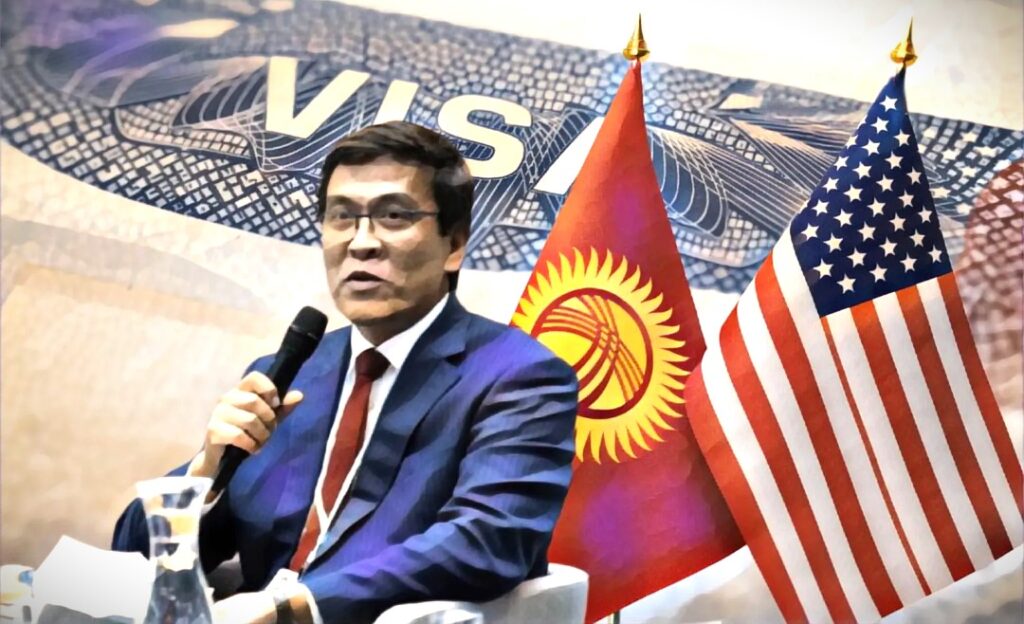
The expansion has already triggered public pushback in Kyrgyzstan. In a post on X on Thursday, Edil Baisalov, the deputy chairman of Kyrgyzstan’s Cabinet of Ministers and a prominent ally of President Sadyr Japarov, urged the Kyrgyz authorities to review visa-free access for U.S. citizens. Kyrgyzstan currently allows U.S. travelers to enter without a visa for stays of up to 30 days.
“I believe that we should initiate a review of our visa-free regime for U.S. citizens following the new visa requirements announced yesterday by the State Department, under which Kyrgyz citizens are required to pay a visa deposit of up to $15,000 when submitting visa applications,” Baisalov wrote. “Visa policy is a matter of parity and mutual respect. If such high barriers are introduced for our citizens, we cannot pretend that nothing has happened.”
Baisalov did not specify precisely what changes Kyrgyzstan might pursue, and any escalation risks provoking a dispute with a far stronger partner. The remarks also come as Kyrgyzstan and other Central Asian governments seek closer engagement with President Donald Trump’s administration while managing competing pressures from Russia and China.
The measure is a setback for Kyrgyz efforts to ease travel barriers with the United States. Kyrgyz Foreign Minister Zheenbek Kulubaev raised visa issues with U.S. Deputy Secretary of State Christopher Landau during a meeting on the sidelines of the U.N. General Assembly in New York in September.
So far, Tajikistan has not matched Kyrgyzstan’s public stance, with no prominent statement appearing on Tajik government channels addressing the bond requirement or signaling reciprocity. Discussion has instead focused on what the new U.S. rules mean for applicants, the implementation timeline, and the bond amounts that may be set at the interview stage.
For Turkmenistan, the requirement adds another hurdle to an already narrow path to U.S. travel. The country’s internal controls and the difficulty of obtaining U.S. visitor visas mean the new deposits will likely concentrate travel among an even smaller group of applicants with significant accessible funds.
The bond policy also creates logistical constraints for those required to post deposits. Bonded travelers must enter the United States through designated airports rather than any international gateway. The designated airports are Boston Logan, John F. Kennedy International Airport in New York, Washington Dulles, Newark, Atlanta, Chicago O’Hare, and Los Angeles, along with Toronto Pearson and Montréal–Trudeau in Canada.
The visa bond program has expanded rapidly, with the list of countries subject to visa bonds growing from 13 to 38 as part of a wider tightening around immigration and visa compliance, including steps aimed at deterring overstays. In Fiscal Year 2024, Mexico recorded 52,083 B-1/B-2 overstays, Venezuela 19,041, and Haiti 15,981, compared with 643 for Kyrgyzstan, 140 for Tajikistan, and 320 for Turkmenistan, according to U.S. Customs and Border Protection data. Although the three Central Asian countries affected send relatively few visitors to the United States, their inclusion reflects a focus on overstay rates by percentage rather than raw overstay numbers.
For applicants, the requirement adds uncertainty late in the process. The bond is imposed only after an applicant is found otherwise eligible, but it can still function as a practical barrier. In economies where access to dollars is limited and household savings are constrained, securing a large refundable deposit at short notice may prove impossible. Even when returned, a bond can tie up funds for months and add financial strain to travel that already carries substantial costs.
As the January 21 implementation date approaches for Kyrgyzstan and Tajikistan, the visa bond policy is likely to remain a point of diplomatic tension, even as its most direct consequences are felt by travelers weighing whether U.S. travel remains financially viable.