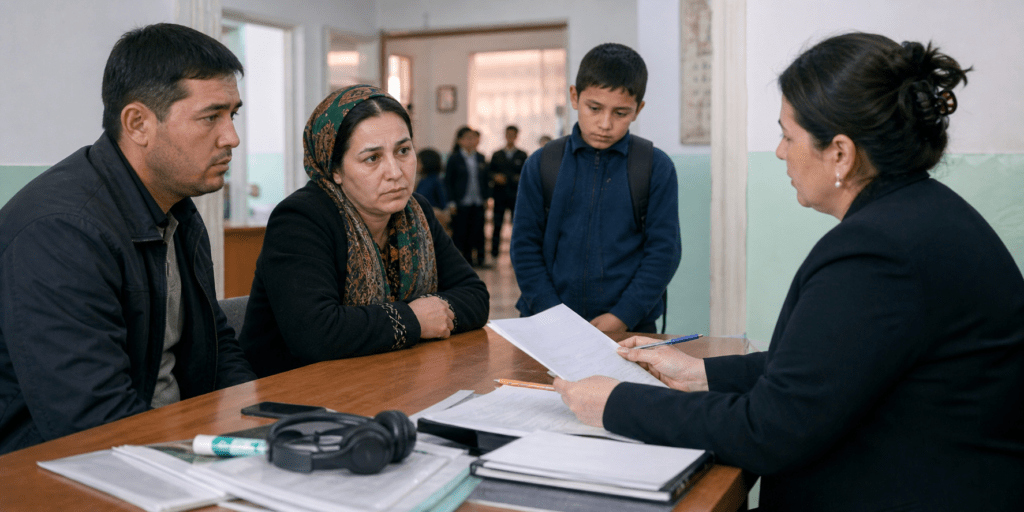
On August 23, 2025, 29 students from Kozybayev University in Petropavlovsk arrived at the University of Arizona. Their journey marks the start of a dual-degree program that allows Kazakh students to spend a semester in the U.S. while completing the rest of their studies at home. Graduates will receive two diplomas, one from each institution.
The program, launched under President Kassym-Jomart Tokayev’s directive, is Kazakhstan’s first large-scale partnership with a U.S. university. Fully funded by the state, it covers tuition, housing, visas, and travel expenses. Courses are offered in biotechnology, information systems, and inclusive education – fields aligned with Kazakhstan’s development priorities.
Part of a Broader Strategy
This initiative is not just about Kozybayev University. It is part of a broader government strategy to internationalize higher education and transform Kazakhstan into an academic hub for Central Asia. In 2022, Tokayev set a goal of opening five foreign university branches by 2025. Since then, partnerships have multiplied: De Montfort University (UK) in Almaty, MEPhI and Gubkin University (Russia) in Almaty and Atyrau, and the University of Arizona in Petropavlovsk. Others are in development, including Heriot-Watt University (Scotland), SeoulTech (South Korea), and Tianjin University (China).
These ventures come with incentives. The government treats foreign universities as “strategic investors,” offering land, tax breaks, and simplified bureaucracy. In return, Kazakhstan gains access to advanced curricula and English-language teaching, while local universities benefit from joint research and faculty exchanges.
Building Domestic Capacity
Kozybayev University has expanded rapidly to accommodate the Arizona program: a new academic laboratory, dormitories, and upgraded infrastructure are in place. The university is also hosting students from 16 countries, including a hundred from Türkiye. This signals a shift – Petropavlovsk, once peripheral in academic terms, is now a point of attraction for international students.
The government’s long-term aim is to convert more domestic universities into research-intensive institutions. By embedding foreign collaborations into the national strategy, Kazakhstan hopes to ensure lasting benefits rather than temporary prestige projects.
Rising Student Mobility
Kazakhstan’s pivot to become an education destination reflects changing regional dynamics. More than 31,000 foreign students now study in Kazakhstan, including over 12,000 from India in medical programs. This is a sharp rise from a few years ago and a reversal of the trend where most Kazakh students went abroad, often to Russia.
The Ministry of Science and Higher Education is actively promoting the country under the “Study in Kazakhstan” campaign, targeting markets like Pakistan, China, and Azerbaijan. For many students, Kazakhstan offers lower costs than the West and the chance to earn dual degrees with reputable foreign institutions.
For many international students, Kazakhstan is becoming an appealing study destination. Tuition fees are comparatively low – ranging from US $1,500 to $5,000 per year – while monthly living costs are in the U.S. $550–$750 range, encompassing accommodation, food, transport, and essentials. These financial benefits, along with government scholarships, English-taught programs, and dual-degree opportunities, make Kazakhstan an increasingly attractive option.
Lessons from Abroad
Kazakhstan’s ambition echoes strategies pursued by the UAE and Singapore. Dubai, for example, has built free zones like Dubai Knowledge Park. Dubai currently has 41 international higher education providers licensed by KHDA, 37 of which are international branch campuses. Its success shows how policy incentives and a favorable location can turn a city into a higher education magnet.
Not every international partnership endures, however. Singapore’s “Global Schoolhouse” initiative brought world-class institutions and raised the city-state’s academic profile, yet a few initiatives, such as UNSW Asia and Yale-NUS College, did not continue long-term. Their experience underscores the importance of careful planning and sustained alignment to ensure programs remain viable.
Kazakhstan appears to be learning from global education hub models by tying new partnerships to local economic needs. For instance, Heriot-Watt University’s engineering programs in Aktobe are tailored to regional industry, while a planned Gazi University branch in Shymkent reflects the city’s growing tech base.
A Turning Point for Kazakhstan
Kazakhstan’s higher education reforms build on a long tradition of investing in global knowledge. Since 1993, the Bolashak scholarship program has sent over 12,000 Kazakhs abroad for study, many of whom now contribute to academia and government. The current wave of partnerships represents a shift: bringing world-class education into Kazakhstan, rather than sending students out.
For students like those departing Kozybayev University, the benefits are immediate – global exposure, international diplomas, and stronger career prospects. For policymakers, the challenge is to ensure these initiatives integrate into the wider system, boost research capacity, and position Kazakhstan as an attractive destination not only for Central Asia but also for students and scholars from a broader international community.
If successful, Kazakhstan could join the UAE and Singapore as a recognized education hub – a crossroads for students from Central Asia, South Asia, and beyond. The departure of Kozybayev’s Arizona-bound cohort is more than a symbolic milestone; it is a test case for the country’s vision of becoming a regional center for science, education, and innovation.