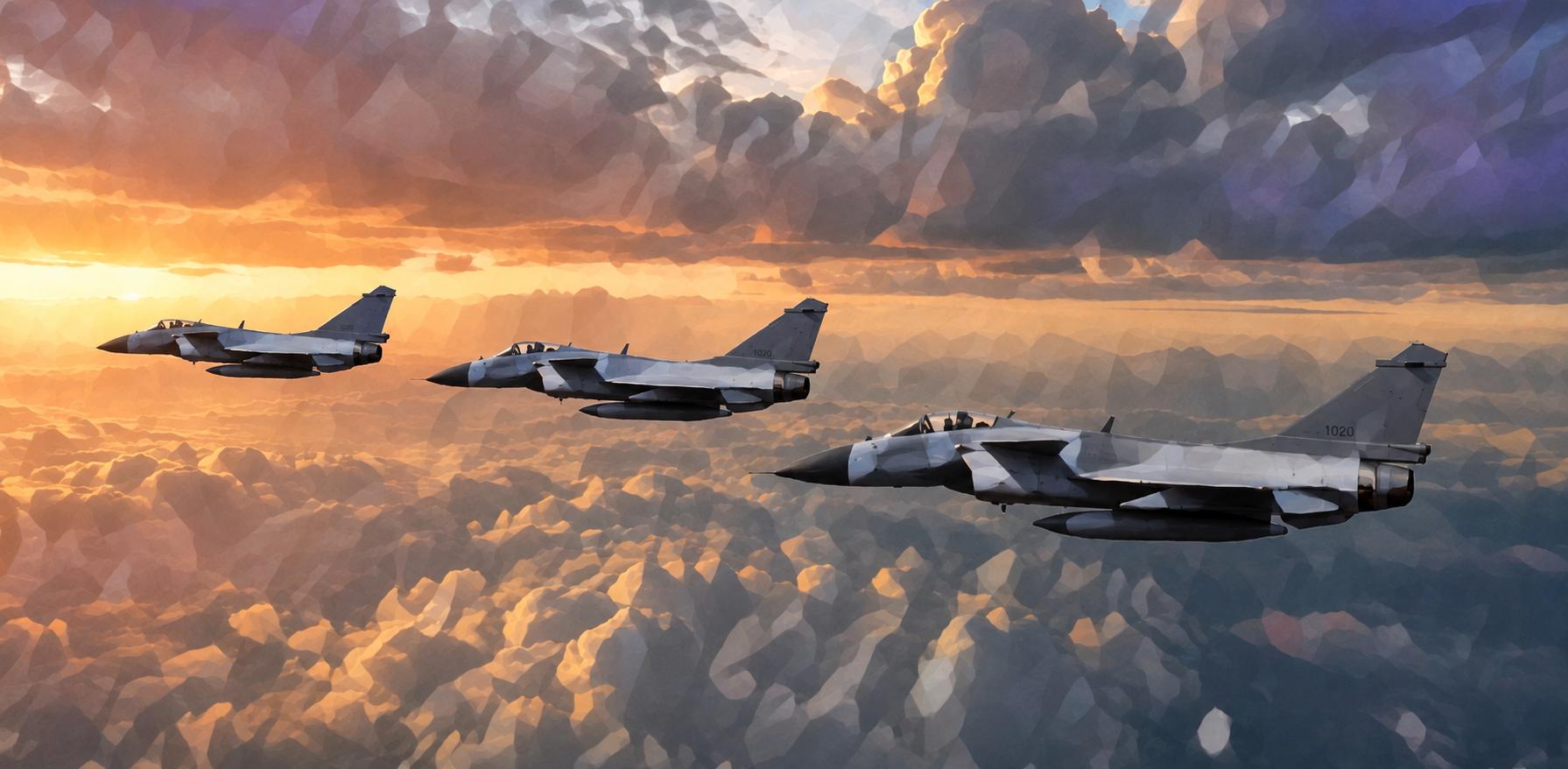
China’s J-10CE could become Uzbekistan’s first new combat fighter in decades that was designed neither in Russia nor the Soviet Union. This summer, defense publications and analysts reported that Tashkent had allegedly already received the first aircraft and could eventually acquire 24 jets. Neither Uzbekistan nor China has confirmed the deal.
If the reports prove accurate, the purchase would mark a notable shift for a region whose armed forces still rely heavily on Soviet- and Russian-made equipment. For decades, Russia was the natural source of new weapons, spare parts and maintenance. Its position is no longer unchallenged. China can offer combat aircraft and air-defense systems, Turkey has established itself in the drone market, while Kazakhstan and Uzbekistan are developing their own defense industries.
Whether or not the reports prove accurate, they point to two broader trends: Central Asian countries are increasingly looking beyond Russia for newer military technology, while some are also trying to produce more equipment at home.
Shadow Purchase
In July, reports emerged of the alleged delivery of four J-10CEs to Uzbekistan. The aircraft is the export version of the Chinese J-10C multirole fighter manufactured by Chengdu Aircraft Corporation. Its export variant has already been purchased by Pakistan. Subsequent reports spoke of a possible contract for 24 aircraft and of Uzbek pilots undergoing training in China.
Uzbek news outlet Kun.uz attempted to verify the claims and contacted the country’s Ministry of Defense. The ministry responded that it had no information it could provide on the matter. Chinese authorities and manufacturers have also made no public announcement of a sale.
Nevertheless, throughout the summer, reports of Uzbekistan purchasing J-10CEs have refused to die down.
Russian Weapons Remain the Backbone of Existing Arsenals
Uzbekistan inherited a combat aircraft fleet from the Soviet Union built primarily around MiG-29 and Su-27 fighters. These aircraft were developed in the Soviet era, and after the collapse of the USSR, Russia remained the main source of compatible spare parts, weapons, repairs, and upgrades. The reports about the J-10CE challenge this established model.
A new fighter comes with a different weapons, maintenance and training ecosystem. Over time, this creates dependence on a new supplier.
According to the Stockholm International Peace Research Institute, or SIPRI, Russian exports of major arms in 2021–2025 were 64% lower than during the previous five-year period. Russia’s share of global arms exports fell from 21% to 6.8%, leaving it the world’s third-largest supplier after the United States and France.
Those figures do not mean that China has replaced Russia as Central Asia’s dominant arms supplier. Russia retains a strong position, above all because of the equipment Central Asian militaries already operate.
Kazakhstan is perhaps the clearest example. According to SIPRI data for 2021–2025, Russia accounted for 83% of Kazakhstan’s imports of major arms. Spain accounted for 7.9% and France for 3.6%.
Kazakhstan operates Russian Su-30SM fighters, as well as helicopters, armored vehicles and air-defense systems. Any abrupt change in procurement policy would raise questions over the compatibility of ammunition, communications systems, maintenance, and the training of crews and technical personnel.
Kyrgyzstan and Tajikistan remain similarly reliant on Soviet- and Russian-made equipment and are closely tied to Russia’s regional security architecture. But Russia’s dominance of existing arsenals does not necessarily extend to every newer category of military technology.
New Niches Are No Longer Guaranteed to Russian Suppliers
While existing arsenals continue to bind Central Asian militaries to Moscow, newer categories of weapons present a different picture.
When Kyrgyzstan sought modern combat drones, it turned to Turkey, first buying Bayraktar TB2s and later adding Aksungur and Anka aircraft.
Kazakhstan has also pursued unmanned aviation cooperation with Turkey through an agreement between Kazakhstan Engineering and Turkish Aerospace to produce and maintain Anka drones domestically.
Turkmenistan began diversifying its military procurement earlier than its neighbors. Ashgabat has acquired Russian, Chinese, Turkish and European equipment, including Turkish drones and naval vessels.
Tajikistan has also looked elsewhere for newer systems. In May 2022, Iran opened a facility in Dushanbe to produce Ababil-2 drones, while the United States announced plans to provide its border forces with Puma reconnaissance drones.
What is emerging, then, is not so much a rejection of Russian weapons as a more fragmented and competitive Central Asian arms market. China can offer fighter aircraft, air-defense systems, armored vehicles and drones. Turkey is strong in UAVs, armored vehicles and several other areas. Iran has established a presence in Tajikistan.
Kazakhstan and Uzbekistan Want to Produce More at Home
Central Asia’s two largest economies are gradually expanding domestic military production, a trend that could ultimately affect the market more than individual foreign contracts.
By regional standards, Kazakhstan already has a developed armored-vehicle manufacturing industry. Kazakhstan Paramount Engineering produces Arlan and Alan-2 vehicles, along with the Barys armored-vehicle family. As of August 2026, the company had manufactured more than 400 vehicles and had annual production capacity of up to 500 units, according to the government. Its order book through 2028 includes another 224 vehicles.
In February 2025, President Shavkat Mirziyoyev visited the Defense Industry Agency’s Center for Innovative Technologies, which produces around 80 types of military equipment and dual-use products.
Uzbekistan is also developing domestic drone production through Sahro Drone Industry, part of its defense-industrial system. The company produces mini-drones and quadcopters for surveillance and search-and-rescue operations, alongside reconnaissance drones and models that provide operators with a first-person view. The Defense Industry Agency’s mandate also includes replacing imports with locally produced equipment and expanding the sector’s export potential.
Russia remains central to the region’s arms market but is losing its status as the default supplier. The change is clearest when Central Asian militaries seek technologies absent from their Soviet-era arsenals or turn to domestic manufacturers. Whether or not the alleged J-10CE deal is confirmed, governments now have a wider choice of foreign suppliers and domestic alternatives.