In recent years, Kazakhstan has become increasingly active at the Frankfurter Buchmesse, the Frankfurt Book Fair. Each year, a national stand brings together publishers and literary institutions that engage with international partners and expand professional networks. Participation in this global event has supported a range of initiatives aimed at introducing Kazakh literature and culture to a broader international audience. On this occasion, we spoke with Juergen Boos, Director of the Frankfurter Buchmesse, about opportunities for entering the global publishing market and the significance of becoming a Guest of Honor at the Frankfurt Book Fair.
TCA: As the world’s largest book fair, what new mission or direction is the Frankfurter Buchmesse pursuing today?
Juergen Boos: Frankfurter Buchmesse today serves not only as the world’s leading marketplace for rights and content but also as a global platform for cultural exchange and professional dialogue. In a rapidly evolving geopolitical and technological environment, our mission is to strengthen international publishing networks, uphold freedom of expression, and facilitate sustainable cooperation across regions. We aim to connect established and emerging markets alike, encouraging long-term partnerships that extend well beyond the fair itself.
TCA: What major changes have you observed in the global publishing industry in recent years?
Juergen Boos: The publishing industry is undergoing significant structural transformation. Digital distribution channels, audio formats, evolving licensing models, and the growing application of artificial intelligence are reshaping the sector. At the same time, we are witnessing gradual diversification in the global publishing landscape. Regions that previously had limited international visibility are increasingly seeking engagement beyond their domestic markets. Central Asia is among those regions demonstrating a clear interest in strengthening its international profile, which adds valuable perspectives to the global literary conversation.

Photo credit: Frankfurter Buchmesse
TCA: How are digital technologies and artificial intelligence transforming the book market?
Juergen Boos: Digital technologies and AI are influencing translation processes, metadata management, copyright issues, discoverability, and market analysis both positively and negatively. On the positive side, AI can increase efficiency and expand access to content. We are already seeing AI evolve from an experimental tool into an integral part of everyday publishing practice. For me, however, literature remains fundamentally human in its origin and intention. Storytelling, cultural nuance, and intellectual depth cannot be automated. The key challenge for the publishing sector lies in integrating technological innovation responsibly while preserving creative integrity and editorial independence.
TCA: Can literature help strengthen mutual understanding between nations? If so, how?
Juergen Boos: Yes, I believe it can. Literature allows readers to understand other societies through lived experiences rather than political abstractions. Through translation and international circulation, books foster empathy and cultural literacy. Book fairs provide a structured professional framework for such exchange. They enable sustained relationships between publishers, authors, and institutions, thereby contributing to long-term cultural understanding.
TCA: Has the importance of books and cultural dialogue increased in today’s geopolitical climate?
Juergen Boos: In times of uncertainty and polarization, the role of thoughtful cultural dialogue becomes even more significant. Books create space for reflection and complexity, offering perspectives that go beyond immediate political narratives. International cooperation in the publishing sector can therefore serve as a stabilizing and constructive element in broader global relations.
TCA: How do you evaluate Kazakhstan’s participation in the Frankfurter Buchmesse?
Juergen Boos: Kazakhstan’s recent presence at the fair has been marked by renewed engagement and visible commitment. Following a period of lower activity, the country returned with a well-conceived national stand, a dedicated stage program, and a range of professional events. The participation of publishers, alongside representatives of the national publishers’ association, reflects institutional support. In addition, for the third time, a representative from Kazakhstan’s publishing community took part in our Special Programme, indicating sustained professional interest. Overall, we are observing growing activity from Kazakhstan and the wider Central Asian region in seeking international cooperation within the publishing sector. This is a constructive and encouraging development.
TCA: How interesting is Central Asian literature for the German and broader European publishing community?
Juergen Boos: Central Asian literature presents considerable potential for discovery. European publishers are increasingly attentive to voices and narratives that have not yet been widely translated or internationally represented. The decisive factors are visibility, translation funding, and consistent professional networking. With sustained efforts in these areas, literature from the region can gradually build a stronger presence in European markets. There is genuine curiosity and a sense that important stories remain to be discovered.
TCA: Do you see Kazakhstan as a potential future Guest of Honor at the Frankfurter Buchmesse?
Juergen Boos: The Guest of Honor program is one of the most prominent cultural platforms in the international publishing world. From a personal perspective, I can certainly envisage Kazakhstan in this role. During my visit to Kazakhstan last year, I had the opportunity to encounter its literary heritage, contemporary writing, and vibrant cultural life first-hand. The richness and diversity I experienced left a strong impression, and it is clear that there is strong interest in reaching international audiences. Efforts to foster cultural connections and to position Kazakhstan within global publishing networks contribute meaningfully to the long-term framework required for cooperation on this scale. If this trajectory of engagement continues in a coordinated and sustained manner, opportunities may well emerge in due course.
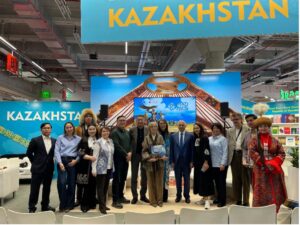
Kazakhstan’s National Stand at the Frankfurt International Book Fair.
Photo credit: Ministry of Culture of the Kazakhstan
TCA: If Kazakhstan were to pursue this status, what preparations or strategic steps would be most important?
Juergen Boos: Pursuing Guest of Honor status would require careful and sustained preparation over several years. A consistent and visible presence of Kazakh publishers at the Frankfurter Buchmesse would be essential to building professional relationships and strengthening international confidence. Equally important would be the establishment of a well-structured and adequately funded translation promotion program to make contemporary and classical works accessible to international audiences. Close coordination between the national publishers’ association and relevant governmental institutions would provide the necessary organizational stability.
In some cases, countries also consider strengthening existing structures or establishing dedicated bodies, such as a national book institute, to oversee long-term strategic development.
Ultimately, the foundation for a successful Guest of Honor presentation lies in a dynamic domestic publishing market and a vibrant contemporary literary scene capable of engaging international readers. As with all such presentations, the initiative must be organized and financed by the guest country itself and prepared well in advance, reflecting a substantial long-term cultural commitment.
TCA: What opportunities does the Frankfurter Buchmesse offer for young authors and independent publishers?
Juergen Boos: We offer international fellowship and professional development programs designed to connect emerging publishing professionals with global networks. Curated matchmaking formats and rights platforms provide particular opportunities for independent publishers. Encouraging new voices and ensuring diversity within the international publishing ecosystem remain central to our work.
TCA: How do you see the global publishing industry evolving over the next decade?
Juergen Boos: The coming decade is likely to bring further digital integration, cross-media collaboration, and increasingly interconnected markets. At the same time, credibility, trust, and cultural authenticity will become even more important in an AI-influenced information environment. Publishing sectors that invest strategically in translation, international partnerships, and cultural cooperation will be well positioned to strengthen their long-term global presence.