Kazakh cinematographer Yerkinbek Ptyraliyev has built an international reputation through his collaborations with director Adilkhan Yerzhanov. Their film The Masters, released in 2014, was selected for the Cannes Film Festival and later screened at major festivals in Venice, Berlin, and other international venues. In 2024, Ptyraliyev became the first Kazakh cinematographer invited to join the Academy of Motion Picture Arts and Sciences.
In an interview with The Times of Central Asia, he spoke about the role of a cinematographer, the technical challenges of filming night scenes in the steppe, and why the Kazakh school of cinematography is increasingly recognized as a distinct brand.
TCA: You recently returned from the Berlin International Film Festival, where your team’s new film, Adilkhan Yerzhanov’s Turghaud, was screened. What are your impressions?
Yerkinbek: Very positive. Our film was received very warmly. There was an engaging discussion after the screening, and it is always valuable to receive immediate feedback rather than hearing reactions later. We sat in the theater and listened to what the audience was saying. It was especially interesting to hear their interpretations. There were many different perspectives.
TCA: Does the perception of foreign audiences differ significantly from that of Kazakh audiences? When I watched the film, it seemed primarily aimed at a domestic audience.
Yerkinbek: I think every filmmaker wants their work to be seen everywhere. I am convinced that cinema has no borders. This year, the Golden Bear at the Berlinale went to a Turkish film, a movie entirely in Turkish, about Turks and Turkey, but shot in Berlin. That did not prevent it from winning.
Language and national context are not limitations; on the contrary, they are resources. We need to support them both in everyday life and in cinema. Adilkhan’s films are universal precisely because he speaks about issues that matter to any modern person. That is why they resonate beyond our own country.
TCA: I remember receiving accreditation for the Cannes Film Festival as a journalist when Adilkhan Yerzhanov was invited there for the first time with the film The Hosts, which you shot. Did that open the door to major cinema for you?
Yerkinbek: Absolutely. It was my debut film and such an immediate success. After that project, foreign directors began to notice me. For example, I started receiving invitations to work in Turkey, where I shot two contemporary dramas. The first passed relatively quietly, but the second attracted significant attention from Turkish audiences.
It was directed by Nazif Tun. Until then, he had spent his career making television films and series, but that project was his feature-film debut. I watched his previous work, it was very close to cinematic language, even though he himself insisted it was television rather than cinema.
TCA: Did you ever consider moving to Turkey? The market there is still larger than ours.
Yerkinbek: No. In recent years I have not even had the opportunity to go there. First, the timing has not worked out. Second, not every story resonates with me. So far, there has been no material compelling enough to make me want to relocate.
TCA: I assumed that, in that sense, it might not matter to a cinematographer what they are shooting.
Yerkinbek: On the contrary, the story has to captivate me. If it does not resonate with you, it is very difficult to work on. I have had that experience before, after two such films, I realized I no longer wanted to take on projects that did not speak to me.
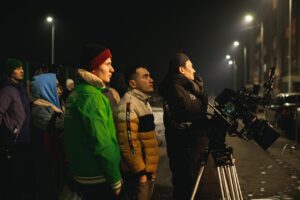
From a personal archive
TCA: Today, the phrase “Kazakh cinematographer” almost sounds like a mark of quality. We really do have strong professionals. Do you think Kazakh cinematographers have a distinctive style?
Yerkinbek: I believe so. Thirty-five years ago, our country gained independence, and with that came a sense of creative freedom. From this emerged our own perspective and the ability to express ourselves fully.
There were talented cinematographers before, but it was harder for them to work because fewer films were being made. Today, production has become easier, and more cinematographers are emerging. I think we now have a very strong school of cinematography. This is no longer the story of a single individual; it is an entire community.
TCA: Is the director of photography the head of the cinematography team? How many people do you usually supervise?
Yerkinbek: It depends on the scale of the project. When I was filming in Turkey, I had a very large crew, 23 people. The cinematography department there includes everyone, from camera assistants to lighting specialists and the grip department.
Grip refers to crew members responsible for setting up and maintaining camera equipment and mechanical support systems such as tracks, cranes, rigs, and other devices used to move the camera.
TCA: Do you assign tasks to each person personally?
Yerkinbek: No, the system works differently. The head of the camera crew is the director of photography. He has a key assistant, in Hollywood this is known as the first assistant camera, while here, following Soviet tradition, we often call this role the “second cameraman.” If necessary, he can fully replace the director of photography.
Next is the gaffer, the head of lighting. His team usually consists of five to seven people, depending on the complexity of the scenes. Then there is the head of the grip department. I explain the tasks to the second cameraman, the gaffer, and the grip team leader, and they distribute the work among their teams.
For example, on the historical film about Zhambyl Zhabayev, our crew consisted of around 17 or 18 people. But on Steppe Wolf, especially during night shoots, the camera crew expanded to 35-40 people.
TCA: Because shooting at night is more difficult?
Yerkinbek: Yes, because night scenes require a great deal of light. Adilkhan Yerzhanov and I have worked on about ten projects together, but we only truly executed a large-scale night scene for the first time on Steppe Wolf.
I remember that while working on The Yellow Cat, which Kazakhstan later submitted for an Academy Award, Adilkhan wrote a beautiful night scene in the script. I read it, studied the director’s notes, and asked to move the scene to daytime.
TCA: Because of the high cost of lighting, especially given that Yerzhanov often works with limited budgets?
Yerkinbek: Yes. Lighting such a scene at night in the way it required was practically impossible. I had the necessary equipment, but because the location was in the open steppe, everything would have looked artificial, almost theatrical.
TCA: Why is it so difficult to film the steppe at night?
Yerkinbek: Because once the sun sets, you can only illuminate a limited area. Every piece of equipment has a range beyond which there is simply darkness.
It can feel as though you have built a fragment of the steppe in a studio, surrounded by black emptiness. Adilkhan asked whether there was absolutely no solution. I told him there was not, at least not until we had a larger budget.
When we began filming Steppe Wolf, we finally had the opportunity to create a real night scene exactly as he envisioned. He said he wanted a pitch-black night that would resemble hell. I said we could do it.
TCA: How much lighting did you ultimately need?
Yerkinbek: In the end, we installed more than 200 kilowatts of lighting.
TCA: Is that a lot?
Yerkinbek: I am not sure how impressive that sounds, but the scale was enormous. Normally we use one generator, here we needed three. The location spanned three hills, each with its own generator and a large number of lighting fixtures.
When I first sketched the lighting diagram on paper, it did not seem nearly as dramatic.
TCA: And then it turned out to be epic?
Yerkinbek: Exactly. I arrived on set, one truck pulled up, then another, because the lighting rigs were huge. Then a five-ton truck arrived near the yurt, its bed filled entirely with cables, kilometers of cables of different diameters.
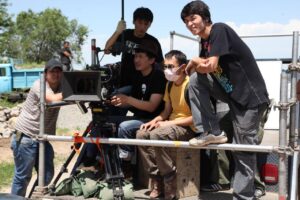
From a personal archive
TCA: And I imagine there were many people on set as well?
Yerkinbek: Yes. Three or four minivans arrived carrying crews from various rental companies, almost all the rental companies were involved. I sat there thinking, “Did I really order all this?”
But when everything was installed and the lights were switched on, the night truly came alive. It was no longer an imitation but a fully realized environment.
TCA: Are there cinematographers you admire or learn from?
Yerkinbek: Of course. You can learn something from any film. We live in an era when many great cinematographers are still actively working, some of them already quite elderly.
Take Roger Deakins, for example. He is nearly 80 and continues to win Academy Awards. He has received Oscars for 1917 and Blade Runner 2049, though in my opinion he could have won for almost every film he has shot, The Shawshank Redemption, No Country for Old Men, and many others.
In the West, experience and time are valued. The older a professional becomes, the deeper their understanding of the craft.
TCA: Here, however, there seems to be greater demand for youth, resilience, and speed.
Yerkinbek: Unfortunately, experience and longevity are not yet our top priorities. That is probably why many people aspire to work in Hollywood, professionals are highly valued there. Even so, it is not easy to find work. You still have to prove you are the best.
It is rare for a debut director and a debut cinematographer to be paired on a major project. If the director is new, they will usually be matched with an experienced cinematographer. That is how the system works.
TCA: You are originally from Shymkent, correct? It has always seemed to me that the city has a unique cultural character, many artists and creative figures come from there. Does one’s place of origin shape a person?
Yerkinbek: I left Shymkent 20 years ago and rarely visit, perhaps once or twice a year. My parents still live there, but my schedule is very busy. One project follows another, and the preparation period is also intense. By that stage, I am already living inside the film.
Does birthplace shape us? I think so. There really are many creative people in Shymkent. It is warm and peaceful there, you can walk around freely from morning until night. I suppose it is easier to create in such an environment.
TCA: Did you go to movie theaters as a child?
Yerkinbek: We mostly watched films on VHS tapes featuring Jean-Claude Van Damme, pirated copies with single-voice dubbing, where you could sometimes still see silhouettes moving across the screen.
I also loved REN TV, which broadcast good films on Thursdays. Now I realize many of them were American B-movies, including those starring Van Damme. But we watched them until morning. That was when I fell in love with cinema, and later in college I began to study it as a major art form.
TCA: Many directors make films about their childhood. What about cinematographers?
Yerkinbek: We bring to life the world imagined by the director. But I believe childhood is crucial for any creative professional, director, cinematographer, or screenwriter. That is when much of the foundation is formed.
We spent most of our childhood outdoors, running, playing, coming home only at night. We lived on the outskirts of town, in a neighborhood that felt almost like a village. We looked after livestock and helped with haymaking. There was little else to do. You would lie in the grass, read a book or a newspaper, daydream, there was almost nothing around, just the sky, and occasionally a plane passing overhead. I think that had a profound influence on me.
I grew up in the mid-1990s, when electricity was often cut off. We could not watch television or read in the evenings, so we played chess by candlelight.
The chessboard kept getting lost, so my father simply drew one on the table where we ate. I still remember the glow of the candle or kerosene lamp, the crackling of the stove. We would all play chess with him. It was impossible to beat him, so we took turns trying. The rest of us sat nearby, waiting and playing with the shadows on the walls.
TCA: It sounds almost like a painting, Kazakh, steppe-like, with shadows, fire, and light.
Yerkinbek: Yes, that image still lives in my memory. I am very grateful to my parents for the childhood they gave me.