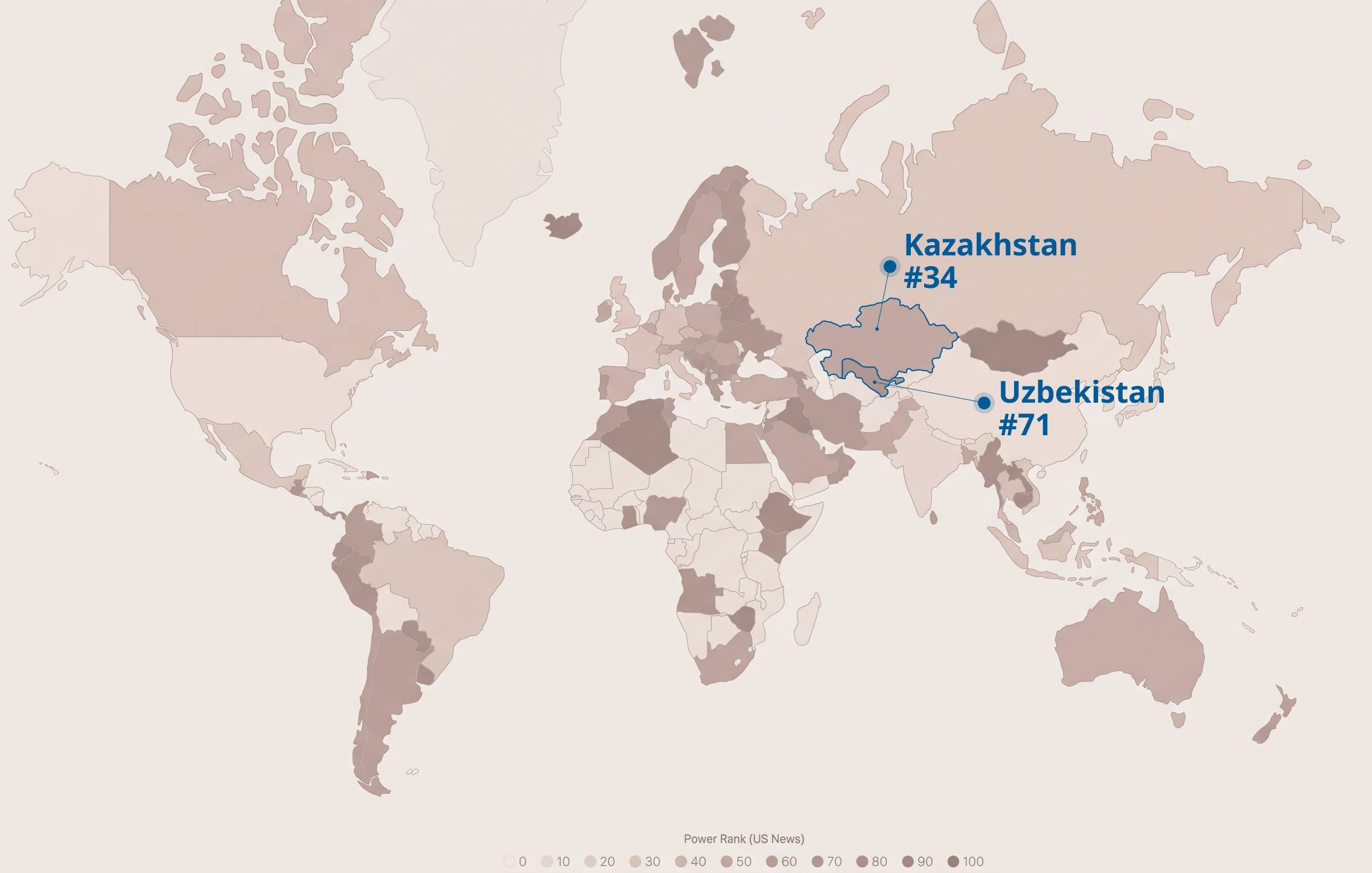
Kazakhstan and Uzbekistan were the only Central Asian countries included in World Population Review’s 2026 ranking of the world’s 100 most powerful countries, placing 34th and 71st, respectively.
Kazakhstan ranked immediately ahead of Egypt (35th), and also placed above the United Arab Emirates (37th), South Africa (38th), Norway (39th), Saudi Arabia (40th), Pakistan (42nd), and Iran (46th). Among former Soviet republics, Russia ranked higher, in 11th place, while Ukraine came in 51st and Belarus 57th.
Uzbekistan placed below Cambodia (69th) and Oman (70th), but ahead of Sri Lanka (72nd), Estonia (75th), Kenya (77th), Algeria (79th), and Armenia (80th).
World Population Review attributes the ranking to the Best Countries study by U.S. News & World Report. The assessment considers perceptions of countries’ economic and political influence, military strength, international alliances, and leadership.
Kazakhstan’s international standing is supported by its established energy and mining industries and extensive diplomatic relationships. The country is the world’s largest uranium producer, accounting for approximately 40% of global mine output in 2025. It also exported 78.7 million tons of oil that year, supplying international energy markets through an extensive network of pipelines and commercial partnerships.
Its multivector foreign policy has allowed Astana to maintain relationships with Russia and China while expanding economic and political cooperation with the United States, Europe, and other partners. Kazakhstan’s uranium industry illustrates this approach, with established customers and industrial partnerships spanning several competing geopolitical blocs.
Kazakhstan’s existing railway network, connections with China, and Caspian ports also support its role in international trade between Asia and Europe. The Trans-Caspian International Transport Route, commonly known as the Middle Corridor, carried approximately 4.1 million tons of freight in 2025, including around 77,000 twenty-foot equivalent units of container traffic.
Uzbekistan’s $147 billion economy in 2025 was larger than those of Oman ($110 billion), Sri Lanka ($109 billion), and Kenya ($136 billion), all ranked in the same range. Algeria, despite an economy approaching $287 billion and its role as a major natural gas supplier to Europe, ranked eight places below Uzbekistan.
Beyond economic size, Uzbekistan has an established position in global mineral markets. According to the U.S. Geological Survey, it was the world’s fifth-largest uranium producer and ninth-largest gold producer in 2024, accounting for 6.6% and 3.9% of global output, respectively. These industries provide an important source of international economic engagement, alongside a domestic market of approximately 39 million people.
The ranking’s top 10 were China, the United States, India, Germany, Japan, South Korea, France, the United Kingdom, Mexico, and Italy.
Kyrgyzstan, Tajikistan, and Turkmenistan did not appear among the 100 countries listed.