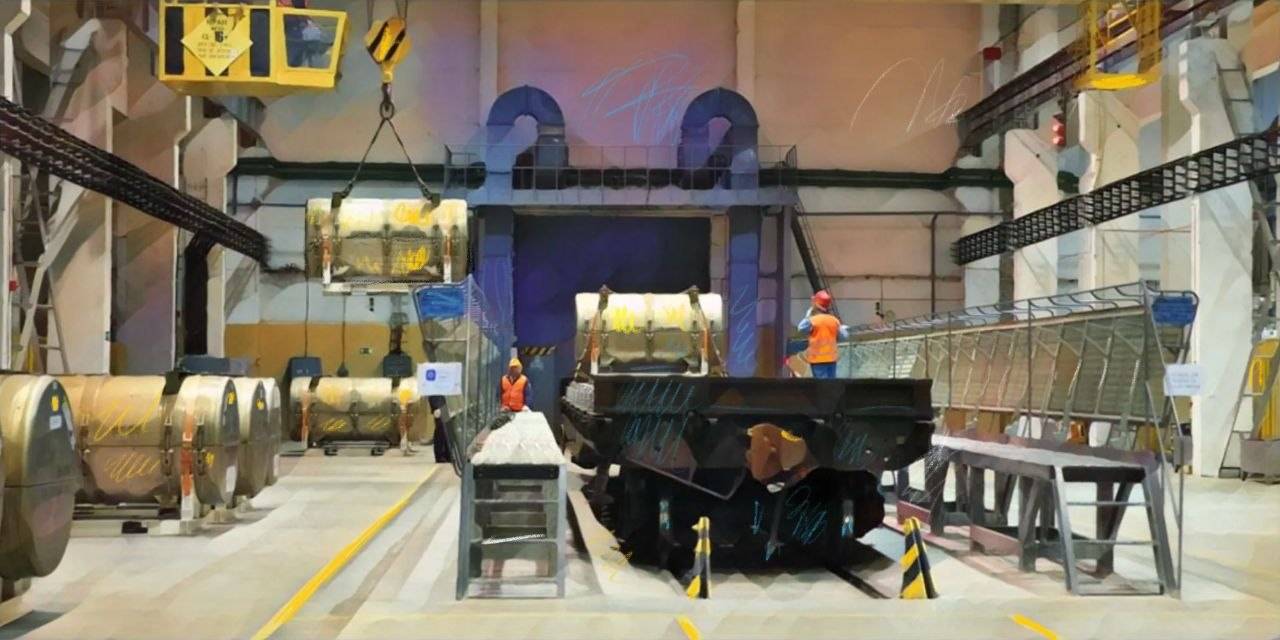
Kazakhstan supplies about two-fifths of the world’s mined uranium, making it a critical supplier to nuclear markets in Asia, Europe, and the Americas. What sets it apart is not simply its resource base, but its ability to produce and deliver uranium at scale.
Kazakhstan already dominates global uranium mining. It produced 25,839 tonnes in 2025, about 40% of world mine output, and production rose another 9% in the first half of 2026. It has been the world’s largest producer since 2009.
Kazakhstan holds about 14% of identified global uranium resources, while Australia, Canada and others also have large deposits. Its advantage is that production capacity is already in place. Developing comparable new supply elsewhere would take years.
Demand is meanwhile expected to rise. The OECD Nuclear Energy Agency and International Atomic Energy Agency project annual uranium requirements could rise by about 50% by 2050 in their lower case, and more than double in their higher case. In either scenario, Kazakhstan’s existing production base would be hard to quickly replace.
A Uranium Supplier Across Major Markets
Kazakhstan supplies markets whose fuel-security priorities increasingly differ. Asia accounted for 56% of Kazatomprom’s consolidated uranium sales in 2025, according to its May 2026 investor handout. The Americas accounted for 25%, and Europe for 19%.
The sales map gives commercial weight to Kazakhstan’s multi-vector foreign policy. China is a major customer and industrial partner. Russia remains an important partner through joint ventures, enrichment services, and long-term supply arrangements. European and North American utilities, meanwhile, buy Kazakh uranium as part of increasingly diversified procurement portfolios.
Kazatomprom widened that customer base in 2025, adding buyers in Switzerland and the Czech Republic, and expanding relationships with Japan and India, according to its full-year financial results.
What distinguishes Kazakhstan is the combination of scale and cross-market integration. It supplies Asian, European, and North American markets while maintaining industrial ties with China, Russia, and Western partners. That gives Kazakhstan room to tailor commercial arrangements to different markets. For Western buyers, this could support additional processing and transit options that meet their commercial and regulatory requirements. Kazakhstan could develop these while continuing to serve established Asian markets, attracting new investment while preserving its multi-vector position.
Kazakhstan’s importance to the U.S. market is substantial. Kazakh-origin uranium accounted for 28% of deliveries to American civilian reactor operators in 2025, second only to Canada, according to the U.S. Energy Information Administration. Kazakhstan was also the EU’s second-largest source of natural uranium in 2025, accounting for 20.3% of deliveries to EU utilities, according to the Euratom Supply Agency.
Kazakhstan’s production share does not mean that equivalent volumes are available for new customers. Twelve of Kazatomprom’s 14 mining operations are partially owned through partnerships, and much of their output is already committed under long-term contracts. Budenovskoye’s 2026 production, for example, is reserved under an existing offtake agreement for Russia’s civilian nuclear industry.
Additional capacity would give Kazakhstan more flexibility to respond to demand across multiple markets.
Kazakhstan’s Stability Underpins Global Uranium Supply
Kazakhstan’s importance to uranium markets rests not only on scale but on its reliability as a supplier. Wesley Monteiro, Global Market Engagement Lead at S&P Global Energy/Platts, told TCA in June that Kazakhstan’s value to uranium-consuming countries reflects its stability, international relationships, and ability to function as a secure supplier.
That reliability has been tested amid the war in Ukraine, sanctions on Russia, and heightened transport risks. Western utilities have continued to receive Kazakh uranium, while greater use of alternative export routes has added resilience. Because utilities secure uranium and fuel-cycle services under long-term contracts and plan reactor refueling years ahead, continuity gives buyers the predictability they need.
Reliable supply also depends on conditions closer to the mine. One immediate constraint is sulfuric acid. Most Kazakh uranium is produced by in-situ recovery, which requires large quantities of sulfuric acid. Kazatomprom’s 2026 production target of 27,500–29,000 tonnes remains subject to acid availability. A new sulfuric acid plant in the Turkestan region, due in early 2027, is designed to produce 800,000 tonnes a year. Until then, sulfuric acid availability will remain an important constraint on Kazakhstan’s ability to expand production.
Transport is another test of resilience. Uranium bound for Western conversion plants has traditionally traveled through Russia via the port of St. Petersburg. Kazatomprom has also expanded use of the Trans-Caspian route through Azerbaijan and Georgia. Both remained operational in early 2026.
In 2025, the Trans-Caspian route carried 48% of Kazatomprom’s deliveries to Western customers, up from 26% a year earlier. It is more complicated than the Russian route, but the increase shows it can handle substantial volumes. More capacity at ports, railways and border crossings would make it a stronger alternative.
As TCA noted in Resources, Capacity, Connectivity: Kazakhstan and the Critical Minerals Nexus, diversification adds resilience only when alternative corridors have enough capacity to sustain shipments during a disruption. Kazakhstan does not need to divide exports evenly between corridors. It needs enough spare capacity to keep shipments moving if either route is disrupted.
Kazakhstan’s Push Downstream
Mining is only the first step in the nuclear fuel cycle. Conversion, enrichment and fuel fabrication are even more concentrated. The International Energy Agency estimates that four suppliers control more than 99% of enrichment capacity, with Russia accounting for about 40%.
Kazakhstan has begun moving downstream. Ulba-FA, a Kazakh-Chinese plant in eastern Kazakhstan, uses technology from France’s Framatome to make fuel assemblies for Chinese reactors. It reached its annual design capacity of 200 tonnes in 2024, backed by a 20-year Chinese purchase commitment.
According to Kazatomprom’s latest Ulba-FA update, the assemblies are already operating in Chinese reactors. The arrangement brings together Kazakh uranium, French technology, Chinese demand and Russian enrichment secured through 2043.
Kazakhstan is already expanding its network of nuclear-sector partnerships. Japanese companies have been partners in its uranium industry for nearly two decades, while Canada’s Cameco and France’s Orano operate major joint ventures. Cooperation with South Korea is also expanding. Amendments adopted in December 2025 create pathways for certain extensions and production increases through greater Kazatomprom participation or the transfer of conversion and enrichment technologies by foreign partners. This approach reflects Kazakhstan’s multi-vector strategy: drawing technology and investment from several nuclear powers while building more of the fuel chain at home.
Developing these capabilities would increase export value, support skilled employment and technology transfer, and strengthen the industrial base for Kazakhstan’s own nuclear power program.
Preparatory work began in 2025 near Lake Balkhash for the first plant in Kazakhstan’s new nuclear power program, with Rosatom selected to lead the project. The plant would extend Kazakhstan’s nuclear role from uranium mining and fuel fabrication into domestic electricity generation.
Kazakhstan does not control the nuclear fuel chain, but its share of global mine production already makes its output difficult to replace quickly.
For nuclear utilities worldwide, the continuity of Kazakh production and exports has become an increasingly important foundation of secure fuel supply.