President Sadyr Japarov has sharply criticized the United States and United Kingdom for imposing what he has called unfounded sanctions on Kyrgyz financial institutions, urging Western leaders to stop “politicizing the economy.” In an interview with state news agency Kabar, Japarov defended two state-owned banks – Keremet Bank and Capital Bank – against allegations that they helped Russia skirt international sanctions, insisting that no evidence of violations has been presented. Neither the UK nor the U.S. has provided a single fact of violation… such facts simply do not exist,” Japarov said, dismissing the sanctions as politically motivated.
UK and U.S. Target Kyrgyz Banks for Russia Sanctions Evasion
Japarov’s comments come after a new wave of Western measures targeting Kyrgyzstan’s banking and crypto sectors for purported links to Russian sanctions evasion. On August 20, London sanctioned Kyrgyzstan-based Capital Bank – along with its director, Kantemir Chalbayev – alleging the bank was being used by Moscow to pay for military goods as part of a “convoluted scheme” to evade sanctions. The British authorities also blacklisted two Kyrgyz cryptocurrency exchanges – Grinex and Meer – that ran the infrastructure for a new rouble-backed crypto coin called A7A5, which moved an estimated $9.3 billion in just four months and was “intentionally created to evade sanctions.”
The UK’s sanctions minister, Stephen Doughty, warned that “laundering transactions through dodgy crypto networks” would not soften the blow of Western sanctions.
These steps followed a U.S. Treasury designation in January 2025 against Keremet Bank, a mid-sized Kyrgyz lender, for creating a hub for trade payments that helped Moscow evade restrictions. U.S. officials allege that Keremet Bank facilitated cross-border transactions for Russia’s sanctioned Promsvyazbank and even sold a controlling stake to a firm linked to a pro-Kremlin oligarch – moves Washington viewed as part of a secret channel to re-export dual-use goods and finance Russia’s defense sector. Those actions marked one of the first instances of Western “secondary sanctions” against Central Asian entities – penalties on third-country institutions accused of abetting a sanctioned nation’s activities.
Kyrgyz Government’s Defensive Measures
President Japarov contends that Kyrgyzstan has been proactive in compliance and that the West’s suspicions are misplaced. He noted that 21 banks operate in Kyrgyzstan, and authorities deliberately limited all Russian rouble transactions to just two state-controlled banks to shield the rest of the financial sector from any inadvertent sanctions breach. “To prevent any of them from falling under sanctions, we decided that only the state-owned Keremet Bank would work with the Russian rouble… All operations are under state control, and the income goes directly to the state treasury,” Japarov stated.
Earlier this year, the government expanded this approach by channeling rouble remittances and payments through Capital Bank, which was brought under 100% state ownership in April. The National Bank of Kyrgyzstan ordered that all cross-border transfers in roubles – including the billions of roubles sent home by Kyrgyz migrant workers each day – be processed exclusively via Capital Bank. Kyrgyz officials argued this centralization was meant to “ensure transparency of financial flows and minimize sanctions risks” under state oversight.
Western regulators, however, have viewed these measures with suspicion. The UK’s sanctions announcement asserts that Russia “turned to the Kyrgyz financial sector” and “opaque financial networks” (including crypto conduits) to bypass sanctions. In Washington’s view, Kyrgyzstan’s state banks became conduits for illicit finance: the U.S. Treasury reported that after Russia invaded Ukraine, a firm associated with Moldovan oligarch Ilan Shor – a fugitive under U.S. sanctions – purchased a controlling stake in Keremet Bank, allegedly to create a sanctions-evasion hub.
The British authorities similarly signaled their concern that Capital Bank might be following “the same path” as Keremet, pointing out that Chalbayev was formerly a top executive at Keremet Bank. Notably, the UK’s latest sanctions also targeted Altair Holding (a Luxembourg-registered company tied to Shor that had acquired a stake in Keremet, underscoring London’s focus on any Shor-linked networks in Kyrgyzstan.
Japarov: No Evidence, Calls Western Claims Unfounded
President Japarov rejects the narrative that Kyrgyz banks are abetting Russia, stressing that neither Washington nor London has provided proof of sanction violations by Kyrgyz institutions. “In January, the U.S. imposed sanctions against Keremet Bank… however, they were unable to provide a single fact confirming this. And they will not be able to, because such facts simply do not exist,” he told Kabar.
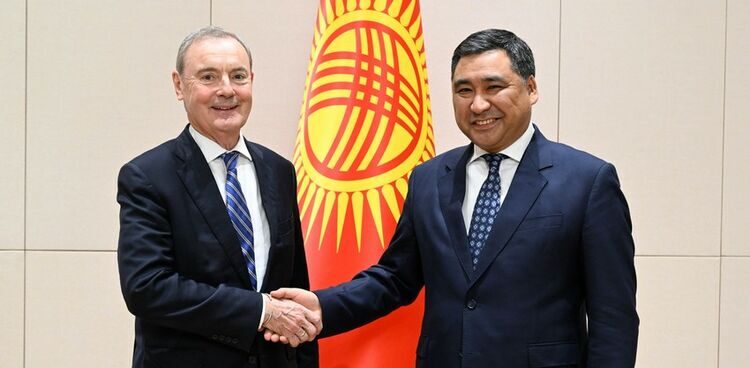
Following the U.S. designation of Keremet, Japarov’s government says it sought dialogue and transparency. First Deputy Prime Minister Daniyar Amangeldiev met with U.S. Ambassador Leslie Viguerie in Bishkek and later traveled to Washington, D.C. to engage with the Treasury’s Office of Foreign Assets Control (OFAC) about the sanctions. Japarov recounted that the Kyrgyz side offered to arrange an independent audit of both Keremet Bank and Capital Bank – inviting neutral experts to scrutinize their operations – but the U.S. declined the offer. “We proposed to involve independent audit companies to check… and then make a decision. But they refused,” he said.
According to Japarov, American officials “were unable to present any facts” of wrongdoing even in private, instead telling Kyrgyz envoys only that “we have information.” The president alleges that this unspecified “information” came from questionable sources: “We understand perfectly well where this ‘information’ comes from – it is transmitted by local NGOs and our internal opponents in the form of anonymous denunciations. Sanctions are imposed on the basis of this false data,” Japarov said, suggesting that hostile domestic actors fed Western governments unsubstantiated reports.
The pattern repeated, Japarov says, with the UK’s blacklisting of Capital Bank. “Now, as in the case of Keremet Bank, the UK is imposing sanctions against Capital Bank – and again without a single piece of evidence. Everything is based only on doubts,” he asserted.
The president framed the sanctions as politically driven rather than based on facts, musing as to whether the pressure might be a response to Kyrgyzstan’s rapid economic rise: “Is this connected with the fact that the Kyrgyz economy is developing at a high rate? Our GDP has grown by 11.7%, and we are ahead of the CIS countries. Perhaps this is how they put pressure on us, because large countries are not interested in other countries developing quickly.”
Kyrgyzstan’s economy has expanded robustly in the past two years – by around 9% annually according to official figures – thanks in part to booming re-exports and inflows from Russia. Japarov insinuated that Western powers find such success inconvenient: “It is more profitable for them when other countries are dependent and look up to them,” he said, implying that sanctions are meant to keep Kyrgyzstan in check.
Appeals to Western Leaders and Citing “Double Standards”
In an unusual personal touch, Japarov directly appealed to prominent Western politicians to intervene. “I would go to the top leadership of these countries – Donald Trump and Keir Starmer. Maybe they are not getting the message,” he said. “There is no need to politicize the economy.”
Japarov argued that Kyrgyzstan pursues a balanced, multi-vector foreign policy and is seeking cooperative economic ties with both East and West. As evidence, Japarov pointed out that despite the UK sanctioning a Kyrgyz bank, Britain remains a top buyer of Kyrgyz gold – about $1 billion worth each year – and that trade between Kyrgyzstan and Western countries continues in other sectors. He also cited data highlighting ongoing Western commerce with Russia: “In 2024, EU countries traded with Russia for $141 billion, of which $36 billion were imports from Russia. The UK, which imposed sanctions against our bank, itself traded $2.2 billion with Russia in 2024,” Japarov stated. “It turns out that they leave the opportunity to cooperate for themselves, but prohibit others,” he added.
Analysts have also observed that several major economies maintain significant trade with Russia despite sanctions, especially in energy and commodities. By Japarov’s account, this amounts to a double standard. “The attitude you [Western nations] demonstrate is unfair. If you do not trust us, bring your data. Our banks are ready to show all the reports,” he said.
Limited Impact at Home – Pledging Resilience
For now, Kyrgyz officials assert that these sanctions – while diplomatically vexing – have not crippled the local banking system or economy. Both Keremet Bank and Capital Bank continue to operate under the Ministry of Finance’s control, serving clients and processing transactions, albeit now effectively cut off from U.S. dollar and British-linked dealings. Japarov emphasized that everyday life in Kyrgyzstan will carry on as normal despite the Western measures. “We are ready to fulfill international obligations and are doing so. But I will not allow the interests of our citizens and the economic development of the country to be sacrificed,” he declared. Even “under the pressure of sanctions, we will continue to live and work,” Japarov concluded, vowing to safeguard Kyrgyz citizens’ economic interests and avoid any interruption to vital financial flows such as remittances.
Western governments, however, have signaled that they will keep scrutinizing channels that could aid Russia’s war effort. The U.S. and UK moves suggest a broader strategy to tighten secondary sanctions enforcement in Central Asia – essentially warning regional banks, businesses, and even crypto platforms against becoming backdoors for sanctioned Russian entities. This places Kyrgyzstan – closely tied to Russia through trade, migrant labor, and investment, yet also seeking positive relations with the West – in a delicate position. Japarov’s administration has walked a fine line, professing neutrality in the Russia-Ukraine conflict and pivoting to whichever partners can spur development. The showdown over sanctions on its banks highlights the rising pressure on such third countries to police any dealings that might undermine the sanctions regime on Moscow.
Editor’s Note: Parts of this article are based on a translated interview with President Sadyr Japarov published by the state news agency Kabar. All trade figures and statements attributed to the president have not been independently verified by The Times of Central Asia.