• KGS/USD = 0.01144 0%
  • KZT/USD = 0.00212 0%
  • TJS/USD = 0.10456 0.19%
  • UZS/USD = 0.00008 0%
  • TMT/USD = 0.28490 0%
  • KGS/USD = 0.01144 0%
  • KZT/USD = 0.00212 0%
  • TJS/USD = 0.10456 0.19%
  • UZS/USD = 0.00008 0%
  • TMT/USD = 0.28490 0%
  • KGS/USD = 0.01144 0%
  • KZT/USD = 0.00212 0%
  • TJS/USD = 0.10456 0.19%
  • UZS/USD = 0.00008 0%
  • TMT/USD = 0.28490 0%
  • KGS/USD = 0.01144 0%
  • KZT/USD = 0.00212 0%
  • TJS/USD = 0.10456 0.19%
  • UZS/USD = 0.00008 0%
  • TMT/USD = 0.28490 0%
  • KGS/USD = 0.01144 0%
  • KZT/USD = 0.00212 0%
  • TJS/USD = 0.10456 0.19%
  • UZS/USD = 0.00008 0%
  • TMT/USD = 0.28490 0%
  • KGS/USD = 0.01144 0%
  • KZT/USD = 0.00212 0%
  • TJS/USD = 0.10456 0.19%
  • UZS/USD = 0.00008 0%
  • TMT/USD = 0.28490 0%
  • KGS/USD = 0.01144 0%
  • KZT/USD = 0.00212 0%
  • TJS/USD = 0.10456 0.19%
  • UZS/USD = 0.00008 0%
  • TMT/USD = 0.28490 0%
  • KGS/USD = 0.01144 0%
  • KZT/USD = 0.00212 0%
  • TJS/USD = 0.10456 0.19%
  • UZS/USD = 0.00008 0%
  • TMT/USD = 0.28490 0%

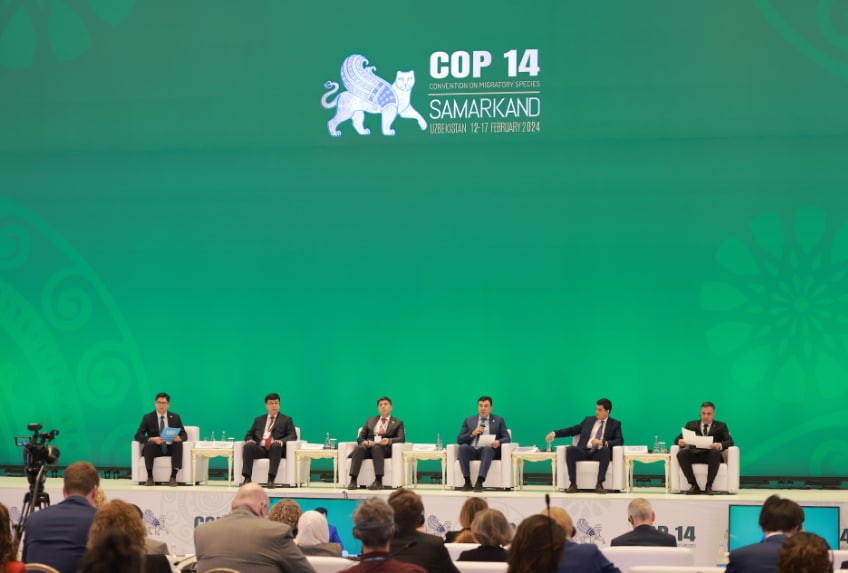
Central Asian Countries Work together to Protect Migratory Species

The 14th Conference of the Parties to the Convention on Migratory Species of Wild Animals (CMS COP14) is taking place from February 12th to 17th in Samarkand, Uzbekistan. 

Uzbekistan’s Minister for Ecology and Environmental Protection, Aziz Abdukhakimov commented on February 11th: “Over the next five days, we will be discussing a range of issues related to migratory species, including the socio-economic and environmental challenges of climate change. Our goal is to find solutions and develop effective plans for the conservation of migratory species, which play a vital role in maintaining ecosystems and a healthy planet.”

As part of the conference, Uzbekistan, Kazakhstan, and Kyrgyzstan have joined the Memorandum of Understanding on the Conservation of Migratory Birds of Prey in Africa and Eurasia. The document was signed by Abdukhakimov and his Kazakh and Kyrgyz counterparts. 

“The memorandum provides for the removal of obstacles to the migration of wild animals and the creation of favorable conditions for their migration from one territory to another. This will protect migrating animals and thereby preserve biodiversity. In addition, it will strengthen the unity of the Central Asian countries in this direction,” the Uzbek minister said.

Uzbekistan and Kazakhstan have also joined their efforts to preserve the wildlife of the Ustyurt Plateau. On February 11th a Memorandum of Cooperation in the conservation of wildlife of the Ustyurt Plateau was signed between Minister Abdukhakimov and the Deputy Minister for Ecology and Natural Resources of Kazakhstan, Nurken Sharbiev.

Farmers in Uzbekistan to Receive 60,000 Hectares of Land

A February 12th meeting chaired by President Shavkat Mirziyoyev focused on the topic of increasing fruit and vegetable production and exports in Uzbekistan, and an additional 60,000 hectares of land will be given to the local farmers with this goal in mind. Government data indicate that an extra $200m can be made in exports on an additional 1.5 million tons of agricultural products from such a move. The meeting also underlined the significance of teaching young people how to farm and keeping them employed across the farms of Uzbekistan.

It was also noted that an extra $1bn worth of goods could be produced by introducing industry and collaboration to the farmsteads and land plots that the local population is being awarded.

Credit resources worth one trillion som will be allotted for this. These loans are provided for cooperating to produce goods, purchase machinery, and fund working capital up to 100 million sum ($8,100) without collateral, or up to 150 million sum ($12,100) with 50% loan collateral.

Ten thousand machines will be leased to farmers and farm laborers for a total of 10 years, with an additional three-year grace period. The three-year customs privilege will be extended for mini tractors and imported/leased cultivators.

At the meeting, further steps were taken to encourage the production of fruits and vegetables in greenhouses. Officials mandated a revision to the crediting system for greenhouse farms. Mirziyoyev assigned the task of constructing up to 200 compact greenhouses measuring 10 square meters each, which must be handed over to farmers for use, after endorsing the experience of constructing fuel-free, small greenhouses. Unsecured loans up to 100 million sum ($8,100) will be made available for those greenhouses under the Family Business farm-credit program.

EDB Plans $3.5bn investment in Kazakhstan Projects in 2024

The Eurasian Development Bank’s annual investment in Kazakhstan’s economy has exceeded $1bn for the second consecutive year, the chairman of its management board Nikolai Podguzov said during a February 12th meeting with Kazakhstan’s president Kassym-Jomart Tokayev. 

The Eurasian Development Bank (EDB) is an international financial institution with member states including Armenia, Belarus, Kazakhstan, Kyrgyzstan, Russia, and Tajikistan. The bank’s investment in 2022 and 2023 amounted to $4.2bn, with the share of Kazakhstan-based projects in the bank’s portfolio steadily increasing and reaching 59% by the end of 2023.

The value of potential EDB projects under consideration for Kazakhstan for 2024 exceeds $3.5bn. These investments are planned for the country’s strategically important sectors such as transport infrastructure, thermal and renewable energy, industrial production, agriculture, and water management.

Podguzov emphasized that this year the EDB intends to foster the growth of Kazakhstan’s financial market, including the implementation of new instruments to fund infrastructure projects.

He also informed Tokayev about the EDB’s research on the Central Asian water and energy complex. Podguzov said that his bank plans to promote the advancement of Kazakhstan as a driver of efficient water use, and stands ready to offer grants totaling up to $10m to develop regional centers of expertise in water conservation and energy-efficient technologies – and to allocate up to $400m for projects involving digital water-metering technologies, laser land levelling for irrigated areas and the establishment of a regional production and service cluster for state-of-the-art irrigation equipment.

Kyrgyz Court Rules in Favor of Shutting Down another Mass Media Outlet

Bishkek’s Oktyabrsky District Court has ruled in favor of liquidating a public foundation named Kloop Media. The official reason, as stated in a social network post by Kloop Media, is discrediting state and municipal bodies. According to the publication’s staff, Bishkek prosecutor Emilbek Abdymannapov filed a lawsuit in court last August seeking to liquidate Kloop Media. The prosecutor had argued that most of the publication’s stories were negative and aimed at discrediting certain representatives of state and municipal bodies.

On August 22nd 2023, Kloop Media published a journalistic investigation focusing on corruption schemes undertaken by top officials in Kyrgyzstan – and later published more material criticizing the president of the republic and his relatives. Consequently, in September 2023, access to the Kloop Media website was blocked, and now the foundation itself has been closed by the authorities following the court’s decision, which states that Kloop Media is not listed in the state register of Kyrgyz media and that the organization’s charter doesn’t specify its main activity, which is the dissemination of information. The Civil Code of the Kyrgyz Republic allows for the liquidation of legal entities if they systematically carry out activities which don’t correspond to the objectives set out in their charters.

Lawyers for the public fund in turn stated that the court session contained multiple violations, and they will appeal the decision to a higher authority.

The public foundation, Kloop Media was established in 2007 and positioned itself as a human rights media outlet. Kloop primarily hired young writers and trained them in investigative journalism.

On the day the court’s decision was announced, the international organization, Reporters without Borders called on the Media Freedom Coalition to take action against what they called an “arbitrary and unjustified decision.”

In April 2023, the Lenin Court of Bishkek ruled in favor of a lawsuit brought by the Ministry of Culture, Information, Sports and Youth Policy of Kyrgyzstan that called for the shutdown of Azattyk Media, which was the Kyrgyz service of Radio Free Europe/Radio Liberty, financed by the U.S. State Department. The Ministry objected to material published about fighting on the border between Kyrgyzstan and Tajikistan. The authorities claimed that the content contained “elements of hostility and unconfirmed information about an alleged attack by the Kyrgyz side on Tajikistan, inflaming the situation in society and causing hatred, discrimination and division among citizens when covering the events in Batken Oblast.”

Two New tourist Stops Open on Kyrgyzstan’s Silk Road

Two new tourist stops have been opened in the south of Kyrgyzstan. One is beside the famous Uzgen Minaret, built almost a thousand years ago; the other is in the village of Barpy, on the highway between Bishkek and Osh. 

Stops like these exist to allow travelers to rest, charge electric cars and gadgets, have something to eat and drink, and take a shower. Kyrgyzstan’s first dedicated tourist stop was opened last spring in the town of Kemin in the north of the country, on the way to Issyk-Kul Lake.

There are now four places for tourists to stop in the south of Kyrgyzstan — Barpy, Uzgen, Kara-Kul, and Jalal-Abad. Two others are currently being built in the Issyk-Kul Region.

Uzbekistan Warns of Labor Migration Fraud involving United States

The press service of the State Security Service (SGB) of Uzbekistan has reported cases of fraud centered around false promises of helping Uzbek workers obtain documents to work in the United States. The first case took place in the capital, Tashkent, where three fraudsters were caught red-handed defrauding six people out of a total of $32,000 by promising to help them obtain visa documents and send them to work in the U.S. via Europe.

The next instance took place in Bukhara, where a thrice-convicted local resident offered to help a friend obtain a visa and employment in the U.S., requesting a payment of $40,000. He was detained in the act of receiving the first payment of $30,000.

The next three incidents took place in Samarkand. In the first case, two men offered a resident the same services, but via a roundabout route: Uzbekistan – Turkey – Portugal – Guatemala – Mexico – USA. They also asked for a smaller payment of $23,000. When they received the $10,000 advance payment, they were detained.

In the second case, the two promised to provide the same services and send the man on the same route. They also demanded $23,000 and were apprehended when receiving an advance payment. A third case followed a similar pattern.

in all cases, criminal proceedings were initiated under articles pertaining to fraud in the criminal code.