• KGS/USD = 0.01144 0%
  • KZT/USD = 0.00193 -0%
  • TJS/USD = 0.10811 -0.28%
  • UZS/USD = 0.00008 0%
  • TMT/USD = 0.28490 0%
  • KGS/USD = 0.01144 0%
  • KZT/USD = 0.00193 -0%
  • TJS/USD = 0.10811 -0.28%
  • UZS/USD = 0.00008 0%
  • TMT/USD = 0.28490 0%
  • KGS/USD = 0.01144 0%
  • KZT/USD = 0.00193 -0%
  • TJS/USD = 0.10811 -0.28%
  • UZS/USD = 0.00008 0%
  • TMT/USD = 0.28490 0%
  • KGS/USD = 0.01144 0%
  • KZT/USD = 0.00193 -0%
  • TJS/USD = 0.10811 -0.28%
  • UZS/USD = 0.00008 0%
  • TMT/USD = 0.28490 0%
  • KGS/USD = 0.01144 0%
  • KZT/USD = 0.00193 -0%
  • TJS/USD = 0.10811 -0.28%
  • UZS/USD = 0.00008 0%
  • TMT/USD = 0.28490 0%
  • KGS/USD = 0.01144 0%
  • KZT/USD = 0.00193 -0%
  • TJS/USD = 0.10811 -0.28%
  • UZS/USD = 0.00008 0%
  • TMT/USD = 0.28490 0%
  • KGS/USD = 0.01144 0%
  • KZT/USD = 0.00193 -0%
  • TJS/USD = 0.10811 -0.28%
  • UZS/USD = 0.00008 0%
  • TMT/USD = 0.28490 0%
  • KGS/USD = 0.01144 0%
  • KZT/USD = 0.00193 -0%
  • TJS/USD = 0.10811 -0.28%
  • UZS/USD = 0.00008 0%
  • TMT/USD = 0.28490 0%
10 December 2025

Uzbekistan Reforms Punishments for Importation of Drones

From June 15, 2024, an Uzbek law will come into force to reduce punishment for the illegal import, sale, purchase, storage or use of drones in Uzbekistan.

Under the current law, the unauthorised importation of drones carries a fine of $270-$540 and confiscation of the device. Punishment for repeated violations is harsh with fines reaching $670-$1,300, or up to three years’ corrective labour, restriction of freedom or imprisonment.

However, in case of voluntary surrender, the perpetrator is exempt from liability.

Uzbekistan’s Customs Committee stated, “The changes should lead to a reduction in the number of offenses related to the use of drones, as well as an increase in foreign tourists to Uzbekistan. In the past, foreign citizens have been detained more than once for importing UAVs, including through ignorance.” .

Earlier this year, the country’s amended administrative liability replaced criminal liability for violating these rules for the first time.

The import of drones has been prohibited since 2015, with the exception of cases specified by law, such as the use of drones for agricultural purposes.

Sixty-two percent of the drones imported by Uzbekistan come from Sudan, 12% from Venezuela and 9% from Russia.

In early 2022, Uzbekistan announced the launch of locally assembled Lochin (Falcon) drones at the Scientific and Production Centre for Unmanned Aerial Complexes, established under Uzbekistan’s State Committee for Oboronprom. Equipped with specialized equipment and a test laboratory, the centre produces drones for surveillance and military strikes and information gathering as well as for work in agriculture and surveillance in nature reserves, geology and cartography.

Starting Over: Central Asian Countries Celebrate the Arrival of Spring

It’s time for renewal in Central Asia.

Spring is arriving and it’s time to tidy up the home. Time for traditional music, cuisine, and brightly colored costumes. An occasion to reflect and renew, give thanks for the past, and build toward the future.

Or set aside bad things that happened and start over.

One of the world’s oldest holidays happens on the spring equinox, which is March 20 (Central Asia time) this year. Known as Nowruz, Navruz, Nauryz, and other variations, it means “New Day” in Farsi and traces its roots to the ancient Persian religion of Zoroastrianism. This year, it coincides with the Muslim holy fasting month of Ramadan. The holiday is also celebrated in the Caucasus, the Middle East, and other regions.

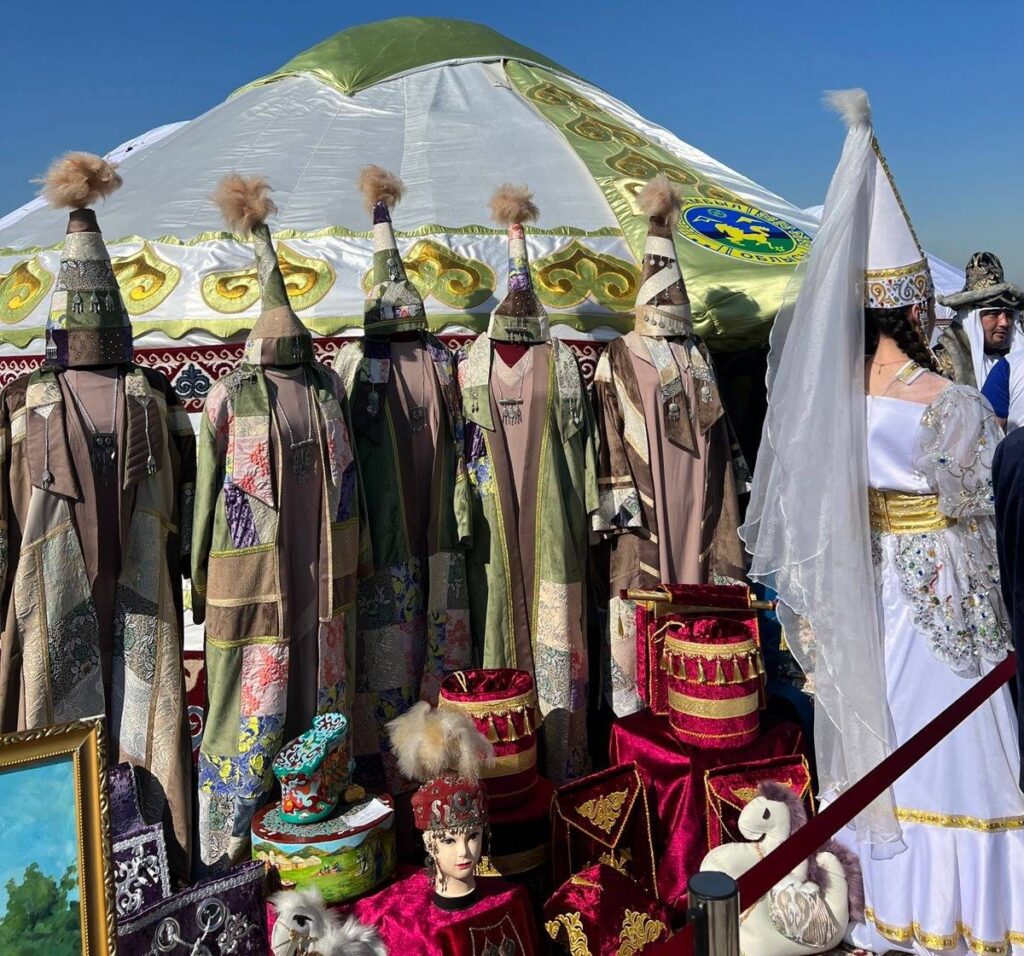
A view of the shanyrak, the central part of the upper dome of the yurt is shown to guests as an art object during Nauryz festivities. A shanyrak design, containing blue that represents the sky, is the national emblem of Kazakhstan. Photo: TCA

Celebrations are already in full swing. This year, Kazakhstan introduced a new format for Nauryz, with events running from March 14-23. In 2009, UNESCO included the day on its list of “intangible cultural heritage of humanity.”

In many parts of Central Asia, people decorate houses with branches of fruit trees to ensure a prosperous year. On the night before the spring equinox, people fill vessels with water from springs, milk, and grain. It is believed that such a ritual will bring abundant rains and a successful harvest in the coming year.

Holiday concerts feature traditional instruments. There are the karnai and surnai (wind instruments) and dutar (strung) in Tajikistan and Uzbekistan, or the dombra and kobyz (both strung) in Kazakhstan and Kyrgyzstan.
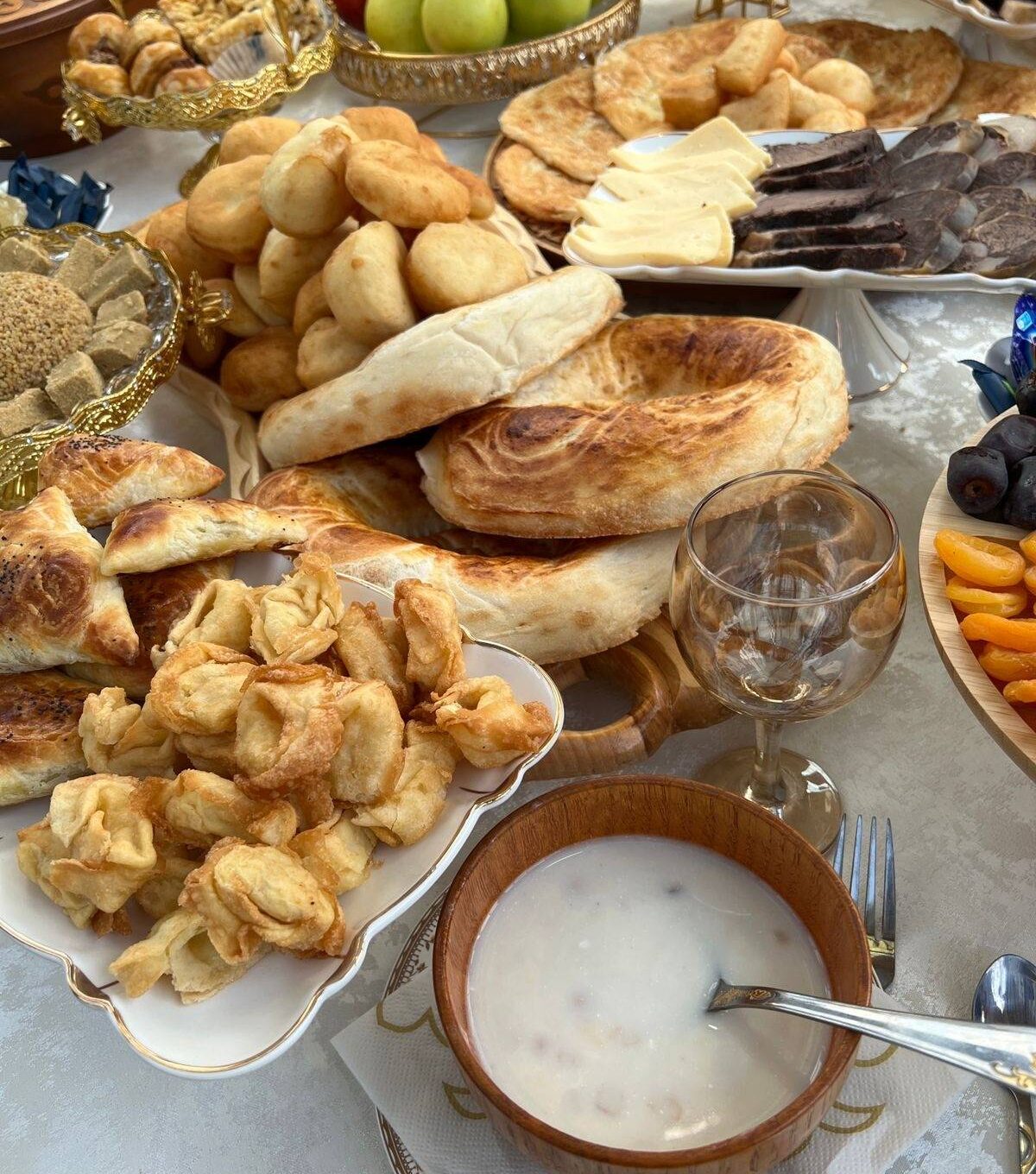
Baursak, a fried bread, and Nauryz kozhe, a cool, hearty drink that symbolizes good luck, are shown during Nauryz celebrations in Almaty, Kazakhstan in 2023. Ingredients of Nauryz kozhe can include water, meat, salt, milk or yogurt, and grain. Photo: TCA

A beautifully set table is another Nauryz tradition. The central place on the table in Tajikistan, Uzbekistan, Kyrgyzstan, and Turkmenistan is occupied by sumanak, a dessert. It is made of germinated wheat and cooked in a metal pot for about 12 hours. According to legend, you should make a wish while stirring the sumanak. It is said that if you make a wish from a pure heart, it will definitely come true.

In Kazakhstan, a special place on the table is occupied by Nauryz kozhe, a hearty soup of milk, meat, butter, two kinds of millet, rice, and corn, symbolizing the seven principles of life: growth, luck, happiness, wealth, health, wisdom, and heavenly protection. At home, it is poured into seven bowls and placed before seven wise elders, known as aksakals.

The number has a special meaning in many aspects of the celebration. Traditionally, everyone should invite seven guests to their home and visit seven houses themselves.

Nauryz is also a time of moral education and mutual understanding. People congratulate each other and share values and traditions with young people.

Boys born on March 21 are called Navruzbek or Navruzbay, and girls are named Navruzgul.

Some cities in Central Asia hold festivals and parades to celebrate the spring holiday. Streets are decorated with flowers, flags, and national symbols.

A game of buzkashi at the Hippodrome in Bishkek, Kyrgyzstan. Photo: TCA

Games and competitions are organized in squares and stadiums. In Tajikistan, it is the national wrestling, gushtingiri, where rivals try to throw each other to the ground, and the game called buzkashi, in which riders compete for a goat, trying to snatch it from the hands of rivals. In Kazakhstan, it is Kazaksha kures and arkan tartys tug-of-war. In Kyrgyzstan, there are large-scale horse games. During the holiday, guests can buy souvenirs and national delicacies at folk fairs.

Nauryz was especially important in Central Asia when populations were primarily nomadic and based their lives around the changing seasons. Today, it’s also an occasion for charitable donations.

Astana Projects Attract Qatari, Turkish, Russian Interest

This month foreign investment projects in Astana’s real estate sector have been high on the agenda at meetings at the Investment Headquarters in Kazakhstan’s capital.

One such project is a new medical center to be constructed in collaboration with a Qatari holding company, and with the participation of American cosmetic skin care provider Cynosure. The first stage is set to comprise a medical center for 50 patients with a planned investment of 88 billion tenge (~$196million), and in the second, the Qatari partners intend to invest around 160 billion tenge (~$360 million) in a larger extension.

According to reports, Qatari investors have also committed funds for the construction of branded international schools in Astana. The first, a Sabis school for almost 3,000 pupils and 530 children of preschool age, is scheduled to open in April this year. The second, to be constructed by International Community Schools Ltd, will accommodate 1,225 pupils and 100 pre-school children, involve private investment of 9 billion tenge (~$20 million), and create over 100 jobs.

The Turkish Tiryaki Company discussed investment of up to $200 million in the construction of a wheat processing plant with a capacity of 240,000 tons per year, and Russian e-commerce giants Wildberries and Ozon expressed their readiness to invest up to 90 billion tenge (~$200 million) in constructing large logistics centers in Astana. The Austrian Lasselsberger Group’s plans for investment of over 25 billion tenge (~$55 million) in a plant at Astana’s Industrial Park Number One will produce 100,000 tons of dry construction mixtures per year and create some 200 jobs.

Kazakhstan Bans LPG Export and Wheat Import

To prevent shortages in the domestic market, the government of Kazakhstan has extended the ban on export of liquefied petroleum gas (LPG) for six months.

The ban on import of wheat by road, rail, and water has also been extended for another six months in a move to prevent ‘gray schemes’ for the import of wheat into Kazakhstan from Russia and its further re-export. The sole exceptions are rail deliveries to Kazakh flour mills and to poultry enterprises for fodder. In both cases, imported wheat can neither be sold on the domestic market nor re-exported.

The Kazakh government has also announced a five-year extension of anti-dumping measures against manufacturers of bearings from China and electrodes from India to protect its country’s manufacture of similar goods.

US Helps Kyrgyzstan Prepare for Future Pandemics

A Global Health Security and Pandemic Preparedness Program was launched last week. The joint initiative between the United States, the Kyrgyz Republic, the Food and Agriculture Organization, the World Health Organization, and a consortium of other organizations, aims to improve Kyrgyzstan’s resilience against public health emergencies and coordinates with the United Nation’s ‘One Health’ policy linking human, animal, and environmental health.

As reported by the U.S. Embassy in Bishkek, the program will target seven key areas in Kyrgyzstan: tracking and reducing antimicrobial resistance; monitoring zoonotic diseases transmissible between animals and humans; strengthening national laboratory systems; disease surveillance; building capacity within the healthcare workforce; developing risk communication and community engagement strategies; and bolstering health emergency management.

U.S. Ambassador to the Kyrgyz Republic Lesslie Viguerie stated, “The United States Government ranks global health security among its top five priorities. Today’s event marks the next chapter in our long collaboration for improving Kyrgyz health care. We worked side-by-side during the COVID-19 pandemic and continued to do so in the pandemic recovery phase. We have made tremendous advancements in detecting and treating tuberculosis and HIV/AIDS. Many lives have been saved thanks to the collaborative efforts between our governments. With the timely launch of the National Action Plan for Health Security last year, the Kyrgyz Republic is taking a lead role to prepare its health systems for any future pandemics.”

The Deputy Minister of Health of the Kyrgyz Republic Bubuzhan Arykbaeva further endorsed the initiative saying, “We are confident that with USAID funding this program will play a critical role in supporting key technical areas of the National Action Plan for Health Security. The implementation of the Global Health Security program in the Kyrgyz Republic will allow our country to create a more stable foundation for future response to threats in the field of public health.”

EBRD Supports Expansion of Kazakhstan’s Salt Production

The European Bank for Reconstruction and Development (EBRD) has provided a convertible loan of up to KZT 5.5 billion (€11 million) to Araltuz, a leading Kazakhstan-based producer of table and low-grade industrial salt in Central Asia.

The funds will be lodged with Salt Industry Ltd., a joint-stock company operating under the jurisdiction of the Astana International Financial Centre and a holding company of Araltuz.

The loan will enhance the company’s investment program and support construction of new manufacturing facilities for Kazakhstan’s production of vacuum salt, also known as evaporated or culinary salt.

It will also help Araltuz diversify and expand exportation to Europe, the Middle East and China, and implement a corporate governance action plan.

With more than €10.1 billion invested in the country to date through 320 projects, Kazakhstan is the EBRD’s largest and longest-running banking operation in Central Asia.