• KGS/USD = 0.01144 0%
  • KZT/USD = 0.00194 0%
  • TJS/USD = 0.10879 -0.18%
  • UZS/USD = 0.00008 0%
  • TMT/USD = 0.28490 0%
  • KGS/USD = 0.01144 0%
  • KZT/USD = 0.00194 0%
  • TJS/USD = 0.10879 -0.18%
  • UZS/USD = 0.00008 0%
  • TMT/USD = 0.28490 0%
  • KGS/USD = 0.01144 0%
  • KZT/USD = 0.00194 0%
  • TJS/USD = 0.10879 -0.18%
  • UZS/USD = 0.00008 0%
  • TMT/USD = 0.28490 0%
  • KGS/USD = 0.01144 0%
  • KZT/USD = 0.00194 0%
  • TJS/USD = 0.10879 -0.18%
  • UZS/USD = 0.00008 0%
  • TMT/USD = 0.28490 0%
  • KGS/USD = 0.01144 0%
  • KZT/USD = 0.00194 0%
  • TJS/USD = 0.10879 -0.18%
  • UZS/USD = 0.00008 0%
  • TMT/USD = 0.28490 0%
  • KGS/USD = 0.01144 0%
  • KZT/USD = 0.00194 0%
  • TJS/USD = 0.10879 -0.18%
  • UZS/USD = 0.00008 0%
  • TMT/USD = 0.28490 0%
  • KGS/USD = 0.01144 0%
  • KZT/USD = 0.00194 0%
  • TJS/USD = 0.10879 -0.18%
  • UZS/USD = 0.00008 0%
  • TMT/USD = 0.28490 0%
  • KGS/USD = 0.01144 0%
  • KZT/USD = 0.00194 0%
  • TJS/USD = 0.10879 -0.18%
  • UZS/USD = 0.00008 0%
  • TMT/USD = 0.28490 0%
15 December 2025

Domestic Violence Victims Can Now Obtain EU Refugee Status After Ruling

Women who have suffered from domestic violence have the right to seek asylum in European Union (EU) countries, according to an EU Court of Justice ruling on January 16th. Anyone who has been subjected to physical and psychological violence, including sexual or domestic violence, can apply. If the those who apply do not meet the conditions for refugee status, they can claim additional measures of protection.
Refugee status may already be granted to third-country nationals who are persecuted on racial, religious, or national grounds, as well as on the basis of political convictions or membership of a particular social group.
According to the judges, threats from relatives “because of an alleged violation of cultural, religious or traditional norms” may qualify. Consequently, genital mutilation or forced marriage are often reasons for absconding, which women will have to disclose to authorities at the first interview.
The EU came to this decision after the story of a Turkish national, a girl of Kurdish origin was forcibly married by her family. In the marriage, she was beaten and threatened by her husband, but managed to escape. The woman, who feared that her life would be in danger if she returned to Turkey, sought help and asked for international protection in Bulgaria. The local justices then referred the case to the Court of Justice of the EU.
Karl Kopp, a migration expert for Pro Asyl – an independent human rights organization that advocates for the rights of refugees in Europe and Germany – said that the outcome is positive, and more women will be able to receive protection in the future.
At present, Kazakhstan is discussing the issue of toughening punishment for domestic violence. A joint study by the Union of Crisis Centers and the Friedrich Ebert Foundation found that in 2021, the public safety authorities of Kazakhstan received almost 115,000 complaints of domestic violence. Of these, only 40% of cases made it to court, whilst 39% of perpetrators got off with sentences that restricted their freedom for periods ranging from two hours to three days.


The Global Family: How Would-Be Parents From Abroad Adopt Kazakhstani Children

Children from Kazakhstan are mainly adopted by citizens of European countries, the USA and Canada, according to the Ministry of Education, which recently discussed some of the changing trends in the adoption of children from Kazakhstan.

There are two types of adoption procedure in the country: adoption by citizens of Kazakhstan or adoption by citizens of other countries. The number of Kazakh children adopted by foreign citizens has decreased significantly over the last decade — from 2013 to 2023 only 158 Kazakh children were adopted abroad, compared with 8,805 children in the period from 1999 to 2011. Since 2013 the Ministry of Foreign Affairs has controlled the process of foreign families adopting children from Kazakhstan.

The Ministry of Education emphasizes that foreign citizens can only adopt a child if the chance to adopt them was refused by relatives who are citizens of Kazakhstan — or if the child does not have any relatives. The ministry also explained that adoption of children by foreign nationals is only permitted to citizens of a country that has child-protection legislation that is on par with that in Kazakhstan.

Children adopted by foreign citizens are registered with the Ministry of Foreign Affairs before leaving Kazakhstan.

Uzbekistan’s Rare Ancient Trees Cut Down Illegally Once Again

Illegal tree felling has been reported in Uzbekistan again, with one of the country’s rare and ancient types of tree — the “Chinar,” also known as an Old Sycamore or Oriental Plane (platanus orientalis) — falling victim. Six of these trees were cut down without a permit.

This particular incident occurred in the Andijan region, as reported by the press service of the regional department of ecology.

The prosecutor’s office has already initiated a criminal case under the relevant articles of Uzbekistan’s criminal code. The incident occurred despite the fact that the country has had a moratorium in place on cutting down valuable species of trees and shrubs since 2019. However, developers persistently ignore the laws.

U.S.-Kazakhstan Relations: Trade Revenue Has Risen to Record Highs, But Investments From U.S. Side Have Fallen

According to Kazakhstan’s Bureau of National Statistics, at the end of 2023 in Kazakhstan there were more than 50,000 enterprises with joint and foreign ownership. The number of legal entities and subsidiaries from the U.S. increased by 10.5% annually, with that number reaching 495 organizations. The lion’s share falls to wholesale and retail trade, and parts for cars and motorcycles. Investors and businesses from the U.S.  also open in Kazakhstan companies in the fields of professional, scientific and technical activity, as well as information technology and telecommunications.
Slightly less activity is found in the financial, industrial, education and construction spheres. Most of the companies are located in the cultural capital of Almaty — or the financial and political capital, Astana. Enterprises are also based in regions oriented towards extraction of energy and minerals, such as Atyrau, Karaganda and Mangistau.
2023 U.S.-Kazakhstan bilateral trade turnover reached a record high of $4bn, an increase of one-third over 2022. The main goods sent to the USA are oil, ferroalloys, sulfur, phosphorus, tantalum, lead, and uranium. Kazakhstan buys airplanes, cars and engines, medicines, as well as poultry meat and other products.
Despite the positive trade figures, investments have decreased slightly. For 2023 they amounted to more than $3bn, which is half of what it was a year ago. The Kazakh Ministry of Foreign Affairs has reported that the U.S. is still among the three main investors in the Kazakh economy, along with the Netherlands and Switzerland.
A special place in the relations between the two countries remains for international exchange programs. The most popular is Work & Travel, under which Kazakhstani students can go to the U.S. to work. Some end up staying for permanent residence.
“My dream since childhood has been to go to America. And five years ago I took part in the Work & Travel program. I went to Wisconsin. I worked hard in order to earn as much as possible and then go to New York. I’ll tell you right away, from the first day I was delighted. Of course, I was very tired, there were a lot of insurance costs and so on. But from the very first days I realized that I wanted to stay here. I like the high standard of living in the country. You can see it in medicine, culture. After the program ended, I really missed that life and travel. But I was able not only to realize my dream [of visiting], but even more — to move. Now I have [received] my diploma, I work as an administrator in a medical center. A year ago I got married. I have big plans,” said Indira Akhmetova, a former migrant worker. She has been living in the United States for seven years, got married and received American citizenship.
A few issues that do weigh on Indira’s American life are the expensive medical care and taxes compared to Kazakhstan. “It’s scary to get sick here. If you don’t have insurance, you have to pay for years for the help you get. And then there are taxes. Our [Kazakh] taxes are [lighter], they are small. But in the U.S. there are taxes on almost everything,” Akhmetova concluded.
Over the first nine months of last year, 314 Kazakhs left for America. Eighty-seven people arrived from the U.S. for permanent residence in Kazakhstan.

Uzbekneftegaz Partners With Canadian Firm Condor Energies

JSC Uzbekneftegaz and Canadian energy company Condor Energies have agreed to jointly increase output at eight producing gas condensate fields in Uzbekistan.

Condor says it will use the same advanced technologies and operational methods used in Western Canada. Work is planned to start in the first quarter of 2024 after the project’s feasibility study is complete.

The agreement will make Condor Uzbekneftegaz’s first Western strategic operating partner. That not only ensures an increase in the country’s domestic natural gas supply, but will also reduce carbon dioxide emissions. The work is expected to provide a significant number of jobs in Uzbekistan. Condor Energies intends to earn a percentage of net profits by assuming all project costs.

Despite the fact that Uzbekistan is introducing green technologies into its energy-production mix, natural gas remains the key source of fuel in the republic. The country’s total gas reserves are estimated at almost 1.9 trillion cubic meters. Uzbekistan has 296 oil & gas fields, 122 of which belong to Uzbekneftegaz. Gas reserves in them amount to 933 billion cubic meters. The largest of these is the Mubarak field, where 33% of the aforementioned volume of gas, or about 305 billion cubic meters, is concentrated. In 2023 the country’s gas production fell 9.6% year-on-year to 46.7 billion cubic meters. Uzbekistan has thus flipped from being a net exporter to a net importer of natural gas. The republic now buys gas from Turkmenistan and Russia.

Kazakhstan And Kyrgyzstan Address Border And Water Issues

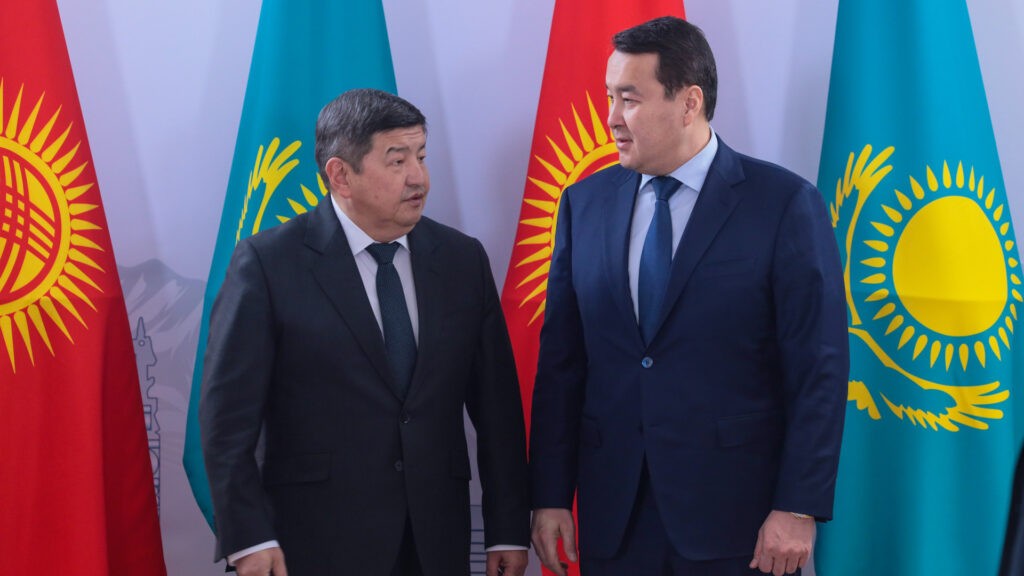
Kazakhstan and Kyrgyzstan will be working together to open an additional checkpoint for goods vehicles on their countries’ border. They are also set to further their cooperation in the water and energy sectors. These agreements were reached at a meeting between the Kazakh prime minister, Alikhan Smailov, and the chairman of Kyrgyzstan’s cabinet of ministers Akylbek Japarov in Almaty on February 1st. 

Kyrgyzstan has complained for years about long lines at the Kazakh border for its cargo trucks bringing goods to Russia through Kazakhstan. The most recent big traffic jam occurred on the Kyrgyz side of the border in August 2023, when more than 600 trucks were stuck at the crossing. 

These delays were caused by Kazakh authorities carrying out enhanced checks on trucks entering the country from Kyrgyzstan, ostensibly to combat illegal border activity. However, the situation caused speculation that the jams were a result of a dispute over irrigation water resources between Kazakhstan and Kyrgyzstan.

Irrigation water remains an issue in Kazakh-Kyrgyz relations. Last summer the southern regions of Kazakhstan experienced a severe shortage of water for their fields, while upstream Kyrgyzstan also lacked water and couldn’t supply enough of it to its northern neighbor. Kazakhstan, especially its dry southern regions, is dependent on water coming from Kyrgyzstan. 

At the meeting on February 1st Mr Smailov also spoke about the growing trade between the two countries, with bilateral trade growing by 12% and reaching $1.3bn between January and November 2023.