Tashkent is changing faster than it can adjust to its own growth. The city is already pressing against the limits of its existing airport; a vast new city designed for up to two million people is being built alongside it, and a separate financial jurisdiction drawing on English common law is being created. Uzbekistan is opening up further to foreign investment, and nearly two-thirds of the country’s foreign-invested enterprises are already concentrated in the capital.
But being the leading business city in your own country and becoming a regional hub are not the same thing. Tashkent already has strong competitors in Central Asia. Given that competition, it is more useful to examine why companies are choosing Tashkent now and what the city still lacks than to declare it the region’s new business capital.
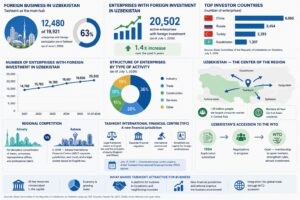
As of July 1, 2026, Uzbekistan had 20,502 operating enterprises with foreign investment. Their number had increased about 1.4 times over five years. China accounted for the largest number, with 6,060 companies, followed by Russia with 3,454, Turkey with 2,293, and Kazakhstan with 1,307.
As of June 1, 12,480 of the 19,921 enterprises with foreign investment then operating in Uzbekistan were located in Tashkent. That was almost 63%.
Why Tashkent?
Part of the answer is obvious: the institutions and services businesses rely on are concentrated there, from government and finance to professional services, technology firms, and skilled workers. That creates a network effect: companies come because partners, clients, and suppliers are already there.
But the capital had roughly the same administrative advantages ten years ago without attracting business on anything like the current scale. What changed first was Uzbekistan’s economy itself.
After 2016, the country began moving away from its previous closed economic model. One of the first major steps was currency liberalization in 2017. Changes followed in trade, taxation, privatization, and the treatment of foreign investors. The state still plays an enormous role in the economy, but it has become considerably easier for foreign private businesses to operate.
Uzbekistan’s GDP grew by 7.7% in 2025. The IMF expects growth of about 6.8% in 2026, while pointing to a longstanding problem: the state’s large footprint in the economy, including major state-owned enterprises and banks, continues to constrain competition and private-sector development.
The combination of rapid growth and a gradually more open economy has benefited Tashkent more than any other city in the country.
Uzbekistan also has an advantage that cannot be created by government decree. With a population of about 38.5 million, it is Central Asia’s most populous country and has a large domestic consumer base. It is also the region’s only country that borders all four other Central Asian republics. For an international company, Tashkent can serve both as an office for the Uzbek market and as a gateway to neighboring countries.
Now, Tashkent is entering territory long occupied by others.
For decades, Almaty has concentrated banks, international representative offices, private companies, and professional talent. In 2018, the Astana International Financial Centre began operations, with a separate jurisdiction, its own court, and a legal framework based on the principles of English common law.
Uzbekistan is now adopting a similar legal model in Tashkent. On July 13, a constitutional law establishing the Tashkent International Financial Centre was signed. The center will have a special legal regime, a separate financial regulator, and an international commercial court, while its legal framework will draw on English common law. Qualifying foreign participants will be eligible for visas of up to five years, while foreign employees whose principal place of work is within the center are exempt from work-permit requirements.
Another development could have an even greater impact on the operating environment for foreign companies: Uzbekistan’s accession to the World Trade Organization.
Uzbekistan applied for WTO membership in 1994, but negotiations resumed in 2020 after a roughly 15-year hiatus. At a Working Party meeting on July 27-28, the authorities again confirmed their intention to complete the accession process in 2026. Since March, Uzbekistan has brought another 190 pieces of legislation into conformity with WTO rules, while the number of bilateral market-access agreements deposited with the WTO Secretariat has reached 31. The negotiations, however, are continuing.
For foreign businesses, this is far less eye-catching than a new skyscraper or a tax break, but it is more practical. Manufacturers care about tariffs, exports, imports of components, and predictable trade rules. This is where WTO membership could change the calculations of companies considering Uzbekistan not simply as a market but as a production base.
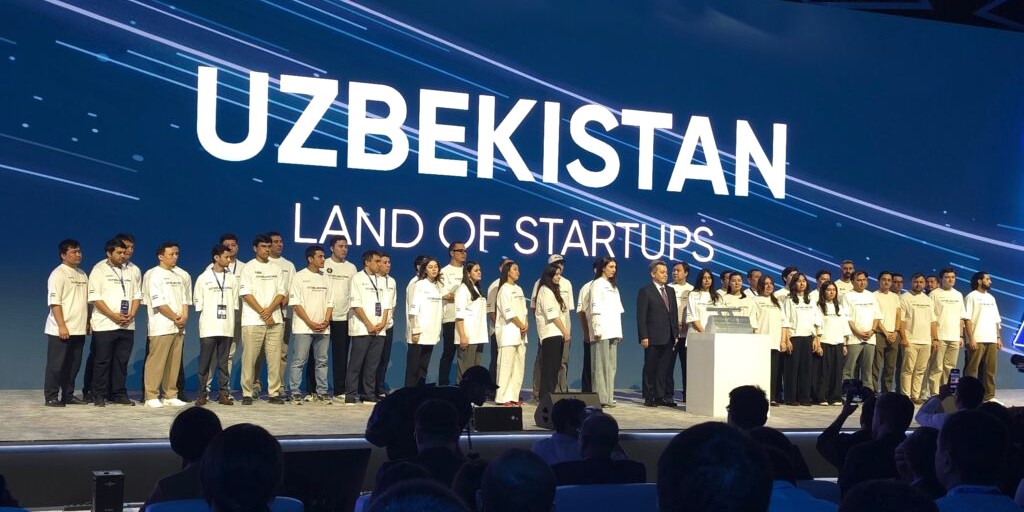
The scale of interest in the country was clearly visible in June at the Tashkent International Investment Forum. The event drew 3,802 foreign delegates from 102 countries, and 166 agreements worth a combined $43.1 billion were signed.
The last figure, however, should be treated with caution. Signed agreements are not the same as $43.1 billion already invested. More important for Tashkent was the composition of the participants: banks, funds, industrial and technology companies from the United States, Europe, China, the Gulf states, and Asia.
The Infrastructure Problem
But the more business Tashkent attracts, the more visible a fairly mundane problem becomes: an infrastructure shortage.
The airport is a good place to start. Passenger demand in the Tashkent area grew by 14.2% between 2024 and 2025, and the existing airport is approaching its limits. The new airport is scheduled to open only in 2030. Its capacity will be up to 20 million passengers a year, and the project is expected to cost more than $2.5 billion. The consortium includes Saudi Arabia’s Vision Invest, Japan’s Sojitz, South Korea’s Incheon International Airport Corporation, and Uzbekistan Airports.
For international businesses, it matters how many flights there are to Dubai, Istanbul, Beijing, or Seoul, and how long it takes to get from the plane to the office.
Beyond the airport gates, the questions become more complicated.
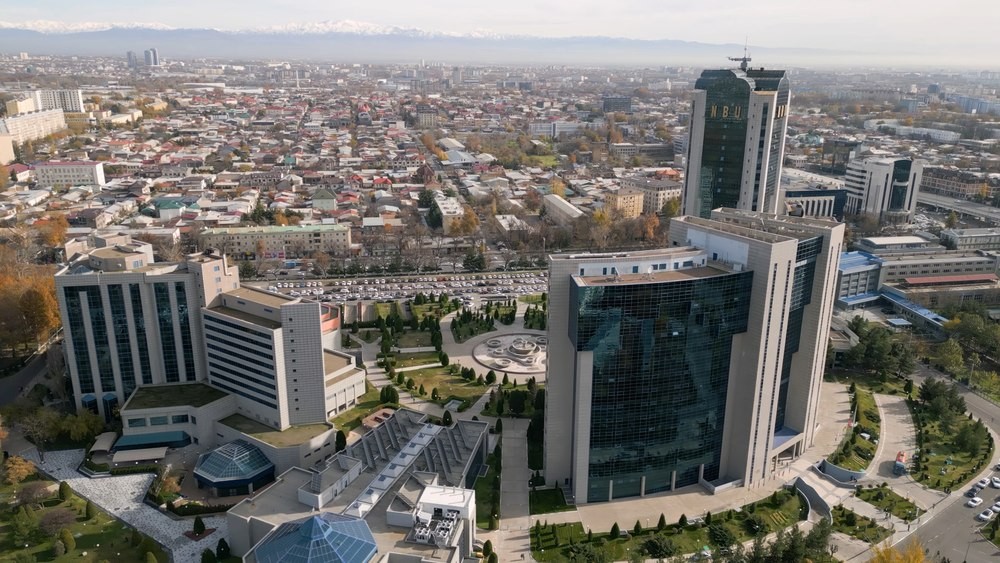
Tashkent is being built up rapidly, while traffic congestion and pressure on urban infrastructure are becoming more visible. Winter brings another problem: smog. The authorities are responding by building New Tashkent, expanding public transportation, and pursuing other major infrastructure projects.
This is where regional competition starts to look very different. A company does not choose a city based solely on its tax rate. It has to persuade a manager to relocate with a family, find an international school, good healthcare and housing, and avoid making employees spend hours in traffic every day. By these measures, Tashkent is competing not just with Almaty and Astana but, in some sectors, with Baku, Tbilisi, Istanbul, and Dubai.
So the question of whether Tashkent is becoming Central Asia’s new business hub may still be somewhat premature. Tashkent has not displaced Almaty or Astana. But only a few years ago, the question of such competition barely arose.