• KGS/USD = 0.01144 0%
  • KZT/USD = 0.00213 0%
  • TJS/USD = 0.10714 0.09%
  • UZS/USD = 0.00008 0%
  • TMT/USD = 0.28571 0%
  • KGS/USD = 0.01144 0%
  • KZT/USD = 0.00213 0%
  • TJS/USD = 0.10714 0.09%
  • UZS/USD = 0.00008 0%
  • TMT/USD = 0.28571 0%
  • KGS/USD = 0.01144 0%
  • KZT/USD = 0.00213 0%
  • TJS/USD = 0.10714 0.09%
  • UZS/USD = 0.00008 0%
  • TMT/USD = 0.28571 0%
  • KGS/USD = 0.01144 0%
  • KZT/USD = 0.00213 0%
  • TJS/USD = 0.10714 0.09%
  • UZS/USD = 0.00008 0%
  • TMT/USD = 0.28571 0%
  • KGS/USD = 0.01144 0%
  • KZT/USD = 0.00213 0%
  • TJS/USD = 0.10714 0.09%
  • UZS/USD = 0.00008 0%
  • TMT/USD = 0.28571 0%
  • KGS/USD = 0.01144 0%
  • KZT/USD = 0.00213 0%
  • TJS/USD = 0.10714 0.09%
  • UZS/USD = 0.00008 0%
  • TMT/USD = 0.28571 0%
  • KGS/USD = 0.01144 0%
  • KZT/USD = 0.00213 0%
  • TJS/USD = 0.10714 0.09%
  • UZS/USD = 0.00008 0%
  • TMT/USD = 0.28571 0%
  • KGS/USD = 0.01144 0%
  • KZT/USD = 0.00213 0%
  • TJS/USD = 0.10714 0.09%
  • UZS/USD = 0.00008 0%
  • TMT/USD = 0.28571 0%

Kazakhstan to Improve Investor Protections and Accelerate Digital Reforms

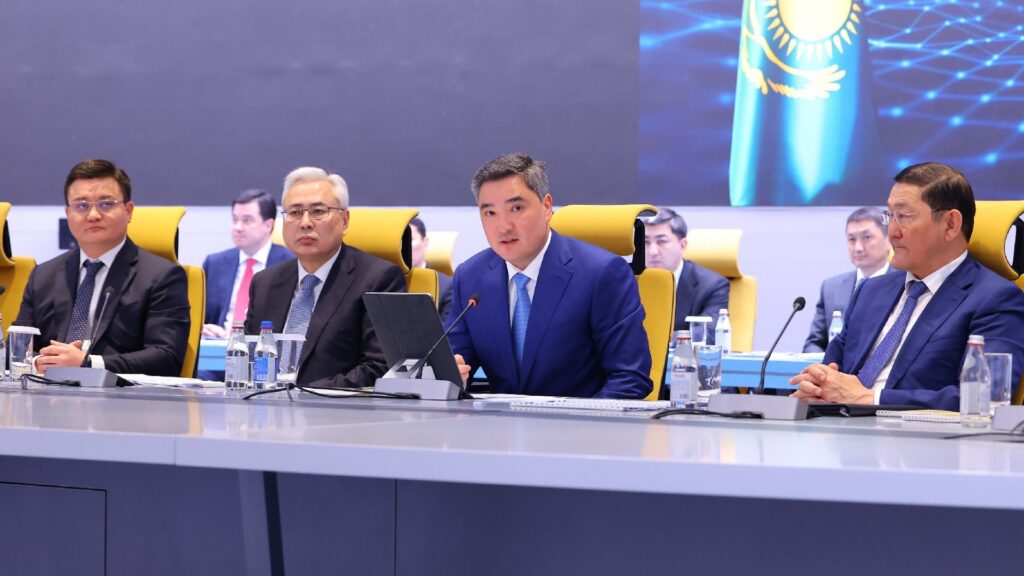
Kazakhstan Prime Minister Olzhas Bektenov has instructed government agencies to accelerate the removal of administrative barriers for investors and expand the digitalization of investment procedures amid intensifying global competition for capital.

Speaking at a meeting on investor rights protection attended by government officials, prosecutors, business representatives, and the Atameken National Chamber of Entrepreneurs, Bektenov said improving the investment climate remains a government priority.

“Just last week, a presidential decree was signed on improving migration policy, aimed at creating a better environment for attracting investors, entrepreneurs, and highly qualified specialists,” Bektenov said.

According to the government, Kazakhstan’s Investment Headquarters reviewed 44 projects worth approximately $25.5 billion during the first quarter of 2026.

Prosecutor General Berik Asylov said the number of criminal cases against businesses has fallen fourfold over the past three years.

“We are overseeing more than 3,000 investment projects. We maintain direct communication and continuous monitoring with investors and the business community,” he said.

According to the Foreign Ministry, investors submitted 273 appeals during the first quarter of the year, with around half resolved positively. The main concerns related to tax administration, customs procedures, and land issues.

Baurzhan Yeraly, chairman of the Committee for the Protection of Investors’ Rights under the General Prosecutor’s Office, said the rights of around 600 investors had already been protected this year, with complaints handled directly rather than transferred between agencies.

Officials cited several successful cases, including the connection of a major energy project in the Atyrau region to engineering infrastructure and the inclusion of a paper products manufacturer in the national registry of domestic producers.

Bektenov criticized what he described as a formalistic approach by some state bodies in dealing with businesses.

“Every request from an investor is a signal behind which stand decisions on capital allocation, the launch of new production facilities, and the creation of jobs,” he said.

The prime minister warned that officials and managers in the quasi-state sector responsible for bureaucratic delays would face “the strictest measures.”

He also pointed to systemic problems, including weak coordination between agencies, delays in public service delivery, and insufficient oversight at the regional level.

Particular attention was given to the role of local administrations, which were instructed to supervise key investment projects directly and accelerate the allocation of land, infrastructure, and permits.

The government also plans to speed up development of the National Digital Investment Platform. More than 3,000 projects worth around $200 billion have already been integrated into the system, though more than 400 projects have yet to be uploaded.

“In the context of global competition for investment, we must ensure a stable and favorable investment climate,” Bektenov said.

Asset Irgaliyev, chairman of the Agency for Strategic Planning and Reforms, said the agency is developing a “regulatory intelligence” platform using artificial intelligence to identify excessive requirements and administrative barriers.

Authorities also plan to expand the overseas network of Kazakh Invest. According to company head Sultangali Kinzhakulov, representative offices in the United States, Germany, China, Russia, Turkey, Malaysia, and Qatar will operate as “one-stop shops” for investors.

Following the meeting, the government instructed agencies to accelerate the launch of a mobile application for the investment platform, implement an AI-based system for processing investor requests, and open specialized investor service windows in all public service centers nationwide.

As previously reported by The Times of Central Asia, Kazakhstan plans to attract a total of $62.7 billion in investment in 2026, including $25.5 billion in foreign capital. Government agencies have been tasked with increasing the inflow of high-quality investment and launching projects with high added value. In line with this strategy, Kazakhstan’s Investment Policy Concept has been updated and extended through 2030.

U.S.-Linked Consortium to Build $1.5 Billion Data Center in Kazakhstan

Kazakhstan has signed a memorandum of cooperation with an international consortium that includes Dornan Engineering Group and JMOT04 to develop a major high-capacity data center project in the country.

Kazakhstan’s Ministry of Artificial Intelligence and Digital Development signed the agreement during GITEX AI Kazakhstan.

According to the ministry, the project involves the construction of a Tier III–Tier IV high-reliability data center with planned capacity ranging from 50 MW to 200 MW. Investment in a 200 MW Tier IV facility is estimated at between $1 billion and $1.5 billion.

To ensure a stable and independent power supply, the project also includes plans to build a gas-fired power plant with capacity of up to 250 MW. Investment in the energy facility is estimated at between $200 million and $400 million. The project will be implemented by Ample Solution Limited, one of Asia’s largest suppliers of electronic components, founded in 2008.

“Kazakhstan has a unique geographic position, a favorable climate, and competitive electricity costs. These factors create a solid foundation for hosting international data centers and developing digital infrastructure,” said Zhaslan Madiyev, deputy prime minister and head of the Ministry of Artificial Intelligence and Digital Development.

Authorities are currently selecting the optimal location for the project, prioritizing sites near gas infrastructure to ensure efficient electricity generation and operational reliability.

The Times of Central Asia previously reported that Kazakhstan’s planned “data center valley” would be located in the northeastern Pavlodar region. Speaking after a government meeting on May 5, Deputy Energy Minister Sungat Yessimkhanov said the first facilities in the cluster are expected to appear as early as next year.

According to Yessimkhanov, work is currently underway to formalize land allocations and ensure a stable electricity supply for the centers.

“We are directly involved in the overall process. At the first stage, 300 MW will be required, and there are no issues with that volume,” he said. “The first facilities will appear in 2027, and uninterrupted electricity supply will be guaranteed by then.”

During the GITEX AI forum, Kazakhstan’s Energy Ministry and the Ministry of Artificial Intelligence and Digital Development also signed cooperation memorandums with Ample Solution Limited and Dominor Partners Ltd covering the development of hyperscale data centers in Kazakhstan, including the creation of a specialized cluster combining digital and energy infrastructure.

Under the agreements, the parties will cooperate on the development of supporting energy infrastructure, including power generation projects using gas, coal, and renewable energy sources to ensure a stable electricity supply for the data centers.

Particular attention will also be given to localizing the production of equipment and technologies to strengthen technological independence and create new opportunities for industrial development.

The agreements additionally provide for technology transfer, workforce development, and joint work on digital and energy infrastructure projects, including the Industrial & Digital Energy Hub initiative.

According to Kazakhstan’s Energy Ministry, the projects are expected to attract investment, support the development of the digital economy, create jobs, and strengthen Kazakhstan’s position as a regional technology and energy hub.

AIIB Backs New Wind Power Project in Uzbekistan with $107 Million Loan

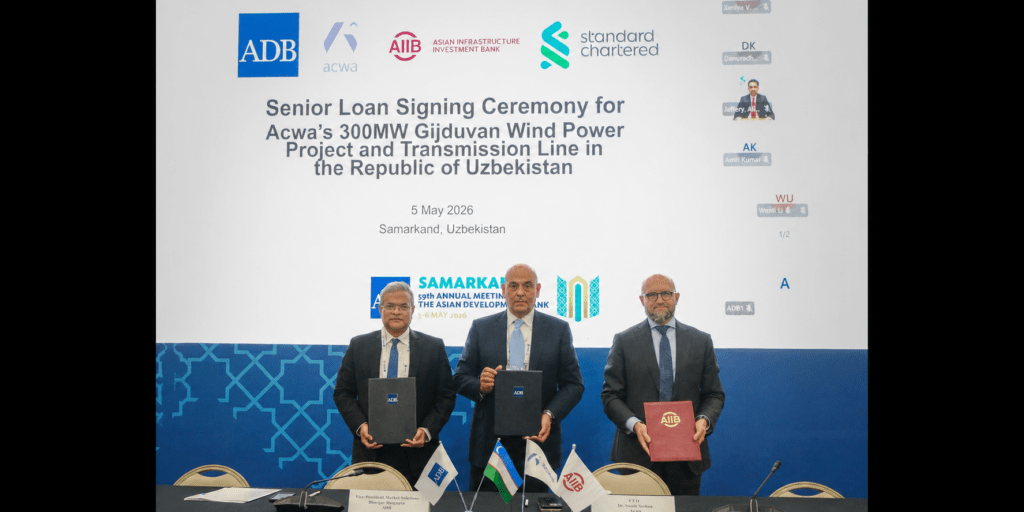
The Asian Infrastructure Investment Bank (AIIB) has signed a $107 million loan agreement with Saudi-based company ACWA Power to support the construction of the Bash 2 wind power plant in Uzbekistan.

The project will be located in the Gijduvan district of the Bukhara region and is expected to have a capacity of 300 megawatts. Once completed, the facility will generate around 943 gigawatt-hours of electricity annually, enough to supply more than 336,000 households. It is also projected to reduce carbon dioxide emissions by approximately 475,000 tons per year.

The Bash 2 project builds on the earlier Bash 1 wind development and forms part of a broader renewable energy cluster in the region. It aligns with Uzbekistan’s strategy to expand clean energy production and diversify its energy mix, with a national target of increasing the share of renewables to 40% by 2030.

“AIIB’s investment in the Bash 2 wind power plant reflects our commitment to supporting Uzbekistan’s transition toward a more sustainable and diversified energy system,” said Konstantin Limitovskiy, Chief Investment Officer at AIIB. He noted that cooperation with private developers such as ACWA Power helps mobilize capital and strengthen energy security while delivering long-term environmental benefits.

ACWA Power also emphasized the significance of the project within its growing partnership with Uzbekistan.

“Bash 2 represents a meaningful step forward in ACWA’s expanding partnership with Uzbekistan and the delivery of its energy transition ambitions,” said Abdulhameed AlMuhaidib, the company’s Chief Financial Officer. He added that the project demonstrates the effectiveness of public-private partnerships in delivering large-scale clean energy solutions.

The investment is supported by a long-term power purchase agreement with the National Electric Grid of Uzbekistan and is co-financed by the Asian Development Bank and Standard Chartered Bank. This financing structure highlights continued investor confidence in Uzbekistan’s renewable energy sector.

Since 2019, AIIB and ACWA Power have jointly invested approximately $440 million in Uzbekistan’s energy sector, covering both renewable and conventional power generation projects.

The latest agreement comes amid broader efforts by Uzbekistan to strengthen energy cooperation with international partners.

As previously reported by The Times of Central Asia, the government has expanded collaboration with Saudi companies, including ACWA Power, through a series of joint projects. During a high-level meeting with Saudi investors, four wind power plants with a combined capacity of 752 megawatts were connected to the national grid, while construction began on additional projects totaling 2.3 gigawatts.

At the same time, infrastructure development has continued, including work on a 1,790-kilometer high-voltage transmission line designed to improve electricity distribution across several regions of the country.

Uzbek Agency Finds Systemic Failures in Dok-1 Max Case

Uzbekistan’s Anti-Corruption Agency has identified serious systemic shortcomings in the pharmaceutical sector following an analysis of court materials related to the Dok-1 Max case, according to a report reviewed by Gazeta.uz.

The agency’s findings point to weaknesses in the processes for registering, certifying, and licensing medicines, where insufficient transparency and limited digitalization allowed a high degree of human discretion. This, in turn, created conditions for corruption risks to emerge.

The case has already led to criminal convictions. On February 26, 2024, a Tashkent court sentenced several individuals to prison terms ranging from three to 20 years. Court documents indicate that during the registration of Dok-1 Max, a number of procedural violations occurred, including decisions that failed to meet established requirements.

According to the agency, one of the key institutional problems lies in the structure and operation of the expert council under the Center for the Safety of Pharmaceutical Products, which operates within the Ministry of Health. The procedure for selecting council members and forming its composition was not defined in any legal document. Although the council consists of 17 members with independent voting rights, some simultaneously held senior positions within the same institution, creating a conflict of interest.

The report cites the example of a department head who participated in the registration process for Dok-1 Max while also voting as a council member. Such overlap, the agency noted, undermined the independence of decision-making.

Transparency issues were also highlighted. The council did not publish quarterly or annual reports, lists of members, or the outcomes of drug registration decisions on its official website. In addition, procedures for conducting inspections of pharmaceutical enterprises and disclosing their results were not clearly regulated, further contributing to corruption risks.

The agency also found that inspection mechanisms were not aligned with international standards. A 2021 government resolution designated a single state enterprise as the sole body responsible for inspections, a structure the agency said contradicts recommendations by the World Health Organization and European regulatory bodies. Under international practice, such oversight is generally carried out directly by the Ministry of Health.

In response to these findings, authorities have taken steps to reform the system. All processes related to the registration, certification, and licensing of pharmaceutical products have now been fully digitalized. In addition, registration certificates for at least 92 types of medicines have been revoked, and their production, import, and sale have been banned following re-evaluation.

The agency recommended further measures, including transitioning all drug registration procedures to a fully online system, ensuring open access to information, increasing transparency in the expert council’s activities, and aligning inspection practices with international standards.

The Dok-1 Max case has drawn international attention since late 2022, when reports emerged that children in Uzbekistan had died after consuming the cough syrup produced by India-based Marion Biotech. Initial reports cited 18 deaths in December 2022, followed by dozens more cases revealed in 2023. During the trial, prosecutors alleged that officials had accepted a $33,000 bribe to bypass proper testing procedures.

The fallout has extended beyond Uzbekistan. Indian authorities launched nationwide inspections of pharmaceutical plants, finding that fewer than a quarter of the country’s 8,500 small manufacturers met World Health Organization standards.

Kazakhstan and Uzbekistan Continue to Popularize Rail Tourism

Kazakhstan’s national railway company, Kazakhstan Temir Zholy (KTZ), and Oʻzbekiston temir yoʻllari, also known as Uzbekistan Railways, organized this year’s second Keruen Express train tour from May 1 to 6.

More than 130 passengers traveled along the Almaty-Turkestan-Samarkand-Tashkent-Almaty route.

Over five days, participants visited major architectural and historical sites in both countries, including the Khoja Ahmed Yasawi Mausoleum in Turkestan, the Gur-e-Amir mausoleum and the Registan in Samarkand, and the Hazrati Imam Complex in Tashkent.

The Keruen Express promotes rail tourism and the region’s historical heritage while strengthening cultural ties between Kazakhstan and Uzbekistan.

Rail tourism is gaining traction in Central Asia. As previously reported by The Times of Central Asia, KTZ expanded its popular Jibek Joly (Silk Road) tourist train route to include Tajikistan. The updated route now reaches the Tajik capital, Dushanbe, extending the tour beyond Kazakhstan and Uzbekistan.

The train-tour projects are part of a regional push to promote Central Asia as a unified tourist destination. Regional leaders have advocated for a shared visa-free regime for foreign visitors, similar to Europe’s Schengen Area, to encourage cross-border travel and boost international tourism.

Speaking at the 59th Annual Meeting of the Board of Governors of the Asian Development Bank in Samarkand on May 4, Uzbekistan President Shavkat Mirziyoyev proposed creating a Central Asia Tourism Ring as a unified tourism space connecting the countries of the region. Mirziyoyev called on neighboring countries, the ADB, and other partners to form a portfolio of tourism development projects and jointly finance them.

Mirziyoyev also highlighted Central Asia’s tourism potential, noting that amid global instability, millions of tourists are seeking safe destinations, and the region has significant opportunities in pilgrimage, cultural, gastronomic, ethnographic, extreme, and medical tourism.

Kazakh Writer Aigul Klinovskaya on Memory, Identity, and the Rise of Contemporary Literature

In recent years, interest in contemporary literature has grown noticeably in Kazakhstan. Authors are increasingly reaching readers directly, taking part in public events, promoting their books through social media, and speaking about local experiences as part of a broader cultural landscape.

The Times of Central Asia spoke with Kazakhstani writer Aigul Klinovskaya about her path into literature, the role of memory and place in her prose, and what contemporary authors need today to gain greater visibility both within the country and abroad.

TCA: To begin with, please tell us a little about yourself. How did you become a writer?

Aigul: I came to literature from IT, that is a well-known fact, and something I often mention in interviews. I worked at a large telecommunications company and headed a department, but at a certain point, I completely changed my field of activity.

Now I write my own books and also help other authors shape their manuscripts as a literary editor and mentor. People work with me to finish and refine their manuscripts, increasing their chances of publication or success in literary competitions.

TCA: When did you first feel that writing was not just an interest for you, but an important part of your life?

Aigul: I tried writing as a child. I had a science fiction novella with an interesting story behind it: I sent it to a children’s magazine, and they replied that the work was good but still needed improvement. I was offended and, in the heat of the moment, destroyed the manuscript. I regret that now because it would have been interesting to reread it.

As a child, I wrote poems and short stories; many people go through that stage. But I began writing prose seriously about five years ago. At that time, I took part in a writing marathon, wrote a short story, and it was immediately included in an anthology. That inspired me: I realized that I could and wanted to write fiction.

The transition from short stories to longer forms was not easy. I wondered whether I could do it and whether I would manage. But now two of my books have already been published, and a third is coming out in June, so something must be working. Many people are surprised to learn that, for most of my life, I was not involved in literature professionally but worked in a completely different field. Now, however, I feel that I am in the right place.

TCA: Your texts often pay close attention to a person’s inner life, to memory, and to the warmth of everyday relationships. Why are these themes close to you?

Aigul: I am interested in people in general, their relationships and emotions. As an author, I want readers, when they immerse themselves in my books, to feel something: to cry at some moments, laugh at others, smile, and reflect.

I believe that every person’s fate is worthy of a book because many remarkable things happen in life. If they are described well, they can become a very interesting story. So I cannot say that only certain themes are close to me. I am interested in people as a whole, and that is why the twists and turns of their lives are reflected in my books.

TCA: How would you describe your prose to someone who hasn’t read your books?

Aigul: There is a term, “feel-good.” I learned it after my first book came out. When I was writing it, I did not know that this was the kind of prose I was creating. These are warm, life-affirming, positive stories.

At the same time, of course, my books also contain the truth of life, which does not consist only of good moments. There is tragedy, sadness, and sorrow. But there is always more light in my stories.

Whatever happens to the characters, the reader understands that in life, despite everything, there is room for joy, happiness, and love. I do not do this deliberately, and I do not try to force a happy ending. I simply tell stories about life, and life is like that: light and dark events are intertwined.

So my prose is life-affirming. There is always room for light in it.

TCA: You were once described as an author working in the genres of realism and magical realism. How close are these definitions to you?

Aigul: Yes, they are close to me. I love realism; I like describing life as it is. But at the same time, as an author, I want to experiment and try myself in different genres.

In the novel Date S, I tried to add a touch of mysticism, while in my next book, Bonnie and Her Fellow Travelers, which will be released in June, there is already more magic and wonder.

Of course, there are genres I probably will not go into because I consider them extremely difficult, for example, children’s literature or detective fiction. Although… never say never.

TCA: Your texts are connected with different emotional registers from psychological prose to memories of native places and time. How do you find the form for each new story?

Aigul: Perhaps the plot itself suggests its own form. An author intuitively understands what can emerge from an idea: a short story, a novella, or a novel.

Not every short-story plot can be expanded into a novel. Conversely, it is difficult to compress an idea for a novel into a short story. When I have an idea, I can usually understand what form it will take.

TCA: Are there themes you return to again and again, even if each time in a new way?

Aigul: Certain enduring values: homeland, family, love, friendship, humanity. These are things that appear in all my books in one way or another, and not intentionally. I do not set myself the goal of necessarily speaking about global issues; they are simply constant elements of our existence.

No matter how reality changes or how fast technological progress becomes, love, friendship, family, and homeland are things that have been, are, and will remain part of every person’s life.

And I like writing about these concepts in their pure form. If it is friendship, then it may go through trials, but it remains friendship. If it is love, then it is real, healthy love, not something painful or distorted. I do not want to chase hype or go against myself just to attract attention. I write the way I feel.

TCA: How important are place, environment, city, and memory of the past to you as parts of the literary world?

Aigul: They are, of course, important pillars of literary work. Writers usually rely on their own experience and on what surrounds them. That is what literary works grow out of.

We often return to the place where we were born, the city where we live, and the memory of our ancestors. We want to learn more about the lives of our parents and grandparents, and then somehow weave that into a book.

As a reader, I love historical works, especially those told through the lives of ordinary people. I’m interested in what happened to an ordinary person at the turning points of eras or during major historical events. So place, environment, city, and memory are all important and meaningful in the creation of truly remarkable books.

TCA: What do you think is happening with contemporary Kazakhstani prose? What changes do you feel as an author?

Aigul: Contemporary Kazakhstani prose is on the rise. I know many authors; we communicate and support one another. In a sense, we are ambassadors because through our books, people around the world discover something new about our country.

Readers often write that they want to come to Kazakhstan and experience the atmosphere they encountered while reading our books. And that is wonderful.

I cannot speak about global changes because I myself came to literature quite recently. But I like what I see. I feel comfortable: I write, I know that my books will be read, and that people are waiting for them. And I am grateful for every reader because they greatly support contemporary authors.

TCA: Do you think readers’ interest in contemporary Kazakhstani literature has changed in recent years?

Aigul: I would like this interest to keep growing year after year. I meet readers who are only just discovering Kazakhstani authors. Fortunately, there are more and more such people, largely thanks to the tireless efforts of writers.

We make every effort: we are active on social media, attend meetings, and appear in the media and on television. But so far, we have reached only part of our potential audience. There are still people who do not know about us, but I am sure they would gladly read our books if they discovered them.

One confirmation of growing interest was the recent International Book Fair in Astana. People came up to me, including some who had traveled specially from other cities. They said warm words about the books and were happy to speak with me and other authors.

Today, writers are no longer inaccessible figures. Readers can talk to us, discuss books, and ask questions. I like these changes, and I think readers do too.

TCA: Is there a feeling that Kazakhstani authors today have more visibility and more space for dialogue with readers?

Aigul: A contemporary author is someone who not only writes books but also promotes them. We regularly take part in events and meet readers. There are many platforms for this, and we use every opportunity to speak about our work.

There is visibility, but as I said earlier, there are still readers who do not know us. How to find them is unclear because we are already doing everything we can on our side.

Once, I conducted an experiment: I went onto one of the streets of Astana and asked people to name three contemporary Kazakhstani writers. In return, I promised them my book with an autograph. Many named classics, but they did not know contemporary authors. That made me a little sad because here we are, writers, walking along the same streets, yet many people still do not know about us.

In the end, I found a student who named three contemporary authors. True, they wrote non-fiction rather than fiction. But she received her honestly earned prize, my book with an autograph.

TCA: What, in your opinion, prevents contemporary Kazakhstani literature from being more widely read both inside the country and abroad?

Aigul: Perhaps nothing directly prevents it. Rather, it is not entirely clear what additional tools could make our voices louder.

For the most part, book promotion rests on the writers themselves. I cannot recall cases when someone approached me and offered, for example, participation in an international book fair or the opportunity to represent the country at a conference. If such opportunities exist, we usually find them ourselves and make the effort to travel and speak about our books and, therefore, about contemporary literature in Kazakhstan.

At the same time, thanks to online marketplaces, our books are sold all over the world. Reviews come from different cities and countries, and the geography of our readership is broad. But in order for people to learn about our books, we constantly speak about them on social media and explain where and how they can be purchased.

TCA: How visible is the role of the state today in the development of contemporary literature in Kazakhstan?

Aigul: What I see now are mostly the steps writers themselves take to promote their books. Of course, some authors receive state recognition. For example, Aset Syzdykov recently received a presidential grant, and we were very happy for him. He wrote a wonderful book about teenagers. Such books are needed and important, and it is great that his work was recognized and supported.

But in general, it is difficult for me to say how systematically the state participates in the development of contemporary literature. At the same time, I understand that I would struggle to answer the question: “What exactly do you need as a writer?” I have not reflected on this much; I rely mainly on myself and continue writing books.

TCA: In your opinion, are there enough literary programs, grants, prizes, or other forms of support for authors in Kazakhstan?

Aigul: We often learn about grants, programs, and prizes by chance, for example, through social media when announcements appear. I would not say that there are many such opportunities or that authors have a wide range of options.

We had the Qalamdas prize from the Open Literary School of Almaty, but as far as I know, it was not held last year, possibly because of a lack of funding.

I would like to see a writers’ residency appear in Kazakhstan, perhaps funded by the state, where authors could complete their books. Such residencies exist around the world and operate successfully. It would be wonderful if Kazakhstan had such a creative space where writers could meet, get to know one another, exchange experiences, and work on their texts.

TCA: What would you like the audience to understand about contemporary literature in Kazakhstan through your texts?

Aigul: I would like readers, when discovering the literature of Kazakhstan, to understand how diverse and talented it is.

As readers, we discover the literature of other countries. I would like our literature to become equally well known.

For me, this is a great responsibility: I am one of those who form a small part of contemporary literature in Kazakhstan. I want readers, when they become acquainted with our works, to understand that we maintain a worthy standard and write in an engaging and high-quality way. I want them to return to our books, love them, and tell their family and friends about them.

TCA: Looking at your path today, what does it personally mean to you to be a woman who writes and speaks to readers?

Aigul: I am simply a person who writes. A person who cannot help writing.

I do it because I enjoy it. After all, writing now makes up a large part of my life. I am not searching for hidden global meanings for myself; I simply want to be an author who speaks to the reader from heart to heart. Everything that is dear and important to me, I reflect in my books. And I know that it resonates with readers.