In recent years, interest in contemporary literature has grown noticeably in Kazakhstan. Authors are increasingly reaching readers directly, taking part in public events, promoting their books through social media, and speaking about local experiences as part of a broader cultural landscape.
The Times of Central Asia spoke with Kazakhstani writer Aigul Klinovskaya about her path into literature, the role of memory and place in her prose, and what contemporary authors need today to gain greater visibility both within the country and abroad.
TCA: To begin with, please tell us a little about yourself. How did you become a writer?
Aigul: I came to literature from IT, that is a well-known fact, and something I often mention in interviews. I worked at a large telecommunications company and headed a department, but at a certain point, I completely changed my field of activity.
Now I write my own books and also help other authors shape their manuscripts as a literary editor and mentor. People work with me to finish and refine their manuscripts, increasing their chances of publication or success in literary competitions.
TCA: When did you first feel that writing was not just an interest for you, but an important part of your life?
Aigul: I tried writing as a child. I had a science fiction novella with an interesting story behind it: I sent it to a children’s magazine, and they replied that the work was good but still needed improvement. I was offended and, in the heat of the moment, destroyed the manuscript. I regret that now because it would have been interesting to reread it.
As a child, I wrote poems and short stories; many people go through that stage. But I began writing prose seriously about five years ago. At that time, I took part in a writing marathon, wrote a short story, and it was immediately included in an anthology. That inspired me: I realized that I could and wanted to write fiction.
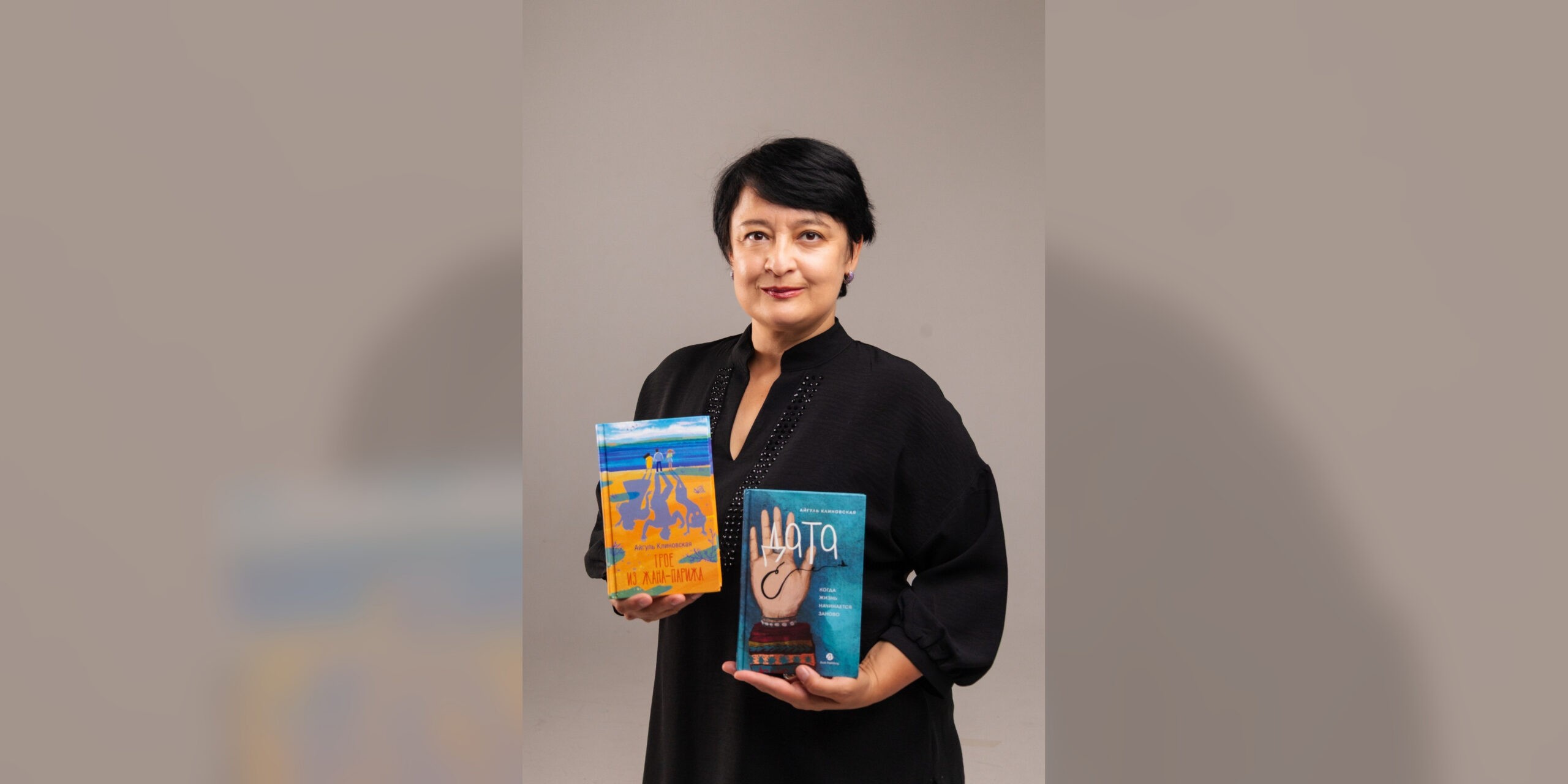
The transition from short stories to longer forms was not easy. I wondered whether I could do it and whether I would manage. But now two of my books have already been published, and a third is coming out in June, so something must be working. Many people are surprised to learn that, for most of my life, I was not involved in literature professionally but worked in a completely different field. Now, however, I feel that I am in the right place.
TCA: Your texts often pay close attention to a person’s inner life, to memory, and to the warmth of everyday relationships. Why are these themes close to you?
Aigul: I am interested in people in general, their relationships and emotions. As an author, I want readers, when they immerse themselves in my books, to feel something: to cry at some moments, laugh at others, smile, and reflect.
I believe that every person’s fate is worthy of a book because many remarkable things happen in life. If they are described well, they can become a very interesting story. So I cannot say that only certain themes are close to me. I am interested in people as a whole, and that is why the twists and turns of their lives are reflected in my books.
TCA: How would you describe your prose to someone who hasn’t read your books?
Aigul: There is a term, “feel-good.” I learned it after my first book came out. When I was writing it, I did not know that this was the kind of prose I was creating. These are warm, life-affirming, positive stories.
At the same time, of course, my books also contain the truth of life, which does not consist only of good moments. There is tragedy, sadness, and sorrow. But there is always more light in my stories.
Whatever happens to the characters, the reader understands that in life, despite everything, there is room for joy, happiness, and love. I do not do this deliberately, and I do not try to force a happy ending. I simply tell stories about life, and life is like that: light and dark events are intertwined.
So my prose is life-affirming. There is always room for light in it.
TCA: You were once described as an author working in the genres of realism and magical realism. How close are these definitions to you?
Aigul: Yes, they are close to me. I love realism; I like describing life as it is. But at the same time, as an author, I want to experiment and try myself in different genres.
In the novel Date S, I tried to add a touch of mysticism, while in my next book, Bonnie and Her Fellow Travelers, which will be released in June, there is already more magic and wonder.
Of course, there are genres I probably will not go into because I consider them extremely difficult, for example, children’s literature or detective fiction. Although… never say never.
TCA: Your texts are connected with different emotional registers from psychological prose to memories of native places and time. How do you find the form for each new story?
Aigul: Perhaps the plot itself suggests its own form. An author intuitively understands what can emerge from an idea: a short story, a novella, or a novel.
Not every short-story plot can be expanded into a novel. Conversely, it is difficult to compress an idea for a novel into a short story. When I have an idea, I can usually understand what form it will take.
TCA: Are there themes you return to again and again, even if each time in a new way?
Aigul: Certain enduring values: homeland, family, love, friendship, humanity. These are things that appear in all my books in one way or another, and not intentionally. I do not set myself the goal of necessarily speaking about global issues; they are simply constant elements of our existence.
No matter how reality changes or how fast technological progress becomes, love, friendship, family, and homeland are things that have been, are, and will remain part of every person’s life.
And I like writing about these concepts in their pure form. If it is friendship, then it may go through trials, but it remains friendship. If it is love, then it is real, healthy love, not something painful or distorted. I do not want to chase hype or go against myself just to attract attention. I write the way I feel.
TCA: How important are place, environment, city, and memory of the past to you as parts of the literary world?
Aigul: They are, of course, important pillars of literary work. Writers usually rely on their own experience and on what surrounds them. That is what literary works grow out of.
We often return to the place where we were born, the city where we live, and the memory of our ancestors. We want to learn more about the lives of our parents and grandparents, and then somehow weave that into a book.
As a reader, I love historical works, especially those told through the lives of ordinary people. I’m interested in what happened to an ordinary person at the turning points of eras or during major historical events. So place, environment, city, and memory are all important and meaningful in the creation of truly remarkable books.
TCA: What do you think is happening with contemporary Kazakhstani prose? What changes do you feel as an author?
Aigul: Contemporary Kazakhstani prose is on the rise. I know many authors; we communicate and support one another. In a sense, we are ambassadors because through our books, people around the world discover something new about our country.
Readers often write that they want to come to Kazakhstan and experience the atmosphere they encountered while reading our books. And that is wonderful.
I cannot speak about global changes because I myself came to literature quite recently. But I like what I see. I feel comfortable: I write, I know that my books will be read, and that people are waiting for them. And I am grateful for every reader because they greatly support contemporary authors.
TCA: Do you think readers’ interest in contemporary Kazakhstani literature has changed in recent years?
Aigul: I would like this interest to keep growing year after year. I meet readers who are only just discovering Kazakhstani authors. Fortunately, there are more and more such people, largely thanks to the tireless efforts of writers.
We make every effort: we are active on social media, attend meetings, and appear in the media and on television. But so far, we have reached only part of our potential audience. There are still people who do not know about us, but I am sure they would gladly read our books if they discovered them.
One confirmation of growing interest was the recent International Book Fair in Astana. People came up to me, including some who had traveled specially from other cities. They said warm words about the books and were happy to speak with me and other authors.
Today, writers are no longer inaccessible figures. Readers can talk to us, discuss books, and ask questions. I like these changes, and I think readers do too.
TCA: Is there a feeling that Kazakhstani authors today have more visibility and more space for dialogue with readers?
Aigul: A contemporary author is someone who not only writes books but also promotes them. We regularly take part in events and meet readers. There are many platforms for this, and we use every opportunity to speak about our work.
There is visibility, but as I said earlier, there are still readers who do not know us. How to find them is unclear because we are already doing everything we can on our side.
Once, I conducted an experiment: I went onto one of the streets of Astana and asked people to name three contemporary Kazakhstani writers. In return, I promised them my book with an autograph. Many named classics, but they did not know contemporary authors. That made me a little sad because here we are, writers, walking along the same streets, yet many people still do not know about us.
In the end, I found a student who named three contemporary authors. True, they wrote non-fiction rather than fiction. But she received her honestly earned prize, my book with an autograph.
TCA: What, in your opinion, prevents contemporary Kazakhstani literature from being more widely read both inside the country and abroad?
Aigul: Perhaps nothing directly prevents it. Rather, it is not entirely clear what additional tools could make our voices louder.
For the most part, book promotion rests on the writers themselves. I cannot recall cases when someone approached me and offered, for example, participation in an international book fair or the opportunity to represent the country at a conference. If such opportunities exist, we usually find them ourselves and make the effort to travel and speak about our books and, therefore, about contemporary literature in Kazakhstan.
At the same time, thanks to online marketplaces, our books are sold all over the world. Reviews come from different cities and countries, and the geography of our readership is broad. But in order for people to learn about our books, we constantly speak about them on social media and explain where and how they can be purchased.
TCA: How visible is the role of the state today in the development of contemporary literature in Kazakhstan?
Aigul: What I see now are mostly the steps writers themselves take to promote their books. Of course, some authors receive state recognition. For example, Aset Syzdykov recently received a presidential grant, and we were very happy for him. He wrote a wonderful book about teenagers. Such books are needed and important, and it is great that his work was recognized and supported.
But in general, it is difficult for me to say how systematically the state participates in the development of contemporary literature. At the same time, I understand that I would struggle to answer the question: “What exactly do you need as a writer?” I have not reflected on this much; I rely mainly on myself and continue writing books.
TCA: In your opinion, are there enough literary programs, grants, prizes, or other forms of support for authors in Kazakhstan?
Aigul: We often learn about grants, programs, and prizes by chance, for example, through social media when announcements appear. I would not say that there are many such opportunities or that authors have a wide range of options.
We had the Qalamdas prize from the Open Literary School of Almaty, but as far as I know, it was not held last year, possibly because of a lack of funding.
I would like to see a writers’ residency appear in Kazakhstan, perhaps funded by the state, where authors could complete their books. Such residencies exist around the world and operate successfully. It would be wonderful if Kazakhstan had such a creative space where writers could meet, get to know one another, exchange experiences, and work on their texts.
TCA: What would you like the audience to understand about contemporary literature in Kazakhstan through your texts?
Aigul: I would like readers, when discovering the literature of Kazakhstan, to understand how diverse and talented it is.
As readers, we discover the literature of other countries. I would like our literature to become equally well known.
For me, this is a great responsibility: I am one of those who form a small part of contemporary literature in Kazakhstan. I want readers, when they become acquainted with our works, to understand that we maintain a worthy standard and write in an engaging and high-quality way. I want them to return to our books, love them, and tell their family and friends about them.
TCA: Looking at your path today, what does it personally mean to you to be a woman who writes and speaks to readers?
Aigul: I am simply a person who writes. A person who cannot help writing.
I do it because I enjoy it. After all, writing now makes up a large part of my life. I am not searching for hidden global meanings for myself; I simply want to be an author who speaks to the reader from heart to heart. Everything that is dear and important to me, I reflect in my books. And I know that it resonates with readers.