A widening conflict in West Asia is forcing India and Central Asia to reassess trade routes, diplomacy, and regional security, with key projects such as Iran’s Chabahar port now facing growing uncertainty. These risks framed discussions in New Delhi on March 25–26, where experts gathered under the banner of “India–Central Asia: Connectivity, Security, and Sustainable Partnerships in a Multipolar World,” with The Times of Central Asia in attendance.
The conference unfolded against the backdrop of two active Eurasian wars—the Russo-Ukrainian and the Israel/U.S.-Iran conflict. Central Asian and Indian participants agreed that the West Asian crisis is widening, putting not only ports and logistics routes but also economies across the globe under serious threat. India’s Chabahar link to Afghanistan and Central Asia is now a high-risk, uncertain investment, weakening overall continental strategic thinking across Eurasia, including efforts to consolidate new trans-Caspian trade corridors. If the conflict cripples or destroys Chabahar, years of progress, hard-won partnerships, and millions in strategic investment would be erased.
On the sidelines, some participants suggested that India could help cool what’s becoming a dangerously global conflict. Unbeknownst to them, India had already held an all-party meeting on March 25 on the West Asia crisis. External Affairs Minister S. Jaishankar’s message: India will not mediate. The revelation surprised some participants—others, not at all. In any event, Central Asian states, in principle, have backed any diplomatic push for peace.
With West Asia in turmoil and platitudes in abundance, conference participants emphasized the need to rethink geopolitics, trade, security, and cultural ties beyond stale frameworks at a time of conflict. Four themes defined the Central and South Asian moment: the dangers of bloc politics, even as regional organizations continue to evolve and expand their influence, the ascendancy of national interests over external pressure, and the emergence of a firm refusal to pick sides in the midst of frictions between competing global pressures.
Dr. Raj Kumar Sharma, a member of the India Central Asia Foundation, stated: “The conference provided an important platform to move beyond theoretical discussion and toward practical engagement. With Central Asia’s ambassadors to India present, we focused on exploring concrete mechanisms to promote peace through sustained diplomatic efforts. Despite the proximity of the conflict in West Asia to both Central Asia and India, participants expressed confidence that dialogue and restraint – buttressed by trade and investment – will ultimately guide outcomes, with particular concern for civilians and those enduring hardship. Notably, the crisis did not overshadow the conference’s primary agenda or its scholarly contributions. Overall, the gathering can be seen as a constructive step in reinforcing diplomatic initiatives dedicated to peace and stability in a conflict-affected region.”
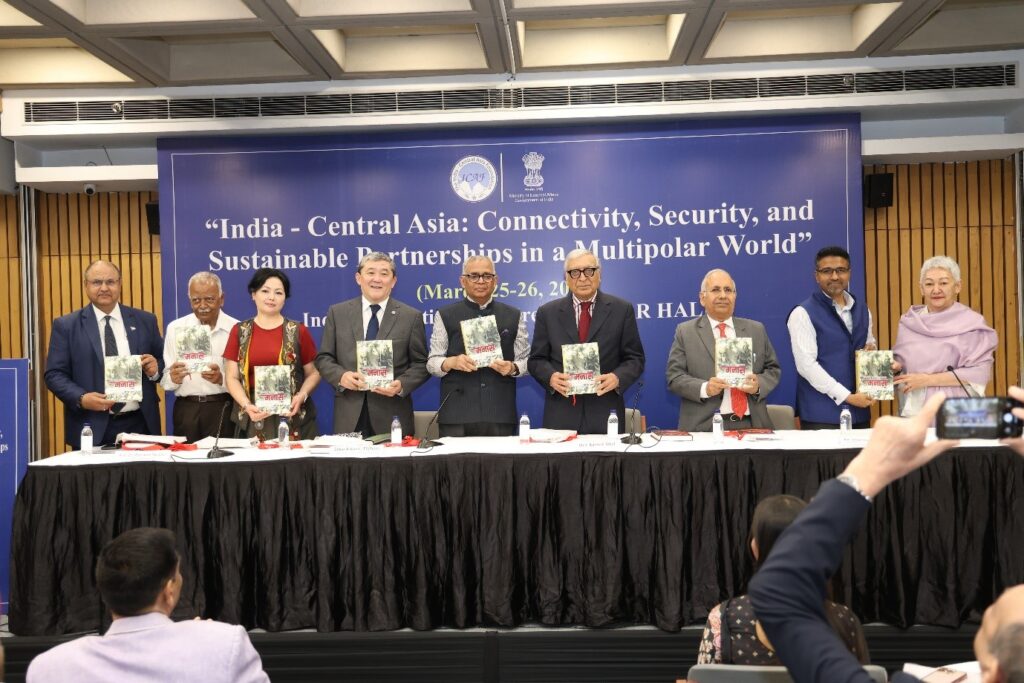
The conference witnessed the release of three significant publications on India–Central Asia relations: India – Kazakhstan Partnership in a Changing Geopolitical Order (eds. Ramakant Dwivedi, Lalit Aggarwal, Kuralay Baizakova), Manas: Kirgiz Vir Gatha Kavya by Ramakant Dwivedi & Hemchandra Pandey and India and Central, East and Southeast Asia: Enhancing the Partnership (eds. Ramakant Dwivedi & Lalit Aggarwal).
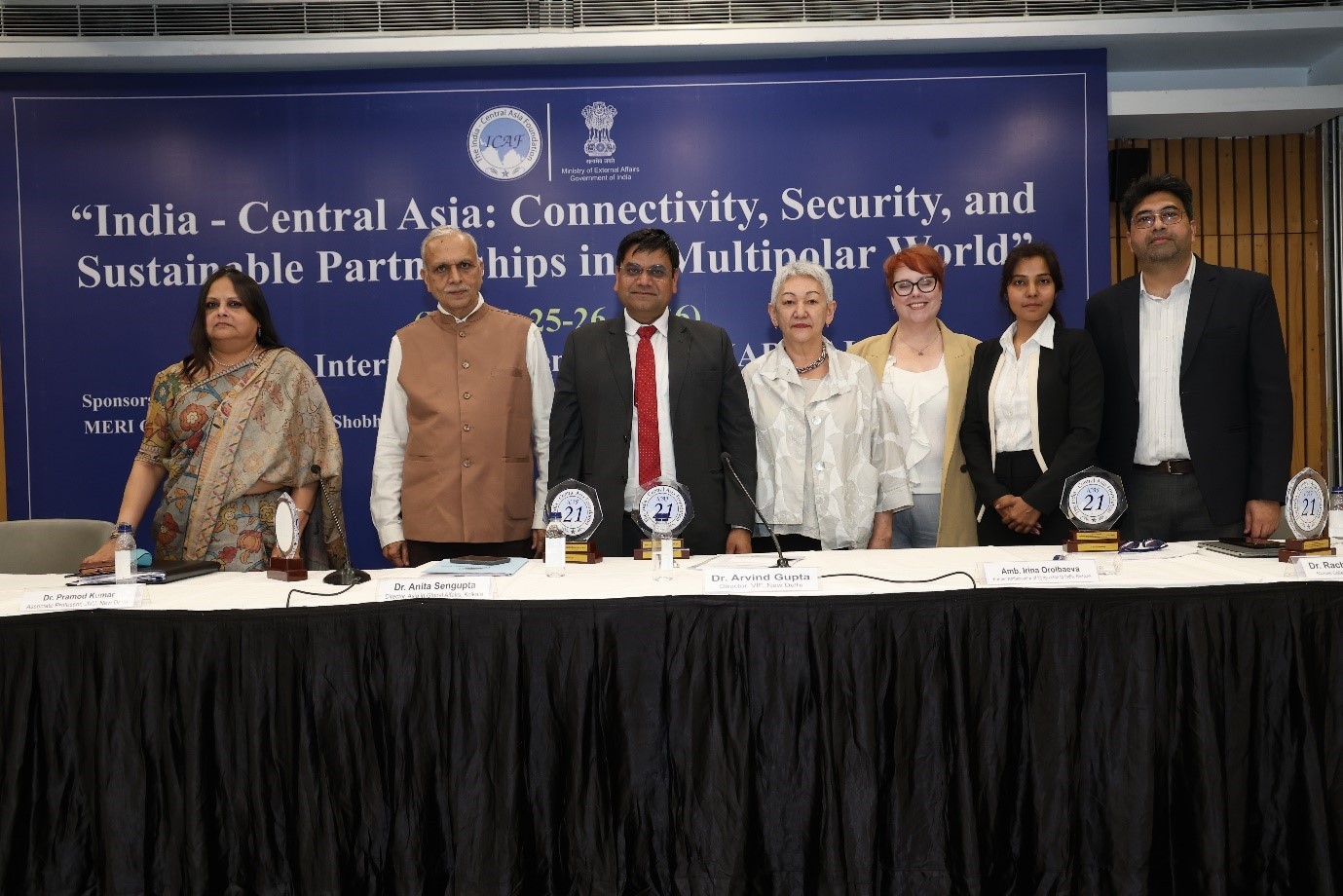
(L-R): Dr Anita Sengupta, Dr Arvind Gupta, Dr Pramod Kumar, Ambassador Irina Orolbaeva, Dr Rachael M. Rudolph, Dr Beena & Dr Raj Kumar Sharma, who all spoke on the role of regional institutions in Central Asian development; image: TCA
Geopolitics in Flux – Central Asia and the Emerging Multipolar Order
At the conference, a clear theme emerged: Central Asia holds an increasingly important place in an emerging multipolar world due to its geography and resources. As conflicts and power plays intensify, especially in West Asia, countries in the region must work to reshape security, trade, and diplomacy to better promote economic development through peace.
For Central Asia and India, understanding these geopolitical shifts is key to navigating risks and maintaining stability. The conference speakers emphasized that, confronted with shared threats, India and Central Asia need even deeper collaboration with Afghanistan through intelligence sharing, training, and joint mechanisms to bolster resilience and sustain regional stability within a complex global environment – this applies equally to the Afghan-Pakistan conflict currently unfolding. All participants underscored the importance of patience, peace, and sober foreign policies, while preserving sovereign autonomy and national interests within a multi-dimensional approach to diplomacy.
The Role of Regional Institutions in Central Asian Development
The participants highlighted that there are many regional institutions in Central Asia, most of which reflect the ideas, interests and needs of external powers. The Central Asian countries need to enhance regional cooperation mechanisms among themselves so that they become the real arbiters of their aspirations and development. Dr Raj Kumar Sharma and Dr Beena, Assistant Professor at MERI Centre for International Studies, highlighted that the Central Asian countries should focus on cooperative climate governance in the region and move towards a green transition collectively. Dr. Sharma called on Central Asia and India – with the agreement of all – to unite in advancing enduring peace and sustainable progress across the region.
Trade, Connectivity and Infrastructure – Challenges and Prospects for Regional Cooperation
Without stronger connectivity, Central Asia will never reach its full potential, conference participants concurred. Central Asian participants expressed their willingness and support for further integration through active multi-vector foreign policies in order to deal with their connectivity and infrastructure challenges. Turkmenistan’s position of maintaining its non-aligned status reflects its geo-economic priorities over geo-political gamesmanship.
Unsurprisingly, the Russo-Ukraine war has reconfirmed certain vulnerabilities of Central Asian countries given their dependence on transportation limitations and longstanding external links, necessitating a reexamination of trade routes, with all options on the table. In addition, sovereign autonomy means greater intra-regional self-reliance.
Since 2018, Consultative Meeting of Heads of States in Central Asia has become the main advisory mechanism for regional cooperation. Early signs of regional cooperation include agreements on joint border management and customs simplification, discussions on shared water and energy resource management, and coordinated positions in international forums. Both Central Asian and Indian participants highlighted that India should continue to reach out to all parties to the conflict in West Asia to safeguard their economic interests in Iran – this applies immediately to Chabahar Port and to oil exports in the first instance.
On the education front, participants noted that with visa barriers going up in America and elsewhere, Indian students are looking for alternative educational markets; Central Asia, in many ways, is ideal for many because it is geographically closer to India and the fees are relatively low. Indian students have become the largest group of international students in Kazakhstan, with nearly 10,000 to 12,000 enrolled as of 2025, marking a massive 211.9% increase from 2022 levels.
India – Central Asia: Historical and Cultural Ties
The organizers stressed that centuries of trade, migration, and cultural exchange have created lasting bonds between India and Central Asia—bonds that will drive future cooperation. India and Central Asia’s ancient economic ties—forged through the Silk Road and the Kushan Empire (which linked northern India with modern Uzbekistan, Tajikistan, Afghanistan, and Turkmenistan)—were fractured by 19th‑century colonialism. Now, experts urge a clear path forward: reconstruct the geo-cultural bridge through education, joint publications, think tank outreach, and media collaboration.