• KGS/USD = 0.01144 0%
  • KZT/USD = 0.00195 -0%
  • TJS/USD = 0.10861 0.18%
  • UZS/USD = 0.00008 0%
  • TMT/USD = 0.28571 0%
  • KGS/USD = 0.01144 0%
  • KZT/USD = 0.00195 -0%
  • TJS/USD = 0.10861 0.18%
  • UZS/USD = 0.00008 0%
  • TMT/USD = 0.28571 0%
  • KGS/USD = 0.01144 0%
  • KZT/USD = 0.00195 -0%
  • TJS/USD = 0.10861 0.18%
  • UZS/USD = 0.00008 0%
  • TMT/USD = 0.28571 0%
  • KGS/USD = 0.01144 0%
  • KZT/USD = 0.00195 -0%
  • TJS/USD = 0.10861 0.18%
  • UZS/USD = 0.00008 0%
  • TMT/USD = 0.28571 0%
  • KGS/USD = 0.01144 0%
  • KZT/USD = 0.00195 -0%
  • TJS/USD = 0.10861 0.18%
  • UZS/USD = 0.00008 0%
  • TMT/USD = 0.28571 0%
  • KGS/USD = 0.01144 0%
  • KZT/USD = 0.00195 -0%
  • TJS/USD = 0.10861 0.18%
  • UZS/USD = 0.00008 0%
  • TMT/USD = 0.28571 0%
  • KGS/USD = 0.01144 0%
  • KZT/USD = 0.00195 -0%
  • TJS/USD = 0.10861 0.18%
  • UZS/USD = 0.00008 0%
  • TMT/USD = 0.28571 0%
  • KGS/USD = 0.01144 0%
  • KZT/USD = 0.00195 -0%
  • TJS/USD = 0.10861 0.18%
  • UZS/USD = 0.00008 0%
  • TMT/USD = 0.28571 0%
18 December 2025

What the Proposed U.S. Ban on Russian Uranium Imports Could Mean for Kazakhstan

On Monday, 11 December 2023, the U.S. House of Representatives passed a new bill banning imports of Russian uranium. While the bill would need to pass the U.S. Senate and be signed off by President Joe Biden in order to become law, this first step towards legality raises questions about the future of nuclear energy in the U.S., and which country could provide the resources necessary to facilitate it going forwards. This bill represents a significant opportunity for Kazakhstan, the world’s largest producer of uranium, which could potentially step into the breach and provide the mineral necessary to meet the U.S.’ nuclear energy needs.

If successfully made into law, the bill entitled the “Prohibiting Russian Uranium Imports Act” will see a complete ban on unirradiated low-enriched uranium (the type used to make nuclear fuel) that is produced in Russia, and annual caps on the amount of low-enriched uranium that can still be imported from the country until 2027. Waivers have been built into the wording of the legislation to allow the U.S. Department of Energy (DOE) to work around the ban if no feasible alternative is found to sustain the functioning of a nuclear reactor or nuclear company. However, the bill also guides the DOE to submit a report outlining the alternatives to Russian-produced uranium, which could be utilized over the next five years. One country sure to be on their radar is Kazakhstan.

A former powerhouse of the Soviet Union’s nuclear weapons testing program, Kazakhstan was left with significant infrastructure for uranium mining after the collapse of the bloc in 1991. Its nuclear production is currently monopolized by one company, Kazatomprom, which has emerged as a global leader in the field. Although the U.S. mines its own uranium, it does not produce enough to meet its domestic demands for nuclear power, which in the year 2022 was over 20,100 metric tonnes in total. That year, the U.S. produced 75 metric tonnes of uranium ore from its own mines. By comparison, Kazakhstan produced 21,227 metric tonnes in the same time period.

Mukhtar Dzhakishev, the former head of Kazatomprom, has spoken about the necessity of increasing the volume of production in Kazakhstan if it were to be a viable candidate for replacing Russia’s supply to the U.S. Greater resources would need to be directed towards mining if the country were to increase its annual uranium yield to make up for the lost volume of Russian uranium.

If the U.S. were to seek a trade agreement with Kazakhstan to bolster its nuclear power supplies, it would indicate an alignment with the European Union, which recently expressed a desire to conduct increased trade with countries in Central Asia. Given that the largest exports from Central Asian countries to Europe are of natural resources such as oil, gas and metals, it is safe to assume that energy will be one of the key goals in any trade deals the EU tries to negotiate.

These announcements have arisen in the wake of Russia’s war in Ukraine, which has triggered a seismic shift in both political lines and public opinion in the West regarding the CIS countries (who formerly made up the Soviet Union), with the view of Russia as the region’s major and most important power being gradually eroded. As Western countries look to distance themselves from Russian-supplied energy and with Kazakhstan and its neighbors increasingly seeking to diversify their relationships, this could present a natural opportunity for Kazakhstan and other Central Asian states like Uzbekistan, another major producer of uranium, to agree deals on the supply of nuclear fuel and other natural resources (such as crude oil) with Western nations.

Potential trade deals with Kazakhstan could represent a longer-term solution to energy concerns in Europe as well as the U.S. The sanctions targeting Russia created serious difficulties for European countries reliant upon Russia for a significant portion of their energy supplies. Without adequate backup planning for a similar eventuality, the Nord Stream 2 pipeline in the Baltic Sea was put on hold, and countries turned to oil-rich Gulf states such as Qatar and Saudi Arabia for alternative energy deals to avoid the prospect of their citizens being left without heating in the winter.

Despite ongoing plans to build them, Kazakhstan does not currently have any nuclear reactors capable of generating electricity for its domestic market, and it has no nuclear weapons program following the collapse of the Soviet Union. Therefore, its entire production of uranium is theoretically well-placed for sale internationally. While the European market will likely be primarily interested in Kazakhstan’s oil and gas reserves (Germany, the world’s largest importer of natural gas, completed a total phaseout of nuclear power this year), uranium may find itself in higher demand over time as Western nations look for cleaner energy solutions for the long-term.

Another challenge which could complicate Kazakhstan’s position as a potential provider of nuclear power to the U.S. and other countries sanctioning Russia lies in the fact that Kazakhstan’s uranium production is deeply intertwined with Russia. This means that some of the uranium being sold by Russian companies to foreign buyers, including the U.S., was actually mined in Kazakhstan whilst being the legal property of Russian suppliers due to fuel contracts. Kazatomprom also routinely mines uranium from sites within Kazakhstan, which is then sent on to Russia for the enrichment process, as Kazakhstan currently does not have the technology to conduct this process domestically.

This Russian involvement in the uranium production process may present a legal challenge to potential U.S. buyers as the wording of the bill prohibits uranium produced in Russia. The severity of this challenge will depend on whether legislators require that the bill solely apply to uranium wholly produced by the sanctioned state, or whether this meaning will be expanded to include partial production, too. In the meantime, Kazatomprom and key decision makers in the U.S. and Kazakhstan should be exploring alternatives to processing Kazakh uranium in Russia, such as whether this infrastructure can be set up in Kazakhstan or whether a neutral third country could be contracted to process the mineral.

The new bill will now need to pass the U.S. Senate after its winter adjournment and no new progress can be made on this issue in the meantime. If it passes, and solutions to the potential obstacles can be found, this could constitute an important new step for Kazakhstan’s economy and its position on the world stage.

Emily Rowland holds a BA in Modern Languages and an MSt in Slavonic Studies from the University of Oxford. Her research interests include social and geopolitical issues affecting the Central and Eastern European region.
Surveillance Cameras to be Installed in Samarkand Region to Combat Fly-Tipping

The Ministry of Ecology in the Samarkand region is taking measures to combat the problem of the illegal dumping of waste, with the Central Office of Dispatching and Online Monitoring developing a plan to install online surveillance cameras to help prevent fly-tipping.

To begin with, 25 cameras will be installed in Samarkand in the most polluted and densely populated areas. Subsequently, it is planned to install 100 cameras throughout the region to ensure comprehensive control over the environmental situation.

The surveillance system will be based on the database of the regional Department of Internal Affairs. A list of people and the registration plates of cars that disrespect the environment will be created. Inspectors from the Department of the Ecology will then contact the offenders and draw up appropriate administrative protocols.

Such an online surveillance system is already successfully operating in other regions of Uzbekistan, such as Tashkent and its environs, as well as in Namangan, Andijan, Syr Darya and the Surkhandarya regions.

Ambitious Program to Plant 65 Million Trees and Shrubs Launched

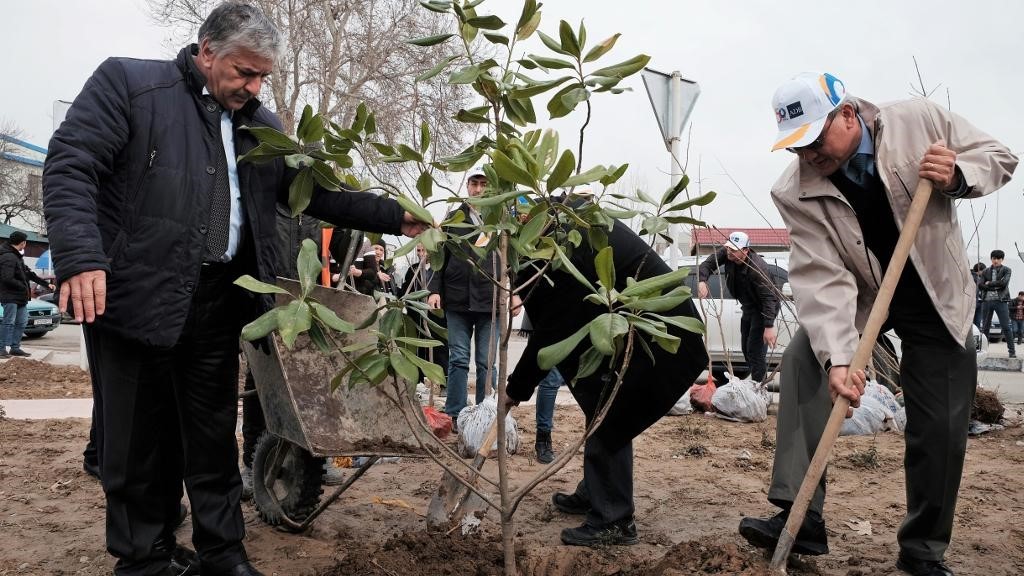
As part of the National Program, “Green Country,” Tajikistan intends to plant 65 million trees and shrubs on an area spanning over 4,000 hectares by 2025.  Special attention will be paid to the planting of fruit trees, rosehip and pine. This ambitious initiative is designed to improve the state of the environment, which has been suffering in recent years due to both natural and human impacts. The program is also aimed at combating global climate change and developing green energy, which will improve the quality of the environment and public health.

It is reported that financing in the amount of 129,875,000, somoni ($11.8 million) is to be provided for the implementation of the Green Country program, which will comprise two stages: the first will executed from 2023 to 2025, and the second from 2026 to 2027.

Mazhilis Expanding Network of Charging Stations for Electric Vehicles

A draft law aimed at creating the necessary infrastructure for electric vehicles in Kazakhstan was presented at the meeting of the Mazhilis. Deputy Samat Musabayev noted that in 2022 a new world record for electric vehicles was set, with sales reaching over 7.8 million units. Forecasts also point to significant growth in sales of electric cars and hybrid vehicles worldwide in 2023, with about 17 million units expected to be sold. In the context of this trend, 7,793 electric vehicles were registered in Kazakhstan by the end of last year.

The deputy noted that the increase in demand for environmentally friendly cars requires the development of appropriate infrastructure and improvement of the current legislation, which the proposed bill is aiming to rectify.

The draft law aims to introduce new rules to ensure the installation of electric charging stations on roads, in residential and public areas. It also defines the competence of the authorities to locate electric charging stations, reserve the territory for them, and facilitates the parking and movement of electric vehicles. In addition, the bill provides for the exemption of electric car owners from parking charges.

In addition, the deputies of the Mazhilis approved in its first reading a bill that provides for administrative liability for violating the rules of stopping or parking vehicles in places intended for recharging electric vehicles. The draft law “On amendments and additions to some legislative acts of the Republic of Kazakhstan on the popularization of environmentally friendly transport and the development of infrastructure for electric vehicles” was approved.

Kazatomprom Changes Work Plan for 2024

The National Atomic Company of Kazakhstan, Kazatomprom has announced that it was forced to make changes to its production plan for the current year. The main reason for the changes was a reduction in the supply of substances needed for uranium mining in Kazakhstan. In addition, it is reported that the heads of the nuclear company recognized the impossibility of implementing the approved plans to create the infrastructure necessary for new mines. The news was published by the official press service of the National Atomic Company.

In 2022, the management of Kazatomprom announced the successful conclusion of a number of contracts and laid out a plan to increase uranium production over the next 2-3 years. In figures, it was set to produce 80% of the subsoil use contracts in 2023, and 90% in 2024.

However, it became clear that these plans were not feasible due to concerns about increasing production. They were also rendered impossible due to changes in global imports, meaning Kazakhstan was unable to establish a supply chain of key materials and reagents for the plant, and alternative sources of necessary materials are yet to be found.

Kazatomprom’s press service also reported that a shortage of sulfuric acid is expected in 2024.

The management of the National Atomic Company reports that it hopes to fulfill all its obligations to customers and will make every effort to do so. However, the 2025 development plan may also be revised if the supply problem persists.

Changes to the current year’s plan will be submitted by February 1st.

Dodo Brands joins growing list of companies moving HQs to Kazakhstan

The head office of Dodo Brands Pizzerias will move from the British Virgin Islands to Astana, Kazakhstan. The CFO of the large chain recently announced the decision in a telegram channel.

“Today we would like to share with you the news that the Board of Directors has approved the redomiciliation of the holding company from the BVI to the International Financial Center Astana (Republic of Kazakhstan) on December 15, 2023. For the purpose of approval of this decision, an absentee vote of shareholders will be held from January 10 to January 26, 2024”,  said Lina Naumova, the CFO of Dodo Brands. She added that they will hold an online meeting with the company’s shareholders at the end of this month and will announce the details later.

Naumova took office as CFO on January 1, 2024.

Dodo Brands is one in a growing list of companies that in the past few years have decided to change their legal address to Kazakhstan. Several companies that closed their offices in Russia have already relocated to Kazakhstan, for instance.

In fact, in the summer of 2022, the President of Kazakhstan, Kassym-Jomart Tokayev,  instructed the government to create all the necessary conditions for the relocation of companies that have left Russia. Tokayev has also said that 1,400 large foreign companies left the Russian market, emphasizing that this presented a good opportunity for Kazakhstan.

More than 20 companies have moved their regional offices and relocated their teams of specialists to Kazakhstan in 2022. Among them there are large global giants such as InDriver (USA), Honeywell (USA), Weir Minerals (UK), Marubeni (Japan), and Koppert (Netherlands), among others.

Furthermore, popular Chinese company TikTok opened its the regional office for Central Asia and the Caucasus in Almaty in October 2022 after freezing activities in Moscow and deciding to expand cooperation with Kazakhstan.

In 2022, Kazakhstan also localized production of Ural Motorcycles (Russia/USA); car seat covers, interior and trunk mats from RIVAL (Russia); breathing circuits for ventilators R-Vent Medical (Turkey), and United Concrete Canvas (UK). Also in 2022, agreements were reached with German companies to begin construction of plants in Kazakhstan for the production of gypsum board (with Knauff) and trailed agricultural machinery (with Reimann).

On November 16, 2022, President Tokayev gave the start of construction of another plant — this one to produce Chery, Changan and Great Wall brand cars. In May 2023, Kazakhstani company Astana Motors received permission to produce the cars. Production is planned to start next year and the company intends to make about 90,000 cars a year.

The chairman of the National Company “Kazakh Invest”, Zhandos Temirgali, noted that 2023 results include 80 companies, 41 of which have already completed the move to Kazakhstan in 2022-2023, and the rest are in active negotiations.

Temirgali said, “The total value of the projects amounted to about $1.5 billion. For example, Wabtec not only relocated a regional office, but also started a project to produce locomotives and components for them. Microsoft Corporation opened a multi-regional hub in Kazakhstan. Wika launched the production of equipment for the oil and gas industry.”

According to Kazakhstan’s law, any such enterprise registered in the country and is a tax resident will have equal rights with other local companies, including in terms of access to state support and financing.