• KGS/USD = 0.01144 0%
  • KZT/USD = 0.00195 -0%
  • TJS/USD = 0.10861 0.18%
  • UZS/USD = 0.00008 0%
  • TMT/USD = 0.28571 0%
  • KGS/USD = 0.01144 0%
  • KZT/USD = 0.00195 -0%
  • TJS/USD = 0.10861 0.18%
  • UZS/USD = 0.00008 0%
  • TMT/USD = 0.28571 0%
  • KGS/USD = 0.01144 0%
  • KZT/USD = 0.00195 -0%
  • TJS/USD = 0.10861 0.18%
  • UZS/USD = 0.00008 0%
  • TMT/USD = 0.28571 0%
  • KGS/USD = 0.01144 0%
  • KZT/USD = 0.00195 -0%
  • TJS/USD = 0.10861 0.18%
  • UZS/USD = 0.00008 0%
  • TMT/USD = 0.28571 0%
  • KGS/USD = 0.01144 0%
  • KZT/USD = 0.00195 -0%
  • TJS/USD = 0.10861 0.18%
  • UZS/USD = 0.00008 0%
  • TMT/USD = 0.28571 0%
  • KGS/USD = 0.01144 0%
  • KZT/USD = 0.00195 -0%
  • TJS/USD = 0.10861 0.18%
  • UZS/USD = 0.00008 0%
  • TMT/USD = 0.28571 0%
  • KGS/USD = 0.01144 0%
  • KZT/USD = 0.00195 -0%
  • TJS/USD = 0.10861 0.18%
  • UZS/USD = 0.00008 0%
  • TMT/USD = 0.28571 0%
  • KGS/USD = 0.01144 0%
  • KZT/USD = 0.00195 -0%
  • TJS/USD = 0.10861 0.18%
  • UZS/USD = 0.00008 0%
  • TMT/USD = 0.28571 0%
18 December 2025

Good news for tourists visiting Kazakhstan

Starting on January 9, 2024, Kazakhstan will officially abolish the “tourist fee” (also known as the “bed tax”), which ranged from US$1.5 to around US$4 per day and was required from all visiting foreigners over 18 years of age. The country’s Ministry of Tourism and Sports has issued an order cancelling these payment throughout the country.

The bed tax is abolished after being implemented for exactly one year. Originally planned for 2022, the introduction of the tax was then postponed to January 2023 due to the COVID 19 pandemic.

President of Kazakhstan Outlines Vision for Country’s Development

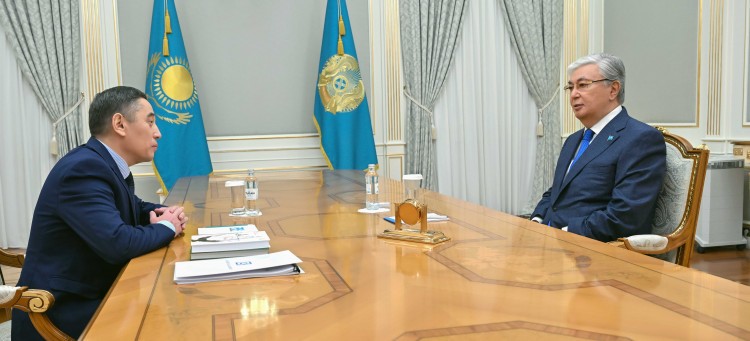
In an interview with the newspaper, Egemen Qazaqstan, President of Kazakhstan, Kassym-Jomart Tokayev spoke about political reforms in Kazakhstan, the country’s economic course, plans for the construction of a nuclear power plant, relations with China, and whether he will participate in the next presidential election.

Tokayev said he believes that 2023 was full of significant events for Kazakhstan, including the completion of major political reforms, the establishment of the Constitutional Court, the holding of elections of deputies to the Mazhilis (parliament) and Maslikhats (local councils) at all levels according to new rules, and the first ever elections of akims (mayors) to districts and cities of regional significance.

Kazakhstan has begun to build a fair and competitive economic system, Tokayev said, diversifying and demonopolizing the economy, updating infrastructure, supporting business, and attracting investment.

In Tokayev’s words, Kazakhstan will continue with a constructive and balanced foreign policy; in 2024, the country will chair several authoritative international organizations: the Shanghai Cooperation Organization, the Collective Security Treaty Organization, the Conference on Interaction and Confidence Building Measures in Asia, the Organization of Turkic States, the International Fund for Saving the Aral Sea, and the Islamic Organization for Food Security. This year, Kazakhstan will also host the World Nomad Games.

Asked about the country’s new economic course for a Fair and Just Kazakhstan and the goal of doubling the size of the economy to $450 billion by 2029, Tokayev said it is completely achievable.

“According to analysts from the International Monetary Fund, by the end of 2023, GDP in Kazakhstan should be over $259 billion, which is 15% more than in 2022. This is the most significant nominal growth in Central Asia. Positive dynamics are also registered in GDP per capita. According to the IMF forecast, by 2028 this figure will increase by a third – up to $16,800.”

The President explained his position vis-à-vis plans for the construction of a nuclear power plant, saying that he pays special attention to the issue given that Kazakhstan is the world’s largest uranium producer and generates its own nuclear fuel.

“As many in Kazakhstan are critical of the construction of nuclear power plants given the tragic consequences of tests at the Semipalatinsk nuclear test site, I proposed submitting the issue to a national referendum,” Tokayev said. “Citizens must consider and discuss all the experts’ arguments in order to make a balanced, thoughtful decision during the free expression of their will. This will be the decision of the people.”

Commenting on relations with China, the President said that today, relations between Kazakhstan and China are developing in the spirit of friendship, neighborliness, and strategic partnership. Kazakhstan firmly supports the Belt and Road Initiative, Tokayev stated, emphasizing the unprecedented growth of bilateral trade, which reached $24.3 billion from January-October 2023. China is also one of the largest investors in the Kazakhstan, with direct Chinese investment having reached $24 billion.

The common border with China and favorable geographical position of Kazakhstan as a bridge between the East and West opens up broad prospects for the transit of Chinese goods, Tokayev said, adding that regarding China, “we should not have fears imported from outside or based on ideas from bygone days. Now, China is a highly developed state, including in the field of high technology. Therefore, it is extremely important for Kazakhstan to cooperate with our eastern neighbor and to effectively use all the advantages of our friendly relations and mutual trust”

Asked about rumors circulating on social networks regarding his alleged plans to hold a constitutional referendum to allow him to take part in the 2026 presidential elections, President Tokayev called that “misinformation.”

“I am convinced that arbitrary amendments to the Constitution, especially on such a fundamental issue, are no longer possible. The provision for a one-time presidential term in the Constitution remains unchanged. This is as unshakable as the norms on independence, territorial integrity, and the form of government of our state,” Tokayev said.

Kazakhstan’s Hotels Report Growing Number of Visitors

Kazakhstan’s hotels grossed more than $384 million over the first nine months of 2023, a 36% increase compared to the same period in the previous year, the Kazakh Ministry of Tourism and Sports has reported. From January to September 2022, the country’s accommodation facilities had brought in $282.5, almost twice as much as pre-pandemic levels.

In total, there are more than 4,000 tourist accommodation facilities throughout Kazakhstan, including hotels, motels, boarding houses, campsites, and hostels.

The acting Chairman of the Tourism Industry Committee at the Ministry of Tourism and Sports, Nurtas Karipbaev said, “The committee will continue to work to create comfortable conditions for guests, expand the range of accommodation and improve the quality of tourism services. These efforts are aimed not only at meeting the needs of our visitors, but also at supporting economic growth in the tourism industry. At the same time, they contribute to strengthening Kazakhstan’s reputation as an attractive tourist destination with a variety of quality accommodation options.”

Uzbekistan Plans to Attract Investment, Green Energy Development

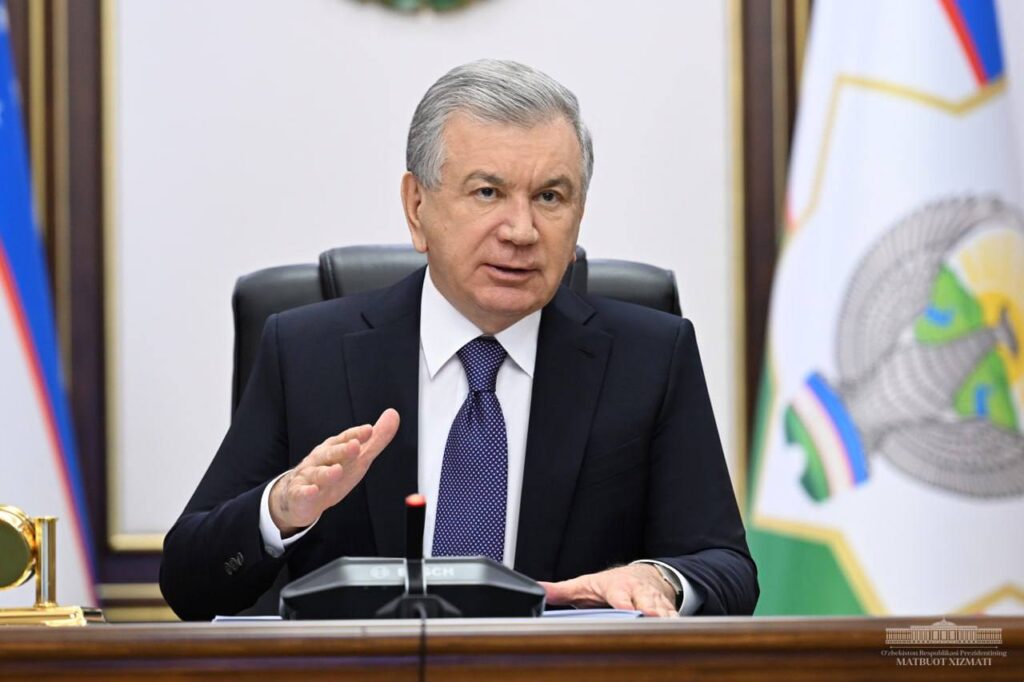
On January 2nd, President Shavkat Mirziyoyev held a government meeting on attracting investments and developing green energy in 2024, at which it was stated that last year Uzbekistan attracted more than $22 billion in foreign investment, a 1.8-fold increase on the previous year.

Mirziyoyev emphasized the importance of increasing the volume of foreign investment this year, with upmost attention to be paid to electrical and mechanical engineering, construction materials, pharmaceuticals, and the textile and leather industries.

The meeting also discussed the development of green energy, with officials reporting that work is ongoing on 28 projects based on public-private partnerships for the construction of solar, wind, and hybrid power plants with a total capacity of 6.3 gigawatts. Of these, the first, with generating capacities of 2.6 gigawatts, were launched in 2023.

Currently, work is underway on the construction of green power plants and energy storage systems together with companies from Saudi Arabia, the UAE, China, France, and Switzerland.

In 2024, Uzbekistan plans to increase the total capacity of solar power plants to 2.6 gigawatts, wind farms to 900 megawatts, and launch energy storage devices with a capacity of 400 megawatts.

At the meeting, instructions were relayed to study the possibility of introducing, based on international experience, agrovoltaics – the practice of agricultural producers installing solar panels on their fields to produce energy for their own needs or for sale, and for specific proposals to be drawn up for this area.

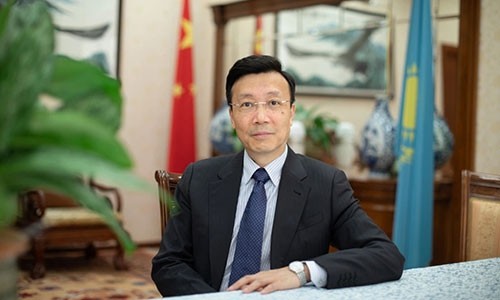
China and Kazakhstan are building the future together, says high-level Chinese diplomat

An article by Ambassador Zhang Xiao of the People’s Republic of China to the Republic of Kazakhstan, which was entitled “China and Kazakhstan are building the future together”, was recently published in Kazakhstani media.

Giving an overview of the past year for his country, the Ambassador notes that China “fully implements the spirit of the XX National Congress of the Communist Party of China and coordinates both domestic and international situation, promoting sustainable economic recovery.” He underlines that in the first three quarters 2023, China’s GDP grew 5.2% year-on-year, “faster than major economies such as the US, the Eurozone and Japan”, and that it “continues to promote comprehensive opening up and international cooperation.”

In terms of bilateral relations, the Ambassador states that the “last year marked the beginning of another ‘golden thirty years’” between China and Kazakhstan, and the results were “fruitful” in the development of an “eternal comprehensive strategic partnership” between the two countries.

The article highlights six main factors for the development of bilateral relations. The diplomacy of the heads of state is credited for the qualitative progression of ties. Strengthening mutual political trust is also an important factor, expressed through the fact that “China and Kazakhstan continue to firmly support each other on issues of core interests, such as safeguarding their sovereignty, security and development interests, and resolutely oppose the interference of outside forces in the internal affairs of the state.” The article also emphasizes that China “firmly supports the path of independent development chosen by Kazakhstan and the measures taken by President [Tokayev] to build a ‘New Kazakhstan’”.

Another factor in the effective development of relations between the countries, according to Ambassador Zhang Xiao, are frequent visits at various levels. In addition, he notes that the joint construction of the “One Belt and One Road” project laid the foundation for new routes. Thanks to this cooperation in the eleven months of 2023, the volume of trade between China and Kazakhstan reached US$36.87 billion, representing an annual increase of 31.1%. China has become Kazakhstan’s largest trading partner and the fifth largest source of investments.

The article also notes that the countries have achieved significant results in the field of humanitarian and cultural cooperation while also maintaining effective international cooperation.

This year marks the 75th anniversary of the founding of the People’s Republic of China and both countries, according to Ambassador Zhang Xiao, “will work together to build a Chinese-Kazakh community of common destiny, characterized by eternal friendship, a high degree of mutual trust, and interconnectedness and make a new contribution to promoting international and regional security, stability, development and prosperity”.

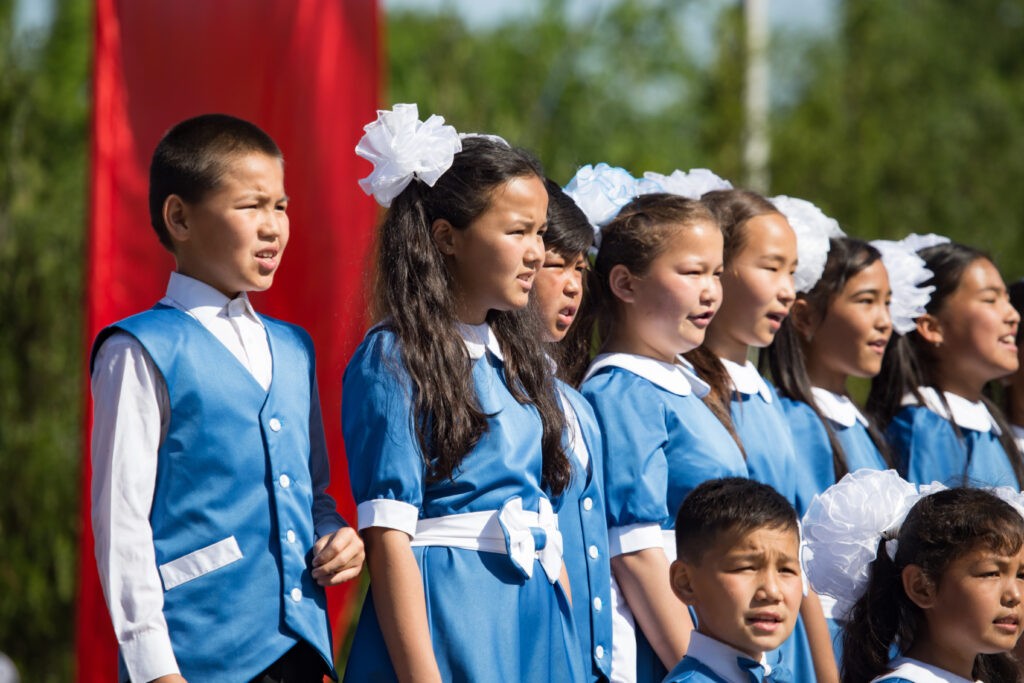
New Law Establishes a National Fund for Children in Kazakhstan

A new law that came into effect on January 1st, 2024, entitled Amendments and Additions to Certain Legislative Acts of the Republic of Kazakhstan, includes provisions regarding the accrual, payment and use of funds transferred from the National Fund to the children of Kazakhstan.  According to this document, all children (up to the age of 18) will receive deductions of fifty percent of the investment income of the National Fund. The project, a first of its kind in Central Asia, is called the “National Fund for Children”.

The National Fund of the Republic of Kazakhstan holds the state’s assets in the form of finances concentrated on the accounts of the Government in the National Bank. It is accumulated via fulfillment of tax obligations on the extraction of mineral resources, rent tax on export of crude oil and gas condensate and royalties, as well as the share of the Republic of Kazakhstan on division of production in kind or money from their realization, with the amount being determined in accordance with the relevant tax legislation.

Lower-end forecasts of savings per child under this new law are calculated to be around US$3,000-4,000. This amount is estimated taking into account the volatility of the capital market and depends on the global economic situation.

Only citizens of Kazakhstan can participate in this program, and any child that changes citizenship loses the right of payment. Furthermore, these funds are exempt from taxation and when a person reaches the age of 18, he or she can decide how to use the sum. It is conceivable that these funds can be used by the new generation to finance their future education, including abroad, or for housing purposes. If the funds are not used within 10 years by the citizen holding the funds, they will be automatically credited to his or her pension account.