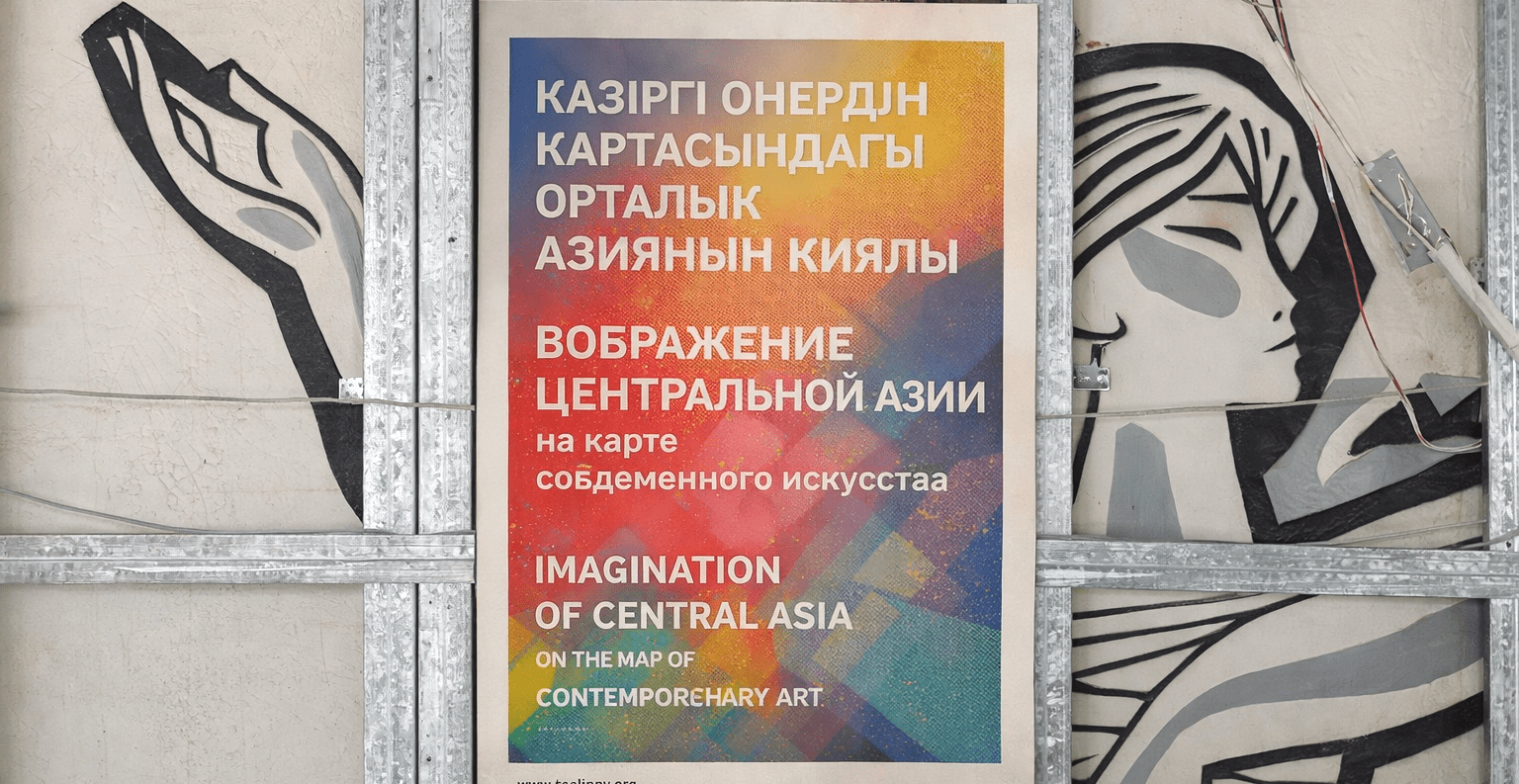
Rhetoric in segments of the Russian media has sharpened debates over sovereignty and influence across Central Asia, pushing these concerns beyond policy circles and into everyday conversations. The region is reassessing not only pipelines and alliances, but language itself. In politics, this shift is visible and symbolic. In culture, it is more difficult to discern. The Russian language still shapes how Central Asian art is funded, circulated, and institutionally processed, even as institutions distance themselves from Moscow’s influence.
This contradiction sits at the heart of contemporary cultural life in the region. Artists produce work rooted in Kazakh, Uzbek, Kyrgyz, Tajik, or Turkmen histories. They title exhibitions in local languages. They speak passionately about decolonial futures and cultural sovereignty. But when the catalogue is written, the grant application submitted, or the curatorial text sent abroad, the language quietly shifts. First to Russian, sometimes to English, and only occasionally does it remain in the local language.
This is not nostalgia, but a structural inheritance. Russian remains the shared professional language of much of the urban cultural sector.
Edward Lemon, President of the Oxus Society for Central Asian Affairs, argues that the language’s endurance reflects both ideology and pragmatism.
“While local languages have become much more widespread as the Central Asian republics have strengthened their nationhood and as there has been an increase in anti-Russian sentiments since the invasion of Ukraine, Russian language use remains widespread,” Lemon told TCA. “Despite the ideological imperative to reduce reliance on Russian, there are some pragmatic reasons why it remains prominent. High levels of migration to Russia, particularly from Uzbekistan, Kyrgyzstan, and Kazakhstan, mean that a basic competence in the language is essential to survival for many Central Asians. Russian remains a language of interethnic communication, particularly in Kazakhstan, where ethnic Russians, for the most part, are reluctant to speak Kazakh.
While English has become more widespread and some of the Central Asian languages are mutually intelligible, Russian retains a status as a diplomatic, business, and civil society language for those working in multiple countries. Russia also remains a language of education. Over 200,000 Central Asians study in Russia, by far the largest destination in the world. Russian-language schools remain prominent at every level in Central Asia, from kindergarten to graduate schools. In short, while the usage of Russian is in slow decline, its position is relatively entrenched.”
For cultural institutions, this reality means that distancing from Moscow politically does not automatically sever the linguistic infrastructure through which grants are written, exhibitions travel, and contracts are signed.
Naima Morelli, an arts writer focused on contemporary art across Asia-Pacific and the Middle East, argues that the issue is less about elimination than coexistence.
“For me, it makes sense that Russian continues to function as a practical operating language across Central Asia’s cultural infrastructure, as an inherited connective tissue of sorts. In the hypothesis of getting rid of it, the most obvious alternative for a shared language for exchanges across countries in Central Asia is English, which the global art world – in Central Asia as elsewhere – already widely employs and often considers more ‘neutral.’ But is any language truly neutral? As I see it, English carries its own hierarchies of power,” Morelli told TCA.
“Of course, Russian does not bear the same perceived neutrality. The colonial legacy the Russian language carries is, in fact, addressed in the work of many Central Asian artists. Carrying something from the past, even something tied to a painful history, can still be productive and somewhat enriching, if we are able to repurpose it. We can see it clearly in Soviet architecture, so why not in the language? I think that instead of erasing Russian altogether, what would be ideal – albeit not so easy to achieve – is a polyphony: a cultural field where Kazakh, Uzbek, Kyrgyz, Russian, and English coexist, and are used depending on the context, reflecting what is the extremely layered identity of the region today.”
Beyond institutional circles, however, the position of the Russian language has gradually weakened, particularly among younger generations educated primarily in national languages. In parts of the region, especially Uzbekistan and Turkmenistan, its role in schooling and public life has narrowed, while English increasingly attracts urban youth seeking international opportunity.
Yet for many artists, Russian is simply the most efficient way to be legible. National languages are emotionally central, but institutionally uneven. Terminology for contemporary art, critical theory, conservation, or curatorial practice is often underdeveloped, inconsistently translated, or unfamiliar to decision makers. Writing a proposal in Kazakh or Uzbek can feel like an act of cultural assertion, but also a risk. Russian offers precision, shared references, and the assurance that a jury will understand exactly what is being proposed.
English occupies a different position. It is the primary language of global art markets, biennials, international foundations, and increasingly of youth. But the level of fluency required for contract negotiations, conceptual writing, and institutional correspondence remains limited to a relatively small cohort of artists and administrators. For those who possess it, English can function as a passport.
This produces a quiet linguistic ladder that few institutions openly acknowledge. Local languages serve identity and symbolism. Russian underpins operation and legitimacy. English delivers visibility and international validation. The uncomfortable truth is that ascending this hierarchy often determines who is seen, funded, or invited abroad.
The consequences of this system become clearest when language policies change. When institutions announce a switch away from Russian towards national languages, the move is usually framed as progressive and overdue. But access does not expand evenly. Older audiences educated in Soviet or early post-Soviet systems often lose their ability to engage with contemporary exhibitions. Independent artists from rural regions, who rely on Russian as a professional lingua franca, can find themselves cut off from institutional conversations that now presume fluency in a standardized national language they may not fully command.
These tensions are not abstract. In Uzbekistan, Alisher Qodirov, a member of parliament, recently criticized the continued dominance of Russian in public services and education, arguing that reliance on Russian language schools and administration undermines the status of Uzbek as the state language and weakens cultural sovereignty. This reflects a broader regional discomfort: even where national languages are legally prioritized, Russian often remains embedded in institutional practice and professional life. The friction lies not between culture and politics, but between symbolism and administrative reality.
Grant cycles and exhibition seasons, which often launch in February and March, are where these tensions surface most clearly. Calls for proposals quietly specify language requirements. In many cases, applications, correspondence, and legal contracts continue to default into Russian. Contracts are drafted in Russian legal language, even when public-facing mission statements emphasize linguistic revival and cultural sovereignty. The gap is rarely acknowledged publicly. The region operates in pragmatic multilingualism. Decolonization is the rhetoric; institutions remain bilingual or trilingual, and international correspondence often defaults to English. Language shapes authority. The language of funding and evaluation determines which narratives travel. National languages are visible in culture but are still consolidating their role in contracts, critiques, and institutional power. Russian is declining symbolically, but operationally persistent.