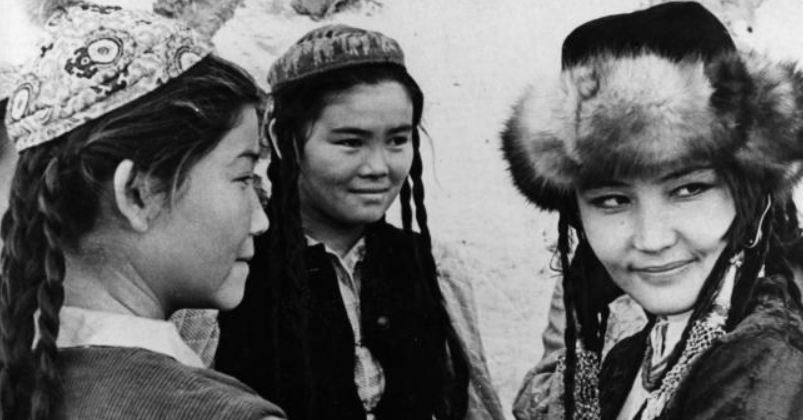
Andrei Konchalovsky’s First Teacher, an adaptation of Chingiz Aitmatov’s famous work of the same name about an educator who undertakes the task of tutoring the kids in a remote Kyrgyz village, re-tailors the protagonist and the plot to convert a coming-of-age symphony into a triumph over tragedy while maintaining the book’s core values.
In one of the earlier frames of First Teacher (Konchalovsky, 1965), the well-meaning beggar-turned-Komsomol member Duishen tears into a young student who suggests that the impermanence of life might also apply to, besides everyone else, Lenin.
Duishen’s God-like reverence for the father of the Soviet experiment is also present in Chingiz Aitmatov’s novel of the same name. And yet, unlike the reserved and understanding protagonist of the book, who has the qualities if not qualifications of an educator and would’ve perhaps counselled the young one in the situation mentioned above, Konchalovsky’s teacher is an obstinate simpleton who is almost always on the edge and yearning for the village’s respect.
Inna Merkoulova and Marina Merkoulova, in their brilliant essay ‘The first teacher: A case of intersemiotic translation. When Chingiz Aitmatov’s short story becomes Andrei Konchalovsky’s film’ discuss how the movie adaptation is a case of intersemiotic translation by the director, wherein the work transforms from Aitmatov’s drama into Konchalovsky’s tragedy through the usage of various film techniques.
In fact, I believe that Duishen’s character undergoes a severe reinterpretation, from a Leninist disciple trying to do his bit for the Proletarian dictatorship by educating the kids in the book to a hot-headed agitator eager to force the Soviet will on the local populace in the film.
In this work, we’ll analyse how the ‘two Duishens’ manage to achieve their objectives and meet at a similar end despite existing in vastly different frameworks.
The ‘first Duishen’ from Chingiz Aitmatov’s book is sketched by an older Altynai, the Red Army soldier’s favourite disciple, who after achieving success as an academician in Moscow, looks back fondly at the bold Duishen of her childhood in the 1920s. A man who used the meagre resources at his disposal to become the village’s first educator. Someone who helped her achieve her potential.
Duishen’s teachings have an importance that is much greater than the bookish knowledge that the soldier imparts. Duishen’s education is an act of courage, for they come from a man who is barely literate himself, his teachings restricted to basic numerals, letters and political wordings.
But it assumes significance in the fact that Duishen shows the fortitude to overcome his circumstances, and becomes more than what fate had assigned him. Further, he indoctrinates the other illiterates, especially the weakest sections of a conservative society: women and children, to follow suit and take first steps towards their emancipation.
Aitmatov’s hero is moulded as a Soviet ideal, and sits closer to the cinematic Duishen’s imagination of ‘hundreds and thousands’ steel-like party members who would keep the revolution alive after Lenin’s demise.
He shows balanced wisdom in judgments, the heart of a soldier in peril, and an appreciation of the simpler things like the rich nature, which he shows by planting two Poplar trees in Altynai’s memory. When Altynai’s aunt seeks to harm her, the teacher uses his wit and becomes her de facto guardian, and looks after her best interests to the end.
The ’other Duishen’ from Andrei Konchalovsky’s film, which came nearly three years after the book, interacts with a village that is undergoing upheaval following the Soviet takeover in the early 20s. This is unlike the novel, set around the 50s-early 60s, where Duishen’s struggles are shown as an occurrence of the past.
The narrative lens also shifts, from a sympathetic individual (Altynai) to a communal one, wherein the entire village or community becomes the perspective. The locals who are never quite sure of the nature of the Soviet regime, which gives them freedoms but at the same time puts restrictions on their traditional beliefs, direct their suspicions on the ‘New Soviet Man’, never at ease with his progressive principles.
This is a big difference, as in the book, the village as a whole doesn’t take extreme stances beyond the discussion on education.
Compounding the situation is Duishen’s character, which is of an unyielding ideologue who, as if by the force of will, wants to meld the village into the Soviet state. He is impulsive in his reactions and visceral in his tactics.
This clash of principles is best on display when Duishen mocks a former landlord, as a depraved oppressor, whereas the majority of the villagers cower before their former master.
In this setup, while a few seek to instigate Duishen time and again, the majority merely want to stick to life as it has been. For Duishen, this primitive state is unacceptable. Thus, in an already tense situation, Duishen’s heads-on approach acts like a catalyst, adding fuel to the fire and giving the plot a tension that is generally lacking in the book.
Unlike the book’s Duishen, who was meant to symbolise hope amidst darkness, the film’s version is a corrosive agent representing intrusion and a clash of civilisations between the new pro-women’s Soviet power and the centuries-old ethno-religious traditions.
The characterisation and construction of the two ‘Duishens’ pitches the novel and its screen adaptation in opposition.
Altynai’s optimism, no doubt informed by her prestigious present, pervades into her recollection of the past in the former, whereas the fault lines that emerge with Duishen’s appearance in the film introduce a bleaker tone that remains to the very end in the latter.
This is visible during the sequences depicting Altynai’s sexual assault in the respective works.
While the book skims through the event hastily, and repairs it with a sequence of Altynai’s ‘rebirth’ in a lake with her ally Duishen by her side, thus reinforcing the positivity prevalent through the rest of the work, the movie painstakingly shows Altynai’s fight, and even the ‘rebirth’ sequence, a powerful admixture of natural sound and images, maintains that an irretrievable change has occurred.
Despite these inherent differences, which are showcased in their respective endings, the two works achieve unity in their principles.
Take the instance of romance between Altynai and Duishen, which blossoms as an innocent teenage infatuation but never really meets a fulfilling end in the book, given Duishen’s dedication to his cause, which means separating from Altynai to send her away for studies. However, it remains a strong undercurrent throughout the work that informs Altynai’s pain for several years after she moves away. It wouldn’t be a stretch to say that losing Duishen was a greater loss for Altynai than leaving her homeland when she is taken to Russia.
On the other hand, the intimate interaction between them is restricted in the movie, yet the rawness present in the two instances that it is shown, when firstly, Duishen accidentally caresses her near the stream and secondly the ‘kiss’ right before Altynai’s departure, builds on the themes of unsaid attraction (in the first case) and intense feeling of longing (in the second), thus successfully evoking the values of Aitmatov’s work.
At the end of the film, Duishen’s final stand against the regressive village traditions make him an unpopular yet unyielding figure on the verge of becoming a victim of the village’s wrath. Although Altynai has begun her journey towards a new life, one where she’ll find success and fame as depicted in the novel, the director keeps the lens on Duishen and finishes his work at a particularly tense moment, with the villagers encircling him even as the soldier vows to keep fighting for his cause.
Literary adaptations of films often reinvent the story to give it a novel theme, like Vijay Anand’s adaptation of R.K. Narayanan’s famous work The Guide (1958). In the movie, Raju’s spiritual rejuvenation takes precedence and overruns the writer’s humorous critique of organized religious systems.
However, Duishen’s last stand reinforces the romantic communist ideals present in Aitmatov’s work. When the novel begins, old Duishen is treated as an outcast and a nobody, often laughed at for his endeavour to educate people despite being barely literate himself, perhaps writer’s way of mirroring ambitious initiatives undertaken by Soviets at a time when the country lacked means of exploiting its resources.
But we learn over time that Duishen’s journey would not entail fame or recognition as an end goal. He found meaning in being a cog in the machine, giving it all to achieve the socialist dream, whether as an educator, a soldier, or a deliveryman.
The village transitioned from traditionalism to socialism, with schools and collective farms opening to all, regardless of gender, and the system’s opponents became loyal citizens of the Soviet republic.
In the narrative of the locals in both works, Duishen’s servitude to his cause is something to be mocked at. But it is this very servitude that connects Aitmatov’s novel and Konchalovsky’s film. In their respective styles, both of them show us that Duishen, despite all his shortcomings, was truly committed to the idea of being a ‘communist’.