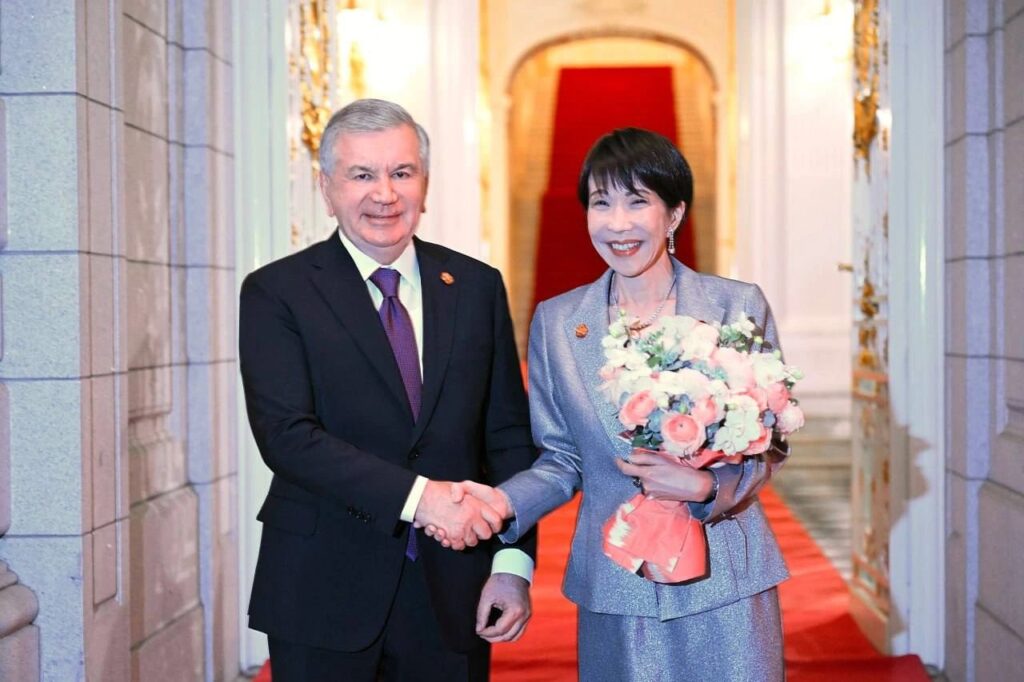
Uzbek President Shavkat Mirziyoyev has concluded an official visit to Japan that both Uzbek and Japanese sources have described as a turning point in bilateral relations. According to Sherzod Asadov, the president’s press secretary, the visit elevated Uzbekistan-Japan ties to an expanded strategic partnership, marking a shift from primarily humanitarian and technical cooperation to a broader economic framework grounded in long-term strategic planning.
During the visit, Mirziyoyev held meetings with Emperor Naruhito, Prime Minister Fumio Kishida, parliamentary leaders, senior government officials, and representatives from Japan’s business and academic communities. Asadov noted that a new portfolio of cooperation projects, valued at more than $12 billion, was formed, encompassing sectors such as education, healthcare, environmental protection, water management, transport, urban development, tourism, agriculture, and disaster-risk reduction.
Particular emphasis was placed on green energy, energy storage systems, and industrial cooperation. Major Japanese corporations were invited to join long-term partnership programs, signaling a deepening of economic ties.
Japanese media also underscored the economic dimension of the visit. NHK World reported on a business forum in Tokyo where Mirziyoyev urged Japanese companies to invest in Uzbekistan’s industrial transformation, highlighting areas such as advanced technology, stable energy supply, and critical minerals development. He emphasized that Japanese participation would bolster ongoing reforms aimed at enhancing productivity and boosting exports.
Japan’s Minister of Economy, Trade and Industry, Ryosei Akazawa, expressed Tokyo’s support for sustainable development in Uzbekistan, with a focus on private-sector cooperation. Japanese firms operating in Uzbekistan presented current projects in renewable energy and mineral exploration. Uzbek business representatives, in turn, highlighted the country’s demand for Japanese technology and acknowledged improvements in the investment environment.
The visit also included President Mirziyoyev’s participation in the first “Central Asia + Japan” summit. Discussions focused on regional connectivity, green economic initiatives, digital and investment collaboration, and human capital development. The summit concluded with the adoption of the Tokyo Declaration, which reaffirmed both sides’ commitment to deepening multilateral cooperation.
Following the engagements in Japan, Mirziyoyev traveled to Russia for a working visit to attend the Supreme Eurasian Economic Council meeting and an informal summit of CIS heads of state in St. Petersburg.