• KGS/USD = 0.01144 0%
  • KZT/USD = 0.00211 0%
  • TJS/USD = 0.10526 0%
  • UZS/USD = 0.00008 0%
  • TMT/USD = 0.28530 0%
  • KGS/USD = 0.01144 0%
  • KZT/USD = 0.00211 0%
  • TJS/USD = 0.10526 0%
  • UZS/USD = 0.00008 0%
  • TMT/USD = 0.28530 0%
  • KGS/USD = 0.01144 0%
  • KZT/USD = 0.00211 0%
  • TJS/USD = 0.10526 0%
  • UZS/USD = 0.00008 0%
  • TMT/USD = 0.28530 0%
  • KGS/USD = 0.01144 0%
  • KZT/USD = 0.00211 0%
  • TJS/USD = 0.10526 0%
  • UZS/USD = 0.00008 0%
  • TMT/USD = 0.28530 0%
  • KGS/USD = 0.01144 0%
  • KZT/USD = 0.00211 0%
  • TJS/USD = 0.10526 0%
  • UZS/USD = 0.00008 0%
  • TMT/USD = 0.28530 0%
  • KGS/USD = 0.01144 0%
  • KZT/USD = 0.00211 0%
  • TJS/USD = 0.10526 0%
  • UZS/USD = 0.00008 0%
  • TMT/USD = 0.28530 0%
  • KGS/USD = 0.01144 0%
  • KZT/USD = 0.00211 0%
  • TJS/USD = 0.10526 0%
  • UZS/USD = 0.00008 0%
  • TMT/USD = 0.28530 0%
  • KGS/USD = 0.01144 0%
  • KZT/USD = 0.00211 0%
  • TJS/USD = 0.10526 0%
  • UZS/USD = 0.00008 0%
  • TMT/USD = 0.28530 0%

Kazakhstan Considers National Messaging App Aitu for Insurance Companies

Kazakhstan’s Agency for Regulation and Development of the Financial Market is considering the use of the domestic messaging platform Aitu for remote communication between insurance companies and other non-bank financial institutions and their clients.

According to Bloomberg, the regulator has recommended that market participants consider using the Kazakh-developed messenger Aitu as a communication tool. Sources cited by the publication said that insurance and brokerage firms received proposals last month regarding the potential use of the platform, partly aimed at strengthening personal data protection.

Market participants expressed concerns, pointing to Aitu’s relatively small user base, limited functionality, potential integration costs, and the absence of clear regulatory guidelines for handling personal and financial data on such platforms.

In response, the regulator clarified that the use of Aitu is not being considered mandatory, but rather as an additional secure communication channel between financial institutions and their clients.

“This issue is being considered by the Agency in connection with the need to strengthen information security, including the protection of personal data amid rising fraud in financial services. The initiative is also aimed at standardizing communication channels between financial organizations and their clients,” the agency said in a statement.

According to the regulator, Aitu’s infrastructure ensures a high level of data protection, in part due to the physical localization of servers within Kazakhstan. This, it argues, reduces risks associated with cross-border data transfers and potential interception of financial information.

Additional security features include end-to-end encryption, with access keys stored only on users’ devices, as well as the Aitu Passport system, which incorporates biometric identification and a cloud-based electronic digital signature. The regulator states that these tools provide legally valid user verification and help minimize risks such as phishing and identity theft.

The agency also noted that the use of open APIs and business dashboards would allow financial institutions to integrate their systems with the platform at relatively low cost, making use of national digital infrastructure.

Government agencies and quasi-state companies had earlier been encouraged to adopt Aitu for official communications. As previously reported by The Times of Central Asia, the rollout of the national messenger has sparked broader debate over the balance between cybersecurity and internet freedom in Kazakhstan.
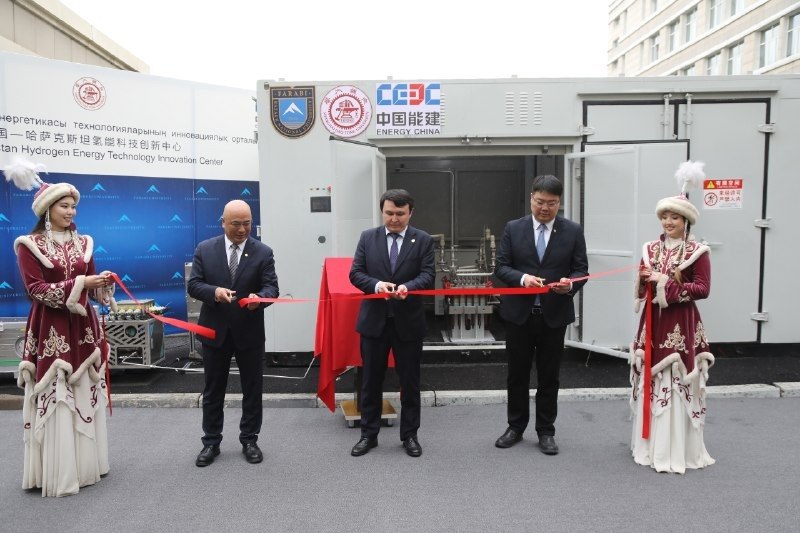

Kazakhstan and China Launch Hydrogen Energy Technology Innovation Center

Kazakhstan and China have expanded cooperation in clean energy with the launch of the China-Kazakhstan Hydrogen Energy Technology Innovation Center at Al-Farabi Kazakh National University in Almaty on April 9.

The center is part of Kazakhstan’s strategy to build a modern technological base linking science, education, and industry in support of the country’s transition to low-carbon energy.

Speaking at the opening ceremony, Energy Minister Yerlan Akkenzhenov highlighted the importance of international partnerships in the development of the energy sector.

“Hydrogen energy is one of the strategic priorities for the development of the energy sector. The Concept adopted in 2024 laid the legal and economic foundation for the creation of a new industry aimed at decarbonizing the economy. The new center should become a key platform for training next-generation engineers, conducting applied research, and rapidly introducing innovations into production,” Akkenzhenov said.

As part of the ceremony, Al-Farabi Kazakh National University, Shanghai Jiao Tong University, and Energy China International Corporation signed a trilateral memorandum of understanding outlining the center’s operational framework.

The agreement includes expanding scientific and technical cooperation, facilitating technology transfer, and promoting academic exchange. The partners also plan to conduct joint research, test hydrogen technologies, and launch pilot projects, with a particular focus on the commercialization of innovations and their integration into Kazakhstan’s industrial sector.

The development of hydrogen energy is a key element of the global transition to cleaner energy systems. According to Kazakhstan’s Ministry of Energy, the country has significant potential in this field due to its natural resource base and growing renewable energy capacity. Cooperation with Chinese technology partners is expected to strengthen Kazakhstan’s position in emerging energy markets and support industrial modernization.

During the ceremony, Zhanseit Tuimebayev, chairman of the board and rector of Al-Farabi Kazakh National University, highlighted the evolving role of universities as drivers of economic and technological development.

“Universities today are not only centers for training specialists but also key drivers of economic growth, technological development, and national competitiveness. Al-Farabi National University has consistently pursued this mission, transforming itself into a new type of university, one that not only educates, but also develops technologies, shapes markets, and acts as a full-fledged partner to the state and industry,” Tuimebayev said.

Kazakh MP Calls for a Legislative Ban on Radical Religious Movements

Kazybek Isa, a deputy of the Mazhilis (Kazakhstan’s lower house of parliament ), has called for a legislative ban on radical religious movements, arguing that their spread poses a threat to social stability and national security. In a parliamentary inquiry addressed to the government and law enforcement agencies, Isa stated that the ability of such groups to recruit followers could undermine social cohesion and national values.

“A legislative ban on radical religious movements is a matter of national security. Such movements threaten social stability, and the state is obligated to protect its citizens from their influence,” the deputy said. He added that the proposed measures are not aimed at religion itself, but at organizations promoting what he described as destructive ideologies.

Several recent high-profile incidents prompted the inquiry. In March 2026, a blogger criticized the celebration of Nauryz, describing it as “not a Kazakh or Muslim holiday.” He was subsequently detained, and a criminal case was opened against him on charges of inciting religious discord.

In a separate case, a YouTube interview circulated featuring a man presenting himself as an imam who claimed to have given his second wife to a student. Following public backlash, he was held administratively liable and fined.

According to Isa, existing regulations governing extremist and radical organizations are dispersed across multiple legal acts and are not always effectively enforced. He proposed developing a more comprehensive legislative framework focused on prevention.

The deputy also raised concerns about compliance with laws regulating face-covering clothing. He referred to a court case in Aktobe in which the defendants’ wives attended hearings wearing niqabs, arguing that this highlighted the need for stricter enforcement of identification requirements.

Kazakhstan previously adopted legislation on the prevention of offenses that includes fines for wearing clothing that conceals the face and hinders identification in public places, including niqabs.

Isa further called for tighter oversight of individuals acting as religious preachers and questioned the role of the Spiritual Administration of Muslims of Kazakhstan in preventing the spread of radical ideologies. He warned that individuals presenting themselves as religious mentors may contribute to social polarization and the recruitment of young people into radical movements.

As previously reported by The Times of Central Asia, in recent years, Kazakhstani authorities have strengthened measures to counter religious extremism, including efforts to prevent radicalization and curb the spread of extremist ideologies.

ADB Growth Forecast Points to Strong Expansion in Tajikistan

Asian Development Bank (ADB) forecasts that Tajikistan’s economy will maintain strong growth over the next two years, driven primarily by industrial expansion and the services sector.

In its latest Asian Development Outlook (April 2026), the bank projects that gross domestic product will grow by 7.3% in 2026 and 6.8% in 2027. This follows an estimated 8.4% expansion in 2025, indicating a slight moderation but continued robust performance.

ADB attributes the outlook to improving industrial competitiveness and rising value-added production, which are expected to support long-term economic development and job creation.

“Tajikistan’s strong growth opens up opportunities to accelerate job creation,” said Ko Sakamoto, ADB country director for Tajikistan. “By developing competitive, value-adding industries from food processing and textiles to mineral products, the country can translate growth into more and better jobs.”

At the same time, inflation is projected to rise to 4.0% in 2026 and 4.5% in 2027. According to ADB, this increase will be driven by stronger consumer lending, remittance inflows, higher public sector wages, supply chain pressures, and adjustments to utility tariffs. The bank noted that the outlook remains subject to revision given the uncertain regional environment.

Despite recent gains, ADB cautioned that Tajikistan’s economic structure remains vulnerable. While industrial output has grown, the country continues to depend heavily on a narrow range of products. Exports are dominated by raw materials and low- to mid-level processed goods, with higher value-added manufactured products accounting for less than 10% of total merchandise exports.

To address these challenges, the report recommends a broader, ecosystem-based industrial policy. This would involve support for specific sectors, along with improvements in infrastructure, workforce skills, access to finance, and the overall business environment.

ADB’s earlier assessments highlight mixed socioeconomic trends. While poverty has declined significantly from 30.9% in 2020 to 19.9% in 2024, inequality and structural constraints continue to pose challenges to long-term development.

AI Will Help the Kyrgyz Parliament Speed Up the Legislative Process

The Jogorku Kenesh (Parliament of Kyrgyzstan) is introducing the e-Kenesh digital platform, which is intended to move parliamentary committee work into an electronic format and use artificial intelligence to help analyze draft legislation. According to the parliament’s press service, the platform is designed to replace paper-based workflows and provide lawmakers with access to all agenda materials via tablets already distributed to deputies. The software was developed by local specialists in cooperation with parliamentary staff.

The e-Kenesh system will also allow civil servants and experts to participate in committee meetings remotely, joining discussions from their workplaces or while on official travel. Parliament says this should make participation easier for officials and experts and improve coordination around committee work. At the same time, key speakers will continue to attend meetings in person to respond to lawmakers’ questions.

The platform is intended to make committee work and legislative tracking more transparent. Users will be able to track the history of each issue, including deliberations, decisions, authorship of legislative initiatives, and voting records.

One of e-Kenesh’s new features is an AI module that can analyze draft laws and generate short summaries. This will help deputies quickly navigate documents and better understand the objectives of proposed legislation.

“You will be able to see which issue was considered and when, as well as what decisions were made. It will also show which MP submitted a proposal and how they voted. Additionally, the app will provide a brief summary of each bill. Artificial intelligence is also being implemented to analyze bills and explain their content and objectives,” said Parliament Speaker Marlen Mamataliev.

According to the Speaker, starting next week, all parliamentary committees are expected to fully abandon paper documents and transition to electronic document management. The shift reflects Kyrgyzstan’s broader push to digitize public administration and streamline legislative work.

Developers noted that the system will continue to be refined during implementation, with any technical issues addressed as they arise.

Pilots for Turkmenistan Airlines to Be Trained in Turkey

Turkmenistan Airlines has announced a recruitment campaign for candidates to study aviation at the Turkish Aeronautical Association University. The four-year program will be funded by the airline.

Selection will be conducted on a competitive basis. Applicants must be male, under the age of 25, hold Turkmen citizenship, and have completed secondary education. Additional requirements include passing a medical examination at the Ashgabat Airport Medical Center and holding a valid military ID.

The admission process consists of several stages. Candidates first undergo an initial interview with airline representatives, followed by entrance exams and an interview with representatives of the Turkish university. In the final stage, applicants must pass a medical examination in Ankara.

The airline will cover tuition fees, dormitory accommodation, and travel costs, including flights to Ankara at the start of the academic year and return travel to Ashgabat upon completion of the program. However, students will be responsible for certain expenses, including visa fees, health insurance, meals, communication, and local transportation.

Upon graduation, participants are required to work for the airline for ten years.

Limited Progress in Air Connectivity

Despite this initiative, Turkmenistan’s broader aviation sector continues to face challenges. No new international routes have been launched, and several previously announced flights have yet to begin operations.

Plans to expand the country’s international air connectivity have been discussed for years, but tangible progress remains limited.