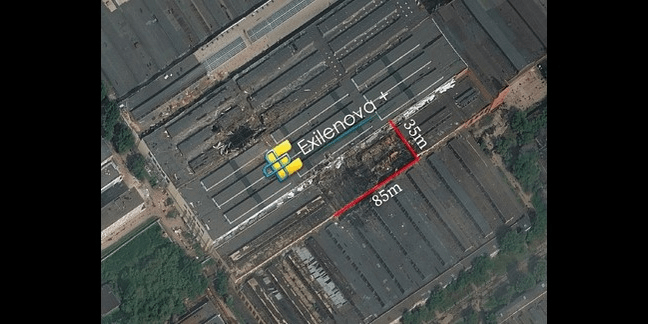
Satellite imagery purportedly showing damage from a Ukrainian missile strike at a key Russian space center is circulating online, although there is no independent confirmation of whether Soyuz rocket facilities at the site were hit.
Without providing details, Russia has acknowledged that industrial infrastructure was hit in an attack late last week in the Samara region, but has not publicly identified any impact on the Progress Rocket Space Center in Samara. Ukraine says it targeted the site because it supports Russia’s war effort. The Progress facility also makes Soyuz-2 rockets that are regularly launched from the Baikonur Cosmodrome in Kazakhstan to deliver spacecraft to the International Space Station.
ExileNova+, a Ukrainian channel that tracks damage assessments and other aspects of the war with Russia, posted what it said was a satellite image of damage to a building involved in Soyuz rocket production.
“Two hits were recorded on building 106A, where onboard electronics, control systems, cable networks, and instrument compartments for the rockets are assembled. Building 106B, where the final assembly takes place, is located nearby,” ExileNova+ said on Telegram. There was no independent confirmation of the claims about damage at building 106A.
Business Insider, a U.S. publication, published a satellite image that it said shows a hole in the roof of a Progress center building, as well as damage to the exterior. The publication said the image was obtained from U.S. firm Vantor.
For now, it is difficult to assess how the missile strike in Samara could affect future Soyuz launches from the Baikonur Cosmodrome, which Russia leases from Kazakhstan.
Roscosmos, the Russian space agency, said a launch pad at Baikonur was damaged during the liftoff of a crewed spacecraft in late November 2025 but was repaired in early 2026. Soyuz rockets then launched Russian spacecraft from Baikonur in March and April of this year.
“The extent of the damage at Progress and its impact on future Soyuz launches will likely become clearer over time. Even a temporary disruption could complicate a production schedule already expected to rely on existing rocket stocks to meet growing demand,” Alison Sayer wrote in an analysis for ISR University, a team of former U.S. Department of Defense professionals, national security experts, and others.
Roscosmos is a civilian entity, but Russia’s military relies on satellites and other space infrastructure provided or operated by the country’s space industry. Tracking platform Orbital Radar identifies the Russian Aerospace Forces, a branch of the Russian military, as the operator of multiple Soyuz-2 launches, including launches from the Plesetsk Cosmodrome in northern Russia.